Spinel - Rare Navaratna pendant in 22 ct. gold, precious gemstones, and Minakari enamels, India, 19th - Pendant - Navaratna ('nine gems')


03
days
11
hours
10
minutes
38
seconds
Current bid
€ 600
Reserve price not met

Expert
Selected by Surya Rutten
Has over 25 years' experience in Asian art and owned an art gallery.
Estimate € 2,900 - € 3,200
54 other people are watching this object
 Bidder 6429 Bidder 6429 | €600 | |
|---|---|---|
 Bidder 6582 Bidder 6582 | €550 | |
| Bidder 6298 | €500 | |
Catawiki Buyer Protection
Your payment’s safe with us until you receive your object.View details
Trustpilot 4.4 | 123113 reviews
Rated Excellent on Trustpilot.
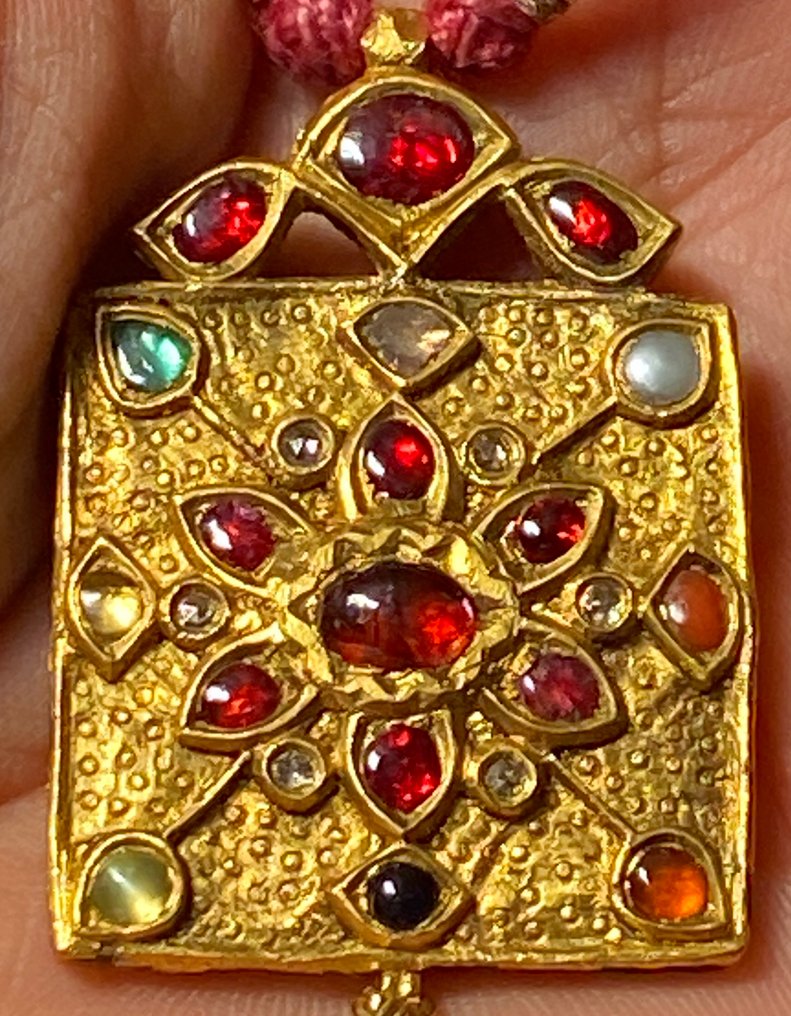
Navaratna pendant in 22 carat gold with Meenakari enamel, India, 19th century in the Moghul Empire style, featuring 25 square-cut spinel cabochons and other precious stones, total weight 16.79 g, dimensions 3 cm by 6.2 cm, originating from a private collection and offered as original without a stand.
AI-assisted summary
Description from the seller
Navaratna pendant with Meenakari inlay, northern India, 19th century
Double-sided 22-carat gold pendant, decorated on the front with an elegant rosette motif and polychrome gemstones according to the traditional navaratna scheme, which involves the use of nine gemstones considered beneficial and auspicious in Indian astrology: spinels, diamonds, blue sapphire, pearl, red coral, and other precious stones. The gemstones, set in cabochon, are arranged within shaped settings that enhance their brightness, with a central radial pattern enriched by dotting with a burin on the gold background.
The reverse of the pendant reveals an elaborate decoration in polychrome enamels (Meenakari), crafted in fire on a gold sheet, featuring a lush floral pattern that alternates red flowers and green leaves on a yellow background, framed by a refined blue geometric border. This chromatic contrast and the lively rendering of the corollas are part of the Indo-Persian ornamental tradition, widely spread in Mughal court jewelry and in the workshops of Jaipur and Benares in the 19th century.
The upper part features three trilobed elements set in kundan with spinels that serve as connectors with the suspension ring.
Complete the composition with a terminal pendant featuring an oval-shaped cabochon emerald pearl, mounted on twisted gold wire. The alternation between the rich gem-studded face and the enameled surface of the back reflects the aesthetic conception of Indian goldsmithery, where every side of the object is decorated and made precious, confirming the apotropaic and votive character of such jewelry.
The quality of craftsmanship, the meticulous technique of Meenakari enamel, and the presence of the nine auspical gems allow the artifact to be placed within the refined production of northern India of the 19th century, in continuity with the late Mughal tradition.
Insured Shipping
Navaratna pendant with Meenakari inlay, northern India, 19th century
Double-sided 22-carat gold pendant, decorated on the front with an elegant rosette motif and polychrome gemstones according to the traditional navaratna scheme, which involves the use of nine gemstones considered beneficial and auspicious in Indian astrology: spinels, diamonds, blue sapphire, pearl, red coral, and other precious stones. The gemstones, set in cabochon, are arranged within shaped settings that enhance their brightness, with a central radial pattern enriched by dotting with a burin on the gold background.
The reverse of the pendant reveals an elaborate decoration in polychrome enamels (Meenakari), crafted in fire on a gold sheet, featuring a lush floral pattern that alternates red flowers and green leaves on a yellow background, framed by a refined blue geometric border. This chromatic contrast and the lively rendering of the corollas are part of the Indo-Persian ornamental tradition, widely spread in Mughal court jewelry and in the workshops of Jaipur and Benares in the 19th century.
The upper part features three trilobed elements set in kundan with spinels that serve as connectors with the suspension ring.
Complete the composition with a terminal pendant featuring an oval-shaped cabochon emerald pearl, mounted on twisted gold wire. The alternation between the rich gem-studded face and the enameled surface of the back reflects the aesthetic conception of Indian goldsmithery, where every side of the object is decorated and made precious, confirming the apotropaic and votive character of such jewelry.
The quality of craftsmanship, the meticulous technique of Meenakari enamel, and the presence of the nine auspical gems allow the artifact to be placed within the refined production of northern India of the 19th century, in continuity with the late Mughal tradition.
Insured Shipping
Details
Estimated period
1850-1900
No. of main gemstones
25
Laboratory Report
No laboratory report
Era
1400-1900
Brand jewellery
No
Metal
Rare Navaratna pendant in 22 ct. gold, precious gemstones, and Minakari enamels, India, 19th
Total carat weight of main stone(s)
0.00
Main Stone
Spinel
Total weight
16.79 g
Condition
Good condition - used with some signs of wear
Country of Origin
India
Dynastic Style/Period
Mughal Empire (1526-1857)
Gender
Unisex
Provenance
Private collection
Title additional information
Navaratna ('nine gems')
Attribution
Original
Sold with stand
No
Shape of main stone
Square
Width
6.2 cm
Length
3 cm
Sold by