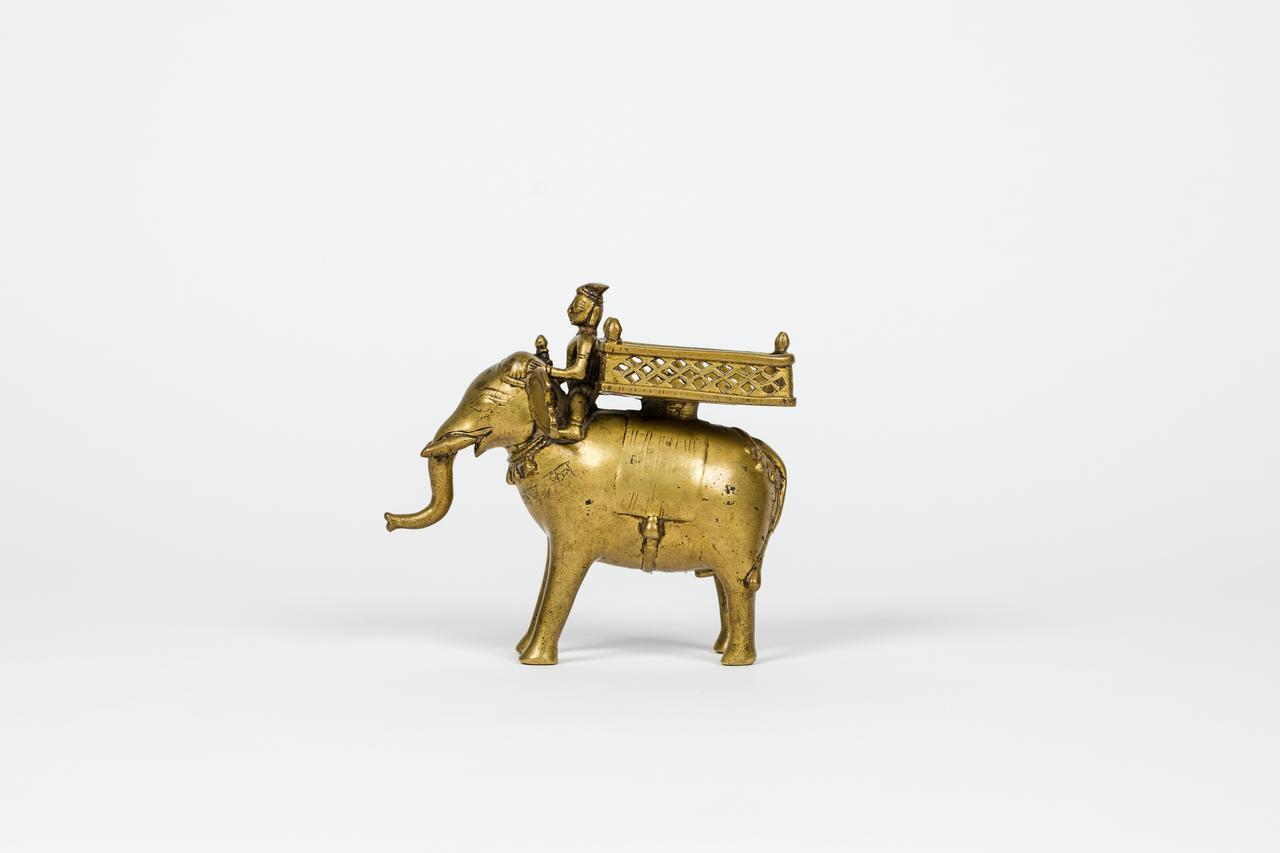
Sculpture, Mahiṣāsuramardinī con prabhāvali a nāga, India occidentale/Deccan, XIX secolo - 19 cm - Lost wax bronze casting



04
days
18
hours
03
minutes
18
seconds
Current bid
€ 150
Reserve price not met

Expert
Selected by Surya Rutten
Has over 25 years' experience in Asian art and owned an art gallery.
Estimate € 950 - € 1,050
6 other people are watching this object
 Bidder 7650 Bidder 7650 | €150 |
|---|
Catawiki Buyer Protection
Your payment’s safe with us until you receive your object.View details
Trustpilot 4.4 | 122986 reviews
Rated Excellent on Trustpilot.
Bronze lost-wax cast from India depicting Mahiṣāsuramardinī with prabhāvali in the Deccan, dating to the Maratha Empire period (1674–1818), 19 cm high, 10.5 cm wide and 8 cm deep, in good condition, unsigned, antique in style, with provenance from a private collection.
AI-assisted summary
Description from the seller
Mahiṣāsuramardinī in bronze with prabhāvali, Western India (Deccan), 19th century.
This refined lost-wax cast bronze depicts the goddess Mahiṣāsuramardinī, the 'Slayer of the Buffalo Demon,' at the moment of victory. The figure, slender and dynamic, is rendered with a long, form-fitting drapery that follows the torsion of the body and highlights the advanced knee; the appreciation for incised fabric and the soft, continuous lines of the sari give the work an almost calligraphic elegance. The goddess, depicted with eight arms, holds attributes of war and protection; she crushes the anthropomorphic asura emerging from the buffalo's body, a central theme in Durgā iconography in the form of Mahiṣāsuramardinī (see, among many museum comparisons, the medieval relief at the Metropolitan Museum and the records of the Freer|Sackler/Smithsonian). The structure is completed by a prabhāvali, topped with a nāga-shaped hood and foliate motifs, with a stepped base in Deccan taste.
From a cultural perspective, the subject belongs to the Śivaita pantheon: Mahiṣāsuramardinī is an aspect of Devi Durga/Parvati, that is, the Śakti (energy) of Shiva; the victory over the chaotic force of Mahiṣa is an allegory of the salvific power of the feminine principle that completes and activates Shiva's masculine aspect (see Devi Māhātmya and literature on the forms of Durga; for the iconography of 'Durga slaying the buffalo demon,' see the summaries by Smarthistory and Met). The fusion technique is the traditional South Indian and Deccan method documented since the Pallava era and perfected during the Chola period.
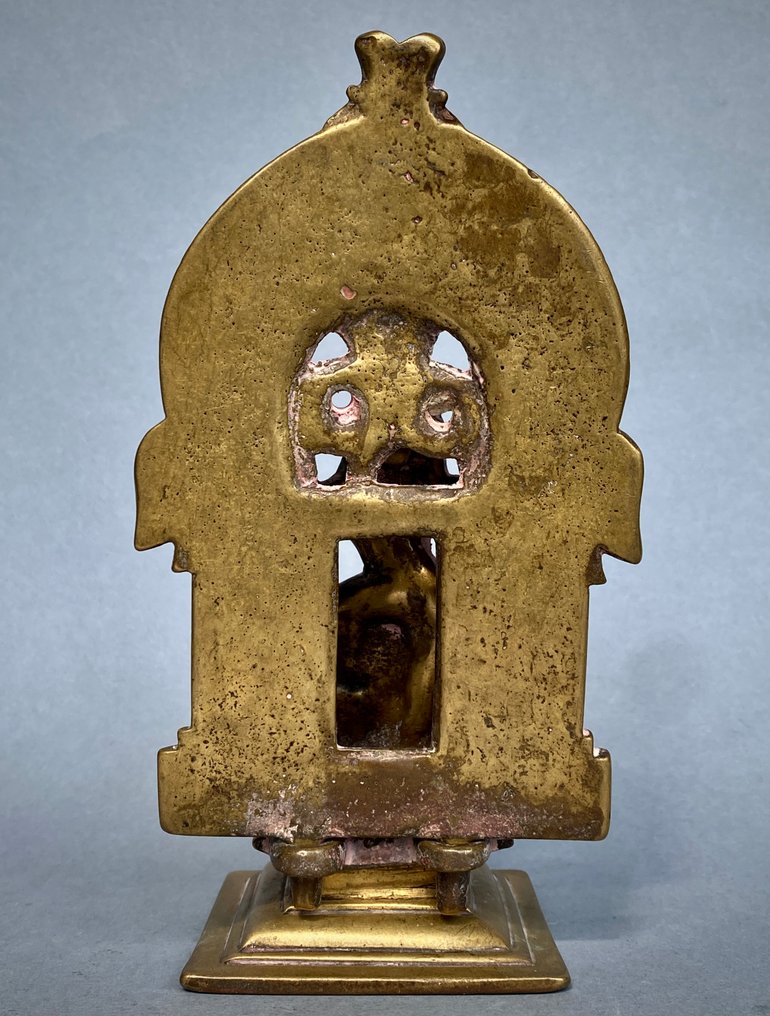
The condition is very good: slight signs of wear, browning, and remnants of red-copper patina in the cavities; the prabhāvali is original and separate, with intact rear joints, as shown in the images of the back. The quality of modeling, particularly the oval face with a high karanda-mukuṭa, the confident drapery, and the balanced dancing pose place the piece in the Deccan area, dating from the late 18th to 19th century, with medieval stylistic survivals.
Mahiṣāsuramardinī in bronze with prabhāvali, Western India (Deccan), 19th century.
This refined lost-wax cast bronze depicts the goddess Mahiṣāsuramardinī, the 'Slayer of the Buffalo Demon,' at the moment of victory. The figure, slender and dynamic, is rendered with a long, form-fitting drapery that follows the torsion of the body and highlights the advanced knee; the appreciation for incised fabric and the soft, continuous lines of the sari give the work an almost calligraphic elegance. The goddess, depicted with eight arms, holds attributes of war and protection; she crushes the anthropomorphic asura emerging from the buffalo's body, a central theme in Durgā iconography in the form of Mahiṣāsuramardinī (see, among many museum comparisons, the medieval relief at the Metropolitan Museum and the records of the Freer|Sackler/Smithsonian). The structure is completed by a prabhāvali, topped with a nāga-shaped hood and foliate motifs, with a stepped base in Deccan taste.
From a cultural perspective, the subject belongs to the Śivaita pantheon: Mahiṣāsuramardinī is an aspect of Devi Durga/Parvati, that is, the Śakti (energy) of Shiva; the victory over the chaotic force of Mahiṣa is an allegory of the salvific power of the feminine principle that completes and activates Shiva's masculine aspect (see Devi Māhātmya and literature on the forms of Durga; for the iconography of 'Durga slaying the buffalo demon,' see the summaries by Smarthistory and Met). The fusion technique is the traditional South Indian and Deccan method documented since the Pallava era and perfected during the Chola period.
The condition is very good: slight signs of wear, browning, and remnants of red-copper patina in the cavities; the prabhāvali is original and separate, with intact rear joints, as shown in the images of the back. The quality of modeling, particularly the oval face with a high karanda-mukuṭa, the confident drapery, and the balanced dancing pose place the piece in the Deccan area, dating from the late 18th to 19th century, with medieval stylistic survivals.
Details
Era
1400-1900
Over 200 years old
No
Country of Origin
India
Style
Antique
Material
Lost wax bronze casting
Title of artwork
Mahiṣāsuramardinī con prabhāvali a nāga, India occidentale/Deccan, XIX secolo
Dynastic Style/Period
Maratha Empire (1674-1818)
Signature
Not signed
Provenance
Private collection
Condition
Good condition
Sold with stand
No
Height
19 cm
Width
10.5 cm
Depth
8 cm
Sold by