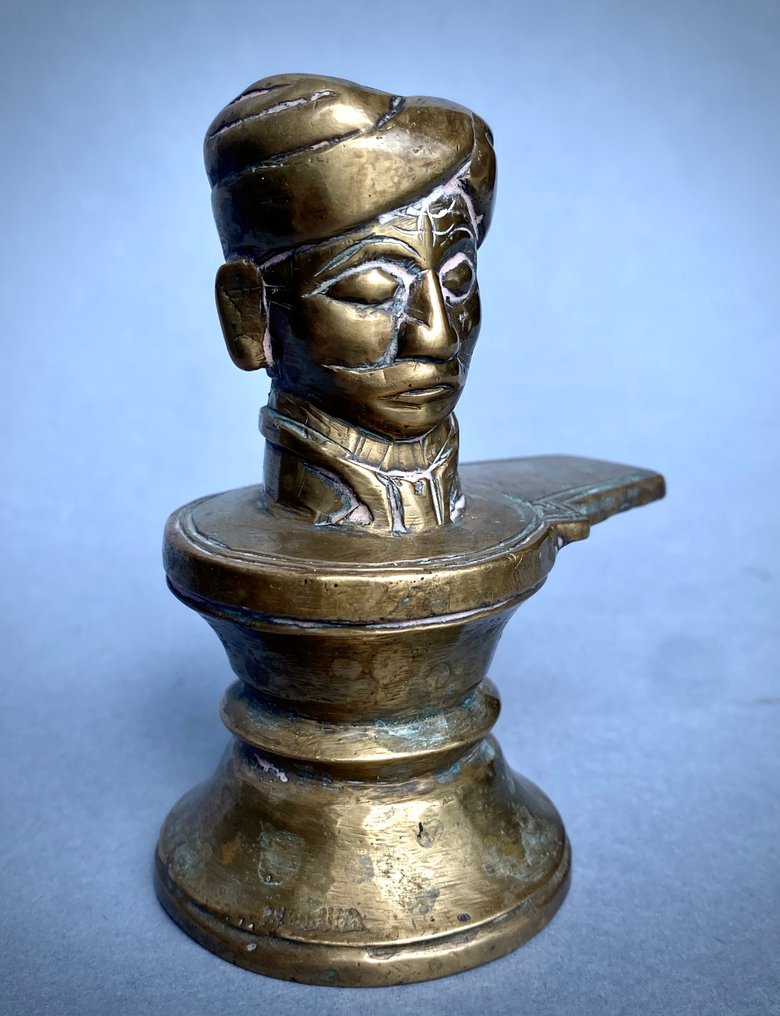
Sculpture, Insolito Mukha-liṅga con pāgṛī in elegante foggia nobiliare tardo-coloniale, India, XIX-XX secolo - 9 cm - Lost wax bronze casting


03
days
01
hour
51
minutes
32
seconds
Starting bid
€ 1
Reserve price not met

Expert
Selected by Surya Rutten
Has over 25 years' experience in Asian art and owned an art gallery.
Estimate € 550 - € 630
No bids placed
Catawiki Buyer Protection
Your payment’s safe with us until you receive your object.View details
Trustpilot 4.4 | 123077 reviews
Rated Excellent on Trustpilot.
From India, this Maratha-period bronze sculpture titled Insolito Mukha-liṅga con pāgṛī in elegante foggia nobiliare tardo-coloniale, India, XIX-XX secolo, is a good-condition unsigned piece made by a Persian-wax fused bronze process.
AI-assisted summary
Description from the seller
Mukha-liṅga 'Sovereign of Śiva' with pāgṛī and basin with prāṇāla, Rajasthan or Gujarat, India, 19th or early 20th century.
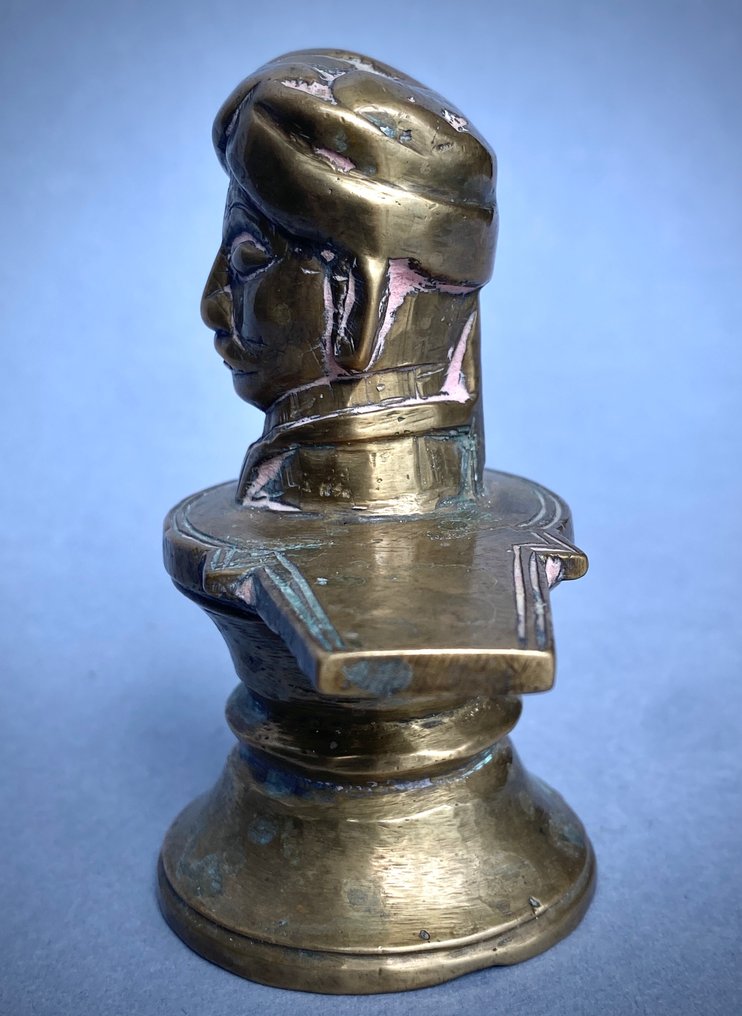
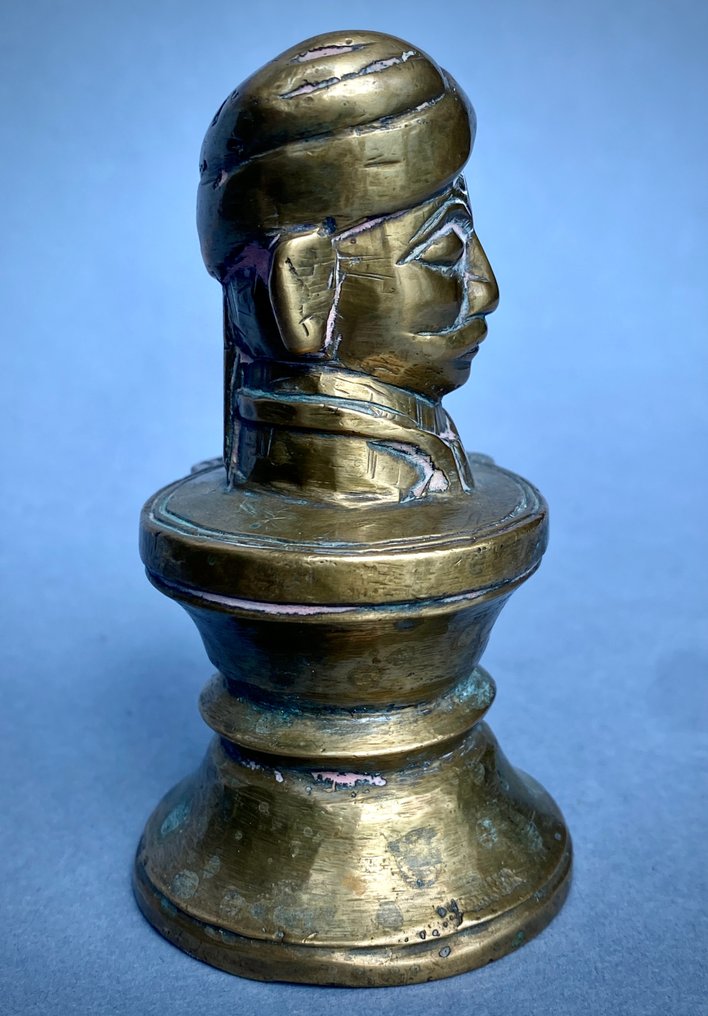
Rare figurative śivaliṅga of the mukha-liṅga type fused in bronze with Persian wax, featuring a male head emerging from the pedestal equipped with a prāṇāla spout for ritual ablution abhiṣeka. The face with large eyes and broad mustaches bears a stylized śaivita tilaka at the center of the forehead, identifying the aspect of Śiva, while the entire personification is 'modernized' in an elegant late-colonial noble style: tall pāgṛī turban with wrapped folds, a jacket with a rigid bandhgala collar, and button earrings.
The iconography, deliberately syncretic, translates the aniconic liṅga into the effigy of a devotee or ruler embodying Śiva, according to a popular devotional sensibility from northwestern India, likely Rajasthan or Gujarat (probably the Kutch–Saurashtra area), where a taste for portraits is characteristic of the Rajput/merchant clientele from the late 19th to the first half of the 20th century. The broad bell-shaped base with a drainage canal attests to its real use in puja: the ritual liquids (jala, kṣīra, ghṛta) would flow onto the head and drain from the prāṇāla, and the reddish-pink encrustations in the carvings are consistent with traces of sindūra/kumkum used during offerings.
The dry yet decisive modeling of the face, the burin engravings, the patina of use with oxidation at the joints, and the minute irregularities of the casting confirm a traditional artisanal production dating back to before post-independence standardization, suggesting a cautious dating to the early 20th century, circa 1900–1940, thus certainly prior to 1947.
Mukha-liṅga 'Sovereign of Śiva' with pāgṛī and basin with prāṇāla, Rajasthan or Gujarat, India, 19th or early 20th century.
Rare figurative śivaliṅga of the mukha-liṅga type fused in bronze with Persian wax, featuring a male head emerging from the pedestal equipped with a prāṇāla spout for ritual ablution abhiṣeka. The face with large eyes and broad mustaches bears a stylized śaivita tilaka at the center of the forehead, identifying the aspect of Śiva, while the entire personification is 'modernized' in an elegant late-colonial noble style: tall pāgṛī turban with wrapped folds, a jacket with a rigid bandhgala collar, and button earrings.
The iconography, deliberately syncretic, translates the aniconic liṅga into the effigy of a devotee or ruler embodying Śiva, according to a popular devotional sensibility from northwestern India, likely Rajasthan or Gujarat (probably the Kutch–Saurashtra area), where a taste for portraits is characteristic of the Rajput/merchant clientele from the late 19th to the first half of the 20th century. The broad bell-shaped base with a drainage canal attests to its real use in puja: the ritual liquids (jala, kṣīra, ghṛta) would flow onto the head and drain from the prāṇāla, and the reddish-pink encrustations in the carvings are consistent with traces of sindūra/kumkum used during offerings.
The dry yet decisive modeling of the face, the burin engravings, the patina of use with oxidation at the joints, and the minute irregularities of the casting confirm a traditional artisanal production dating back to before post-independence standardization, suggesting a cautious dating to the early 20th century, circa 1900–1940, thus certainly prior to 1947.
Details
Era
1400-1900
Over 200 years old
No
Country of Origin
India
Style
Antique
Material
Lost wax bronze casting
Title of artwork
Insolito Mukha-liṅga con pāgṛī in elegante foggia nobiliare tardo-coloniale, India, XIX-XX secolo
Dynastic Style/Period
Maratha Empire (1674-1818)
Signature
Not signed
Provenance
Private collection
Condition
Good condition
Sold with stand
No
Height
9 cm
Width
0 cm
Depth
0 cm
Sold by