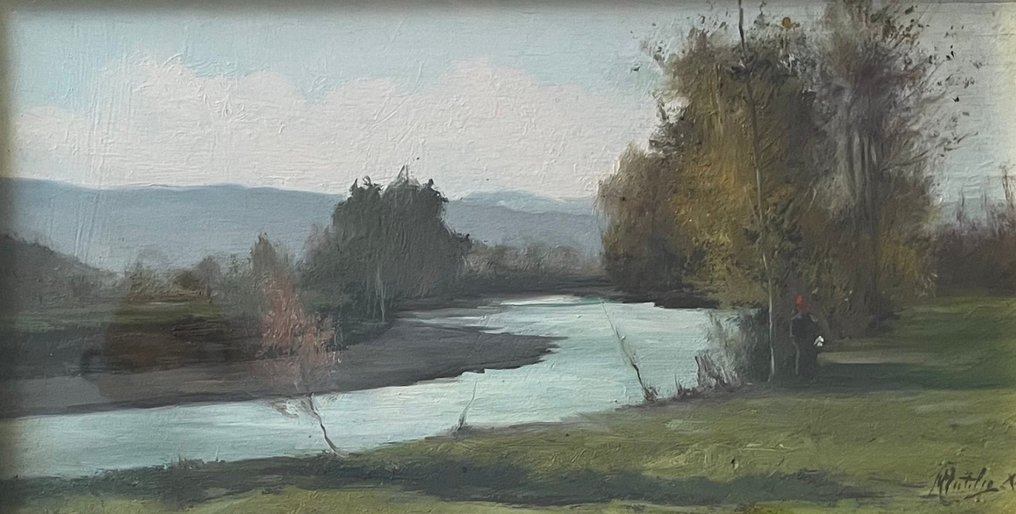
Rutilio Muti (1904-1995) - Paesaggio di campagna col fiume Sevie


08
days
18
hours
34
minutes
11
seconds
Starting bid
€ 1
No reserve price

Expert
Selected by Caterina Maffeis
Master in early Renaissance Italian painting with internship at Sotheby’s and 15 years' experience.
Estimate € 250 - € 300
No bids placed
Catawiki Buyer Protection
Your payment’s safe with us until you receive your object.View details
Trustpilot 4.4 | 122986 reviews
Rated Excellent on Trustpilot.
Paesaggio di campagna col fiume Sevie, oil on panel, period 1930–1940, Italy, Original, hand-signed, sold with frame.
AI-assisted summary
Description from the seller
Rutilio Muti (1904-1995)
Rural landscape with the Sevie river, Mugello.
1937
A medley on the table
Signed and dated at the bottom right: M Rutilio XV.
With cornice and glass
Painting dimensions: 33.0 x 17.5 cm
Frame dimensions: 50.0 x 34.0 cm.
In excellent condition (please see the images).
Rutilio Muti was born in Vicchio di Mugello (Florence) on September 4, 1904, the son of Fortunato, a bricklayer, and Enrichetta, a housewife.
After completing elementary school, he went to help his father as a laborer, the first step to learning the craft of a mason. Despite this beginning not exactly painterly, Muti showed from a young age a certain, unmistakable love for drawing; even at work, his artistic passion for painting soon emerged, combining his job as a mason with that of a decorator painter. The decorator work also took him to Florence, and he often returned home with sketches and notes of that monument, or that view, or that square that had attracted him, just as many more famous Tuscan artists and thinkers had done before. Rutilio was a painter, instinctively a painter; he only lacked the step, the opportunity to become one concretely. Mr. Gengaroli from Genoa, who had seen Rutilio's work as a decorator, perhaps provided the final push, encouraging Muti to start painting.
Rutilio recounted that the year he began his painting career was 1925, with a portrait of Gengaroli and a landscape of Vicchio. But it was 1928 that marked the true and significant turning point when, along the Sieve, Rutilio found Ferruccio Rontini sitting at his easel... everything about the painting Rontini was creating deeply struck Rutilio; the energy and at the same time the sobriety of the great master's work were the wave that shook Muti, who had finally found someone who could make him become what he desired, what he was: a painter. Rutilio uttered the phrase that would definitively mark his life: 'Professor, I would like to paint too.'
From that chance encounter, a long-lasting and enduring friendship was born between the master and his pupil, a deep understanding that went far beyond the pure bond established between a disciple and their teacher, a friendship that extended beyond the mere artistic activity they shared.
Da Rontini Rutilio learned the fundamentals of the technique and tricks; moreover, with his help and presentation, the first true exhibitions of Rutilio's works began in 1929. Notably, the 1930 monographic exhibition in Florence (Galleria Materazzi) was a significant success: almost all of the painter's works were sold.
The decade of 1930-1940 saw Muti follow Rontini around Italy to paint and sell his works. Among the various locations visited during this tour, Rontini's Livorno was naturally a key stop, where the Professor was able to introduce the student to the Gruppo Labronico. Most of the paintings from this period (especially from 1933) depict areas such as Calambrone, Ardenza, Quercianella, and nearby regions, sometimes referred to by gallery owners and merchants as 'maremme.' This decade also produced paintings in an original divisionism style, possibly influenced by encounters with Plinio Nomellini, although they also show strong similarities to Segantini.
However, it is important to highlight a very significant fact: excluding the great master and friend Ferruccio Rontini, whose friendship went beyond artistic passion, Rutilio would never have connected with the other members of the Gruppo Labronico. Rutilio would not have been part of it, and the Livorno experience, although important and formative, would have ended quite early. By 1934, Muti had already returned to his Mugello.
Muti is therefore not a 'Livorno painter'; he has a Livorno master and friend, travels, sees, paints, knows Livorno, its areas, and its painters, but he will never become a 'Livorno painter.' This is a profound and, most likely, instinctive choice by the artist. Rutilio perhaps represents the first true and complete artist strictly from Mugello of the twentieth century; his bond with his land will never cease, except with death; the passion, the entirely personal style of Muti, even if strongly influenced by Rontini, finds in the glimpses of his Mugello, in his people, everything a painter like Muti could desire. Rutilio will travel and paint other areas, producing excellent and outstanding works, but ultimately, his main paintings are created in Mugello, about Mugello, and for Mugello.
Other two key dates for Muti are 1936, the year he married Annunziata Giustini, with whom he had three children, and 1953, the year of his wife's death. The grief over Annunziata's death was a truly hard blow for the painter, who was also left alone to raise three children; painting significantly helped Muti to endure this difficult and sad period of his life.
In the 1960s, we find him in Venice and Marina di Ravenna, with remarkable works. The paintings from the 'Venetian period' demonstrate the painter's ability to interpret, with his very personal style, other regions outside Mugello as well, although, as previously mentioned, it is in his homeland that the artist will gift us with his greatest masterpieces.
Also worth remembering is 1966, the devastating flood of Florence. A fine exhibition of the painter held at the 'Casa di Dante' was indeed flooded, with the destruction of several works.
Rutilio did not attend the Academy, nor did he undertake a specific or formal course of study; what he knows he learned on his own or from Rontini. Many other painters would have 'limited' themselves in their artistic 'experiments,' given the limitations.
Despite these basic limitations, Muti wants to try new techniques and surpass his own painting. Over seventy years old, he returns to use a personal technique very close to divisionism, characterized by large patches of color, straightforward and vivid; the subjects are mainly from Mugello, but with unreal colorations and plays of light that are striking and highly impactful visually.
Painting was always a great passion for Rutilio; if not the same level of passion, he continued to paint until 1993 when he was struck by a severe stroke shortly after completing his last work ('Il Cistio'). After two long years of infirmity, he died on December 14, 1995.
Rutilio Muti (1904-1995)
Rural landscape with the Sevie river, Mugello.
1937
A medley on the table
Signed and dated at the bottom right: M Rutilio XV.
With cornice and glass
Painting dimensions: 33.0 x 17.5 cm
Frame dimensions: 50.0 x 34.0 cm.
In excellent condition (please see the images).
Rutilio Muti was born in Vicchio di Mugello (Florence) on September 4, 1904, the son of Fortunato, a bricklayer, and Enrichetta, a housewife.
After completing elementary school, he went to help his father as a laborer, the first step to learning the craft of a mason. Despite this beginning not exactly painterly, Muti showed from a young age a certain, unmistakable love for drawing; even at work, his artistic passion for painting soon emerged, combining his job as a mason with that of a decorator painter. The decorator work also took him to Florence, and he often returned home with sketches and notes of that monument, or that view, or that square that had attracted him, just as many more famous Tuscan artists and thinkers had done before. Rutilio was a painter, instinctively a painter; he only lacked the step, the opportunity to become one concretely. Mr. Gengaroli from Genoa, who had seen Rutilio's work as a decorator, perhaps provided the final push, encouraging Muti to start painting.
Rutilio recounted that the year he began his painting career was 1925, with a portrait of Gengaroli and a landscape of Vicchio. But it was 1928 that marked the true and significant turning point when, along the Sieve, Rutilio found Ferruccio Rontini sitting at his easel... everything about the painting Rontini was creating deeply struck Rutilio; the energy and at the same time the sobriety of the great master's work were the wave that shook Muti, who had finally found someone who could make him become what he desired, what he was: a painter. Rutilio uttered the phrase that would definitively mark his life: 'Professor, I would like to paint too.'
From that chance encounter, a long-lasting and enduring friendship was born between the master and his pupil, a deep understanding that went far beyond the pure bond established between a disciple and their teacher, a friendship that extended beyond the mere artistic activity they shared.
Da Rontini Rutilio learned the fundamentals of the technique and tricks; moreover, with his help and presentation, the first true exhibitions of Rutilio's works began in 1929. Notably, the 1930 monographic exhibition in Florence (Galleria Materazzi) was a significant success: almost all of the painter's works were sold.
The decade of 1930-1940 saw Muti follow Rontini around Italy to paint and sell his works. Among the various locations visited during this tour, Rontini's Livorno was naturally a key stop, where the Professor was able to introduce the student to the Gruppo Labronico. Most of the paintings from this period (especially from 1933) depict areas such as Calambrone, Ardenza, Quercianella, and nearby regions, sometimes referred to by gallery owners and merchants as 'maremme.' This decade also produced paintings in an original divisionism style, possibly influenced by encounters with Plinio Nomellini, although they also show strong similarities to Segantini.
However, it is important to highlight a very significant fact: excluding the great master and friend Ferruccio Rontini, whose friendship went beyond artistic passion, Rutilio would never have connected with the other members of the Gruppo Labronico. Rutilio would not have been part of it, and the Livorno experience, although important and formative, would have ended quite early. By 1934, Muti had already returned to his Mugello.
Muti is therefore not a 'Livorno painter'; he has a Livorno master and friend, travels, sees, paints, knows Livorno, its areas, and its painters, but he will never become a 'Livorno painter.' This is a profound and, most likely, instinctive choice by the artist. Rutilio perhaps represents the first true and complete artist strictly from Mugello of the twentieth century; his bond with his land will never cease, except with death; the passion, the entirely personal style of Muti, even if strongly influenced by Rontini, finds in the glimpses of his Mugello, in his people, everything a painter like Muti could desire. Rutilio will travel and paint other areas, producing excellent and outstanding works, but ultimately, his main paintings are created in Mugello, about Mugello, and for Mugello.
Other two key dates for Muti are 1936, the year he married Annunziata Giustini, with whom he had three children, and 1953, the year of his wife's death. The grief over Annunziata's death was a truly hard blow for the painter, who was also left alone to raise three children; painting significantly helped Muti to endure this difficult and sad period of his life.
In the 1960s, we find him in Venice and Marina di Ravenna, with remarkable works. The paintings from the 'Venetian period' demonstrate the painter's ability to interpret, with his very personal style, other regions outside Mugello as well, although, as previously mentioned, it is in his homeland that the artist will gift us with his greatest masterpieces.
Also worth remembering is 1966, the devastating flood of Florence. A fine exhibition of the painter held at the 'Casa di Dante' was indeed flooded, with the destruction of several works.
Rutilio did not attend the Academy, nor did he undertake a specific or formal course of study; what he knows he learned on his own or from Rontini. Many other painters would have 'limited' themselves in their artistic 'experiments,' given the limitations.
Despite these basic limitations, Muti wants to try new techniques and surpass his own painting. Over seventy years old, he returns to use a personal technique very close to divisionism, characterized by large patches of color, straightforward and vivid; the subjects are mainly from Mugello, but with unreal colorations and plays of light that are striking and highly impactful visually.
Painting was always a great passion for Rutilio; if not the same level of passion, he continued to paint until 1993 when he was struck by a severe stroke shortly after completing his last work ('Il Cistio'). After two long years of infirmity, he died on December 14, 1995.
Details
Artist
Rutilio Muti (1904-1995)
Sold with frame
Yes
Sold by
Owner or reseller
Edition
Original
Title of artwork
Paesaggio di campagna col fiume Sevie
Technique
Oil painting
Signature
Hand signed
Country of Origin
Italy
Condition
Excellent condition
Height
17.5 cm
Width
33 cm
Depiction/Theme
Landscape
Style
Realism
Period
1930-1940
Sold by
