Viktor Belányi (1877-1955) - Natura Morta con Fiori e Frutta



08
days
09
hours
43
minutes
59
seconds
Starting bid
€ 1
Reserve price not met

Expert
Selected by Caroline Bokobza
Graduated as French auctioneer and worked in Sotheby’s Paris valuation department.
Estimate € 400 - € 500
No bids placed
Catawiki Buyer Protection
Your payment’s safe with us until you receive your object.View details
Trustpilot 4.4 | 122910 reviews
Rated Excellent on Trustpilot.
Description from the seller
Author
Viktor Belányi (1877-1955) was a Hungarian painter. Born in Lőcse (in present-day Slovakia), he perfectly embodies the cosmopolitan spirit of early 20th-century Central European art. His education was a true journey through the cultural capitals of the era: after initial studies in Budapest, he moved to Munich to study under Simon Hollósy, a master who profoundly influenced modern Hungarian painting. His artistic development was finally shaped in Paris, where he attended the Académie Julian, and later in the famous artist colony of Nagybánya, where he absorbed the lessons of en plein air painting. This rich education allowed him to blend the rigor of academic drawing with the chromatic and luminous freedom typical of French Impressionism.
Although he painted landscapes and portraits, Belányi is mainly remembered as a master of intimate atmospheres, excelling in interior scenes and floral still lifes. His painting is characterized by a soft, almost velvety brushstroke and the use of warm, vibrant colors that manage to give solidity and volume to everyday objects, such as ceramic pitchers and wildflowers he loved to depict. A regular exhibitor at major Hungarian institutions like the Galleria d'Arte Műcsarnok and the Museo Ernst, he worked tirelessly until his death in Budapest in 1955, leaving works that are now housed in the Hungarian National Gallery and numerous private collections.
Description
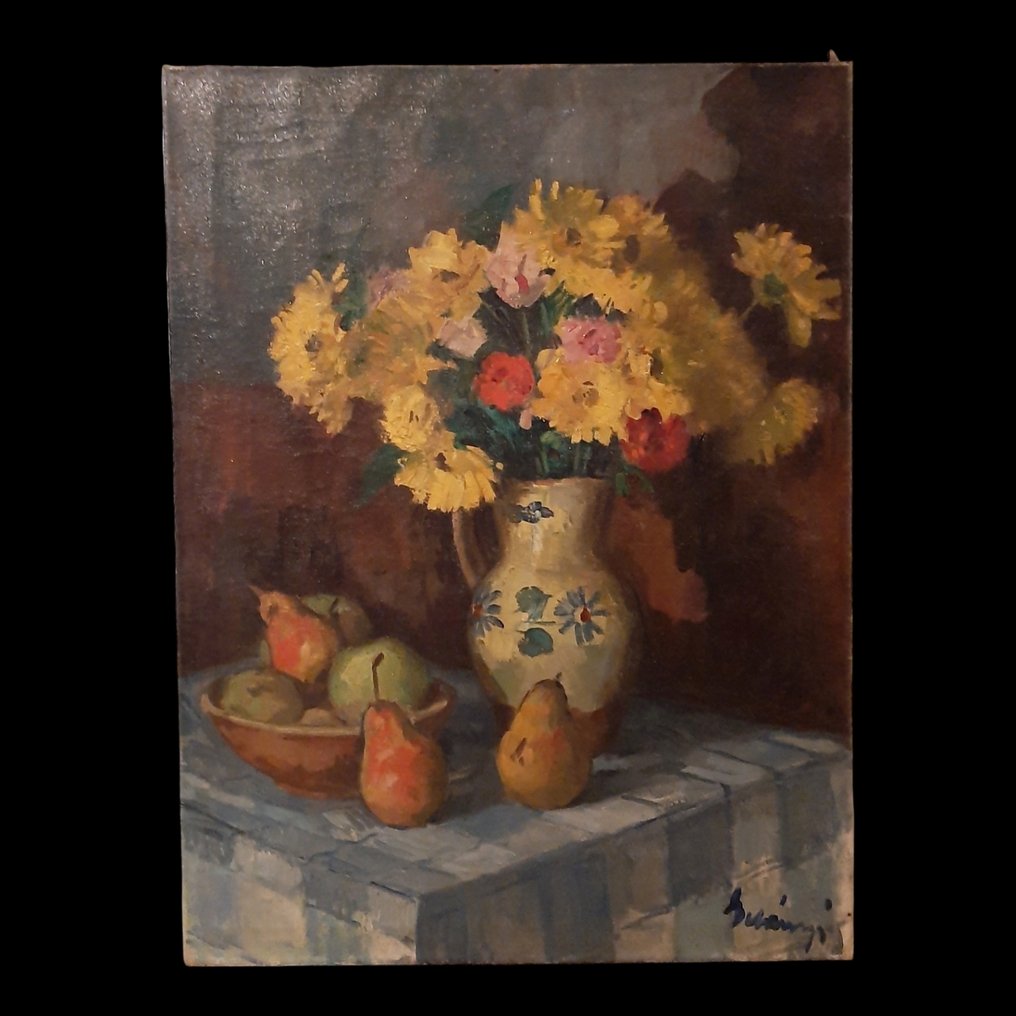
"Natura Morta con Fiori e Frutta", oil on board, 81*61cm, signed lower right, datable to the 1920s. On the back, an label with inventory number and a stamp bearing the coat of arms of Hungary.
The work features a composition centered around a glazed ceramic jug decorated with blue floral motifs, typical of Hungarian folk tradition. The vase holds a lush bouquet of chrysanthemums and dahlias that burst in shades of yellow and pink, dominating the scene with their vitality. To balance the verticality of the bouquet, on the left is a bowl filled with fruit, while two pears, rendered with particular volumetric attention, rest directly on the table surface in the foreground, all visually supported by a white and blue checkered cloth that defines the spatial depth.
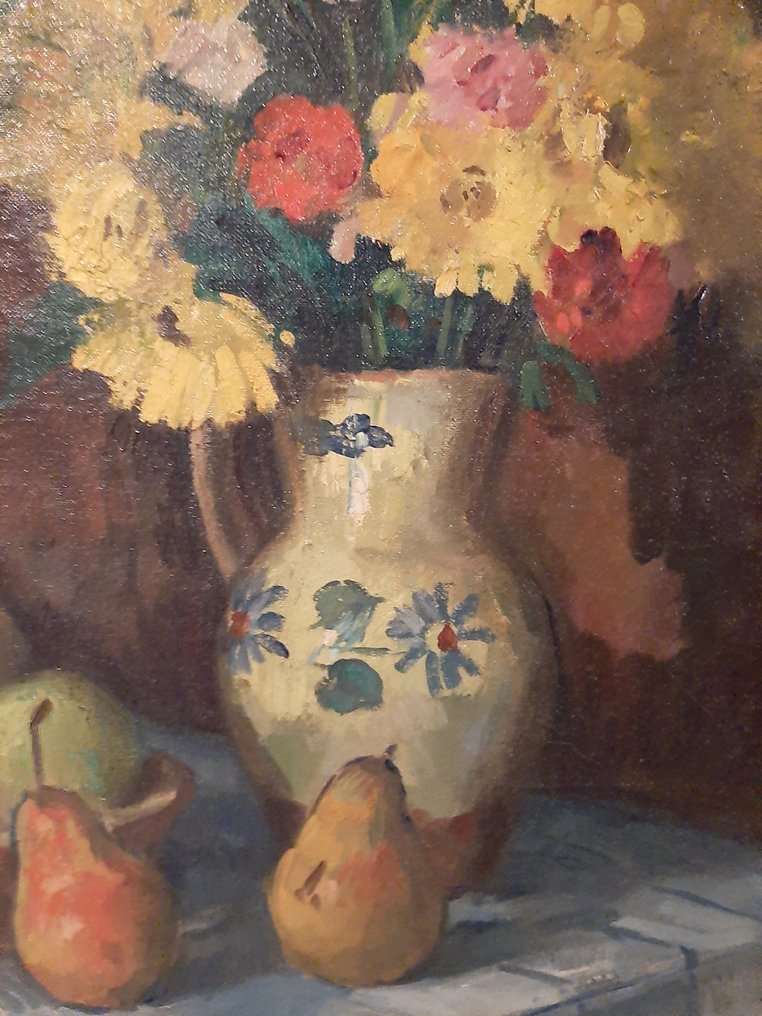
The painterly technique reveals the artist's full maturity and the synthesis of his international experiences. The brushwork is dense, tactile, and vibrant, clearly indebted to the post-impressionist lesson assimilated during his stay in Paris and to the Nagybánya school. Belányi constructs volumes through color rather than with sharp drawing, using a skillful play of contrasts where light caresses the roundness of the fruit and the texture of the petals, making them stand out strongly from a dark, undefined background. The use of warm, earthy colors contrasted with the cool tones of the tablecloth creates an intimate and cozy atmosphere, endowing everyday objects with their own dignity and poetic quality.
This canvas is an emblematic example of Belányi's preference for still life, a genre in which the artist managed to blend the academic rigor learned in Monaco with French expressive freedom. He succeeded in transforming a simple domestic composition into a celebration of light and matter, perfectly aligned with the trends of Hungarian modernism in the first half of the 20th century. A work of beautiful and fresh composition, with a pleasing aesthetic and decorative impact.
Condition Report
The overall condition is good, with the painting intact in all parts, featuring vivid colors and brushstrokes that are clear and well defined.
Tracked and insured shipment with adequate packaging.
Author
Viktor Belányi (1877-1955) was a Hungarian painter. Born in Lőcse (in present-day Slovakia), he perfectly embodies the cosmopolitan spirit of early 20th-century Central European art. His education was a true journey through the cultural capitals of the era: after initial studies in Budapest, he moved to Munich to study under Simon Hollósy, a master who profoundly influenced modern Hungarian painting. His artistic development was finally shaped in Paris, where he attended the Académie Julian, and later in the famous artist colony of Nagybánya, where he absorbed the lessons of en plein air painting. This rich education allowed him to blend the rigor of academic drawing with the chromatic and luminous freedom typical of French Impressionism.
Although he painted landscapes and portraits, Belányi is mainly remembered as a master of intimate atmospheres, excelling in interior scenes and floral still lifes. His painting is characterized by a soft, almost velvety brushstroke and the use of warm, vibrant colors that manage to give solidity and volume to everyday objects, such as ceramic pitchers and wildflowers he loved to depict. A regular exhibitor at major Hungarian institutions like the Galleria d'Arte Műcsarnok and the Museo Ernst, he worked tirelessly until his death in Budapest in 1955, leaving works that are now housed in the Hungarian National Gallery and numerous private collections.
Description
"Natura Morta con Fiori e Frutta", oil on board, 81*61cm, signed lower right, datable to the 1920s. On the back, an label with inventory number and a stamp bearing the coat of arms of Hungary.
The work features a composition centered around a glazed ceramic jug decorated with blue floral motifs, typical of Hungarian folk tradition. The vase holds a lush bouquet of chrysanthemums and dahlias that burst in shades of yellow and pink, dominating the scene with their vitality. To balance the verticality of the bouquet, on the left is a bowl filled with fruit, while two pears, rendered with particular volumetric attention, rest directly on the table surface in the foreground, all visually supported by a white and blue checkered cloth that defines the spatial depth.
The painterly technique reveals the artist's full maturity and the synthesis of his international experiences. The brushwork is dense, tactile, and vibrant, clearly indebted to the post-impressionist lesson assimilated during his stay in Paris and to the Nagybánya school. Belányi constructs volumes through color rather than with sharp drawing, using a skillful play of contrasts where light caresses the roundness of the fruit and the texture of the petals, making them stand out strongly from a dark, undefined background. The use of warm, earthy colors contrasted with the cool tones of the tablecloth creates an intimate and cozy atmosphere, endowing everyday objects with their own dignity and poetic quality.
This canvas is an emblematic example of Belányi's preference for still life, a genre in which the artist managed to blend the academic rigor learned in Monaco with French expressive freedom. He succeeded in transforming a simple domestic composition into a celebration of light and matter, perfectly aligned with the trends of Hungarian modernism in the first half of the 20th century. A work of beautiful and fresh composition, with a pleasing aesthetic and decorative impact.
Condition Report
The overall condition is good, with the painting intact in all parts, featuring vivid colors and brushstrokes that are clear and well defined.
Tracked and insured shipment with adequate packaging.
Details
Artist
Viktor Belányi (1877-1955)
Sold with frame
No
Sold by
Gallery
Edition
Original
Title of artwork
Natura Morta con Fiori e Frutta
Technique
Oil painting
Signature
Signed
Country of Origin
Hungary
Condition
Good condition
Height
81 cm
Width
61 cm
Depiction/Theme
Still life
Style
Post-Impressionism
Period
1920-1930
Sold by
