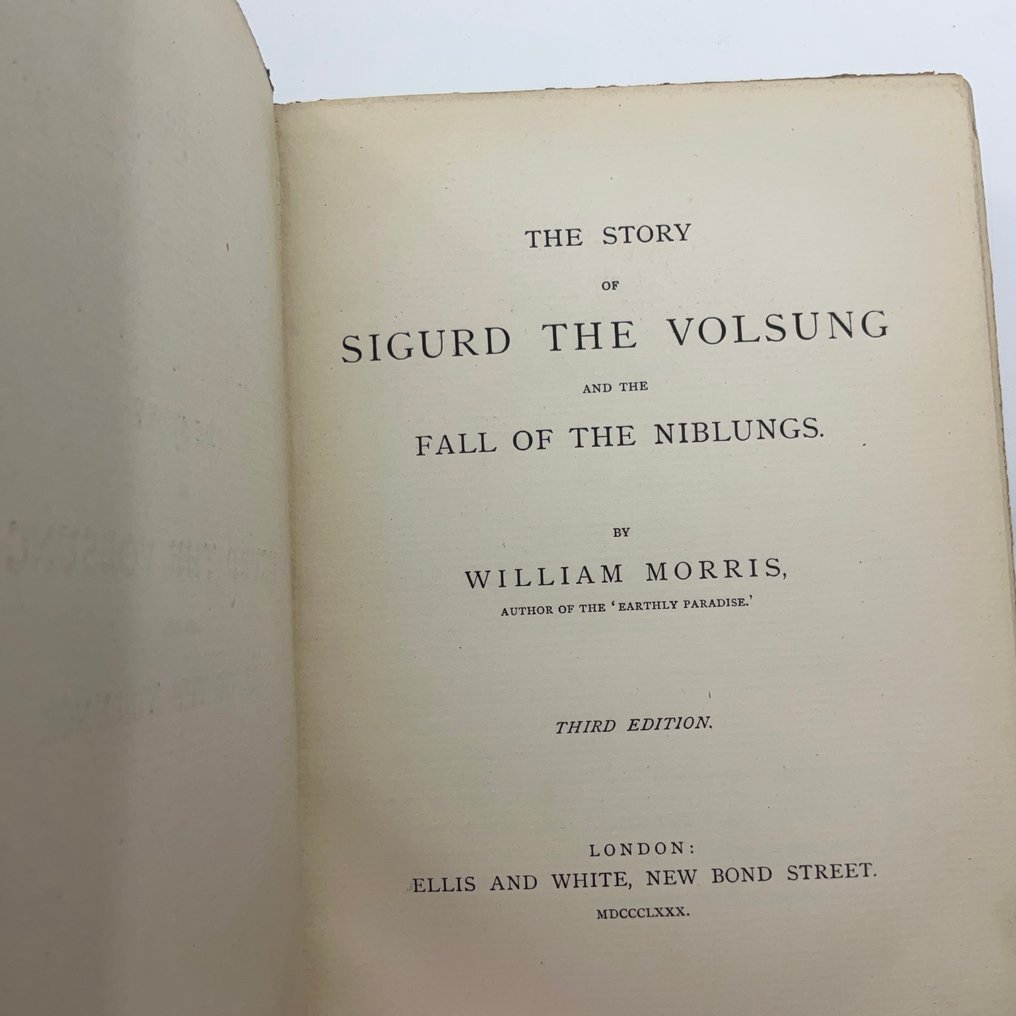
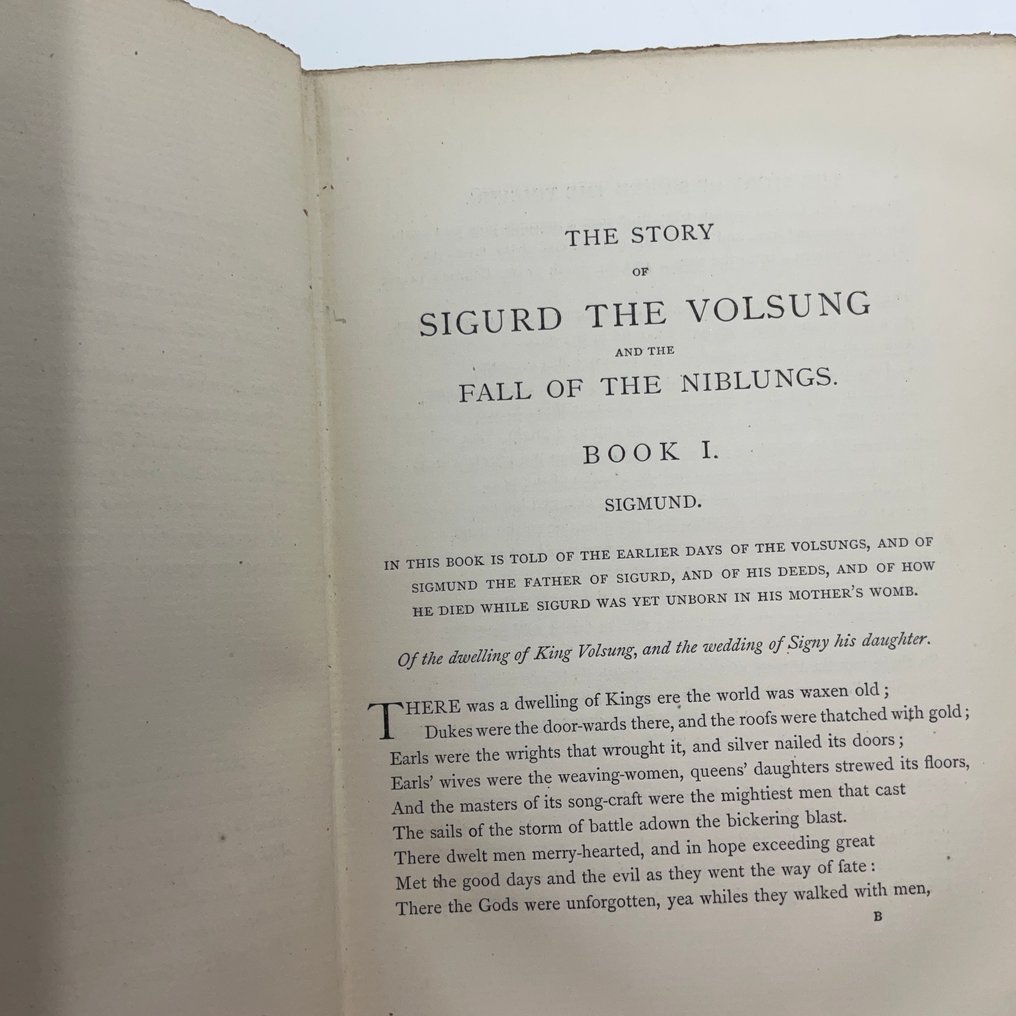
William Morris - The Story of Sigurd the Volsung and the Fall of the Niblungs - 1880



13
days
06
hours
24
minutes
57
seconds

No bids placed
Catawiki Buyer Protection
Your payment’s safe with us until you receive your object.View details
Trustpilot 4.4 | 122910 reviews
Rated Excellent on Trustpilot.
William Morris, The Story of Sigurd the Volsung and the Fall of the Niblungs, a hardback English edition published in 1880 in the original publisher's binding, good condition.
AI-assisted summary
Description from the seller
"The Story of Sigurd the Volsung and the Fall of the Niblungs" by William Morris - Ellis and White, London - 1880 edition - 18cmx15cm - condition: good, in original publisher's binding with some rubbing and wear to edges, name to ffep, complete.
In the scarce publisher's original cloth binding.Composed of over 10,000 lines, Morris recounts the tale of Norse hero Sigmund, his son Sigurd, and Sigurd's wife Gudrun, drawn from the Icelandic Volsunga Saga and Elder Edda. Having encountered the tale at a young age, Morris began to learn Old Norse from an Icelandic scholar in 1868, and embarked on his own translations of the Icelandic classics.It was Morris's own favourite of his poems, and was enthusiastically praised both by contemporary critics and by figures including T. E. Lawrence and George Bernard Shaw, and is viewed as having influenced the work of J. R. R. Tolkien and Andrew Lang
"The Story of Sigurd the Volsung and the Fall of the Niblungs" by William Morris - Ellis and White, London - 1880 edition - 18cmx15cm - condition: good, in original publisher's binding with some rubbing and wear to edges, name to ffep, complete.
In the scarce publisher's original cloth binding.Composed of over 10,000 lines, Morris recounts the tale of Norse hero Sigmund, his son Sigurd, and Sigurd's wife Gudrun, drawn from the Icelandic Volsunga Saga and Elder Edda. Having encountered the tale at a young age, Morris began to learn Old Norse from an Icelandic scholar in 1868, and embarked on his own translations of the Icelandic classics.It was Morris's own favourite of his poems, and was enthusiastically praised both by contemporary critics and by figures including T. E. Lawrence and George Bernard Shaw, and is viewed as having influenced the work of J. R. R. Tolkien and Andrew Lang
Details
Number of Books
1
Subject
Literature
Book Title
The Story of Sigurd the Volsung and the Fall of the Niblungs
Author/ Illustrator
William Morris
Condition
Good
Publication year oldest item
1880
Edition
Subsequent edition
Language
English
Original language
Yes
Binding/ Material
Hardback
Number of pages
0
Sold by
