Johannes Duns Scotus - POST-INCUNABLE - 1520



Opens 11:00
Starting bid
€ 1
Add to your favourites to get an alert when the auction starts.

Expert
Selected by Volker Riepenhausen
Specialist in travel literature and pre-1600 rare prints with 28 years experience.
Estimate € 1,500 - € 4,500
Catawiki Buyer Protection
Your payment’s safe with us until you receive your object.View details
Trustpilot 4.4 | 122813 reviews
Rated Excellent on Trustpilot.
Description from the seller
1520 POST-INCUNABLE by Johannes Duns Scotus or "Duns the Scot" (ca.1265-1308), a Scottish Catholic priest, Franciscan friar, university professor and philosopher. He is considered one of the most important medieval philosopher-theologians of Western Christianity, together with Thomas Aquinas, Bonaventure and William of Ockham. Scotus studied at a medieval university under the Franciscan order in Oxford and then taught at the universities of Paris, Cologne and Cambridge. This book, "Quaestiones Quodlibetales" (Questions and Answers on Any Subject), represents his mature thought and is a collection of analyses, reflections, and polemics. These debates, with free choice of topic, were held in the Middle Ages in European universities at fixed times (2nd-3rd week of Advent; 4th week of Lent). The topics ranged across a wide range of philosophical and religious subjects: theology, sacred scripture, Aristotle, fortune, God, freedom, death, eternity, universe, future, ethics, sin, morality, canon law, and so on. For all these questions, the "Master Scotus" had to coordinate the debate and provide answers. Antique half-leather binding, in excellent condition. No copies for sale; only 5 copies are available in public bookstores in Italy, Germany, Canada, and the USA. References; World Cat OCLC n°635314977; Bamberg, Staatsbibliothek - GND-ID: (DE-588)118528165; Roberto Caracciolo Library in Lecce, IT-LE0097, n°BVEE019156; Duns Scotus (Great Medieval Thinkers), by Richard Cross, 2023; John Duns Scotus, God and Creatures. The Quodlibetal Questions, by Wolter, Allan B. and Felix Alluntis, Washington, D.C., Catholic University of America Press, 1975; Duns Scotus: Philosophical Writings, by Wolter, Allan B., Indianapolis: Hackett Publishing Company, 1987; Williams, Thomas (2019), "John Duns Scotus", The Stanford Encyclopedia of Philosophy.
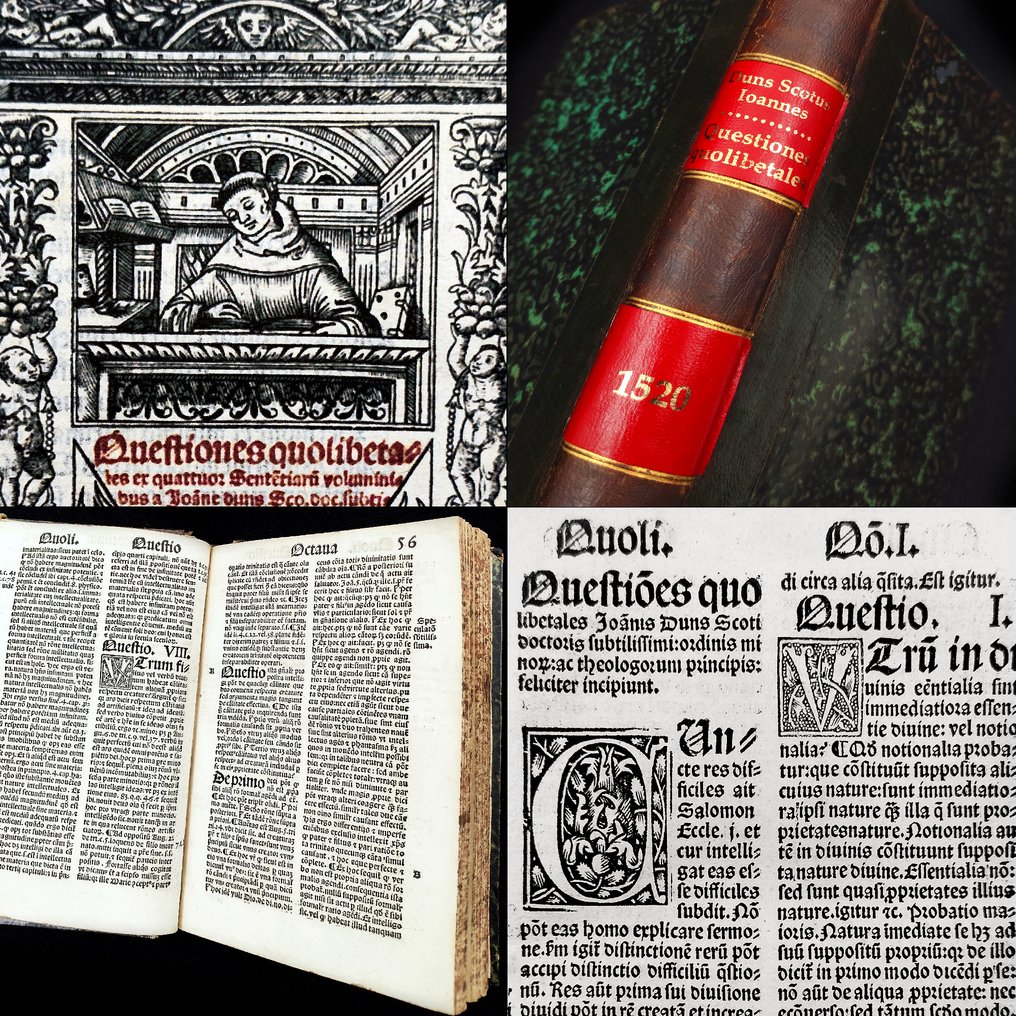
Title page printed in red within a beautiful woodcut architectural border populated by cherubs, with a portrait of Duns Scotus in his study at the top and the publisher's lily mark Giunta at the bottom. The work is dated on the last page, as shown in the fourth photo (April 1520). Duns Scotus was given the scholastic accolade Doctor Subtilis ("the subtle doctor") for his penetrating and subtle manner of thought. He was beatified by Pope John Paul II in 1993. In the early Middle Ages, the idea was widespread that every professor of theology or philosophy had to submit their theses and assertions to public debate. Without this test of resistance to counterarguments, no philosophical or theological position could be considered "mature." It wasn't enough to simply state things; they had to be supported with reasoning. Twice a year, anyone could pose the "Quaestiones Quodlibetales" (Questions and Answers on Any Subject). These were questions anyone could publicly pose, on any topic, to the professor in question, who was then required to respond publicly, providing reasoned arguments. The surviving "Quaestiones Quodlibetales" by various medieval authors, such as Thomas Aquinas and Duns Scotus, are fascinating texts that demonstrate the ability of these thinkers to apply their philosophical and theological principles to any topic presented to them. The thought of Duns Scotus, also known as Scotism, had a strong following in the Franciscan school, including in Italy and France, where mention should be made of the theologian Bartolomeo Mastri, known as Scotistarum princeps, the prince of the Scotists, and the French theologian Guillaume de Vorilong and Claude Frassen. In the 19th century, Duns Scotus was called the "Kant of scholastic philosophy", and has had a notable influence on both Catholic and secular thought.
TITLE: Questiones Quodlibetales Ex Quatuor Sententiarum Voluminibus...(Questions and Answers on Any Subject on Four Books...)
AUTHORS: Johannes Duns Scotus, and with additional comments by Antonio De Fantis (ca.1460-1533), theologian from Venice, studied and taught at the University of Padova, was a scholar and commentator of various works of Scotus and Thomas Aquinas
PUBLISHER: printed by Iacobum Myt (Jacques Myt) for Jacques Giunta
DATE: MDXX (April 1520), in Lugduni (Lyon), text in Latin
DESCRIPTION: In 8vo size, height 164 x width 119 mm (6.5 by 4.7 inches). 136 numbered sheets, i.e. 272 pages + [4]; complete book, text in Latin. Title page printed in red within a beautiful woodcut architectural border populated by cherubs, with a portrait of the author in his study at the top and the publisher's lily mark Giunta at the bottom. The work is dated on the last page, as shown in the photo (April 1520). Beautiful, solid half-leather binding in excellent condition circa 1850, with marbled boards, gilt titles on a red background, small signs of use on the sides and edges but of no importance. Woodcut initials, some small and negligible stains in the upper outer corner, some slightly browned quires, the last leaves with pale marginal stains and some small tears at the ends in the white margins without loss of text or images. A few old-hand notes in the white margins of about ten pages. All in very good overall condition. COMPLETE EDITION.
AUTHOR: John Duns Scotus or "Duns the Scot", (ca.1265-1308) was a Scottish Catholic priest and Franciscan friar, university professor, philosopher and theologian. He is considered among the most important philosopher-theologians in Western Christendom during the last part of the medieval period, together with Thomas Aquinas, Bonaventure and William of Ockham. Duns Scotus has had considerable influence on both Catholic and secular thought. The intellectual tradition derived from Scotus' work is called Scotism. Duns Scotus was given the scholastic accolade Doctor Subtilis ("the subtle doctor") for his penetrating and subtle manner of thought. He was beatified by Pope John Paul II in 1993.
SHIPPING: via UPS, DHL, National Postal Services, protected, INSURED and fully tracked package. Estimated time for Europe 3-5 working days. Shipping within one working day, you can combine shipping if you purchases several items from us, saving money and time.
1520 POST-INCUNABLE by Johannes Duns Scotus or "Duns the Scot" (ca.1265-1308), a Scottish Catholic priest, Franciscan friar, university professor and philosopher. He is considered one of the most important medieval philosopher-theologians of Western Christianity, together with Thomas Aquinas, Bonaventure and William of Ockham. Scotus studied at a medieval university under the Franciscan order in Oxford and then taught at the universities of Paris, Cologne and Cambridge. This book, "Quaestiones Quodlibetales" (Questions and Answers on Any Subject), represents his mature thought and is a collection of analyses, reflections, and polemics. These debates, with free choice of topic, were held in the Middle Ages in European universities at fixed times (2nd-3rd week of Advent; 4th week of Lent). The topics ranged across a wide range of philosophical and religious subjects: theology, sacred scripture, Aristotle, fortune, God, freedom, death, eternity, universe, future, ethics, sin, morality, canon law, and so on. For all these questions, the "Master Scotus" had to coordinate the debate and provide answers. Antique half-leather binding, in excellent condition. No copies for sale; only 5 copies are available in public bookstores in Italy, Germany, Canada, and the USA. References; World Cat OCLC n°635314977; Bamberg, Staatsbibliothek - GND-ID: (DE-588)118528165; Roberto Caracciolo Library in Lecce, IT-LE0097, n°BVEE019156; Duns Scotus (Great Medieval Thinkers), by Richard Cross, 2023; John Duns Scotus, God and Creatures. The Quodlibetal Questions, by Wolter, Allan B. and Felix Alluntis, Washington, D.C., Catholic University of America Press, 1975; Duns Scotus: Philosophical Writings, by Wolter, Allan B., Indianapolis: Hackett Publishing Company, 1987; Williams, Thomas (2019), "John Duns Scotus", The Stanford Encyclopedia of Philosophy.
Title page printed in red within a beautiful woodcut architectural border populated by cherubs, with a portrait of Duns Scotus in his study at the top and the publisher's lily mark Giunta at the bottom. The work is dated on the last page, as shown in the fourth photo (April 1520). Duns Scotus was given the scholastic accolade Doctor Subtilis ("the subtle doctor") for his penetrating and subtle manner of thought. He was beatified by Pope John Paul II in 1993. In the early Middle Ages, the idea was widespread that every professor of theology or philosophy had to submit their theses and assertions to public debate. Without this test of resistance to counterarguments, no philosophical or theological position could be considered "mature." It wasn't enough to simply state things; they had to be supported with reasoning. Twice a year, anyone could pose the "Quaestiones Quodlibetales" (Questions and Answers on Any Subject). These were questions anyone could publicly pose, on any topic, to the professor in question, who was then required to respond publicly, providing reasoned arguments. The surviving "Quaestiones Quodlibetales" by various medieval authors, such as Thomas Aquinas and Duns Scotus, are fascinating texts that demonstrate the ability of these thinkers to apply their philosophical and theological principles to any topic presented to them. The thought of Duns Scotus, also known as Scotism, had a strong following in the Franciscan school, including in Italy and France, where mention should be made of the theologian Bartolomeo Mastri, known as Scotistarum princeps, the prince of the Scotists, and the French theologian Guillaume de Vorilong and Claude Frassen. In the 19th century, Duns Scotus was called the "Kant of scholastic philosophy", and has had a notable influence on both Catholic and secular thought.
TITLE: Questiones Quodlibetales Ex Quatuor Sententiarum Voluminibus...(Questions and Answers on Any Subject on Four Books...)
AUTHORS: Johannes Duns Scotus, and with additional comments by Antonio De Fantis (ca.1460-1533), theologian from Venice, studied and taught at the University of Padova, was a scholar and commentator of various works of Scotus and Thomas Aquinas
PUBLISHER: printed by Iacobum Myt (Jacques Myt) for Jacques Giunta
DATE: MDXX (April 1520), in Lugduni (Lyon), text in Latin
DESCRIPTION: In 8vo size, height 164 x width 119 mm (6.5 by 4.7 inches). 136 numbered sheets, i.e. 272 pages + [4]; complete book, text in Latin. Title page printed in red within a beautiful woodcut architectural border populated by cherubs, with a portrait of the author in his study at the top and the publisher's lily mark Giunta at the bottom. The work is dated on the last page, as shown in the photo (April 1520). Beautiful, solid half-leather binding in excellent condition circa 1850, with marbled boards, gilt titles on a red background, small signs of use on the sides and edges but of no importance. Woodcut initials, some small and negligible stains in the upper outer corner, some slightly browned quires, the last leaves with pale marginal stains and some small tears at the ends in the white margins without loss of text or images. A few old-hand notes in the white margins of about ten pages. All in very good overall condition. COMPLETE EDITION.
AUTHOR: John Duns Scotus or "Duns the Scot", (ca.1265-1308) was a Scottish Catholic priest and Franciscan friar, university professor, philosopher and theologian. He is considered among the most important philosopher-theologians in Western Christendom during the last part of the medieval period, together with Thomas Aquinas, Bonaventure and William of Ockham. Duns Scotus has had considerable influence on both Catholic and secular thought. The intellectual tradition derived from Scotus' work is called Scotism. Duns Scotus was given the scholastic accolade Doctor Subtilis ("the subtle doctor") for his penetrating and subtle manner of thought. He was beatified by Pope John Paul II in 1993.
SHIPPING: via UPS, DHL, National Postal Services, protected, INSURED and fully tracked package. Estimated time for Europe 3-5 working days. Shipping within one working day, you can combine shipping if you purchases several items from us, saving money and time.
Details
Number of Books
1
Subject
Anthropology, Art, Bibles, Curio & ephemera, Europe, History, Incunabula & early printing, Judaica, Law, Literature, Memorabilia, Philosophy, Religion, Sociology, Vatican
Book Title
POST-INCUNABLE
Author/ Illustrator
Johannes Duns Scotus
Condition
Very good
Publication year oldest item
1520
Height
164 mm
Edition
1st Edition Thus
Width
119 mm
Language
Latin
Original language
Yes
Binding/ Material
Half leather
Number of pages
272
Sold by
