David Joseph Bles (1821-1899) - Kaartspelers Discussie (No Reserve)

10
days
08
hours
41
minutes
16
seconds
Current bid
€ 651
No reserve price

Expert
Selected by Leo Setz
Over 30 years’ experience as art dealer, appraiser and restorer.
Estimate € 2,000 - € 2,400
49 other people are watching this object
 Bidder 9953 Bidder 9953 | €651 | |
|---|---|---|
 Bidder 3953 Bidder 3953 | €600 | |
 Bidder 5090 Bidder 5090 | €550 | |
Catawiki Buyer Protection
Your payment’s safe with us until you receive your object.View details
Trustpilot 4.4 | 123641 reviews
Rated Excellent on Trustpilot.
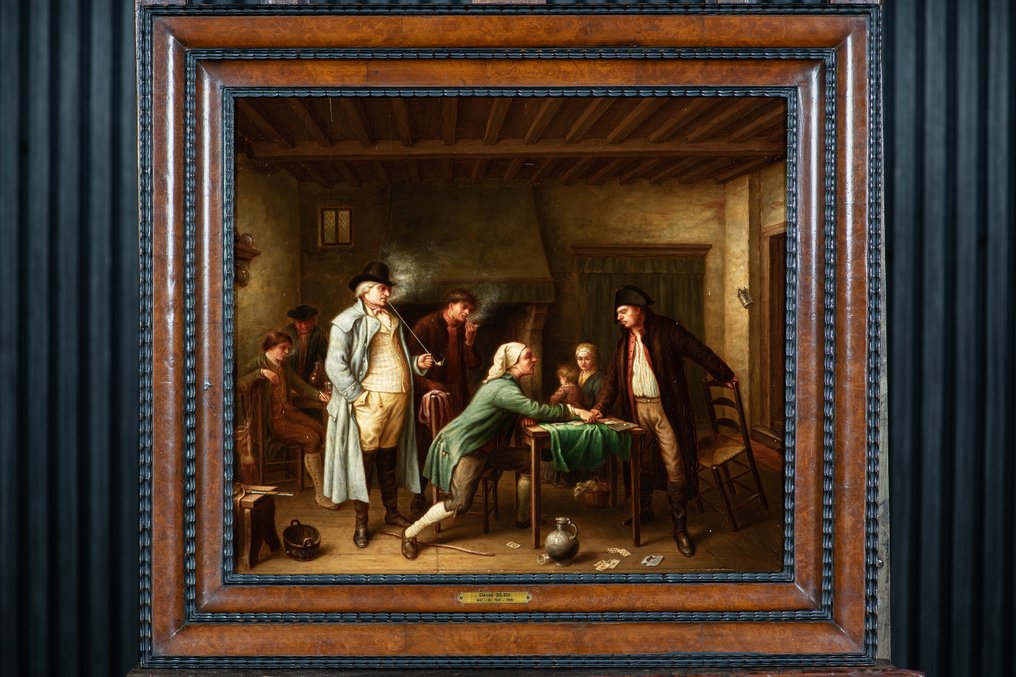
Kaartspelers Discussie, an oil painting on panel by David Joseph Bles (1821–1899), dated 1889, in the Romantic genre from the Netherlands, measuring 43.5 × 50.5 cm (58 × 65 cm with frame) and sold with frame.
AI-assisted summary
Description from the seller
Artist: David Joseph Bles (1821–1899) after Jean-Baptiste Madou (1796–1877)
Card players discussion
Medium/technique: oil paint on panel
Dimensions: 43.5 × 50.5 cm; with frame 58 × 65 cm.
Style/periodization: 19th century, Romantic genre art (historical interior scene)
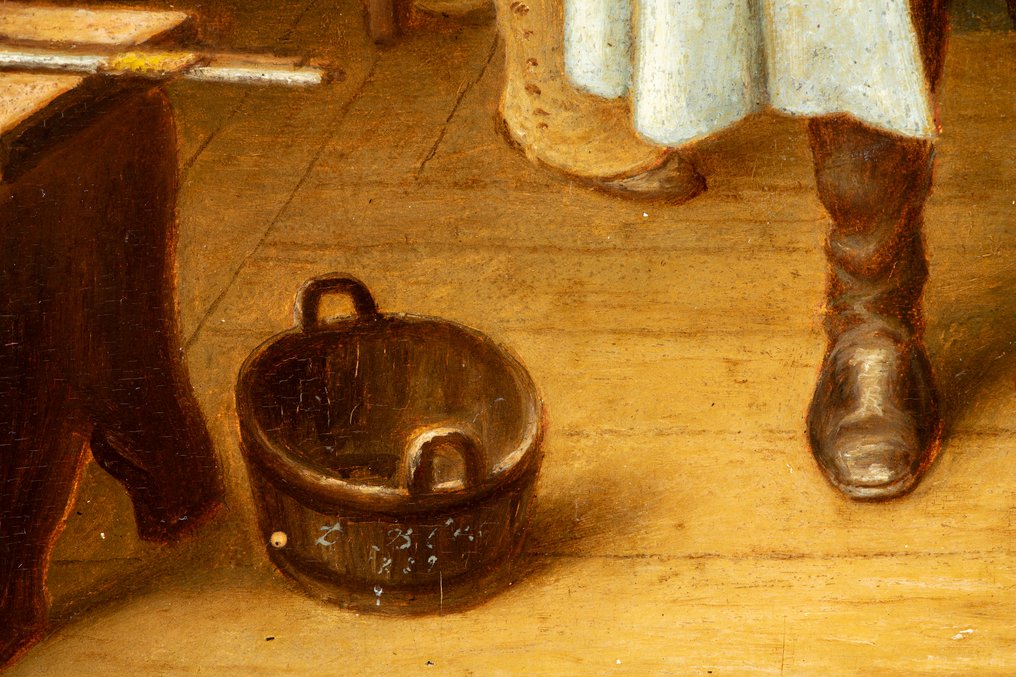
Signature/date: hand-signed bottom left and dated 1889.
Condition: sporadic old retouchings (visible under UV), locally light vertical craquelé; panel stable.
Details: composition based on Madou’s The Cardplayers’ Dispute (signed and dated 1863; exhibited at Brussels Salon 1863); provenance: high-quality Dutch private collection; No Reserve.
Positioning: a 19th-century 'towards' work with recognizable origin.
This painting is not merely 'in the spirit of' Madou, but is concretely based on a well-known example: Jean-Baptiste Madou’s The Cardplayers’ Dispute, signed and dated 1863, and exhibited at the Brussels Salon of that same year. In this way, Bles’ panel fits into a classic 19th-century practice: reusing a successful composition (as a homage, variation, or collectible 'reduction') by a respected contemporary artist with his own signature and finish. Bles’ dating of 1889 further marks the work as a late, mature genre interior, executed with technical precision that aligns well with his reputation as a subtle storyteller in images.
A discussion you almost hear
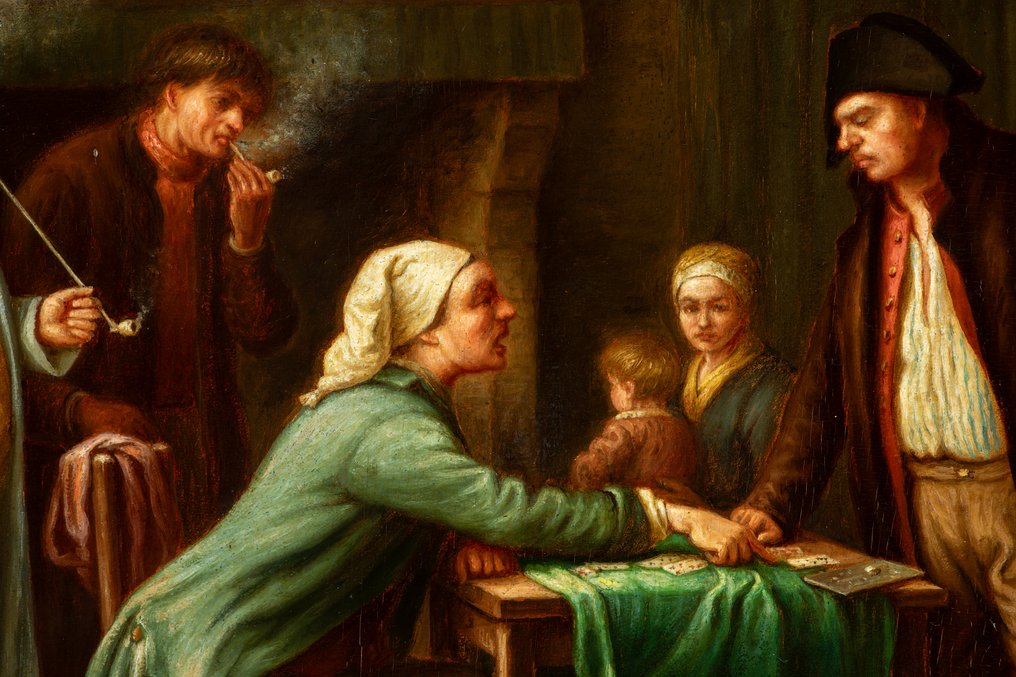
The scene revolves around a card game that spirals into a dispute. The action is focused around the table: one player leans forward intensely—urgent, accusatory—while his opponent on the right defensively positions himself, seeking support from the chair and with closed, defensive body language. The onlookers reinforce the psychology: on the left, a group watches silently; centrally, a smoking figure observes the situation with cool detachment. In the background, women and a child watch; this domestic 'audience' adds extra moral tension to the scene, as if the game and the men's behavior are under social scrutiny.
Composition: theatrical clarity and perfect direction.
Bles arranges the space as a stage. The focal point is at the green table, where arms, cans, and diagonals converge. The standing figure on the right forms a visual keystone, while the heavy chimney in the middle stabilizes the composition and defines the depth of the room. Chairs, floorboards, and the positioning of the figures guide the eye in a carefully constructed arc: from the 'spectators' on the left, through the central smoker, to the conflict on the right. The result is a lively scene that is immediately readable but rewards longer viewing with small details and subtle character nuances.
Technique and material: oil paint on panel with controlled detailing.
Oil paint on panel is ideally suited for accurately depicting texture and nuance—precisely where this work excels. Wood, ceramics, fabrics, and skin tones are convincingly modeled without excessive paint buildup. The painting is fine and controlled, with a certain 'gloss' in the highlights (clothing folds, pipe smoke, reflections on the jug and table). This type of paint treatment aligns with the 19th-century pursuit of narrative clarity: the technique is entirely in service of the story.
Color palette and light: warm interior with deliberate accents
The palette is predominantly warm and earthy (ochre, brown, and reddish-brown tones), fitting for a tavern-like interior. Bles adds clear accents here:
The cool, striking gray/light blue of the coat on the left, which immediately draws attention and marks a 'distance' figure.
The saturated green of the tablecloth and clothing in the foreground, drawing the eye to the conflict.
The light is subdued and 'room-moderated': not harsh chiaroscuro, but a soft modeling that makes the space feel realistic and intimate. The pipe smoke acts as an atmospheric veil, subtly enhancing depth and tension.
To Madou: relation to the original
The relationship to Madou’s The Cardplayers’ Dispute is both substantively and compositional essential. Madou was highly renowned for this type of sharply observed scenes from everyday life, where humor, character, and social friction come together. The catalog entry of the original (1863) and the Salon exhibition in Brussels emphasize that this was a prominent work at the time—exactly the kind of composition later adopted by collectors and artists. Bles’ panel can be read within that tradition as a late 19th-century reinterpretation: recognizable as a famous example, but executed with Bles’ own color accents, painting discipline, and narrative timing.
Art historical placement: romantic genre painting and historicizing realism
Within romanticism, attention often shifts from the heroic history piece to the 'small drama': moral and psychological scenes from everyday life, often dressed in a historical style. This work fits perfectly within that line: a compact narrative, full of character studies, where the social space (watching, judging, participating, recoiling) is just as important as the card game itself.
Stylistic peers (national and international): Charles Rochussen, Alexander Hugo Bakker Korff, Petrus van Schendel, Christoffel Bisschop, Jean-Louis-Ernest Meissonier, Ludwig Knaus.
Condition, UV, and presentation
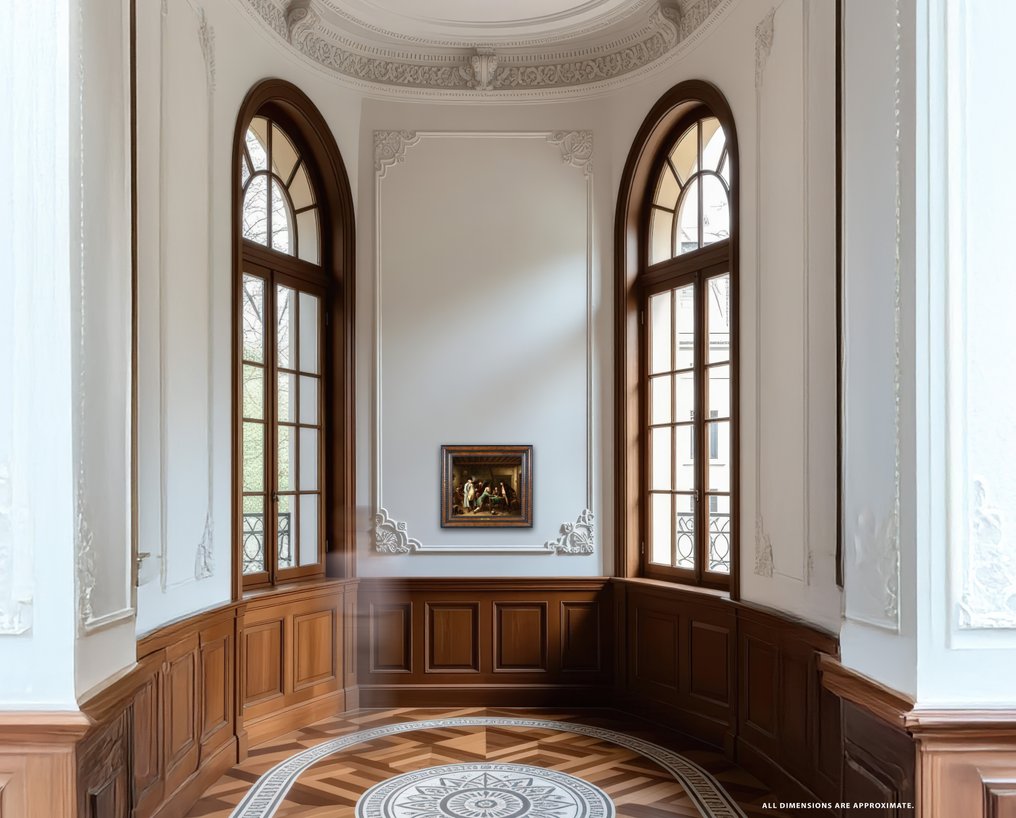
The condition is well maintained within the context of a 19th-century panel: there are sporadic old retouchings (visible under UV imaging), localized light vertical craquelé, and the panel is described as stable. The work is beautifully presented in a classic frame (overall size 58 × 65 cm), which enhances its historical genre appeal and makes the painting immediately 'interior-worthy'.
Provenance
From a quality Dutch private collection. Offered without reserve—a compelling entry point for collectors of 19th-century genre pieces and for enthusiasts of the Belgian-Dutch tradition around Madou, in an interpretation signed and dated (1889) by Bles.
The work 'Card Players' Discussion' is a rich wooden robbelist of museum quality with a brass artist's nameplate.
Total dimensions: 58x65cm
Panel dimensions: 43.5x50.5
All shipments are sent in professional packaging via FedEx, DPD, or PostNL.
For all shipments, a surcharge for packaging material applies, which is already included in the stated shipping price.
We aim to deliver your artwork to you safely and in optimal condition, paying careful attention to packaging and the shipping process. If you have any questions or special requests, you can always contact Catawiki customer service.
The customer is responsible for any customs duties and additional costs that may apply upon delivery abroad.
Seller's Story
Welcome to Vandenberg Fine Art BV on Catawiki.
Vandenberg Fine Art BV specializes in painting from the 15th through the 19th century, with a particular focus on Dutch, Flemish, and Italian masters. Our carefully curated collection comprises high-quality artworks distinguished by their artistic merit, authenticity, and historical significance.
Our offering includes works by leading artists of the Dutch and Flemish schools, as well as important representatives of the Italian Renaissance and Baroque. Each artwork is selected with expertise and care, with close attention paid to condition, provenance, and art-historical relevance.
At Vandenberg Fine Art, reliability and transparency are fundamental values. We provide detailed descriptions, high-quality images, and thoroughly conducted provenance research. Our aim is to support both experienced collectors and emerging art enthusiasts in making well-informed decisions.
Explore our exclusive collection and experience the rich history and enduring beauty of classical painting.
Translated by Google TranslateArtist: David Joseph Bles (1821–1899) after Jean-Baptiste Madou (1796–1877)
Card players discussion
Medium/technique: oil paint on panel
Dimensions: 43.5 × 50.5 cm; with frame 58 × 65 cm.
Style/periodization: 19th century, Romantic genre art (historical interior scene)
Signature/date: hand-signed bottom left and dated 1889.
Condition: sporadic old retouchings (visible under UV), locally light vertical craquelé; panel stable.
Details: composition based on Madou’s The Cardplayers’ Dispute (signed and dated 1863; exhibited at Brussels Salon 1863); provenance: high-quality Dutch private collection; No Reserve.
Positioning: a 19th-century 'towards' work with recognizable origin.
This painting is not merely 'in the spirit of' Madou, but is concretely based on a well-known example: Jean-Baptiste Madou’s The Cardplayers’ Dispute, signed and dated 1863, and exhibited at the Brussels Salon of that same year. In this way, Bles’ panel fits into a classic 19th-century practice: reusing a successful composition (as a homage, variation, or collectible 'reduction') by a respected contemporary artist with his own signature and finish. Bles’ dating of 1889 further marks the work as a late, mature genre interior, executed with technical precision that aligns well with his reputation as a subtle storyteller in images.
A discussion you almost hear
The scene revolves around a card game that spirals into a dispute. The action is focused around the table: one player leans forward intensely—urgent, accusatory—while his opponent on the right defensively positions himself, seeking support from the chair and with closed, defensive body language. The onlookers reinforce the psychology: on the left, a group watches silently; centrally, a smoking figure observes the situation with cool detachment. In the background, women and a child watch; this domestic 'audience' adds extra moral tension to the scene, as if the game and the men's behavior are under social scrutiny.
Composition: theatrical clarity and perfect direction.
Bles arranges the space as a stage. The focal point is at the green table, where arms, cans, and diagonals converge. The standing figure on the right forms a visual keystone, while the heavy chimney in the middle stabilizes the composition and defines the depth of the room. Chairs, floorboards, and the positioning of the figures guide the eye in a carefully constructed arc: from the 'spectators' on the left, through the central smoker, to the conflict on the right. The result is a lively scene that is immediately readable but rewards longer viewing with small details and subtle character nuances.
Technique and material: oil paint on panel with controlled detailing.
Oil paint on panel is ideally suited for accurately depicting texture and nuance—precisely where this work excels. Wood, ceramics, fabrics, and skin tones are convincingly modeled without excessive paint buildup. The painting is fine and controlled, with a certain 'gloss' in the highlights (clothing folds, pipe smoke, reflections on the jug and table). This type of paint treatment aligns with the 19th-century pursuit of narrative clarity: the technique is entirely in service of the story.
Color palette and light: warm interior with deliberate accents
The palette is predominantly warm and earthy (ochre, brown, and reddish-brown tones), fitting for a tavern-like interior. Bles adds clear accents here:
The cool, striking gray/light blue of the coat on the left, which immediately draws attention and marks a 'distance' figure.
The saturated green of the tablecloth and clothing in the foreground, drawing the eye to the conflict.
The light is subdued and 'room-moderated': not harsh chiaroscuro, but a soft modeling that makes the space feel realistic and intimate. The pipe smoke acts as an atmospheric veil, subtly enhancing depth and tension.
To Madou: relation to the original
The relationship to Madou’s The Cardplayers’ Dispute is both substantively and compositional essential. Madou was highly renowned for this type of sharply observed scenes from everyday life, where humor, character, and social friction come together. The catalog entry of the original (1863) and the Salon exhibition in Brussels emphasize that this was a prominent work at the time—exactly the kind of composition later adopted by collectors and artists. Bles’ panel can be read within that tradition as a late 19th-century reinterpretation: recognizable as a famous example, but executed with Bles’ own color accents, painting discipline, and narrative timing.
Art historical placement: romantic genre painting and historicizing realism
Within romanticism, attention often shifts from the heroic history piece to the 'small drama': moral and psychological scenes from everyday life, often dressed in a historical style. This work fits perfectly within that line: a compact narrative, full of character studies, where the social space (watching, judging, participating, recoiling) is just as important as the card game itself.
Stylistic peers (national and international): Charles Rochussen, Alexander Hugo Bakker Korff, Petrus van Schendel, Christoffel Bisschop, Jean-Louis-Ernest Meissonier, Ludwig Knaus.
Condition, UV, and presentation
The condition is well maintained within the context of a 19th-century panel: there are sporadic old retouchings (visible under UV imaging), localized light vertical craquelé, and the panel is described as stable. The work is beautifully presented in a classic frame (overall size 58 × 65 cm), which enhances its historical genre appeal and makes the painting immediately 'interior-worthy'.
Provenance
From a quality Dutch private collection. Offered without reserve—a compelling entry point for collectors of 19th-century genre pieces and for enthusiasts of the Belgian-Dutch tradition around Madou, in an interpretation signed and dated (1889) by Bles.
The work 'Card Players' Discussion' is a rich wooden robbelist of museum quality with a brass artist's nameplate.
Total dimensions: 58x65cm
Panel dimensions: 43.5x50.5
All shipments are sent in professional packaging via FedEx, DPD, or PostNL.
For all shipments, a surcharge for packaging material applies, which is already included in the stated shipping price.
We aim to deliver your artwork to you safely and in optimal condition, paying careful attention to packaging and the shipping process. If you have any questions or special requests, you can always contact Catawiki customer service.
The customer is responsible for any customs duties and additional costs that may apply upon delivery abroad.
Seller's Story
Welcome to Vandenberg Fine Art BV on Catawiki.
Vandenberg Fine Art BV specializes in painting from the 15th through the 19th century, with a particular focus on Dutch, Flemish, and Italian masters. Our carefully curated collection comprises high-quality artworks distinguished by their artistic merit, authenticity, and historical significance.
Our offering includes works by leading artists of the Dutch and Flemish schools, as well as important representatives of the Italian Renaissance and Baroque. Each artwork is selected with expertise and care, with close attention paid to condition, provenance, and art-historical relevance.
At Vandenberg Fine Art, reliability and transparency are fundamental values. We provide detailed descriptions, high-quality images, and thoroughly conducted provenance research. Our aim is to support both experienced collectors and emerging art enthusiasts in making well-informed decisions.
Explore our exclusive collection and experience the rich history and enduring beauty of classical painting.
Translated by Google TranslateDetails
Artist
David Joseph Bles (1821-1899)
Sold with frame
Yes
Title of artwork
Kaartspelers Discussie (No Reserve)
Technique
Oil painting
Signature
Hand signed
Country of Origin
Netherlands
Year
1889
Condition
Good condition
Height
58 cm
Width
65 cm
Style
Romanticism
Period
19th century
Sold by
