Northern european school (XIX) - NO RESERVE - The fraction of bread


11
days
09
hours
39
minutes
41
seconds
Current bid
€ 3
No reserve price

Expert
Selected by Caterina Maffeis
Master in early Renaissance Italian painting with internship at Sotheby’s and 15 years' experience.
Estimate € 1,000 - € 1,500
7 other people are watching this object
 Bidder 9790 Bidder 9790 | €3 | |
|---|---|---|
 Bidder 6223 Bidder 6223 | €2 |
Catawiki Buyer Protection
Your payment’s safe with us until you receive your object.View details
Trustpilot 4.4 | 122986 reviews
Rated Excellent on Trustpilot.
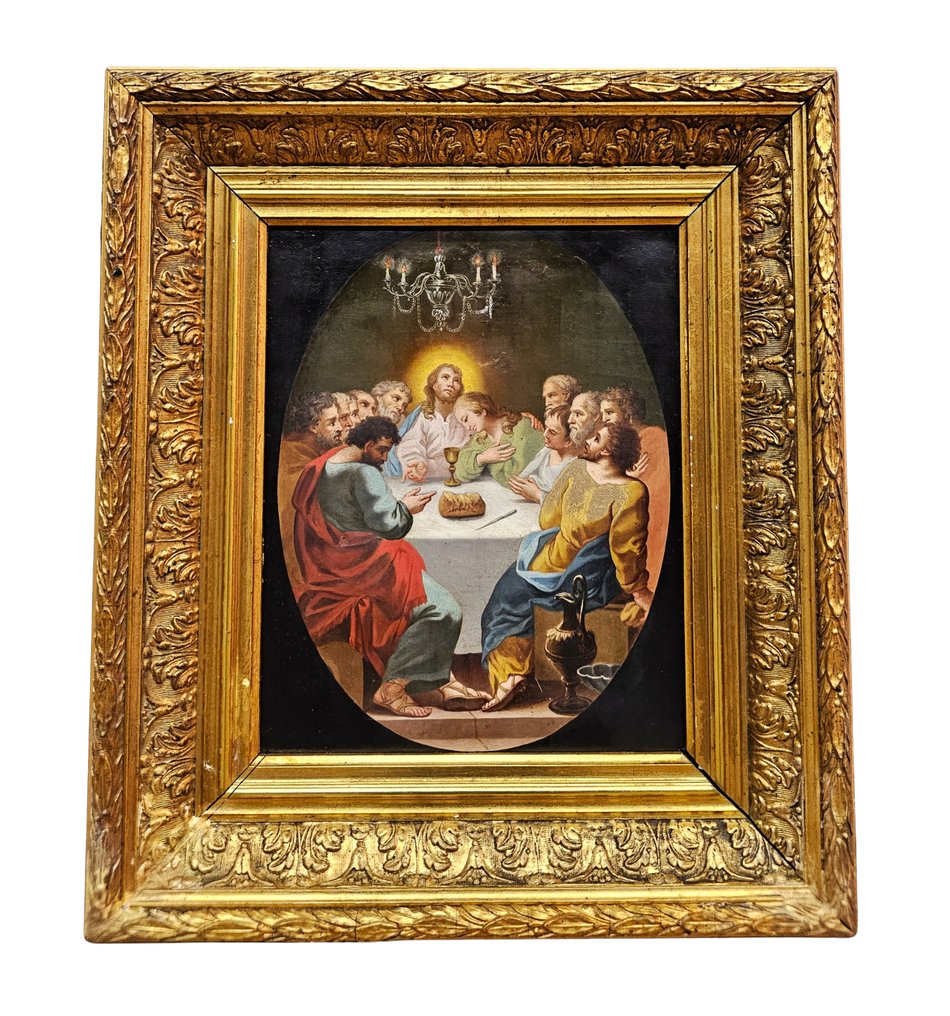
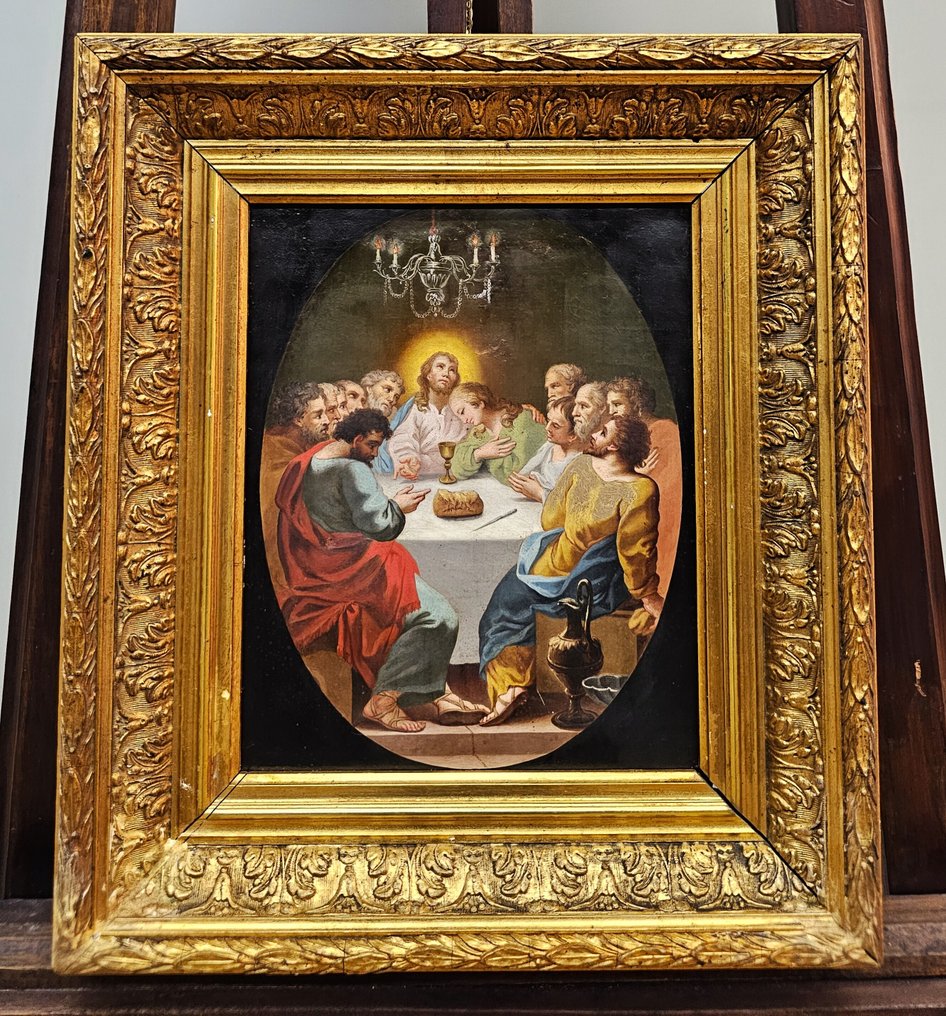
Oil painting titled The fraction of bread, from the 19th‑century Northern European realist school, origin Spain, signed, framed, and in good condition, measuring 40.5 × 30.5 cm (frame 40 × 34 cm).
AI-assisted summary
Description from the seller
The fraction of the bread
Devotional Naturalism · Central European School (Northern Europe), 19th century
Technical Data Sheet
Author: Anonymous, North European school (19th century)
Plausible attribution: environment of the German Nazarene Circle (influences of Overbeck / Cornelius) with a clear look towards Italian Baroque.
Chronology: c. 1830–1870
Technique: oil on canvas
Measurements: 26.5 × 21.5 cm
Measurements with frame: 40 × 34 cm
Marco: original water-gilded frame, carved wood with foliage and scrolls, excellent artisanal quality.
Condition: very good; homogeneous patina. Recently cleaned by a professional restorer.
1. Descriptive and Iconographic Composition
The scene depicts The Last Supper, focusing on the moment of breaking the bread, a symbolic core of the Eucharist. Christ, with a luminous halo, occupies the central axis, surrounded by the apostles arranged in a closed oval that enhances the spiritual intimacy of the moment.
The use of the oval shape reinforces devotional concentration, while the chalice, bread, and knife structure the sacramental narrative. The contained gestures, crossed gazes, and focal lighting evoke contemplation more than drama.
2. Style, School, and Historical Context
The work is rooted in a devotional naturalism of academic origin, typical of Northern Europe in the 19th century, with clear inspiration from Italian Baroque models.
The gentle treatment of the faces, the warm palette, and the absence of violent chiaroscuro distance the work from pure Caravaggism, bringing it closer to the German Nazarene ideal, which sought to recover the spirituality of the Renaissance and early Baroque.
There are compositional echoes of Philippe de Champaigne, Sassoferrato, and nineteenth-century readings of Leonardo.
Aesthetic and Comparative Evaluation
A work of notable quality for its format, probably intended for private oratory or bourgeois domestic devotion.
His interest lies in the synthesis between Baroque tradition and religious Romantic sensitivity. Comparable, in intention and finish, to valued productions from the circle of Overbeck or followers of 19th-century German and Italian sacred painting.
The original gold frame, of great nobility, reinforces its character as a complete devotional object and significantly increases its appeal in the specialized market and thematic auction.
Seller's Story
At Barcelona Art Gallery, we are a large family of art collectors in Barcelona who have been acquiring all kinds of paintings for 2 centuries.
Headquartered in the Les Corts neighborhood of Barcelona.
We offer part of our private collection for auction: high period and modern paintings that we have been acquiring over time, mainly from art galleries, antique dealers, auctions, private collections and very diverse origins.
Translated by Google TranslateThe fraction of the bread
Devotional Naturalism · Central European School (Northern Europe), 19th century
Technical Data Sheet
Author: Anonymous, North European school (19th century)
Plausible attribution: environment of the German Nazarene Circle (influences of Overbeck / Cornelius) with a clear look towards Italian Baroque.
Chronology: c. 1830–1870
Technique: oil on canvas
Measurements: 26.5 × 21.5 cm
Measurements with frame: 40 × 34 cm
Marco: original water-gilded frame, carved wood with foliage and scrolls, excellent artisanal quality.
Condition: very good; homogeneous patina. Recently cleaned by a professional restorer.
1. Descriptive and Iconographic Composition
The scene depicts The Last Supper, focusing on the moment of breaking the bread, a symbolic core of the Eucharist. Christ, with a luminous halo, occupies the central axis, surrounded by the apostles arranged in a closed oval that enhances the spiritual intimacy of the moment.
The use of the oval shape reinforces devotional concentration, while the chalice, bread, and knife structure the sacramental narrative. The contained gestures, crossed gazes, and focal lighting evoke contemplation more than drama.
2. Style, School, and Historical Context
The work is rooted in a devotional naturalism of academic origin, typical of Northern Europe in the 19th century, with clear inspiration from Italian Baroque models.
The gentle treatment of the faces, the warm palette, and the absence of violent chiaroscuro distance the work from pure Caravaggism, bringing it closer to the German Nazarene ideal, which sought to recover the spirituality of the Renaissance and early Baroque.
There are compositional echoes of Philippe de Champaigne, Sassoferrato, and nineteenth-century readings of Leonardo.
Aesthetic and Comparative Evaluation
A work of notable quality for its format, probably intended for private oratory or bourgeois domestic devotion.
His interest lies in the synthesis between Baroque tradition and religious Romantic sensitivity. Comparable, in intention and finish, to valued productions from the circle of Overbeck or followers of 19th-century German and Italian sacred painting.
The original gold frame, of great nobility, reinforces its character as a complete devotional object and significantly increases its appeal in the specialized market and thematic auction.
Seller's Story
At Barcelona Art Gallery, we are a large family of art collectors in Barcelona who have been acquiring all kinds of paintings for 2 centuries.
Headquartered in the Les Corts neighborhood of Barcelona.
We offer part of our private collection for auction: high period and modern paintings that we have been acquiring over time, mainly from art galleries, antique dealers, auctions, private collections and very diverse origins.
Translated by Google TranslateDetails
Artist
Northern european school (XIX) - NO RESERVE
Sold with frame
Yes
Title of artwork
The fraction of bread
Technique
Oil painting
Signature
Signed
Country of Origin
Spain
Condition
Good condition
Height
40.5 cm
Width
30.5 cm
Weight
3 kg
Depiction/Theme
Religion
Style
Realism
Period
19th century
Sold by
