Pittore caravaggesco attivo a Napoli (XVII) - San Pietro


Opens 17:00
Starting bid
€ 1
Add to your favourites to get an alert when the auction starts.

Expert
Selected by Caterina Maffeis
Master in early Renaissance Italian painting with internship at Sotheby’s and 15 years' experience.
Estimate € 8,000 - € 12,000
Catawiki Buyer Protection
Your payment’s safe with us until you receive your object.View details
Trustpilot 4.4 | 122910 reviews
Rated Excellent on Trustpilot.
Description from the seller
Caravaggio painter active in Naples
Active in the Kingdom of the Two Sicilies in the 1600s.
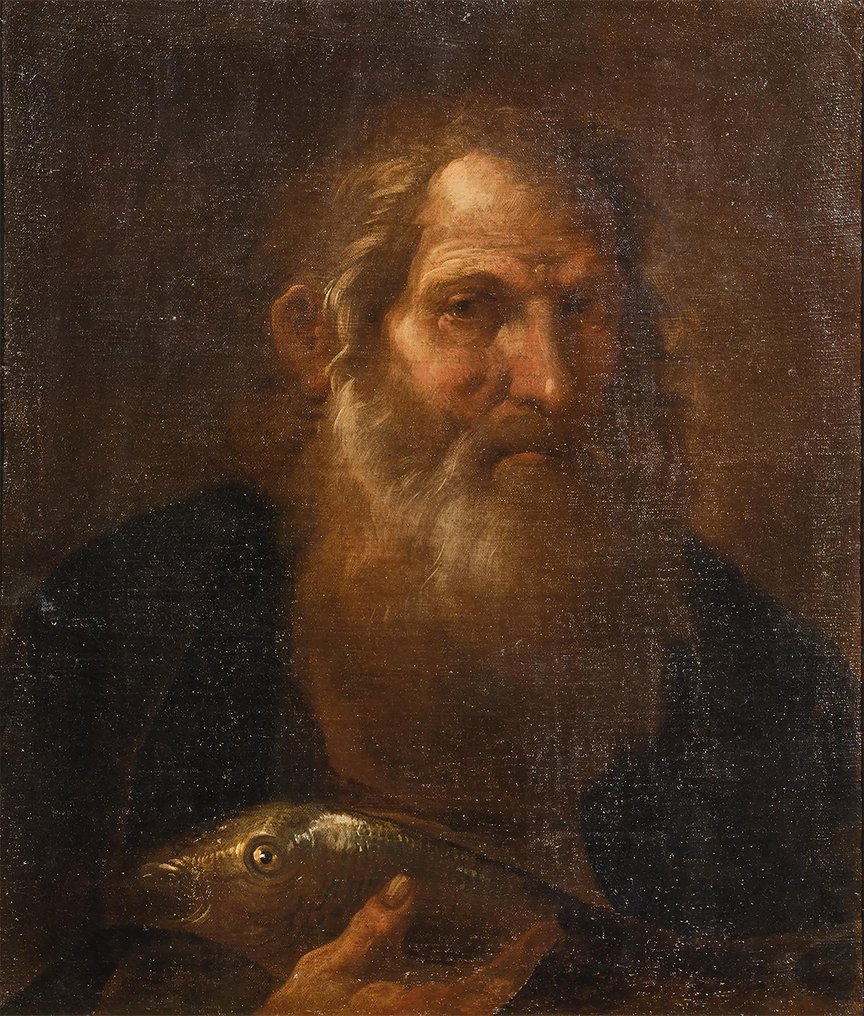
Saint Peter with the fish in hand
Oil on canvas, 60 x 49.5 cm
Frame size approx. 90 x 81 x 6 cm.
Note: Publication of the Intermidiart collection artworks catalog. Certificate of Guarantee and Lawful Provenance. Artwork with a gilded frame, crafted with a metal caption at the front reading 'JUSEIP RIBERA LO SPAGNOLETTO 1632' (defects):
We present in our catalog an interesting oil painting on canvas of good quality, depicting a biblical scene with Saint Peter the Apostle in the symbolic act of his calling, identifiable by the fish held in his hand. The composition shows a mature, bearded man, portrayed from the waist up, wrapped in a rough brown cloak, with his gaze directly facing the viewer. This is a rather rare iconography of Saint Peter during the vocation, an evangelic episode linked to the miracle of the catch.
The painting belongs to the successful production of figures of apostles and philosophers, typical of the southern painting school of the first half of the seventeenth century, strongly influenced by the presence, starting from 1616, of the Spanish master Jusepe de Ribera (Xàtiva, 1591 – Naples, 1652) in the city of Naples.
The work exhibits a significant expressive strength rooted in Caravaggesque style. The artist indeed reveals himself to be part of that intense and dramatic naturalism characteristic of the Neapolitan school of the early seventeenth century, in which Caravaggio's language evolves along autonomous declinations, especially through the work of Ribera. The strong Caravaggesque influence, whether direct or mediated by the pupils and followers of Merisi, emerges both in the choice of popular types, rendered with frankness and truth, and in the construction of forms, shaped through sharp and incisive contrasts of light and shadow.
The half-figure, depicted with raw realism and an accentuated dark taste, is placed in the foreground, slightly three-quarters, with its gaze directed at the viewer while holding the fish in its hand. The figure emerges from a darkened and compact background, with which it seems to merge, and is created using generous and thick brushstrokes. Alongside the plasticity of the forms, there is a skillful play of lights and colors, which follows a rightward movement, animated by expressive impulse and a stern light that concentrates on the flesh.
The work bears a collector's attribution to Spagnoletto, also confirmed by Professor Franco Fazio (an expert in restoration from Palermo), who links it to a piece executed within Ribera's workshop, or possibly an autograph. However, later on, the painting was made famous as a masterpiece by art historian Stefano Causa, who confidently proposed the correct attribution to Nunzio Rossi (Naples 1626 – Sicily 1651), based on clear stylistic similarities with well-known works by the artist.
Beyond the attributive issues, the painting expresses a remarkable pictorial quality, supported by a lively brushwork, rich in warm luminosity and chromatic intensity.
It can finally be concluded that the work presents evident elements attributable to Riberesco naturalism and is fully integrated into the Neapolitan Baroque cultural context, as evidenced by the quick brushstrokes, vivid tones, and pronounced chiaroscuro. The characteristics of Neapolitan artistic culture between 1630 and 1650 are also recognizable, a period during which the presence of foreign artists such as Van Dyck and Rubens complements and enriches the landscape of Neapolitan painters.
Regarding its condition, the canvas presents generally decent conditions considering the age of the painting. The painted surface shows a patina and does not exhibit reading difficulties. The support has been relined. Under Wood light, some small scattered restorations and slight surface veiling and oxidation are visible, but nothing truly significant. Under sunlight, a fine craquelure typical of the period is visible. The dimensions of the canvas are 60 x 49.5 cm. The painting is enhanced by a beautiful gilded frame with a metal plaque at the front reading 'JUSEIP RIBERA LO SPAGNOLETTO 1632', which has a strong decorative effect (the frame measures approximately 90 x 81 x 6 cm and has some defects). The frame shown in the photos above was added to the artwork by the seller or a third party. The frame is provided at no additional cost so that it is ready for display upon arrival. The frame is included as a courtesy and is not considered an integral part of the artwork. Therefore, any potential damage to the frame that does not affect the artwork itself will not be accepted as a valid reason to open a claim or request order cancellation.
Provenance: private collection
Publication
Unpublished
Myths and the Territory in Sicily with a thousand cultures. UNPUBLISHED QUADRERIA, general catalog of the paintings from the collection of the cycle 'Myths and the Territory,' Publisher Lab_04, Marsala, 2025.
The work will be shipped – due to its fragility – in a wooden case and polystyrene or by a trusted carrier. In the case of sales outside Italian territory, the buyer will need to wait for the export procedures to be completed.
It is informed that shipments may experience delays due to the Christmas holidays.
Seller's Story
Born in Le Locle, Switzerland, in 1975, graduated as a commercial expert, he is the owner of the Intermidiart Ancient Art Gallery - founded in 2011 - in which he offers a fine selection of works of art, in particular 17th century paintings (such as Guido Reni , Francesco Furini, Pietro Novelli, Carlo Saraceni, Lorenzo Lippi, Bernardo Strozzi, others) and XVIII century (such as Luca Giordano, Giuseppe Maria Crespi, etc.).
He founded the cultural association "Fiera Franca Ss. Salvatore" in 2015, with the aim of representing an important vehicle for promoting knowledge of local art and culture.
It collaborates both with professionals in restoration and specialized laboratories for the technical studies and analysis of ancient works, and with national and international art historians and experts. After gaining work experience in national galleries and exhibitions, he boasts numerous essay publications. He has directed several editions of exhibitions for the unpublished cycle "MYTHS AND THE TERRITORY in Sicily of a thousand cultures", sponsored by the Ministry of Cultural Heritage, the Region of Sicily, Superintendence for Cultural and Environmental Heritage of Trapani, and other bodies.
Translated by Google TranslateCaravaggio painter active in Naples
Active in the Kingdom of the Two Sicilies in the 1600s.
Saint Peter with the fish in hand
Oil on canvas, 60 x 49.5 cm
Frame size approx. 90 x 81 x 6 cm.
Note: Publication of the Intermidiart collection artworks catalog. Certificate of Guarantee and Lawful Provenance. Artwork with a gilded frame, crafted with a metal caption at the front reading 'JUSEIP RIBERA LO SPAGNOLETTO 1632' (defects):
We present in our catalog an interesting oil painting on canvas of good quality, depicting a biblical scene with Saint Peter the Apostle in the symbolic act of his calling, identifiable by the fish held in his hand. The composition shows a mature, bearded man, portrayed from the waist up, wrapped in a rough brown cloak, with his gaze directly facing the viewer. This is a rather rare iconography of Saint Peter during the vocation, an evangelic episode linked to the miracle of the catch.
The painting belongs to the successful production of figures of apostles and philosophers, typical of the southern painting school of the first half of the seventeenth century, strongly influenced by the presence, starting from 1616, of the Spanish master Jusepe de Ribera (Xàtiva, 1591 – Naples, 1652) in the city of Naples.
The work exhibits a significant expressive strength rooted in Caravaggesque style. The artist indeed reveals himself to be part of that intense and dramatic naturalism characteristic of the Neapolitan school of the early seventeenth century, in which Caravaggio's language evolves along autonomous declinations, especially through the work of Ribera. The strong Caravaggesque influence, whether direct or mediated by the pupils and followers of Merisi, emerges both in the choice of popular types, rendered with frankness and truth, and in the construction of forms, shaped through sharp and incisive contrasts of light and shadow.
The half-figure, depicted with raw realism and an accentuated dark taste, is placed in the foreground, slightly three-quarters, with its gaze directed at the viewer while holding the fish in its hand. The figure emerges from a darkened and compact background, with which it seems to merge, and is created using generous and thick brushstrokes. Alongside the plasticity of the forms, there is a skillful play of lights and colors, which follows a rightward movement, animated by expressive impulse and a stern light that concentrates on the flesh.
The work bears a collector's attribution to Spagnoletto, also confirmed by Professor Franco Fazio (an expert in restoration from Palermo), who links it to a piece executed within Ribera's workshop, or possibly an autograph. However, later on, the painting was made famous as a masterpiece by art historian Stefano Causa, who confidently proposed the correct attribution to Nunzio Rossi (Naples 1626 – Sicily 1651), based on clear stylistic similarities with well-known works by the artist.
Beyond the attributive issues, the painting expresses a remarkable pictorial quality, supported by a lively brushwork, rich in warm luminosity and chromatic intensity.
It can finally be concluded that the work presents evident elements attributable to Riberesco naturalism and is fully integrated into the Neapolitan Baroque cultural context, as evidenced by the quick brushstrokes, vivid tones, and pronounced chiaroscuro. The characteristics of Neapolitan artistic culture between 1630 and 1650 are also recognizable, a period during which the presence of foreign artists such as Van Dyck and Rubens complements and enriches the landscape of Neapolitan painters.
Regarding its condition, the canvas presents generally decent conditions considering the age of the painting. The painted surface shows a patina and does not exhibit reading difficulties. The support has been relined. Under Wood light, some small scattered restorations and slight surface veiling and oxidation are visible, but nothing truly significant. Under sunlight, a fine craquelure typical of the period is visible. The dimensions of the canvas are 60 x 49.5 cm. The painting is enhanced by a beautiful gilded frame with a metal plaque at the front reading 'JUSEIP RIBERA LO SPAGNOLETTO 1632', which has a strong decorative effect (the frame measures approximately 90 x 81 x 6 cm and has some defects). The frame shown in the photos above was added to the artwork by the seller or a third party. The frame is provided at no additional cost so that it is ready for display upon arrival. The frame is included as a courtesy and is not considered an integral part of the artwork. Therefore, any potential damage to the frame that does not affect the artwork itself will not be accepted as a valid reason to open a claim or request order cancellation.
Provenance: private collection
Publication
Unpublished
Myths and the Territory in Sicily with a thousand cultures. UNPUBLISHED QUADRERIA, general catalog of the paintings from the collection of the cycle 'Myths and the Territory,' Publisher Lab_04, Marsala, 2025.
The work will be shipped – due to its fragility – in a wooden case and polystyrene or by a trusted carrier. In the case of sales outside Italian territory, the buyer will need to wait for the export procedures to be completed.
It is informed that shipments may experience delays due to the Christmas holidays.
Seller's Story
Born in Le Locle, Switzerland, in 1975, graduated as a commercial expert, he is the owner of the Intermidiart Ancient Art Gallery - founded in 2011 - in which he offers a fine selection of works of art, in particular 17th century paintings (such as Guido Reni , Francesco Furini, Pietro Novelli, Carlo Saraceni, Lorenzo Lippi, Bernardo Strozzi, others) and XVIII century (such as Luca Giordano, Giuseppe Maria Crespi, etc.).
He founded the cultural association "Fiera Franca Ss. Salvatore" in 2015, with the aim of representing an important vehicle for promoting knowledge of local art and culture.
It collaborates both with professionals in restoration and specialized laboratories for the technical studies and analysis of ancient works, and with national and international art historians and experts. After gaining work experience in national galleries and exhibitions, he boasts numerous essay publications. He has directed several editions of exhibitions for the unpublished cycle "MYTHS AND THE TERRITORY in Sicily of a thousand cultures", sponsored by the Ministry of Cultural Heritage, the Region of Sicily, Superintendence for Cultural and Environmental Heritage of Trapani, and other bodies.
Translated by Google TranslateDetails
Artist
Pittore caravaggesco attivo a Napoli (XVII)
Sold with frame
Yes
Title of artwork
San Pietro
Technique
Oil painting
Signature
Not signed
Country of Origin
Italy
Condition
Fair condition
Height
90 cm
Width
81 cm
Weight
8 kg
Depiction/Theme
Religion
Style
Baroque
Period
17th century
Sold by
