Frans Hals (1580-1666), Follower of - Pendant Herenportretten (NO RESERVE)


07
days
09
hours
59
minutes
37
seconds
Current bid
€ 313
No reserve price

Expert
Selected by Leo Setz
Over 30 years’ experience as art dealer, appraiser and restorer.
Estimate € 1,000 - € 1,200
30 other people are watching this object
 Bidder 5738 Bidder 5738 | €313 | |
|---|---|---|
 Bidder 2993 Bidder 2993 | €293 | |
| Bidder 5738 | €273 | |
Catawiki Buyer Protection
Your payment’s safe with us until you receive your object.View details
Trustpilot 4.4 | 123779 reviews
Rated Excellent on Trustpilot.
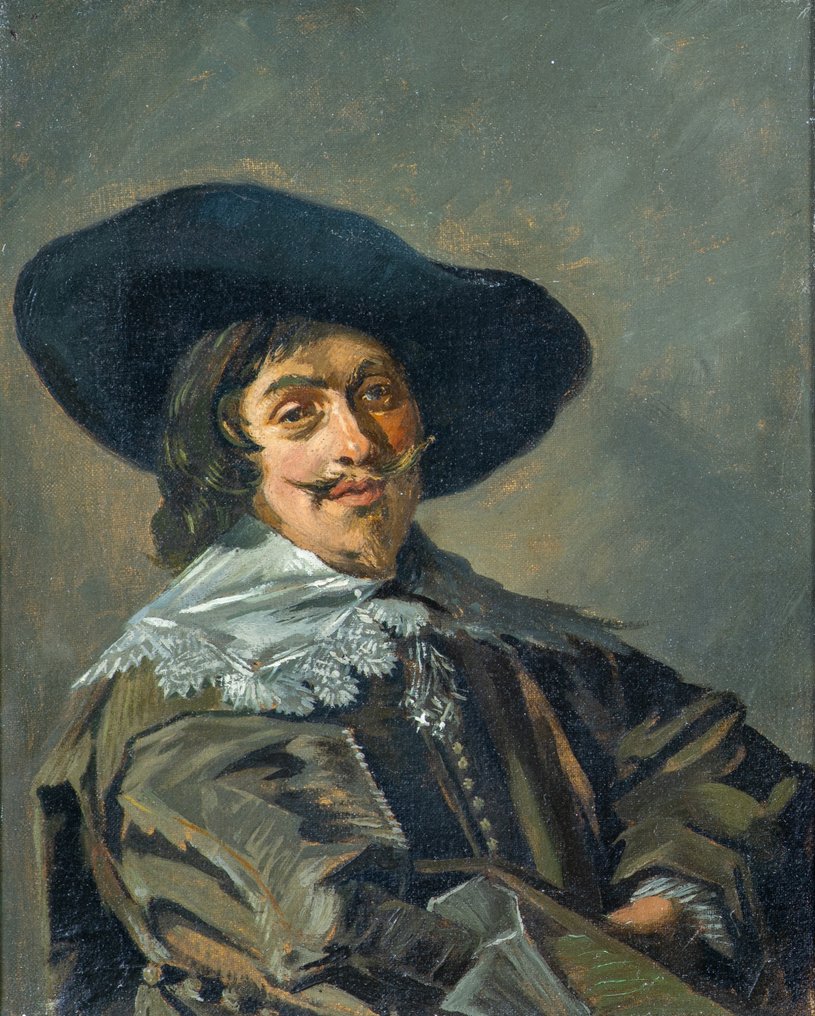
Pendant Herenportretten, a 17th‑century Dutch oil painting on canvas by a follower of Frans Hals, sold with a frame.
AI-assisted summary
Description from the seller
Frans Hals (1580–1666) (20th-century follower)
Pendant men's portraits
Oil painting on canvas – approx. 25 × 20.5 cm (with frame approx. 36 × 31 cm)
inspired by the Dutch Golden Age
unsigned
Good condition, no retouchings observed under UV.
No reserve.
Introduction
This charming pendant consists of two small-scale portrait paintings of gentlemen, deliberately referencing the most recognizable type from Dutch portrait art: the half-figure with a broad hat, subtle smile, and a richly detailed white collar. As a set, the paintings work convincingly together: two variations on the same social world of elegance, self-awareness, and light theatrical pose, intended to hang side by side as a pair and enhance each other.
Performance and composition
Both gentlemen are depicted three-quarters against a sober, neutral background. The image is closely cropped to the figure, directing the viewer's gaze immediately to the face and collar. In the left portrait, the pose is more nonchalant, with a slightly reclined posture and a more expressive, lively facial expression. The right portrait is calmer and more formal, with a steadier shoulder line and a more restrained expressive tone. Together, they create a pleasing tension between spontaneity and dignity—precisely the register in which 'Halsiaanse' portraits are so effective.
Technique and paint treatment
The painter employs a portrait-like approach in which the contrast between materials is convincingly played out: the soft transitions in the face contrast with the more direct, visible brushstrokes in the clothing areas and hat. The accents in the white collar are applied with confident light touches that suggest fabric texture without falling into meticulous miniaturization. This economical paint handling—more suggestive than descriptive—enhances the impression of bravura and 'liveliness' associated with Frans Hals.
Color palette and lighting effects
The palette is classic and restrained: deep blacks and warm brown tones in clothing and hat, broken white in the collar, and a muted gray-olive background that brings the figures forward. The light comes softly from the side, shaping cheeks, nose, and mustache with limited but effective highlights. It is precisely this reserved lighting that keeps the focus on character and posture—the core of the portrait genre.
Stylistic embedding: Dutch Golden Age as a frame of reference.
Although these pendants were made in the 20th century, they are convincingly conceived as a homage to the 17th-century Dutch portrait tradition. The combination of informal pose, direct gaze, and loose brushwork refers to the Haarlem portrait culture in which Frans Hals excelled. This is not about literal copying, but rather a stylistic approach that evokes the spirit of the Golden Age: sober decor, maximum expression, and an artistic alternation between fine and broad brushwork.
Frans Hals: context and meaning
Frans Hals is regarded as one of the great innovators of portraiture in the Dutch Golden Age. Working in Haarlem, he developed a painting style known for its liveliness: spontaneous poses, direct psychology, and a remarkably free brushwork that is especially evident in areas such as lace, cuffs, and highlights. His portraits—ranging from individual citizens to group compositions—have served as exemplary models over the centuries precisely because they convincingly capture the fleeting and human aspects.
Related names within the style tradition
Rembrandt van Rijn, Judith Leyster, Bartholomeus van der Helst, Gerard ter Borch, Johannes Verspronck; Diego Velázquez, Anthony van Dyck.
Condition, research, and presentation
The works are in good condition; UV examination shows no signs of retouching. Presented in the current, tasteful frames, the portraits appear as a coherent pair—ideal for a symmetrical display in a hall, salon, or library. Thanks to their intimate size, they function both as a subtle ensemble at eye level and as a refined accent within a larger wall composition.
No reserve
Offered without a minimum price, this pendant presents an attractive opportunity to acquire two harmonizing, decorative, and art-historically readable portraits, with a direct nod to the enduring allure of the Dutch Golden Age.
The works 'Pendant Herenportretten' are in matte black wooden frames with a silver-colored finish.
Total dimensions: 36x31cm
Canvas dimensions: 25x20.5cm
All shipments are sent in professional packaging via FedEx, DPD, or PostNL.
For all shipments, a surcharge for packaging material applies, which is already included in the stated shipping price.
We aim to deliver your artwork to you safely and in optimal condition, paying careful attention to packaging and the shipping process. If you have any questions or special requests, you can always contact Catawiki customer service.
The customer is responsible for any customs duties and additional costs that may apply upon delivery abroad.
Seller's Story
Welcome to Vandenberg Fine Art BV on Catawiki.
Vandenberg Fine Art BV specializes in painting from the 15th through the 19th century, with a particular focus on Dutch, Flemish, and Italian masters. Our carefully curated collection comprises high-quality artworks distinguished by their artistic merit, authenticity, and historical significance.
Our offering includes works by leading artists of the Dutch and Flemish schools, as well as important representatives of the Italian Renaissance and Baroque. Each artwork is selected with expertise and care, with close attention paid to condition, provenance, and art-historical relevance.
At Vandenberg Fine Art, reliability and transparency are fundamental values. We provide detailed descriptions, high-quality images, and thoroughly conducted provenance research. Our aim is to support both experienced collectors and emerging art enthusiasts in making well-informed decisions.
Explore our exclusive collection and experience the rich history and enduring beauty of classical painting.
Translated by Google TranslateFrans Hals (1580–1666) (20th-century follower)
Pendant men's portraits
Oil painting on canvas – approx. 25 × 20.5 cm (with frame approx. 36 × 31 cm)
inspired by the Dutch Golden Age
unsigned
Good condition, no retouchings observed under UV.
No reserve.
Introduction
This charming pendant consists of two small-scale portrait paintings of gentlemen, deliberately referencing the most recognizable type from Dutch portrait art: the half-figure with a broad hat, subtle smile, and a richly detailed white collar. As a set, the paintings work convincingly together: two variations on the same social world of elegance, self-awareness, and light theatrical pose, intended to hang side by side as a pair and enhance each other.
Performance and composition
Both gentlemen are depicted three-quarters against a sober, neutral background. The image is closely cropped to the figure, directing the viewer's gaze immediately to the face and collar. In the left portrait, the pose is more nonchalant, with a slightly reclined posture and a more expressive, lively facial expression. The right portrait is calmer and more formal, with a steadier shoulder line and a more restrained expressive tone. Together, they create a pleasing tension between spontaneity and dignity—precisely the register in which 'Halsiaanse' portraits are so effective.
Technique and paint treatment
The painter employs a portrait-like approach in which the contrast between materials is convincingly played out: the soft transitions in the face contrast with the more direct, visible brushstrokes in the clothing areas and hat. The accents in the white collar are applied with confident light touches that suggest fabric texture without falling into meticulous miniaturization. This economical paint handling—more suggestive than descriptive—enhances the impression of bravura and 'liveliness' associated with Frans Hals.
Color palette and lighting effects
The palette is classic and restrained: deep blacks and warm brown tones in clothing and hat, broken white in the collar, and a muted gray-olive background that brings the figures forward. The light comes softly from the side, shaping cheeks, nose, and mustache with limited but effective highlights. It is precisely this reserved lighting that keeps the focus on character and posture—the core of the portrait genre.
Stylistic embedding: Dutch Golden Age as a frame of reference.
Although these pendants were made in the 20th century, they are convincingly conceived as a homage to the 17th-century Dutch portrait tradition. The combination of informal pose, direct gaze, and loose brushwork refers to the Haarlem portrait culture in which Frans Hals excelled. This is not about literal copying, but rather a stylistic approach that evokes the spirit of the Golden Age: sober decor, maximum expression, and an artistic alternation between fine and broad brushwork.
Frans Hals: context and meaning
Frans Hals is regarded as one of the great innovators of portraiture in the Dutch Golden Age. Working in Haarlem, he developed a painting style known for its liveliness: spontaneous poses, direct psychology, and a remarkably free brushwork that is especially evident in areas such as lace, cuffs, and highlights. His portraits—ranging from individual citizens to group compositions—have served as exemplary models over the centuries precisely because they convincingly capture the fleeting and human aspects.
Related names within the style tradition
Rembrandt van Rijn, Judith Leyster, Bartholomeus van der Helst, Gerard ter Borch, Johannes Verspronck; Diego Velázquez, Anthony van Dyck.
Condition, research, and presentation
The works are in good condition; UV examination shows no signs of retouching. Presented in the current, tasteful frames, the portraits appear as a coherent pair—ideal for a symmetrical display in a hall, salon, or library. Thanks to their intimate size, they function both as a subtle ensemble at eye level and as a refined accent within a larger wall composition.
No reserve
Offered without a minimum price, this pendant presents an attractive opportunity to acquire two harmonizing, decorative, and art-historically readable portraits, with a direct nod to the enduring allure of the Dutch Golden Age.
The works 'Pendant Herenportretten' are in matte black wooden frames with a silver-colored finish.
Total dimensions: 36x31cm
Canvas dimensions: 25x20.5cm
All shipments are sent in professional packaging via FedEx, DPD, or PostNL.
For all shipments, a surcharge for packaging material applies, which is already included in the stated shipping price.
We aim to deliver your artwork to you safely and in optimal condition, paying careful attention to packaging and the shipping process. If you have any questions or special requests, you can always contact Catawiki customer service.
The customer is responsible for any customs duties and additional costs that may apply upon delivery abroad.
Seller's Story
Welcome to Vandenberg Fine Art BV on Catawiki.
Vandenberg Fine Art BV specializes in painting from the 15th through the 19th century, with a particular focus on Dutch, Flemish, and Italian masters. Our carefully curated collection comprises high-quality artworks distinguished by their artistic merit, authenticity, and historical significance.
Our offering includes works by leading artists of the Dutch and Flemish schools, as well as important representatives of the Italian Renaissance and Baroque. Each artwork is selected with expertise and care, with close attention paid to condition, provenance, and art-historical relevance.
At Vandenberg Fine Art, reliability and transparency are fundamental values. We provide detailed descriptions, high-quality images, and thoroughly conducted provenance research. Our aim is to support both experienced collectors and emerging art enthusiasts in making well-informed decisions.
Explore our exclusive collection and experience the rich history and enduring beauty of classical painting.
Translated by Google TranslateDetails
Artist
Frans Hals (1580-1666)
Sold with frame
Yes
Attribution
Follower of
Title of artwork
Pendant Herenportretten (NO RESERVE)
Technique
Oil painting
Signature
Not signed
Country of Origin
Netherlands
Condition
Good condition
Height
36 cm
Width
31 cm
Depiction/Theme
Portrait
Style
Dutch Golden Age
Period
17th century
Sold by
