US Army M-1938 Lensatic Compass - working - Infantry - Airborne - Military equipment



06
days
12
hours
29
minutes
13
seconds

6 other people are watching this object
 Bidder 0192 Bidder 0192 | €1 |
|---|
Catawiki Buyer Protection
Your payment’s safe with us until you receive your object.View details
Trustpilot 4.4 | 122910 reviews
Rated Excellent on Trustpilot.
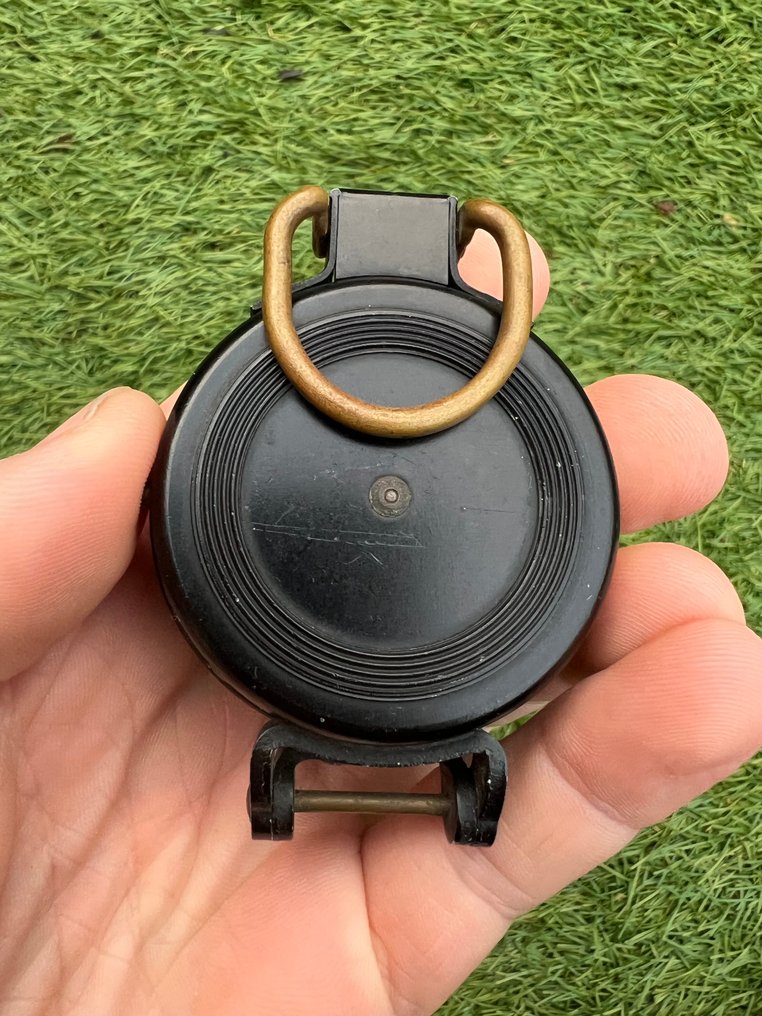
US Army M-1938 Lensatic Compass, original, in good condition and working order, used by Infantry and Airborne units during World War II.
AI-assisted summary
Description from the seller
Offered for auction is a very nice early war (1940-1943) US Army WW2 M-1938 lensatic compass, as used by officers and lower ranks during WW2. This compass was made by the Troy and Gurle company. It functions as it should and is in very good condition for its age. It is nicely marked on the compass itself. A very nice compass for your collection. The lens works, the compass freely moves, and the wire is present and not damaged — in very good condition!
Great and rare 100% original item from WW2! Also check out our other interesting military books and militaria for sale!
History of the M-1938 Lensatic Compass
Undoubtedly, U.S. Army service personnel became aware of the Verner prismatic compasses while serving with their British counterparts in World War I. The Army authorized research and development projects to develop a new compass at the request of the U.S. Army’s Infantry School in Fort Benning. The first of these R&D projects for a new compass was issued on March 21, 1928. The agency responsible for the research and development of compasses for the U.S. Army, at that time, was The Engineering and Topographic Laboratories at Fort Belvoir, Virginia. Additional research projects were issued until 1938. Special Project 280 (SP-280) was authorized on October 21, 1938, to find a suitable commercial lensatic compass for the Infantry that met the Infantry School’s requirements. The Engineer Board did not discover a commercial compass that met the standards published by the Infantry School. However, two companies, The W. & L. E. Gurley Company and The Taylor Instrument Company, offered to make new compass prototypes based on the Infantry School’s requirements. After testing and modifications of their compasses, they were recommended for procurement in 1940. Both manufacturers supplied compasses to the U.S. Army during World War II. Their compasses were designated as the M-1938 Lensatic Compass.
The U.S. Army continued to suggest improvements to the M-1938 lensatic compass throughout World War II. For example, there were several attempts to solve the mechanical dampening problem with the lensatic compass. In short, they were trying to find ways to prevent the compass needle from oscillating when taking a bearing. Reducing needle oscillation helps to achieve a more accurate reading when determining an azimuth and bearing for land navigation. A liquid was commonly used for dampening in lensatic compasses throughout most of World War II. The use of liquid dampening was a better option given the technology of the time. However, experimentation with the dampening process continued throughout the war.
Seller's Story
We specialize in the sale of professional military regulations, academic literature, and other militaria with over 20 years of experience. With a carefully selected range, we serve collectors, historians, defense professionals, and enthusiasts of military history. Our products offer reliable and authentic information and are of high quality. We stand for expertise, reliability, and a passion for military heritage.
Translated by Google TranslateOffered for auction is a very nice early war (1940-1943) US Army WW2 M-1938 lensatic compass, as used by officers and lower ranks during WW2. This compass was made by the Troy and Gurle company. It functions as it should and is in very good condition for its age. It is nicely marked on the compass itself. A very nice compass for your collection. The lens works, the compass freely moves, and the wire is present and not damaged — in very good condition!
Great and rare 100% original item from WW2! Also check out our other interesting military books and militaria for sale!
History of the M-1938 Lensatic Compass
Undoubtedly, U.S. Army service personnel became aware of the Verner prismatic compasses while serving with their British counterparts in World War I. The Army authorized research and development projects to develop a new compass at the request of the U.S. Army’s Infantry School in Fort Benning. The first of these R&D projects for a new compass was issued on March 21, 1928. The agency responsible for the research and development of compasses for the U.S. Army, at that time, was The Engineering and Topographic Laboratories at Fort Belvoir, Virginia. Additional research projects were issued until 1938. Special Project 280 (SP-280) was authorized on October 21, 1938, to find a suitable commercial lensatic compass for the Infantry that met the Infantry School’s requirements. The Engineer Board did not discover a commercial compass that met the standards published by the Infantry School. However, two companies, The W. & L. E. Gurley Company and The Taylor Instrument Company, offered to make new compass prototypes based on the Infantry School’s requirements. After testing and modifications of their compasses, they were recommended for procurement in 1940. Both manufacturers supplied compasses to the U.S. Army during World War II. Their compasses were designated as the M-1938 Lensatic Compass.
The U.S. Army continued to suggest improvements to the M-1938 lensatic compass throughout World War II. For example, there were several attempts to solve the mechanical dampening problem with the lensatic compass. In short, they were trying to find ways to prevent the compass needle from oscillating when taking a bearing. Reducing needle oscillation helps to achieve a more accurate reading when determining an azimuth and bearing for land navigation. A liquid was commonly used for dampening in lensatic compasses throughout most of World War II. The use of liquid dampening was a better option given the technology of the time. However, experimentation with the dampening process continued throughout the war.
Seller's Story
We specialize in the sale of professional military regulations, academic literature, and other militaria with over 20 years of experience. With a carefully selected range, we serve collectors, historians, defense professionals, and enthusiasts of military history. Our products offer reliable and authentic information and are of high quality. We stand for expertise, reliability, and a passion for military heritage.
Translated by Google TranslateDetails
Era
1900-2000
Army Unit
US Army M-1938 Lensatic Compass - working - Infantry - Airborne
Condition
Good
Original/ Replica
Original
Comes with certificate of authenticity
No
Sold by