Giovanni Battista Bicaissii/ Honoré Bicaise - Manuale Medicorum + Hippocrates Aphorisms - 1660-1719




03
days
20
hours
04
minutes
14
seconds
Current bid
€ 97
No reserve price

Expert
Selected by Zena Chiara Masud
Holds a master’s degree in bibliography, with seven years of experience specialising in incunabula and Arabic manuscripts.
Estimate € 250 - € 300
35 other people are watching this object
 Bidder 1518 Bidder 1518 | €97 | |
|---|---|---|
 Bidder 0755 Bidder 0755 | €92 | |
| Bidder 1518 | €87 | |
Catawiki Buyer Protection
Your payment’s safe with us until you receive your object.View details
Trustpilot 4.4 | 123759 reviews
Rated Excellent on Trustpilot.
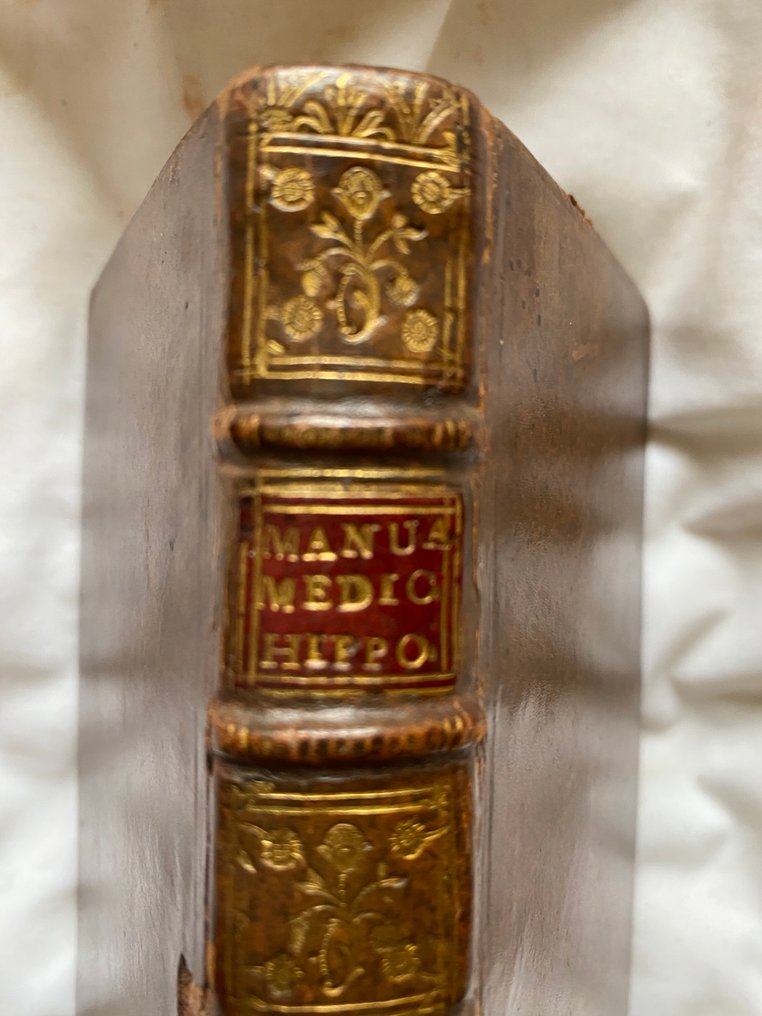
Manuale Medicorum, seu, Hippocratis Aphorisms, Praenotionum, Coacarum, & Praedictionum, secundum propriam morborum omnium nomenclaturam, alphabetico digesta ordine / labore & industria D. Honorius Bicaissii; Giovanni Battista Bicaissii’s Manvale Medicorum, 1st Edition Thus, Latin, original language, Geneva: Chouet, leather binding, 260 pages, 13 x 8 cm, oldest 1660, youngest 1719, Very good.
AI-assisted summary
Description from the seller
Manuale medicorum, seu, [Sunaxis] Aphorismorum Hippocratis, Praenotionum, Coacarum, & Praedictionum, secundùm propriam morborum omnium nomenclaturam, alphabetico digesta ordine / labore & industria D. Honorati Bicaissii
Giovanni Battista Bicaissii’s Manvale Medicorum is a concise medical handbook aimed at practicing physicians rather than academic theorists. It seems to have been issued a year earlier in London and perhaps in Paris in 1637.
Bicaissii, an Italian-trained doctor, wrote the work in a deliberately compressed style, presenting medical knowledge in short, structured entries that could be quickly consulted. The Geneva edition reflects the city’s role as an international printing center, allowing Bicaissii’s text to circulate beyond Italy and reach a broader European medical audience.
Bicaissii’s approach is firmly rooted in Galenic and Hippocratic medicine, but the Manvale emphasizes clinical usefulness over philosophical debate. Diseases are categorized systematically, often by affected organs or dominant symptoms, and paired with clear therapeutic guidance. Bloodletting, purgatives, and compound remedies feature prominently, along with careful attention to regimen—diet, sleep, and environment—which Bicaissii treats as essential tools of medical intervention rather than secondary considerations.
What makes Manvale Medicorum significant is how clearly it reflects the working mindset of seventeenth-century physicians. Instead of proposing new theories, Bicaissii codifies established practice, offering a distilled version of what a competent doctor was expected to know and apply. The book therefore serves as a practical mirror of everyday medicine just before experimental physiology and mechanistic explanations began to challenge traditional humoral frameworks later in the century.
This text is followed by a Latin edition of Hippocrates, 1719 and a profuse index. The Hippocrates is 'Magni Hippocratis coi aphorismi cum concordantia eorumdem ac indice locupletissimo'.
A small 12mo: 6, 225 pages, then after another title page 66 pages + 30 page index.
In nice contemporary calf with defect to rear board. Solid and very agreeable example.
Manuale medicorum, seu, [Sunaxis] Aphorismorum Hippocratis, Praenotionum, Coacarum, & Praedictionum, secundùm propriam morborum omnium nomenclaturam, alphabetico digesta ordine / labore & industria D. Honorati Bicaissii
Giovanni Battista Bicaissii’s Manvale Medicorum is a concise medical handbook aimed at practicing physicians rather than academic theorists. It seems to have been issued a year earlier in London and perhaps in Paris in 1637.
Bicaissii, an Italian-trained doctor, wrote the work in a deliberately compressed style, presenting medical knowledge in short, structured entries that could be quickly consulted. The Geneva edition reflects the city’s role as an international printing center, allowing Bicaissii’s text to circulate beyond Italy and reach a broader European medical audience.
Bicaissii’s approach is firmly rooted in Galenic and Hippocratic medicine, but the Manvale emphasizes clinical usefulness over philosophical debate. Diseases are categorized systematically, often by affected organs or dominant symptoms, and paired with clear therapeutic guidance. Bloodletting, purgatives, and compound remedies feature prominently, along with careful attention to regimen—diet, sleep, and environment—which Bicaissii treats as essential tools of medical intervention rather than secondary considerations.
What makes Manvale Medicorum significant is how clearly it reflects the working mindset of seventeenth-century physicians. Instead of proposing new theories, Bicaissii codifies established practice, offering a distilled version of what a competent doctor was expected to know and apply. The book therefore serves as a practical mirror of everyday medicine just before experimental physiology and mechanistic explanations began to challenge traditional humoral frameworks later in the century.
This text is followed by a Latin edition of Hippocrates, 1719 and a profuse index. The Hippocrates is 'Magni Hippocratis coi aphorismi cum concordantia eorumdem ac indice locupletissimo'.
A small 12mo: 6, 225 pages, then after another title page 66 pages + 30 page index.
In nice contemporary calf with defect to rear board. Solid and very agreeable example.
Details
Number of Books
1
Subject
Medicine
Book Title
Manuale Medicorum + Hippocrates Aphorisms
Author/ Illustrator
Giovanni Battista Bicaissii/ Honoré Bicaise
Condition
Very good
Publication year oldest item
1660
Publication year youngest item
1719
Height
13 cm
Edition
1st Edition Thus
Width
8 cm
Language
Latin
Original language
Yes
Publisher
Geneva: Chouet
Binding/ Material
Leather
Number of pages
260
Sold by
