Johann Adam Kulmu - Tabulae Anatomicae - 1744-1744



10
days
17
hours
09
minutes
55
seconds
Current bid
€ 55
Reserve price not met

Expert
Selected by Zena Chiara Masud
Holds a master’s degree in bibliography, with seven years of experience specialising in incunabula and Arabic manuscripts.
Estimate € 500 - € 650
22 other people are watching this object
 Bidder 1243 Bidder 1243 | €55 | |
|---|---|---|
| Bidder 8133 | €30 |
Catawiki Buyer Protection
Your payment’s safe with us until you receive your object.View details
Trustpilot 4.4 | 123327 reviews
Rated Excellent on Trustpilot.
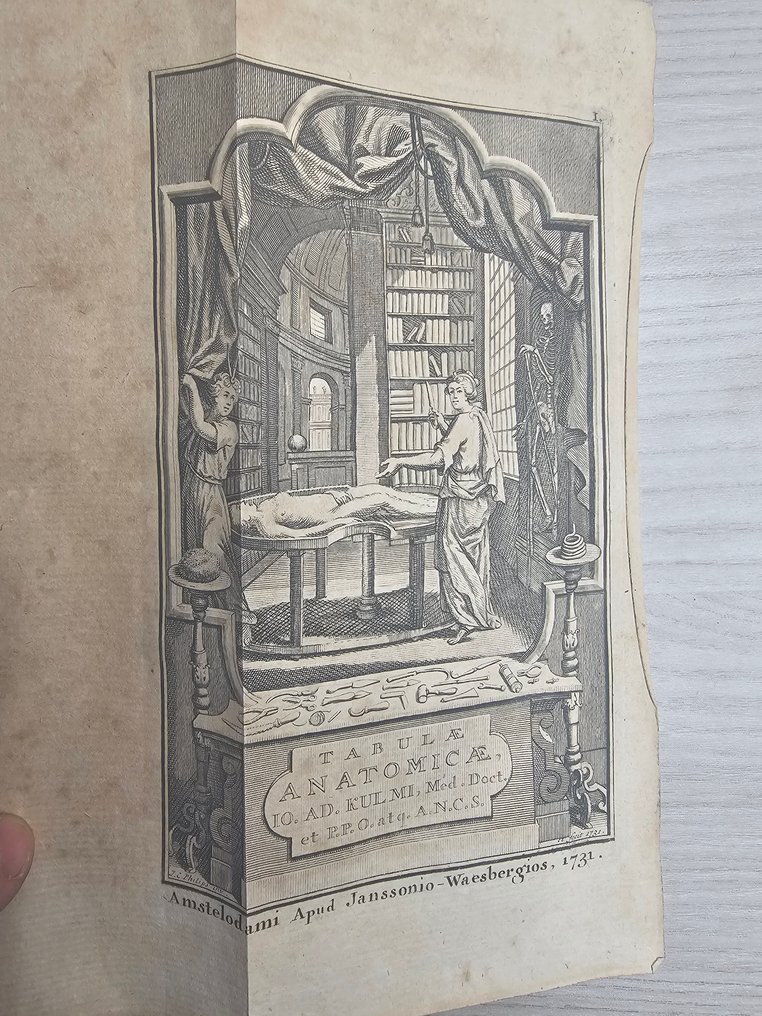
Johann Adam Kulmus – Tabulae Anatomicae, a Latin edition from 1744 in folio, 100 pages, bound in full leather with folding plates.
AI-assisted summary
Description from the seller
Johann Adam Kulmus – Tabulae Anatomicae
Amsterdam, at Janssonio-Waesbergios, 1744
In folio – contemporary binding in full leather
Bibliographic Description
Important and celebrated anatomical work by the German physician and anatomist Johann Adam Kulmus (1689–1745), one of the most influential texts of the 18th-century medical-scientific tradition.
Full title:
Anatomical Tables, in which the structure and function of all parts of the human body are briefly explained.
Printed in Amsterdam in 1744 at Janssonio-Waesbergios, this edition is among the most appreciated of the work, known for the quality of its iconographic apparatus and for the clarity of its exposition.
CONTENT OF THE WORK
The Tabulae Anatomicae constitute a systematic and organic work dedicated to the comprehensive study of the human body, designed with both scientific and educational purposes.
The work analyzes in an orderly and progressive manner.
the human skeleton, with particular attention to the bone structure and joints
The muscle structure, represented through detailed tables that illustrate the different muscle layers.
the nervous system, both central and peripheral
internal organs (heart, lungs, liver, digestive system, urogenital system)
the skull and its components, including sections and multiple views
Each plate is accompanied by an explanatory text in Latin that describes not only the anatomical structure but also the function of the individual parts of the body, making the work particularly modern for its time. Kulmus indeed manages to combine direct anatomical observation with a clear and accessible synthesis, designed for university teaching.
The engravings, created with great precision and clarity, are designed to be immediately understandable even visually: this feature made the work extremely popular and facilitated widespread dissemination throughout Europe. Kulmus's plates were used for decades as educational references and profoundly influenced subsequent anatomical atlases.
Importance of the work
Le Tabulae Anatomicae represent one of the fundamental texts of 18th-century anatomy. The work achieved extraordinary dissemination and was adopted in numerous European universities as a reference manual.
The historical value of the work resides in:
in the complete systematization of human anatomy
in high quality and clarity of the iconographic apparatus.
the influence on 18th-century European anatomical tradition
Today, the work is particularly sought after by collectors of antique medical books, history of science, and scientific engravings.
Conditions
Complete set of the tables.
Binding: full contemporary leather, with evident signs of age, abrasions, and superficial damages to the boards and corners. Despite its worn appearance, the binding is structurally solid; the hinges are intact, and the volume is easily fanned through.
Interior: presence of diffuse browning on practically all the papers, which gives the paper a browned tone. These browning do not compromise readability, which remains excellent.
Tables: well printed, complete, with normal folding marks and slight signs of aging.
Card: solid, without structural fragility.
FINAL CONSIDERATIONS
Fascinating and important 18th-century anatomical work, of great historical and scientific value, enriched with a remarkable iconographic apparatus. A volume of definite interest for collectors of antique books, history of medicine, and scientific engraving.
Johann Adam Kulmus – Tabulae Anatomicae
Amsterdam, at Janssonio-Waesbergios, 1744
In folio – contemporary binding in full leather
Bibliographic Description
Important and celebrated anatomical work by the German physician and anatomist Johann Adam Kulmus (1689–1745), one of the most influential texts of the 18th-century medical-scientific tradition.
Full title:
Anatomical Tables, in which the structure and function of all parts of the human body are briefly explained.
Printed in Amsterdam in 1744 at Janssonio-Waesbergios, this edition is among the most appreciated of the work, known for the quality of its iconographic apparatus and for the clarity of its exposition.
CONTENT OF THE WORK
The Tabulae Anatomicae constitute a systematic and organic work dedicated to the comprehensive study of the human body, designed with both scientific and educational purposes.
The work analyzes in an orderly and progressive manner.
the human skeleton, with particular attention to the bone structure and joints
The muscle structure, represented through detailed tables that illustrate the different muscle layers.
the nervous system, both central and peripheral
internal organs (heart, lungs, liver, digestive system, urogenital system)
the skull and its components, including sections and multiple views
Each plate is accompanied by an explanatory text in Latin that describes not only the anatomical structure but also the function of the individual parts of the body, making the work particularly modern for its time. Kulmus indeed manages to combine direct anatomical observation with a clear and accessible synthesis, designed for university teaching.
The engravings, created with great precision and clarity, are designed to be immediately understandable even visually: this feature made the work extremely popular and facilitated widespread dissemination throughout Europe. Kulmus's plates were used for decades as educational references and profoundly influenced subsequent anatomical atlases.
Importance of the work
Le Tabulae Anatomicae represent one of the fundamental texts of 18th-century anatomy. The work achieved extraordinary dissemination and was adopted in numerous European universities as a reference manual.
The historical value of the work resides in:
in the complete systematization of human anatomy
in high quality and clarity of the iconographic apparatus.
the influence on 18th-century European anatomical tradition
Today, the work is particularly sought after by collectors of antique medical books, history of science, and scientific engravings.
Conditions
Complete set of the tables.
Binding: full contemporary leather, with evident signs of age, abrasions, and superficial damages to the boards and corners. Despite its worn appearance, the binding is structurally solid; the hinges are intact, and the volume is easily fanned through.
Interior: presence of diffuse browning on practically all the papers, which gives the paper a browned tone. These browning do not compromise readability, which remains excellent.
Tables: well printed, complete, with normal folding marks and slight signs of aging.
Card: solid, without structural fragility.
FINAL CONSIDERATIONS
Fascinating and important 18th-century anatomical work, of great historical and scientific value, enriched with a remarkable iconographic apparatus. A volume of definite interest for collectors of antique books, history of medicine, and scientific engraving.
Details
Number of Books
1
Subject
Medicine
Book Title
Tabulae Anatomicae
Author/ Illustrator
Johann Adam Kulmu
Condition
Fair
Publication year oldest item
1744
Publication year youngest item
1744
Height
22 cm
Edition
Other edition
Width
13 cm
Language
Latin
Original language
Yes
Binding/ Material
Leather
Extras
Fold out maps or plates
Number of pages
100
Sold by
