Vari - Tacuinum sanitatis in medicina - 1986



Opens 11:00
Starting bid
€ 1
Add to your favourites to get an alert when the auction starts.

Expert
Selected by Sebastian Hau
Founded and directed two French book fairs; nearly 20 years of experience in contemporary books.
Estimate € 380 - € 450
Catawiki Buyer Protection
Your payment’s safe with us until you receive your object.View details
Trustpilot 4.4 | 123418 reviews
Rated Excellent on Trustpilot.
Description from the seller
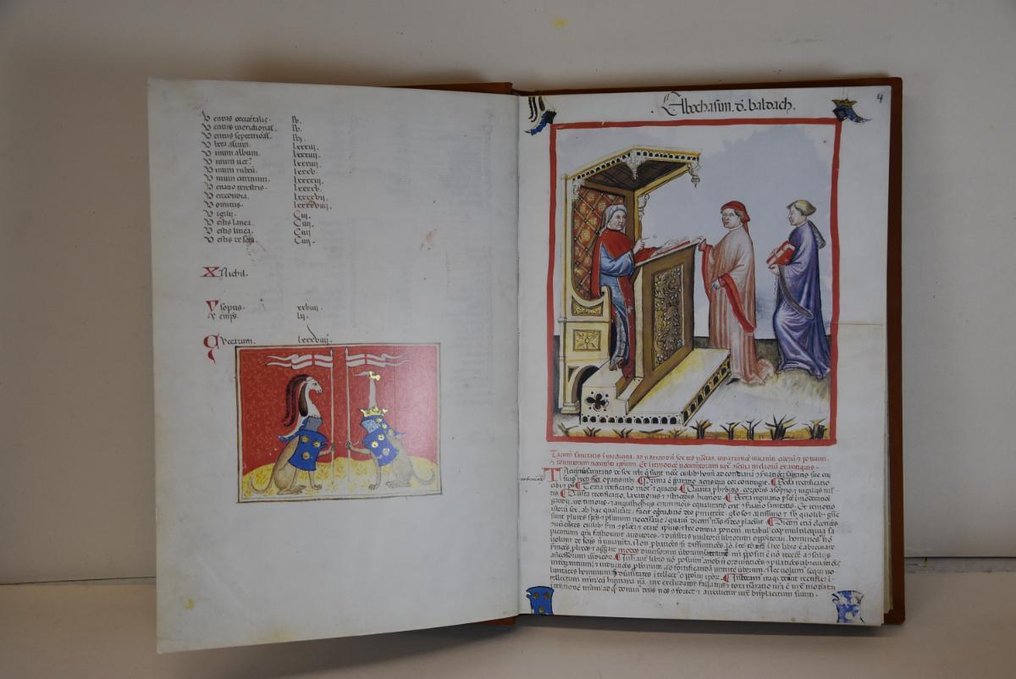
Tacuinum Sanitatis In Medicine. Codex Vindobonensis Series Nova 2644 of the Austrian National Library. Rome, Salerno publisher, 1986. Complete edition in a faithful facsimile of the original Codex copy. Dimensions: 34.5 x 24 cm.
Volumes - reproduction of the codex and the commentary, in a hardcover box in cloth.
Codex binding in full leather with nerves on the spine.
Cloth binding of the commentary.
Pages 107; 134.
Numbered edition limited to 399 copies, 21 with Roman numerals plus 200 copies for a special series for the Cassa di Risparmio di Verona, and finally 100 unnumbered cloth-bound copies. Our copy No. 2.
Both volumes are in excellent condition. Two faded labels are noted on the back of the plates of both volumes.
Unreserved auction!!! Don't miss our other auctions!!!
Attention: there may be issues with shipping to the USA.
Tacuina sanitatis
The Ira, from the copy of the Tacuinum sanitatis of Vienna (Vindob. Ser. n. 2644)
Under the name 'Tacuina sanitatis,' all those manuals of medical science written and illustrated from the second half of the 14th century to around 1450 are classified. They described, in the form of brief precepts, the medicinal properties of vegetables, fruit trees, spices, and foods, as well as seasons, natural events, and emotional states, detailing their effects on the human body and ways to correct them.
Origin and diffusion
These works mainly based their content on an original text by the Arab doctor Ibn Butlan (transliterated as Ububchasym de Baldach), active in Baghdad around the mid-11th century and who died there in 1052 or 1066. The name likely derives from the Arabic Taqwīm al‑ṣiḥḥa, meaning 'Tables of health.' The Latin translation of the treatise probably took place in the 13th century at the court of King Manfred of Sicily. According to other hypotheses, the names Gerardo da Cremona (1114-1187) and later Faraj ibn Salim (Ferragut), a translator at the court of King Charles I of Anjou of Sicily (1263-1285) in Naples, are mentioned. From then on, the Tacuina sanitatis experienced rapid and widespread dissemination, allowing the European world of the time to learn about the hygienic and dietary standards of Arab rational medicine, which radically changed Western medical practices, which until then were more rooted in inherited traditions, magical beliefs, and religious practices than in an objective study of scientific discipline.
The dissemination of the most famous Tacuina miniati mainly took place in the Lombard area, commissioned by an aristocratic audience, predominantly lay, who were particularly interested in possessing a work that not only advised remedies for maintaining health but also made learning such norms easier and more enjoyable through a brief but precise text accompanied by sumptuous miniatures. Thus, these texts transitioned from an initial practical function to a primarily aesthetic one over time. Thanks to the meticulous and vivid illustrations that were developed within them, the Tacuina still constitute an iconographic source of exceptional richness and importance for the study of various aspects of human life during the medieval period.
Style and general features
Tacuina dealt with the six fundamental things to stay healthy: suitable foods and drinks, movement and rest, good air, frequent sleep, and emotional regulation. Some of these miniature codes have survived to our time; of these, three are considered of greater value: one is kept in Vienna (National Library), one in Paris (National Library of France), and another in Rome (Casanatense Library), which, unlike the other two, is called Theatrum sanitatis.
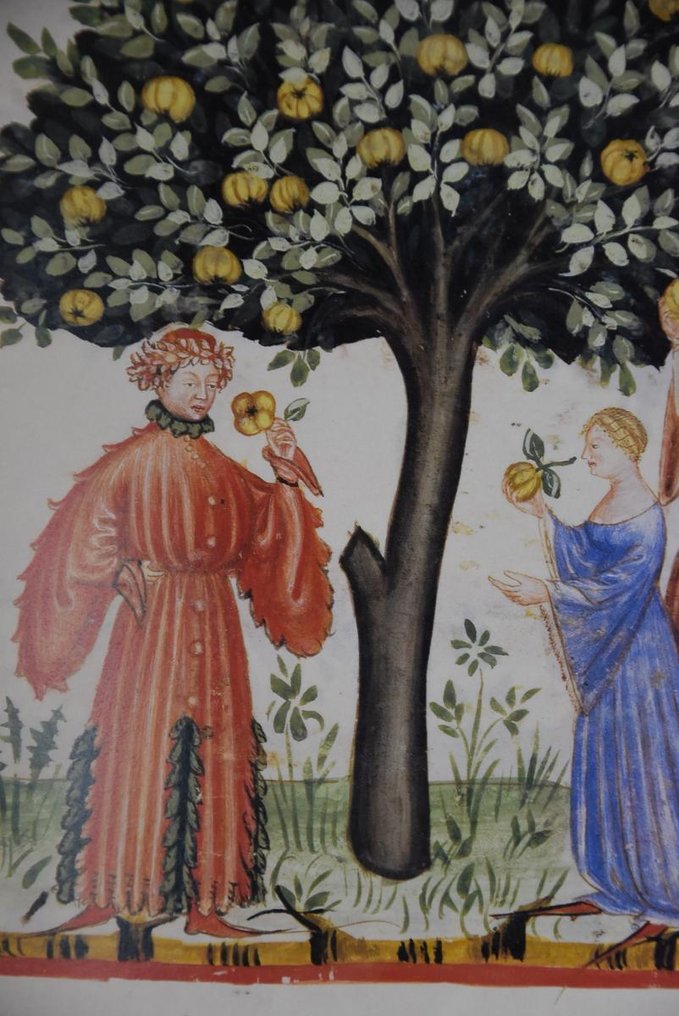
In each Tacuinum, the text occupies only a few lines at the bottom of each page, with the remaining space entirely dedicated to a miniature illustrating the specific subject to which the precept refers. The miniatures depict plants, vegetables, fruits, along with women and men indicating their methods of cultivation, harvesting, or preparation. Interior scenes of workshops are also shown, where healthy products and vendors preparing or selling them can be seen. Essentially, what we see on the pages of the Tacuinum sanitatis is a clear transposition of a serene medieval reality, illustrated with rich detail and evocative descriptions of that reality. These depictions are unique in their kind, not only for style and composition but also, and most importantly, for the great narrative freshness characteristic of the Gothic-international style.
Tacuinum Sanitatis In Medicine. Codex Vindobonensis Series Nova 2644 of the Austrian National Library. Rome, Salerno publisher, 1986. Complete edition in a faithful facsimile of the original Codex copy. Dimensions: 34.5 x 24 cm.
Volumes - reproduction of the codex and the commentary, in a hardcover box in cloth.
Codex binding in full leather with nerves on the spine.
Cloth binding of the commentary.
Pages 107; 134.
Numbered edition limited to 399 copies, 21 with Roman numerals plus 200 copies for a special series for the Cassa di Risparmio di Verona, and finally 100 unnumbered cloth-bound copies. Our copy No. 2.
Both volumes are in excellent condition. Two faded labels are noted on the back of the plates of both volumes.
Unreserved auction!!! Don't miss our other auctions!!!
Attention: there may be issues with shipping to the USA.
Tacuina sanitatis
The Ira, from the copy of the Tacuinum sanitatis of Vienna (Vindob. Ser. n. 2644)
Under the name 'Tacuina sanitatis,' all those manuals of medical science written and illustrated from the second half of the 14th century to around 1450 are classified. They described, in the form of brief precepts, the medicinal properties of vegetables, fruit trees, spices, and foods, as well as seasons, natural events, and emotional states, detailing their effects on the human body and ways to correct them.
Origin and diffusion
These works mainly based their content on an original text by the Arab doctor Ibn Butlan (transliterated as Ububchasym de Baldach), active in Baghdad around the mid-11th century and who died there in 1052 or 1066. The name likely derives from the Arabic Taqwīm al‑ṣiḥḥa, meaning 'Tables of health.' The Latin translation of the treatise probably took place in the 13th century at the court of King Manfred of Sicily. According to other hypotheses, the names Gerardo da Cremona (1114-1187) and later Faraj ibn Salim (Ferragut), a translator at the court of King Charles I of Anjou of Sicily (1263-1285) in Naples, are mentioned. From then on, the Tacuina sanitatis experienced rapid and widespread dissemination, allowing the European world of the time to learn about the hygienic and dietary standards of Arab rational medicine, which radically changed Western medical practices, which until then were more rooted in inherited traditions, magical beliefs, and religious practices than in an objective study of scientific discipline.
The dissemination of the most famous Tacuina miniati mainly took place in the Lombard area, commissioned by an aristocratic audience, predominantly lay, who were particularly interested in possessing a work that not only advised remedies for maintaining health but also made learning such norms easier and more enjoyable through a brief but precise text accompanied by sumptuous miniatures. Thus, these texts transitioned from an initial practical function to a primarily aesthetic one over time. Thanks to the meticulous and vivid illustrations that were developed within them, the Tacuina still constitute an iconographic source of exceptional richness and importance for the study of various aspects of human life during the medieval period.
Style and general features
Tacuina dealt with the six fundamental things to stay healthy: suitable foods and drinks, movement and rest, good air, frequent sleep, and emotional regulation. Some of these miniature codes have survived to our time; of these, three are considered of greater value: one is kept in Vienna (National Library), one in Paris (National Library of France), and another in Rome (Casanatense Library), which, unlike the other two, is called Theatrum sanitatis.
In each Tacuinum, the text occupies only a few lines at the bottom of each page, with the remaining space entirely dedicated to a miniature illustrating the specific subject to which the precept refers. The miniatures depict plants, vegetables, fruits, along with women and men indicating their methods of cultivation, harvesting, or preparation. Interior scenes of workshops are also shown, where healthy products and vendors preparing or selling them can be seen. Essentially, what we see on the pages of the Tacuinum sanitatis is a clear transposition of a serene medieval reality, illustrated with rich detail and evocative descriptions of that reality. These depictions are unique in their kind, not only for style and composition but also, and most importantly, for the great narrative freshness characteristic of the Gothic-international style.
Details
Number of Books
2
Subject
Art, History, Medicine
Book Title
Tacuinum sanitatis in medicina
Author/ Illustrator
Vari
Condition
Fine
Publication year oldest item
1986
Edition
Illustrated Edition
Language
Italian
Original language
Yes
Publisher
Salerno Editore Roma
Binding/ Material
Leather
Number of pages
134
Sold by
