Uddharani - ritual spoon - Bronze - India - Early 20th century


00
days
10
hours
31
minutes
21
seconds
Current bid
€ 60
Reserve price not met

Expert
Selected by Surya Rutten
Has over 25 years' experience in Asian art and owned an art gallery.
Estimate € 150 - € 200
15 other people are watching this object
 Bidder 6301 Bidder 6301 | €60 | |
|---|---|---|
| Bidder 6301 | €55 | |
 Bidder 8879 Bidder 8879 | €50 | |
Catawiki Buyer Protection
Your payment’s safe with us until you receive your object.View details
Trustpilot 4.4 | 123332 reviews
Rated Excellent on Trustpilot.
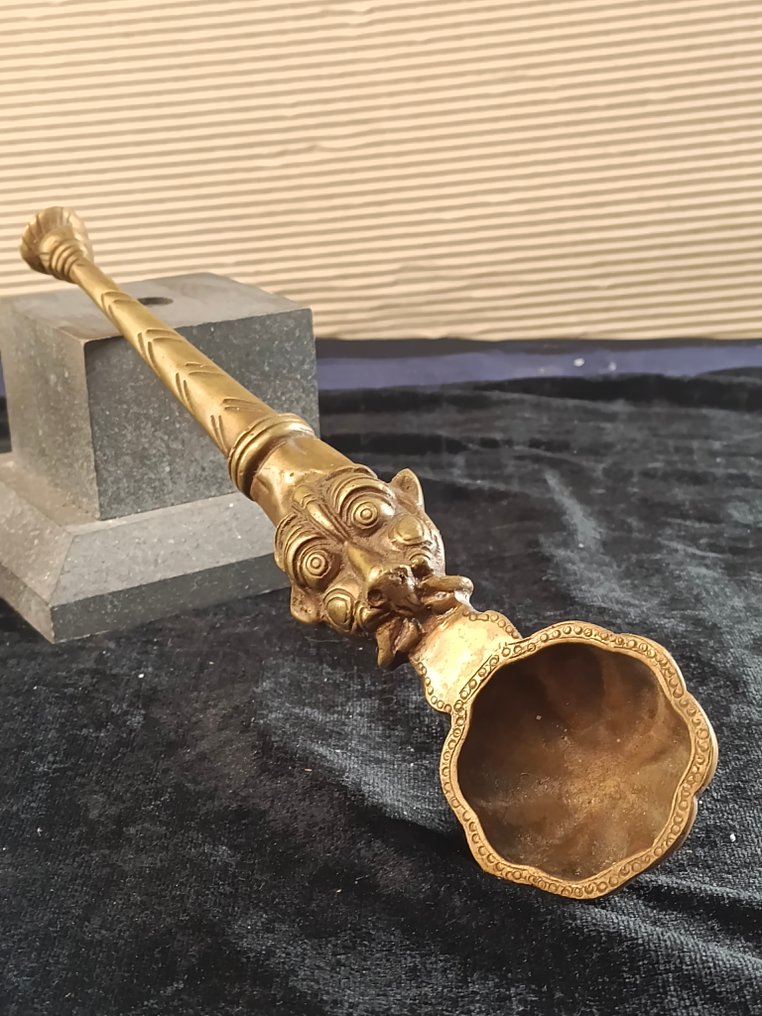
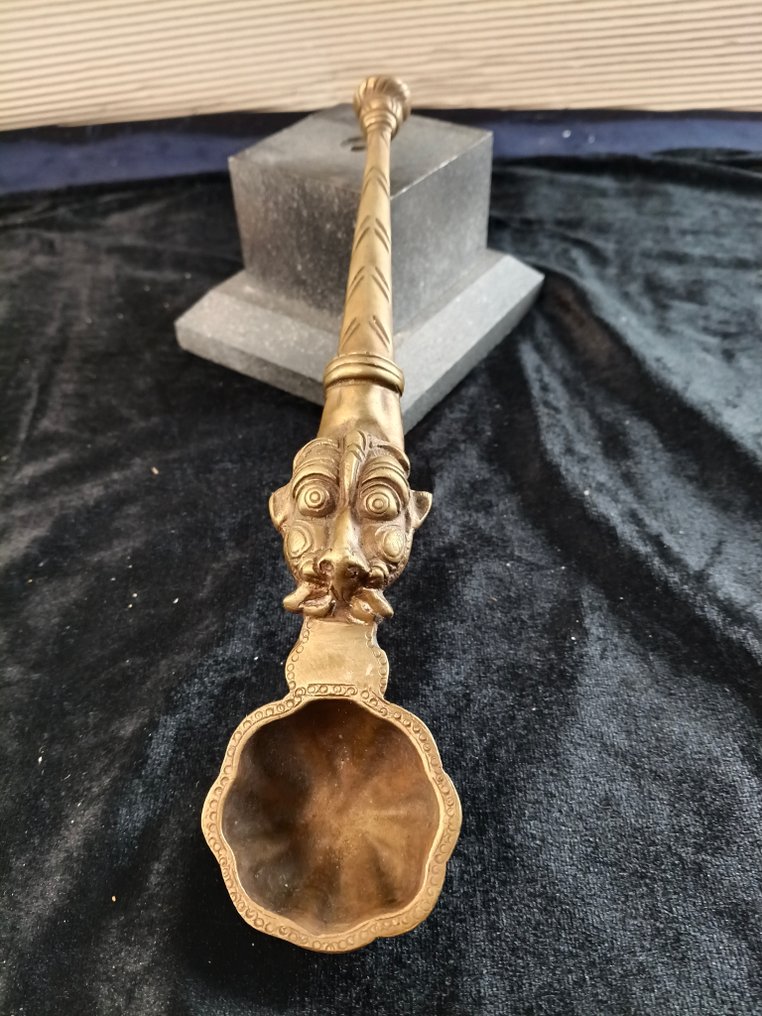
Bronze ritual spoon (Uddharani) for Puja from South India, dating to the early 20th century (1900–1920), with a zoomorphic tip, 25.6 cm long, 5.4 cm wide, 2.8 cm deep, weight 350 g, origin India, original attribution, in excellent condition.
AI-assisted summary
Description from the seller
Ancient Indian ritual spoon in bronze for Puja (Uddharani) with zoomorphic tip - South India, circa 1900-1920
This extraordinary ritual spoon in cast bronze, made using the traditional lost-wax casting technique, represents a masterpiece of early 20th-century Indian religious craftsmanship.
Acquired from a dealer specializing in Indo-Tibetan art in the 1970s, it was declared to have an origin that is over 50 years old. (Mudit International, New Delhi)
It is an *Uddharani* (or Achmani) – the traditional ceremonial spoon used during *puja* (worship ceremonies) in Hindu temples.
It was used to distribute the consecrated water (theertham) to devotees, pour ritually purified ghee into sacred lamps, and administer ritual powders such as kumkum during religious celebrations.
This object represents a direct bridge between the faithful and the divine in the Hindu tradition.
The most distinctive feature is the finely crafted zoomorphic end at the base of the bowl, depicting a stylized mythical creature (probably a sacred feline or guardian lion), typical of Hindu iconography. It features concentric incised eyes (a symbol of spiritual vision and enlightenment), elaborate geometric decorations, and details reflecting the esoteric principles of the Shilpa Shastra (ancient Indian treatises on sacred art and architecture).
Each element reveals the artisanal mastery of the Sthapathi from Swamimalai, Tamil Nadu, the most renowned traditional Indian bronze artisans.
The precision of the decorative definition – from engravings on the handle to the design of the pouring cup – cannot be achieved with modern industrial processes, demonstrating a completely manual craftsmanship.
Measurement: Total length: 25.6 cm, maximum width (bowl): 5.4 cm, thickness: 2.8 cm, weight 350 grams, material: authentic cast bronze (density confirmed 8.7-8.9 g/cm³).
These proportions represent a significant size, above the average of modern pieces, indicative of important ceremonial use in notable temples.
It does not display visible foundry marks – a crucial element since Swamimalai workshops only began systematic marking from 1960-1970.
This physical data unambiguously confirms the dating to pre-1950, supporting the early 20th century period (1900-1920).
The production era of this piece (1900-1920) represents the peak of traditional Indian craftsmanship, still entirely manual before the gradual industrialization.
It is part of a ceremonial tradition dating back to the medieval Chola dynasties, when Swamimalai established itself as a world center of excellence in ritual bronze casting.
Excellent condition. Original patina intact, no structural damage, slight superficial wear consistent with age and historical ceremonial use.
Quickly, very well packaged with styrofoam and/or bubble wrap, and shipped with tracking and insurance with the best shipping agencies.
The shipping cost includes shipment tracking, packaging material, and insurance for the artwork.
Due to customs and duties issues, we do not ship to the U.S.A.
This research was also conducted with the help of Artificial Intelligence. (Data was verified and compared with images and web searches.)
Ancient Indian ritual spoon in bronze for Puja (Uddharani) with zoomorphic tip - South India, circa 1900-1920
This extraordinary ritual spoon in cast bronze, made using the traditional lost-wax casting technique, represents a masterpiece of early 20th-century Indian religious craftsmanship.
Acquired from a dealer specializing in Indo-Tibetan art in the 1970s, it was declared to have an origin that is over 50 years old. (Mudit International, New Delhi)
It is an *Uddharani* (or Achmani) – the traditional ceremonial spoon used during *puja* (worship ceremonies) in Hindu temples.
It was used to distribute the consecrated water (theertham) to devotees, pour ritually purified ghee into sacred lamps, and administer ritual powders such as kumkum during religious celebrations.
This object represents a direct bridge between the faithful and the divine in the Hindu tradition.
The most distinctive feature is the finely crafted zoomorphic end at the base of the bowl, depicting a stylized mythical creature (probably a sacred feline or guardian lion), typical of Hindu iconography. It features concentric incised eyes (a symbol of spiritual vision and enlightenment), elaborate geometric decorations, and details reflecting the esoteric principles of the Shilpa Shastra (ancient Indian treatises on sacred art and architecture).
Each element reveals the artisanal mastery of the Sthapathi from Swamimalai, Tamil Nadu, the most renowned traditional Indian bronze artisans.
The precision of the decorative definition – from engravings on the handle to the design of the pouring cup – cannot be achieved with modern industrial processes, demonstrating a completely manual craftsmanship.
Measurement: Total length: 25.6 cm, maximum width (bowl): 5.4 cm, thickness: 2.8 cm, weight 350 grams, material: authentic cast bronze (density confirmed 8.7-8.9 g/cm³).
These proportions represent a significant size, above the average of modern pieces, indicative of important ceremonial use in notable temples.
It does not display visible foundry marks – a crucial element since Swamimalai workshops only began systematic marking from 1960-1970.
This physical data unambiguously confirms the dating to pre-1950, supporting the early 20th century period (1900-1920).
The production era of this piece (1900-1920) represents the peak of traditional Indian craftsmanship, still entirely manual before the gradual industrialization.
It is part of a ceremonial tradition dating back to the medieval Chola dynasties, when Swamimalai established itself as a world center of excellence in ritual bronze casting.
Excellent condition. Original patina intact, no structural damage, slight superficial wear consistent with age and historical ceremonial use.
Quickly, very well packaged with styrofoam and/or bubble wrap, and shipped with tracking and insurance with the best shipping agencies.
The shipping cost includes shipment tracking, packaging material, and insurance for the artwork.
Due to customs and duties issues, we do not ship to the U.S.A.
This research was also conducted with the help of Artificial Intelligence. (Data was verified and compared with images and web searches.)
Details
Dynastic Style/Period
Early 20th century
Country of Origin
India
Attribution
Original
Material
Bronze
Height
25.6 cm
Width
5.4 cm
Title of artwork
Uddharani - ritual spoon
Depth
2.8 cm
Condition
Excellent condition
Provenance
Gallery / Antique dealer