Glenn Miller, Fats Waller, Benny Goodman, Gershwin / Ambrose - From “Moonlight Serenade” to “Rhapsody in Blue” (17 records) - 78 RPM shellac record - 1927




13
days
04
hours
21
minutes
08
seconds

No bids placed
Catawiki Buyer Protection
Your payment’s safe with us until you receive your object.View details
Trustpilot 4.4 | 123077 reviews
Rated Excellent on Trustpilot.
Seventeen British-pressed 78rpm jazz and swing records from the late 1920s to the late 1950s, featuring Glenn Miller, Fats Waller, Benny Goodman, Gershwin via Ambrose, George Shearing and other British artists, all in VG+ to EX condition.
AI-assisted summary
Description from the seller
A carefully curated group of 17 British-pressed 78rpm records spanning the late 1920s to late 1950s, focused on jazz, swing, and dance-band classics.
Highlights include major international names such as Glenn Miller, Fats Waller, Benny Goodman, George Gershwin (via Ambrose), and George Shearing, alongside key British figures including Ambrose, Ted Heath, Nat Gonella, and Harry Roy.
The selection balances landmark recordings with historically important supporting titles, offering a strong overview of both American and British jazz influence on UK shellac production. The records are in VG+ to EX condition.
Glenn Miller and His Orchestra – American Patrol / Moonlight Serenade – HMV B.D.5942 – UK – c.1940
A definitive swing-era pairing and one of the most recognisable records of the twentieth century. American Patrol drives forward with crisp precision and martial momentum, showcasing Miller’s tightly drilled ensemble and rhythmic confidence, while Moonlight Serenade presents the iconic clarinet-led theme that became inseparable from his name. A cornerstone recording whose cultural impact extends far beyond jazz collecting.
Ambrose and His Orchestra – Rhapsody in Blue / Rhapsody in Blue (Contd.) – Decca F.5454 – UK – 1935
An ambitious British dance-band adaptation of Gershwin’s modern masterpiece, spread across both sides of the disc. Recorded at the Embassy Club with Bert Barnes at the piano, this version balances symphonic sweep with rhythmic discipline, translating concert-hall modernism into a form accessible to the dance-band audience. One of Ambrose’s most artistically significant recordings.
“Fats” Waller and His Rhythm – Shortnin’ Bread / My Very Good Friend the Milkman – HMV B.D.1218 – UK – c.1935
A joyous coupling from Waller’s peak years, combining infectious rhythmic drive with effortless humour. Shortnin’ Bread bursts with playful swing and instrumental vitality, while My Very Good Friend the Milkman exemplifies Waller’s unmatched gift for comic timing and melodic charm. A quintessential example of jazz virtuosity disguised as pure entertainment.
Benny Goodman Sextet – Ain’t Misbehavin’ / China Boy – Parlophone R.3014 – UK – c.1946
A classic small-group Goodman release, highlighting the elegance and precision of his sextet format. Ain’t Misbehavin’ unfolds with relaxed sophistication and lyrical poise, while China Boy brings sharper rhythmic bite and ensemble interplay. A prime post-war British pressing that distils Goodman’s influence on swing and small-group jazz.
Red Nichols and His Five Pennies – Ida! Sweet as Apple Cider / Feelin’ No Pain – Brunswick 3626 – UK – c.1927
A vital early jazz pairing capturing Nichols’s compact, tightly arranged ensemble style. Ida! sparkles with crisp articulation and forward momentum, while Feelin’ No Pain relaxes into a smoother fox-trot feel. Historically important as an example of American hot jazz reaching British audiences during the formative years of the genre.
George Shearing Quintet – Bop, Look and Listen / September in the Rain – MGM MGM.235 – UK – c.1949
A defining early Shearing release, showcasing the quintet sound that brought him international acclaim. Bop, Look and Listen reflects modern jazz clarity and rhythmic lightness, while September in the Rain demonstrates Shearing’s refined harmonic touch and urbane swing. A landmark post-war British pressing of modern jazz.
Ted Heath and His Music – Swingin’ Shepherd Blues / Runnin’ – Decca F.11000 – UK – 1958
A powerful late-period British big-band record, illustrating Heath’s continued commitment to modern swing. Swingin’ Shepherd Blues offers a polished blues-based framework, while Runnin’ drives forward with contemporary energy and precision brass writing. A testament to Heath’s role in sustaining big-band jazz into the late 1950s.
Les Paul / Les Paul and Mary Ford – Meet Mister Callaghan / Take Me in Your Arms and Hold Me – Capitol CL.13793 – UK – c.1951
A landmark Capitol pairing bridging instrumental innovation and vocal-pop intimacy. Meet Mister Callaghan highlights Les Paul’s technical brilliance and rhythmic invention, while Take Me in Your Arms and Hold Me exemplifies the duo’s pioneering use of multitracked vocals and guitar. Historically crucial for its influence on recording techniques.
Harry Roy and His Orchestra – Cuban Pete – Rumba / Is It True What They Say About Dixie? – Parlophone F 482 – UK – c.1939
A colourful late-1930s hotel-orchestra coupling from the May Fair Hotel. Cuban Pete – Rumba reflects the era’s fascination with Latin-inflected rhythms, while Is It True What They Say About Dixie? returns to American popular-song territory, delivered with polished British dance-band sophistication.
Nat Gonella and His Trumpet – Rockin’ Chair / When You’re Smiling – Decca F.3292 – UK – c.1934
A warm and engaging mid-1930s Decca pairing showcasing Gonella’s relaxed trumpet style and personable vocals. Rockin’ Chair unfolds with understated jazz charm, while When You’re Smiling radiates buoyant optimism. A key example of British jazz personality shaped by American influence.
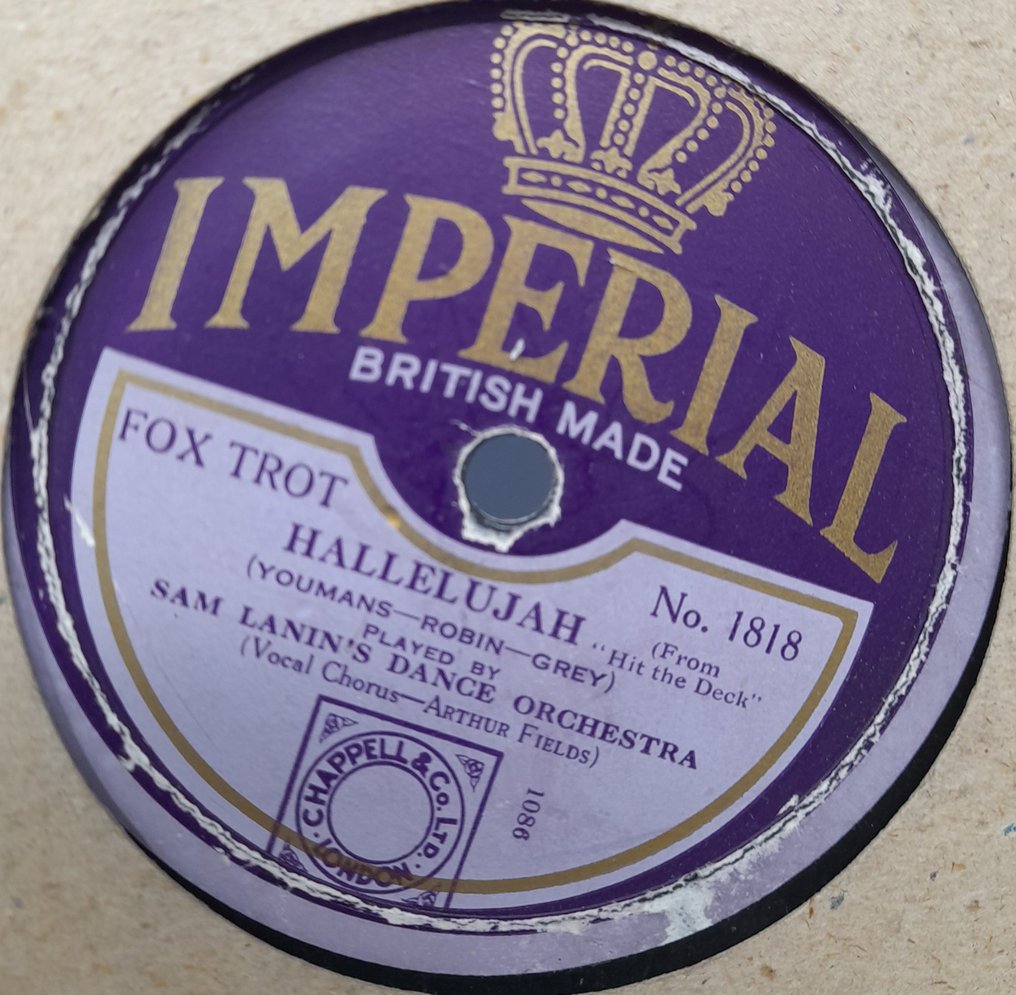
Sam Lanin’s Dance Orchestra – Dancing Tambourine / Hallelujah – Imperial 1818 – UK – c.1927–28
An early British-pressed example of American dance-band style, pairing novelty rhythm with jazz-inflected popular material. Lanin’s orchestra provides polished, energetic performances that illustrate how American jazz idioms were adapted for the UK market during the late 1920s dance craze.
Ted Lewis and His Band – Moonlight Madness (Then You Were Gone) / Good Night, Waltz – Columbia 5485 – UK – c.1928
A contrasting late-1920s coupling combining jazz-tinged fox-trot sentiment with a smoother ballroom waltz. Moonlight Madness reflects Lewis’s distinctive novelty phrasing, while Good Night, Waltz offers a gentle, dance-hall closing number typical of British Columbia issues of the period.
Sid Phillips and His Band – Canadian Capers / Sweet Georgia Brown – HMV B.10015 – UK – 1951
A solid example of early-1950s British swing revivalism. Canadian Capers delivers brisk ensemble drive, while Sweet Georgia Brown revisits a jazz standard with bright post-war confidence. Representative rather than groundbreaking, but musically assured.
Kay Starr – Am I a Toy or Treasure / Fortune in Dreams – Capitol CL.14151 – UK – c.1952
A polished Capitol vocal-pop pairing from Starr’s prime years. Am I a Toy or Treasure balances emotional directness with orchestral restraint, while Fortune in Dreams leans toward lush romanticism. Important within post-war popular vocal recording rather than jazz innovation.
Ted Heath and His Music – Armen’s Theme / Baby Doll – Decca F.10827 – UK – c.1954
A stylish mid-1950s Heath release contrasting dramatic orchestral colour with relaxed swing. Armen’s Theme reflects Heath’s flair for bold arrangement, while Baby Doll offers smooth rhythmic polish. A secondary but well-crafted entry in his discography.
Ted Heath and His Music – Obsession – Decca F.9881 – UK – c.1953
A tightly constructed modern big-band performance, driven by insistent rhythm and sharply voiced brass. Obsession illustrates Heath’s engagement with contemporary jazz-influenced writing, though it lacks the lasting impact of his most celebrated recordings.
Hal McIntyre and His Music – Noble Fred at Chantal – Decca F.9881 – UK – c.1953
A competent American swing performance pressed for the British market, blending buoyant ensemble phrasing with accessible dance-band drive. Musically sound but of mainly contextual interest, representing the final years of mainstream big-band swing.
A carefully curated group of 17 British-pressed 78rpm records spanning the late 1920s to late 1950s, focused on jazz, swing, and dance-band classics.
Highlights include major international names such as Glenn Miller, Fats Waller, Benny Goodman, George Gershwin (via Ambrose), and George Shearing, alongside key British figures including Ambrose, Ted Heath, Nat Gonella, and Harry Roy.
The selection balances landmark recordings with historically important supporting titles, offering a strong overview of both American and British jazz influence on UK shellac production. The records are in VG+ to EX condition.
Glenn Miller and His Orchestra – American Patrol / Moonlight Serenade – HMV B.D.5942 – UK – c.1940
A definitive swing-era pairing and one of the most recognisable records of the twentieth century. American Patrol drives forward with crisp precision and martial momentum, showcasing Miller’s tightly drilled ensemble and rhythmic confidence, while Moonlight Serenade presents the iconic clarinet-led theme that became inseparable from his name. A cornerstone recording whose cultural impact extends far beyond jazz collecting.
Ambrose and His Orchestra – Rhapsody in Blue / Rhapsody in Blue (Contd.) – Decca F.5454 – UK – 1935
An ambitious British dance-band adaptation of Gershwin’s modern masterpiece, spread across both sides of the disc. Recorded at the Embassy Club with Bert Barnes at the piano, this version balances symphonic sweep with rhythmic discipline, translating concert-hall modernism into a form accessible to the dance-band audience. One of Ambrose’s most artistically significant recordings.
“Fats” Waller and His Rhythm – Shortnin’ Bread / My Very Good Friend the Milkman – HMV B.D.1218 – UK – c.1935
A joyous coupling from Waller’s peak years, combining infectious rhythmic drive with effortless humour. Shortnin’ Bread bursts with playful swing and instrumental vitality, while My Very Good Friend the Milkman exemplifies Waller’s unmatched gift for comic timing and melodic charm. A quintessential example of jazz virtuosity disguised as pure entertainment.
Benny Goodman Sextet – Ain’t Misbehavin’ / China Boy – Parlophone R.3014 – UK – c.1946
A classic small-group Goodman release, highlighting the elegance and precision of his sextet format. Ain’t Misbehavin’ unfolds with relaxed sophistication and lyrical poise, while China Boy brings sharper rhythmic bite and ensemble interplay. A prime post-war British pressing that distils Goodman’s influence on swing and small-group jazz.
Red Nichols and His Five Pennies – Ida! Sweet as Apple Cider / Feelin’ No Pain – Brunswick 3626 – UK – c.1927
A vital early jazz pairing capturing Nichols’s compact, tightly arranged ensemble style. Ida! sparkles with crisp articulation and forward momentum, while Feelin’ No Pain relaxes into a smoother fox-trot feel. Historically important as an example of American hot jazz reaching British audiences during the formative years of the genre.
George Shearing Quintet – Bop, Look and Listen / September in the Rain – MGM MGM.235 – UK – c.1949
A defining early Shearing release, showcasing the quintet sound that brought him international acclaim. Bop, Look and Listen reflects modern jazz clarity and rhythmic lightness, while September in the Rain demonstrates Shearing’s refined harmonic touch and urbane swing. A landmark post-war British pressing of modern jazz.
Ted Heath and His Music – Swingin’ Shepherd Blues / Runnin’ – Decca F.11000 – UK – 1958
A powerful late-period British big-band record, illustrating Heath’s continued commitment to modern swing. Swingin’ Shepherd Blues offers a polished blues-based framework, while Runnin’ drives forward with contemporary energy and precision brass writing. A testament to Heath’s role in sustaining big-band jazz into the late 1950s.
Les Paul / Les Paul and Mary Ford – Meet Mister Callaghan / Take Me in Your Arms and Hold Me – Capitol CL.13793 – UK – c.1951
A landmark Capitol pairing bridging instrumental innovation and vocal-pop intimacy. Meet Mister Callaghan highlights Les Paul’s technical brilliance and rhythmic invention, while Take Me in Your Arms and Hold Me exemplifies the duo’s pioneering use of multitracked vocals and guitar. Historically crucial for its influence on recording techniques.
Harry Roy and His Orchestra – Cuban Pete – Rumba / Is It True What They Say About Dixie? – Parlophone F 482 – UK – c.1939
A colourful late-1930s hotel-orchestra coupling from the May Fair Hotel. Cuban Pete – Rumba reflects the era’s fascination with Latin-inflected rhythms, while Is It True What They Say About Dixie? returns to American popular-song territory, delivered with polished British dance-band sophistication.
Nat Gonella and His Trumpet – Rockin’ Chair / When You’re Smiling – Decca F.3292 – UK – c.1934
A warm and engaging mid-1930s Decca pairing showcasing Gonella’s relaxed trumpet style and personable vocals. Rockin’ Chair unfolds with understated jazz charm, while When You’re Smiling radiates buoyant optimism. A key example of British jazz personality shaped by American influence.
Sam Lanin’s Dance Orchestra – Dancing Tambourine / Hallelujah – Imperial 1818 – UK – c.1927–28
An early British-pressed example of American dance-band style, pairing novelty rhythm with jazz-inflected popular material. Lanin’s orchestra provides polished, energetic performances that illustrate how American jazz idioms were adapted for the UK market during the late 1920s dance craze.
Ted Lewis and His Band – Moonlight Madness (Then You Were Gone) / Good Night, Waltz – Columbia 5485 – UK – c.1928
A contrasting late-1920s coupling combining jazz-tinged fox-trot sentiment with a smoother ballroom waltz. Moonlight Madness reflects Lewis’s distinctive novelty phrasing, while Good Night, Waltz offers a gentle, dance-hall closing number typical of British Columbia issues of the period.
Sid Phillips and His Band – Canadian Capers / Sweet Georgia Brown – HMV B.10015 – UK – 1951
A solid example of early-1950s British swing revivalism. Canadian Capers delivers brisk ensemble drive, while Sweet Georgia Brown revisits a jazz standard with bright post-war confidence. Representative rather than groundbreaking, but musically assured.
Kay Starr – Am I a Toy or Treasure / Fortune in Dreams – Capitol CL.14151 – UK – c.1952
A polished Capitol vocal-pop pairing from Starr’s prime years. Am I a Toy or Treasure balances emotional directness with orchestral restraint, while Fortune in Dreams leans toward lush romanticism. Important within post-war popular vocal recording rather than jazz innovation.
Ted Heath and His Music – Armen’s Theme / Baby Doll – Decca F.10827 – UK – c.1954
A stylish mid-1950s Heath release contrasting dramatic orchestral colour with relaxed swing. Armen’s Theme reflects Heath’s flair for bold arrangement, while Baby Doll offers smooth rhythmic polish. A secondary but well-crafted entry in his discography.
Ted Heath and His Music – Obsession – Decca F.9881 – UK – c.1953
A tightly constructed modern big-band performance, driven by insistent rhythm and sharply voiced brass. Obsession illustrates Heath’s engagement with contemporary jazz-influenced writing, though it lacks the lasting impact of his most celebrated recordings.
Hal McIntyre and His Music – Noble Fred at Chantal – Decca F.9881 – UK – c.1953
A competent American swing performance pressed for the British market, blending buoyant ensemble phrasing with accessible dance-band drive. Musically sound but of mainly contextual interest, representing the final years of mainstream big-band swing.
Details
Era
1900-2000
Artist/ Band (max 3)
Glenn Miller, Fats Waller, Benny Goodman, Gershwin / Ambrose
Record Title
From “Moonlight Serenade” to “Rhapsody in Blue” (17 records)
Nr of items
17
Release Country
United Kingdom
Release year (oldest)
1927
Case / sleeve condition
Very Good Plus (VG+)
Media condition
Very Good Plus (VG+)
Genre
Jazz/Fusion
Sold by