Katana - Japan - Edo Period (1600-1868)



07
days
21
hours
31
minutes
37
seconds
Current bid
€ 2,200
Reserve price not met

Expert
Selected by Julien Gauthier
With almost a decade of experience bridging science, museum curation, and traditional blacksmithing, Julien has developed a unique expertise in historical arms, armour, and African art.
Estimate € 9,400 - € 10,400
18 other people are watching this object
 Bidder 9374 Bidder 9374 | €2,200 | |
|---|---|---|
| Bidder 9374 | €2,000 | |
| Bidder 9374 | €1,900 | |
Catawiki Buyer Protection
Your payment’s safe with us until you receive your object.View details
Trustpilot 4.4 | 123294 reviews
Rated Excellent on Trustpilot.
Description from the seller
Samurai Sword Katana Bishū-jū Katsushige Sengo School Muramasa Lineage
Bishū-jū Fujiwara Katsushige (勝重)
Descendant of Muramasa Sengo School
Disciple of Sengo Masashige (son of Muramasa)
Honorary title: Mikawa no Kami (三河守)
Katsushige forged blades in Kuwana (Ise) and Nagoya (Owari) during the Kanbun Era. His name carries martial symbolism — 勝 (Katsu) = Victory, 重 (Shige) = Consecutive and his swords were believed to bring victory upon victory to the warrior who carried them. This made his work especially valued among samurai of rank and status.
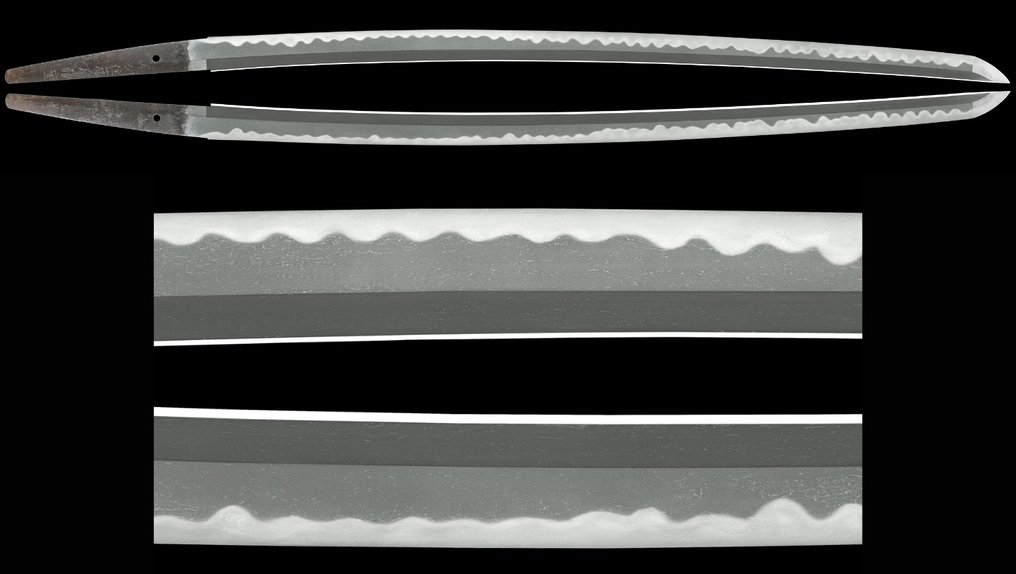
The blade has excelent polish, bright and exceptionally healthy, allowing the steel activity and hamon to be clearly admired.
Koshirae
This sword is mounted in a Type 98 Japanese Army Guntō (陸軍将校九八式軍刀) — the regulation mounting worn by Imperial Japanese Army officers during WWII. This example features:
• Field-officer tassel attached
• Excellent overall condition
• Samurai-family mon inlaid on both sides of the tsuka
• Traditional ray skin & original wartime bindings
The presence of two different mon suggests the officer who carried this sword descended of notable samurai lineage an uncommon and historically desirable feature.
Family Crests (Mon) on the Handle
1. Kiri Mon (Paulownia Crest)
A classical Kiri (桐) crest, used by Toyotomi Hideyoshi, Imperial government officials, high-ranking samurai, and later by the Japanese state itself. It symbolizes authority, honor, and government-granted status. Its presence strongly indicates a family of position or imperial connection.
2. Kanji Mon – 久 (Hisa / Hisashi / Kyū)
The second mon features the character 久, meaning eternal, everlasting, enduring. This type of single-character mon was used by specific samurai families — often bearing 久 in their family name (Hisamatsu, Hisatsune, Hisayoshi, etc.) or as a hereditary personal crest. A personal mon like this typically identifies a particular lineage, making this koshirae highly research worthy.
Together, these mon suggest a blade carried by an officer of noble samurai ancestry, maintaining family identity even into the Showa military era.
Sengo School History
Founded by the legendary Muramasa, the Sengo tradition is one of Japan's most famous and storied sword lineages. Muramasa’s blades were admired and feared for their sharpness and powerful temperament.
Legends describe them as “living steel,” influencing the spirit of those who wielded them.
• Established in Kuwana, Ise Province (modern Mie).
• Masashige (1st gen) is believed to be Muramasa’s son,Katsuhige was the student of Masahige.
• The name Sengo links to Senju-Kannon (Thousand-Armed Bodhisattva).
• Blades are known for cutting strength, vitality and battlefield spirit.
Katsushige represents one of the strong post Muramasa successors, preserving the fierce characteristics of the school well into the Edo period.
Specifications
Nagasa: 71.8 cm
Sori: 1.3 cm
Motohaba: 3.3 cm
Kasane: 7 mm
Sakihaba: 2.35 cm
Saki-kasane: 4.8 mm
Mekugi-ana: 1
Era: Edo – Kanbun (1661–1673)
Mounting: Type 98 Field Officer Guntō
Condition: Excellent
Certification: NBTHK Hozon
Highlights
• NBTHK Hozon — guaranteed authentic
• Muramasa-lineage blade by Fujiwara Katsushige
• Mounted in Type 98 officer guntō with field tassel
• Two mon on the tsuka — Kiri & 久 family crest
• Beautiful polish with strong activity visible
• A rare combination of Edo craftsmanship & military history
NBTHK Hozon – Preserved Sword
Edo Period – Kanbun Era 1661
Mounted in Type 98 Field Officer Guntō Koshirae with dual family mon
A superb blade uniting samurai heritage, Muramasa bloodline and Imperial-era military legacy one of the best combinations a collector can hope to find.
Seller's Story
Continuing your pursuit of the Bushido path and Japanese antiques, you may discover that each piece you encounter carries a unique narrative, inviting you to unveil the wisdom and ethos of the Samurai. Through these artifacts, you can forge a personal connection to the noble ideals of Bushido, allowing you to understand:
Honor, discipline, integrity, and loyalty.
It is our way of life that we share with you.
We hope you enjoy your journey into Japanese history, just as we do.
looking forward to meet
Member Dutch Token Society
Website www bushidoshop nl
Translated by Google TranslateSamurai Sword Katana Bishū-jū Katsushige Sengo School Muramasa Lineage
Bishū-jū Fujiwara Katsushige (勝重)
Descendant of Muramasa Sengo School
Disciple of Sengo Masashige (son of Muramasa)
Honorary title: Mikawa no Kami (三河守)
Katsushige forged blades in Kuwana (Ise) and Nagoya (Owari) during the Kanbun Era. His name carries martial symbolism — 勝 (Katsu) = Victory, 重 (Shige) = Consecutive and his swords were believed to bring victory upon victory to the warrior who carried them. This made his work especially valued among samurai of rank and status.
The blade has excelent polish, bright and exceptionally healthy, allowing the steel activity and hamon to be clearly admired.
Koshirae
This sword is mounted in a Type 98 Japanese Army Guntō (陸軍将校九八式軍刀) — the regulation mounting worn by Imperial Japanese Army officers during WWII. This example features:
• Field-officer tassel attached
• Excellent overall condition
• Samurai-family mon inlaid on both sides of the tsuka
• Traditional ray skin & original wartime bindings
The presence of two different mon suggests the officer who carried this sword descended of notable samurai lineage an uncommon and historically desirable feature.
Family Crests (Mon) on the Handle
1. Kiri Mon (Paulownia Crest)
A classical Kiri (桐) crest, used by Toyotomi Hideyoshi, Imperial government officials, high-ranking samurai, and later by the Japanese state itself. It symbolizes authority, honor, and government-granted status. Its presence strongly indicates a family of position or imperial connection.
2. Kanji Mon – 久 (Hisa / Hisashi / Kyū)
The second mon features the character 久, meaning eternal, everlasting, enduring. This type of single-character mon was used by specific samurai families — often bearing 久 in their family name (Hisamatsu, Hisatsune, Hisayoshi, etc.) or as a hereditary personal crest. A personal mon like this typically identifies a particular lineage, making this koshirae highly research worthy.
Together, these mon suggest a blade carried by an officer of noble samurai ancestry, maintaining family identity even into the Showa military era.
Sengo School History
Founded by the legendary Muramasa, the Sengo tradition is one of Japan's most famous and storied sword lineages. Muramasa’s blades were admired and feared for their sharpness and powerful temperament.
Legends describe them as “living steel,” influencing the spirit of those who wielded them.
• Established in Kuwana, Ise Province (modern Mie).
• Masashige (1st gen) is believed to be Muramasa’s son,Katsuhige was the student of Masahige.
• The name Sengo links to Senju-Kannon (Thousand-Armed Bodhisattva).
• Blades are known for cutting strength, vitality and battlefield spirit.
Katsushige represents one of the strong post Muramasa successors, preserving the fierce characteristics of the school well into the Edo period.
Specifications
Nagasa: 71.8 cm
Sori: 1.3 cm
Motohaba: 3.3 cm
Kasane: 7 mm
Sakihaba: 2.35 cm
Saki-kasane: 4.8 mm
Mekugi-ana: 1
Era: Edo – Kanbun (1661–1673)
Mounting: Type 98 Field Officer Guntō
Condition: Excellent
Certification: NBTHK Hozon
Highlights
• NBTHK Hozon — guaranteed authentic
• Muramasa-lineage blade by Fujiwara Katsushige
• Mounted in Type 98 officer guntō with field tassel
• Two mon on the tsuka — Kiri & 久 family crest
• Beautiful polish with strong activity visible
• A rare combination of Edo craftsmanship & military history
NBTHK Hozon – Preserved Sword
Edo Period – Kanbun Era 1661
Mounted in Type 98 Field Officer Guntō Koshirae with dual family mon
A superb blade uniting samurai heritage, Muramasa bloodline and Imperial-era military legacy one of the best combinations a collector can hope to find.
Seller's Story
Continuing your pursuit of the Bushido path and Japanese antiques, you may discover that each piece you encounter carries a unique narrative, inviting you to unveil the wisdom and ethos of the Samurai. Through these artifacts, you can forge a personal connection to the noble ideals of Bushido, allowing you to understand:
Honor, discipline, integrity, and loyalty.
It is our way of life that we share with you.
We hope you enjoy your journey into Japanese history, just as we do.
looking forward to meet
Member Dutch Token Society
Website www bushidoshop nl
Translated by Google TranslateDetails
Era
1400-1900
Country of Origin
Japan
Condition
Excellent
Dynastic Style/Period
Edo Period (1600-1868)
Height
3 cm
Provenance
Private collection
Width
3 cm
Depth
3 cm
Attribution
Original
Overall Length
71.8 cm
Estimated period
1650-1700
Sold by
