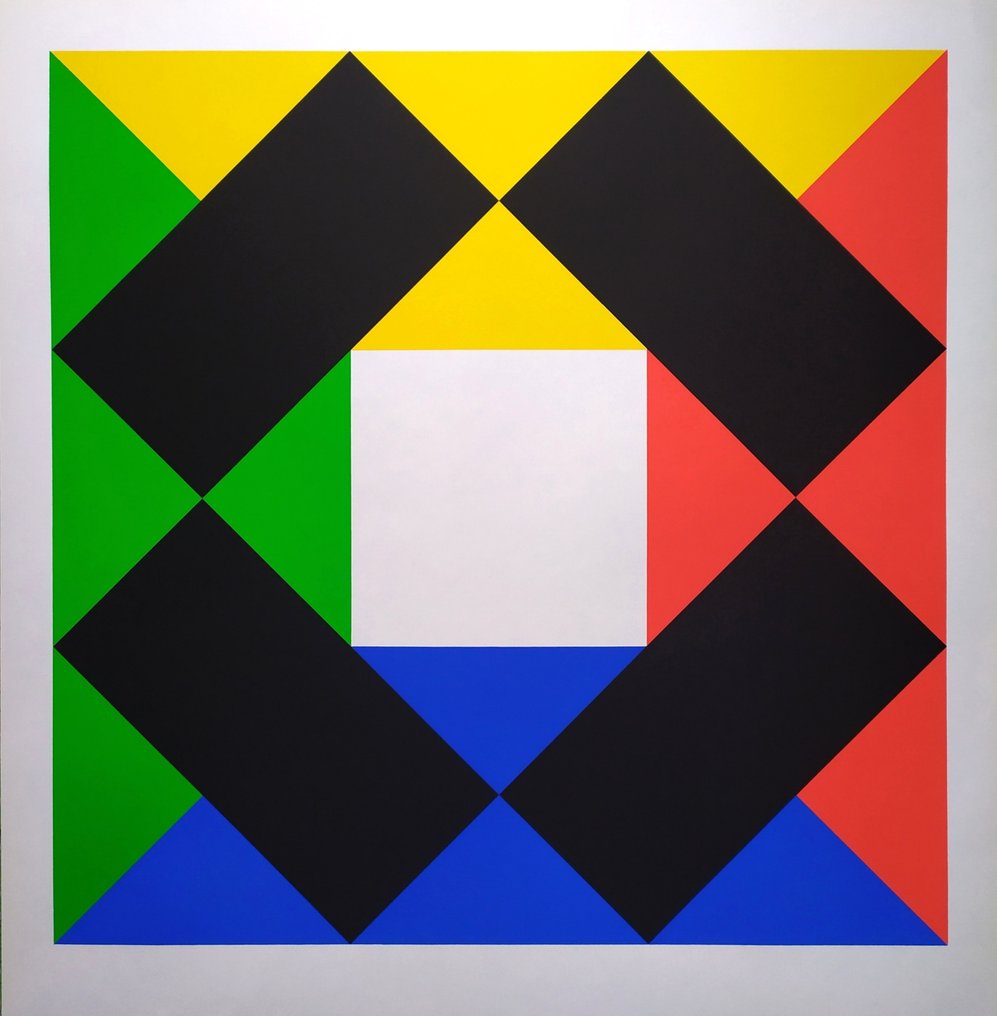
Max Bill (1908-1994) - "Komposition Mit Weißem Zentrum, 1972"



06
days
09
hours
01
minute
27
seconds
Current bid
€ 1
No reserve price

Expert
Selected by Juan Antonio Rodríguez
Eight years experience valuing posters, previously valuer at Balclis, Barcelona.
Estimate € 150 - € 200
7 other people are watching this object
 Bidder 5585 Bidder 5585 | €1 |
|---|
Catawiki Buyer Protection
Your payment’s safe with us until you receive your object.View details
Trustpilot 4.4 | 123418 reviews
Rated Excellent on Trustpilot.
Description from the seller
- Screenprint / Serigraph on fine veil paper, published in 1972 in the 'Look At' edition of the Galerie Thomas (Munich).
Size: 67x68.5cm.
Discontinued item. Closed edition, available only in the secondary market (auctions, resellers, galleries, etc.).
- Condition: excellent. Never framed, never exposed.
- Max Bill (1908–1994) was a Swiss architect, painter, sculptor, and designer, widely recognized as one of the most important figures of Concrete Art. Trained at the Bauhaus in Dessau under teachers such as Wassily Kandinsky and Paul Klee, Bill developed a rigorous visual language that combined mathematics, geometry, and aesthetic clarity. His art is characterized by precise forms, vibrant color fields, and a pursuit of harmony through proportion and balance. Beyond painting, his career extended into architecture and industrial design, where he applied the same principles of clarity and function.
Bill’s works are highly valued in the international art market, particularly his paintings, prints, and sculptures that exemplify geometric abstraction. Collectors and institutions appreciate his contribution as a bridge between Bauhaus modernism and postwar minimal and conceptual practices.
Composition with White Center (1972) is a striking example of Bill’s geometric rigor. The composition features a square divided into colorful triangular and rectangular sections—red, yellow, green, blue, and black—arranged around a stark white center. The work demonstrates Bill’s interest in balance and contrast, with the white void serving as a focal point of calm amid the dynamic interplay of colors and shapes. It embodies his idea of art as 'concrete,' free from representation, existing purely as an arrangement of forms and relationships.
Some artists of similar importance include Basquiat, Picasso, Hockney, Lichtenstein, Miro, Banksy, Brainwash, Delaunay, Nara, Soulages, Lagasse, Ramos, Rothko, Lautrec, Klimt, Matisse, Hirst, Chagall, Koons, Haring, Indiana, Mondrian, Groening, Richter, Monroe, Kusama, Murakami, Testa, Villemot, Oldenburg, Hopper, Ripolles, Wesselmann, Magritte, Jenk, Orlinski, Wille, Rizzi, Manara, Thiebaud, Herrera, Laurent, Klein, Coa, Dior, Vuitton, Kaws, Valentino, Cappiello, Kandinsky, Warhol, Buffa, Tura, Castle, Ponti, Knoll, Le Corbusier, Robert, Johns, Starck, Breuer, Nelson, Mogensen, Ponti, Bertoia, Urquiola, Chillida, Magistretti, Gauguin, Monet, Cezanne, Van Gogh, Botero, Katz, Braque, among others.
Seller's Story
Seller on Catawiki for over seven years.
I invite you to visit my profile, where you'll find a complete list of the different lots currently being auctioned. Click on "Yuke."
Good luck at the auctions!
Translated by Google Translate- Screenprint / Serigraph on fine veil paper, published in 1972 in the 'Look At' edition of the Galerie Thomas (Munich).
Size: 67x68.5cm.
Discontinued item. Closed edition, available only in the secondary market (auctions, resellers, galleries, etc.).
- Condition: excellent. Never framed, never exposed.
- Max Bill (1908–1994) was a Swiss architect, painter, sculptor, and designer, widely recognized as one of the most important figures of Concrete Art. Trained at the Bauhaus in Dessau under teachers such as Wassily Kandinsky and Paul Klee, Bill developed a rigorous visual language that combined mathematics, geometry, and aesthetic clarity. His art is characterized by precise forms, vibrant color fields, and a pursuit of harmony through proportion and balance. Beyond painting, his career extended into architecture and industrial design, where he applied the same principles of clarity and function.
Bill’s works are highly valued in the international art market, particularly his paintings, prints, and sculptures that exemplify geometric abstraction. Collectors and institutions appreciate his contribution as a bridge between Bauhaus modernism and postwar minimal and conceptual practices.
Composition with White Center (1972) is a striking example of Bill’s geometric rigor. The composition features a square divided into colorful triangular and rectangular sections—red, yellow, green, blue, and black—arranged around a stark white center. The work demonstrates Bill’s interest in balance and contrast, with the white void serving as a focal point of calm amid the dynamic interplay of colors and shapes. It embodies his idea of art as 'concrete,' free from representation, existing purely as an arrangement of forms and relationships.
Some artists of similar importance include Basquiat, Picasso, Hockney, Lichtenstein, Miro, Banksy, Brainwash, Delaunay, Nara, Soulages, Lagasse, Ramos, Rothko, Lautrec, Klimt, Matisse, Hirst, Chagall, Koons, Haring, Indiana, Mondrian, Groening, Richter, Monroe, Kusama, Murakami, Testa, Villemot, Oldenburg, Hopper, Ripolles, Wesselmann, Magritte, Jenk, Orlinski, Wille, Rizzi, Manara, Thiebaud, Herrera, Laurent, Klein, Coa, Dior, Vuitton, Kaws, Valentino, Cappiello, Kandinsky, Warhol, Buffa, Tura, Castle, Ponti, Knoll, Le Corbusier, Robert, Johns, Starck, Breuer, Nelson, Mogensen, Ponti, Bertoia, Urquiola, Chillida, Magistretti, Gauguin, Monet, Cezanne, Van Gogh, Botero, Katz, Braque, among others.
Seller's Story
Seller on Catawiki for over seven years.
I invite you to visit my profile, where you'll find a complete list of the different lots currently being auctioned. Click on "Yuke."
Good luck at the auctions!
Translated by Google Translate