Heinrich Riebesehl - Agrarlandschaften (FIRST PRINTING, WITH ORIGINAL DUSTJACKET) - 1979



09
days
05
hours
35
minutes
11
seconds
Current bid
€ 6
No reserve price

Expert
Selected by Sebastian Hau
Founded and directed two French book fairs; nearly 20 years of experience in contemporary books.
Estimate € 230 - € 280
22 other people are watching this object
 Bidder 9619 Bidder 9619 | €6 | |
|---|---|---|
 Bidder 4817 Bidder 4817 | €5 | |
| Bidder 2036 | €3 | |
Catawiki Buyer Protection
Your payment’s safe with us until you receive your object.View details
Trustpilot 4.4 | 124046 reviews
Rated Excellent on Trustpilot.
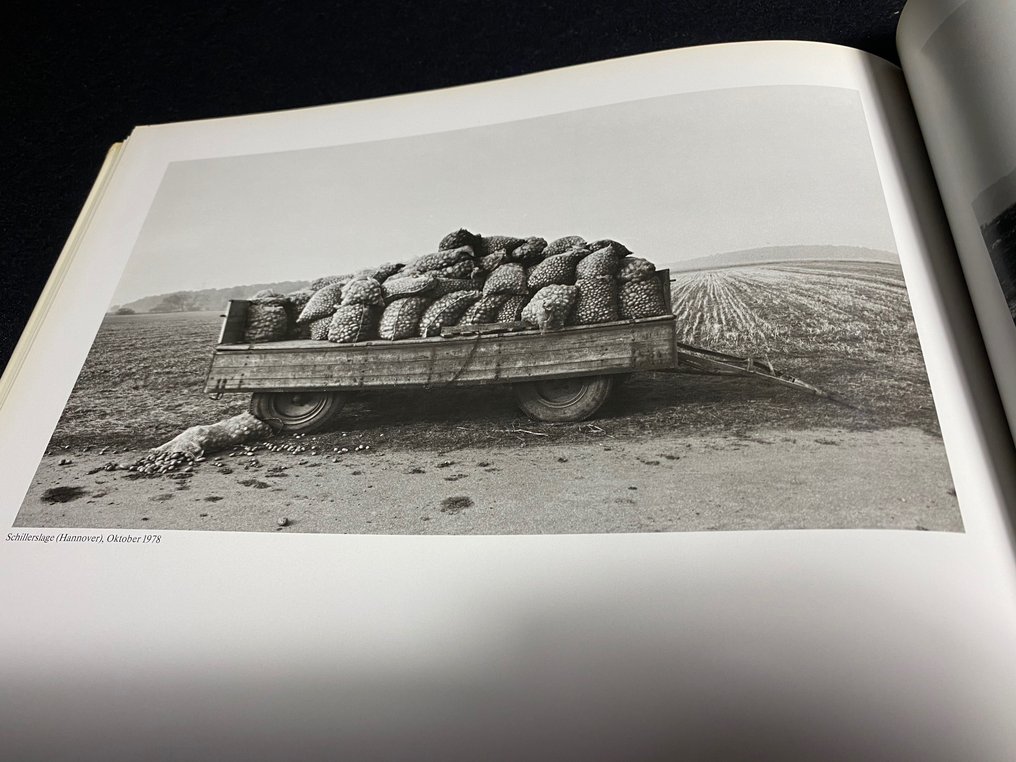
Agrarlandschaften (FIRST PRINTING, WITH ORIGINAL DUSTJACKET) by Heinrich Riebesehl, first edition hardback in German, 96 pages, oversize 402 x 296 mm, published in 1979, with the original dust jacket and in good condition.
AI-assisted summary
Description from the seller
MOST FAMOUS BOOK TITLE by the IMPORTANT GERMAN PHOTOGRAPHER Heinrich Riebesehl (1938-2010), mentioned here:
Martin Parr, Gerry Badger, The photobook, vol 2, page 267.
TRUE ORIGINAL FIRST PRINTING in the VERY IMPRESSIVE OVER-SIZE-FORMAT
(there was a much more smaller format edition published, much more later, in 2002).
SCARCE GERMAN PHOTOBOOK TITLE - with the VERY SCARCE ORIGINAL DUSTJACKET.
This is the LAST EXCLUSIVE BEST-OF-PHOTOBOOKS AUCTION by 5Uhr30.com, Cologne, Germany -
STARTING THIS YEAR.
Heinrich Riebesehl is - alongside Bernd and Hilla Becher - the great documentarist of German photography in the second half of the 20th century.
5Uhr30.com guarantees detailed and accurate descriptions, 100% transport protection, 100% transport insurance and of course combined shipping - worldwide.
Schmalfeldt, Bremen. 1979. First edition, first printing.
Hardback with full black cloth and dustjacket. 296 x 402 cm. 96 pages. 84 black and white photographs. Photos: Heinrich Riebesehl. Additional photos: Albert Renger-Patzsch, Ansel Adams, Bernd and Hilla Becher and Minor White. Design: Hartmut Brückner. Text (introduction essay): Peter Sager. Text in German.
Condition:
Book inside and outside excellent, very fresh and flawless; clean with no marks and with no foxing. The extrem fragile oversize dustjacket still impressive, but with various (mostly smaller) flaws at the edges; little creases and tears (mostly taped from behind) or other forms of smaller defects. Overall very good condition.
German photobook classic - with the original dustjacket (hard to find in any condition).
"Heinrich Riebesehl was a German post-war photographer and university lecturer.
In April 1963 Heinrich Riebesehl began his studies with Otto Steinert at the Folkwangschule für Gestaltung in Essen in the photography work group. In 1965 he left the Folkwangschule after a conflict with Otto Steinert, but resumed his studies in October 1972 after being accepted into the final semester on Steinert's advice. In January 1973, Riebesehl completed his studies with an overall grade of "very good". As his practical final thesis, he submitted photographs from the series Locomotives, Sabine, People in Lifts and Self-Portrayals, among others. Riebesehl wrote his theoretical thesis on the subject of "photographic memories."
The work "Situationen und Objekte" ("Situations and Objects") brings together individual images taken by Riebesehl between 1973 and 1977 in Germany, Japan and Scotland, which can be stylistically assigned to "Magical Realism" and "Subjective Photography" as influenced by Otto Steinert. Situations and Objects is an attempt to make visible the element of the magical, the unreal, inherent in seemingly everyday situations or ordinary objects. Riebesehl worked with hard contrasts and unusual perspectives in order to isolate the objects or people from their surroundings and to situate them in a new context, contrary to the usual viewing habits. Here too, as in the conceptual portrait photographs, the images are numbered consecutively instead of having titles.
The subjective approach Riebesehl pursued in Situations and Objects gives way to working in a documentary style in the series "Agricultural Landscapes", taken from 1976 to 1979. The photographs show a sober, objective image of North German landscapes, mostly deserted and distanced. By choosing a wide-angle framing and a light that is as neutral as possible and by refraining from technical manipulation, Riebesehl pursues the goal of creating an "image that is as simple as possible and easy for the viewer to comprehend".
While Riebesehl initially photographed with a 35 mm camera, he first switched to medium format for the agricultural landscapes and finally to large format (plate camera) in the following series. On the one hand, this technique made it possible to produce detailed, large-format prints with many gradations between black and white; on the other hand, the size and weight of the camera and the resulting need to work with a tripod and slow shutter speeds created a certain static and distance in the pictures. The spontaneity of situations and objects gives way in Agricultural Landscapes to a slower, more considered way of working.
Based on the documentary visual language developed in "Agricultural Landscapes", further series of North German cultural landscapes were created in the 1970s, including industrial buildings, port facilities and railway landscapes. Taken together, these represent an attempt at a topographical survey of the North German landscape and its transformation in the course of increasing industrialisation. Riebesehl worked on this complex of works until the beginning of 2000, which he completed in 2001 with the series Dorfansichten, for which he photographed in colour for the first time. For Agricultural Landscapes, Heinrich Riebesehl was the first photographer to receive the Bernhard Sprengel Prize for Fine Arts in 1981."
(Wikipedia)
Seller's Story
welcome to 5h30.
5Uhr30 is based in ehrenfeld, the trendiest neighborhood in cologne - with a shop and with a showroom for photography.
5H30 offers very rare, very beautiful, very special photobooks - sold-out, modern-antiquarian and antiquarian. we are also offering photo invitation cards, film and photo posters, photo catalogs and original photo prints.
5Uhr30 is specialized on german photo publications,
but also has an exciting range of photo books from all over europe, japan, north and south america. travel brochures, children's books, company brochures...everything that has to do with photography in the narrower or broader sense inspires us. please visit us if you are in cologne or the surrounding area. You will not regret it! :)
5:30 am always tries to offer the best condition.
5h30 is shipping worldwide, fast and safe -
with 100% protection, with full insurance and with tracking number.
please contact us by email, if you have any questions or if you are looking for something special, cause only a part of our offers are online.
Thanks for your interest.
ecki heuser and team
Translated by Google TranslateMOST FAMOUS BOOK TITLE by the IMPORTANT GERMAN PHOTOGRAPHER Heinrich Riebesehl (1938-2010), mentioned here:
Martin Parr, Gerry Badger, The photobook, vol 2, page 267.
TRUE ORIGINAL FIRST PRINTING in the VERY IMPRESSIVE OVER-SIZE-FORMAT
(there was a much more smaller format edition published, much more later, in 2002).
SCARCE GERMAN PHOTOBOOK TITLE - with the VERY SCARCE ORIGINAL DUSTJACKET.
This is the LAST EXCLUSIVE BEST-OF-PHOTOBOOKS AUCTION by 5Uhr30.com, Cologne, Germany -
STARTING THIS YEAR.
Heinrich Riebesehl is - alongside Bernd and Hilla Becher - the great documentarist of German photography in the second half of the 20th century.
5Uhr30.com guarantees detailed and accurate descriptions, 100% transport protection, 100% transport insurance and of course combined shipping - worldwide.
Schmalfeldt, Bremen. 1979. First edition, first printing.
Hardback with full black cloth and dustjacket. 296 x 402 cm. 96 pages. 84 black and white photographs. Photos: Heinrich Riebesehl. Additional photos: Albert Renger-Patzsch, Ansel Adams, Bernd and Hilla Becher and Minor White. Design: Hartmut Brückner. Text (introduction essay): Peter Sager. Text in German.
Condition:
Book inside and outside excellent, very fresh and flawless; clean with no marks and with no foxing. The extrem fragile oversize dustjacket still impressive, but with various (mostly smaller) flaws at the edges; little creases and tears (mostly taped from behind) or other forms of smaller defects. Overall very good condition.
German photobook classic - with the original dustjacket (hard to find in any condition).
"Heinrich Riebesehl was a German post-war photographer and university lecturer.
In April 1963 Heinrich Riebesehl began his studies with Otto Steinert at the Folkwangschule für Gestaltung in Essen in the photography work group. In 1965 he left the Folkwangschule after a conflict with Otto Steinert, but resumed his studies in October 1972 after being accepted into the final semester on Steinert's advice. In January 1973, Riebesehl completed his studies with an overall grade of "very good". As his practical final thesis, he submitted photographs from the series Locomotives, Sabine, People in Lifts and Self-Portrayals, among others. Riebesehl wrote his theoretical thesis on the subject of "photographic memories."
The work "Situationen und Objekte" ("Situations and Objects") brings together individual images taken by Riebesehl between 1973 and 1977 in Germany, Japan and Scotland, which can be stylistically assigned to "Magical Realism" and "Subjective Photography" as influenced by Otto Steinert. Situations and Objects is an attempt to make visible the element of the magical, the unreal, inherent in seemingly everyday situations or ordinary objects. Riebesehl worked with hard contrasts and unusual perspectives in order to isolate the objects or people from their surroundings and to situate them in a new context, contrary to the usual viewing habits. Here too, as in the conceptual portrait photographs, the images are numbered consecutively instead of having titles.
The subjective approach Riebesehl pursued in Situations and Objects gives way to working in a documentary style in the series "Agricultural Landscapes", taken from 1976 to 1979. The photographs show a sober, objective image of North German landscapes, mostly deserted and distanced. By choosing a wide-angle framing and a light that is as neutral as possible and by refraining from technical manipulation, Riebesehl pursues the goal of creating an "image that is as simple as possible and easy for the viewer to comprehend".
While Riebesehl initially photographed with a 35 mm camera, he first switched to medium format for the agricultural landscapes and finally to large format (plate camera) in the following series. On the one hand, this technique made it possible to produce detailed, large-format prints with many gradations between black and white; on the other hand, the size and weight of the camera and the resulting need to work with a tripod and slow shutter speeds created a certain static and distance in the pictures. The spontaneity of situations and objects gives way in Agricultural Landscapes to a slower, more considered way of working.
Based on the documentary visual language developed in "Agricultural Landscapes", further series of North German cultural landscapes were created in the 1970s, including industrial buildings, port facilities and railway landscapes. Taken together, these represent an attempt at a topographical survey of the North German landscape and its transformation in the course of increasing industrialisation. Riebesehl worked on this complex of works until the beginning of 2000, which he completed in 2001 with the series Dorfansichten, for which he photographed in colour for the first time. For Agricultural Landscapes, Heinrich Riebesehl was the first photographer to receive the Bernhard Sprengel Prize for Fine Arts in 1981."
(Wikipedia)
Seller's Story
welcome to 5h30.
5Uhr30 is based in ehrenfeld, the trendiest neighborhood in cologne - with a shop and with a showroom for photography.
5H30 offers very rare, very beautiful, very special photobooks - sold-out, modern-antiquarian and antiquarian. we are also offering photo invitation cards, film and photo posters, photo catalogs and original photo prints.
5Uhr30 is specialized on german photo publications,
but also has an exciting range of photo books from all over europe, japan, north and south america. travel brochures, children's books, company brochures...everything that has to do with photography in the narrower or broader sense inspires us. please visit us if you are in cologne or the surrounding area. You will not regret it! :)
5:30 am always tries to offer the best condition.
5h30 is shipping worldwide, fast and safe -
with 100% protection, with full insurance and with tracking number.
please contact us by email, if you have any questions or if you are looking for something special, cause only a part of our offers are online.
Thanks for your interest.
ecki heuser and team
Translated by Google TranslateDetails
Number of Books
1
Subject
Art, Photography
Book Title
Agrarlandschaften (FIRST PRINTING, WITH ORIGINAL DUSTJACKET)
Author/ Illustrator
Heinrich Riebesehl
Condition
Good
Publication year oldest item
1979
Height
402 mm
Edition
1st Edition
Width
296 mm
Language
German
Original language
Yes
Publisher
J H Schmalfeldt
Binding/ Material
Hardback
Extras
Dust jacket
Number of pages
96
Sold by
GermanyVerified
protop
Rechtliche Informationen des Verkäufers
- Unternehmen:
- 5Uhr30.com
- Repräsentant:
- Ecki Heuser
- Adresse:
- 5Uhr30.com
Thebäerstr. 34
50823 Köln
GERMANY - Telefonnummer:
- +491728184000
- Email:
- photobooks@5Uhr30.com
- USt-IdNr.:
- DE154811593
AGB
AGB des Verkäufers. Mit einem Gebot auf dieses Los akzeptieren Sie ebenfalls die AGB des Verkäufers.
Widerrufsbelehrung
- Frist: 14 Tage sowie gemäß den hier angegebenen Bedingungen
- Rücksendkosten: Käufer trägt die unmittelbaren Kosten der Rücksendung der Ware
- Vollständige Widerrufsbelehrung