Hollandse School (XVII) - Struikrovers (NO RESERVE)


13
days
01
hour
18
minutes
21
seconds
Current bid
€ 2
No reserve price

Expert
Selected by Leo Setz
Over 30 years’ experience as art dealer, appraiser and restorer.
Estimate € 2,200 - € 2,700
9 other people are watching this object
 Bidder 8452 Bidder 8452 | €2 |
|---|
Catawiki Buyer Protection
Your payment’s safe with us until you receive your object.View details
Trustpilot 4.4 | 123536 reviews
Rated Excellent on Trustpilot.
Struikrovers, a 17th‑century oil painting from the Netherlands, hand-signed and sold with a frame.
AI-assisted summary
Description from the seller
Hollandse School (XVII)
Struikrovers
Oil paint on panel, 49.5 × 65 cm
With list 60.5 × 75.5 cm
Dutch Golden Age
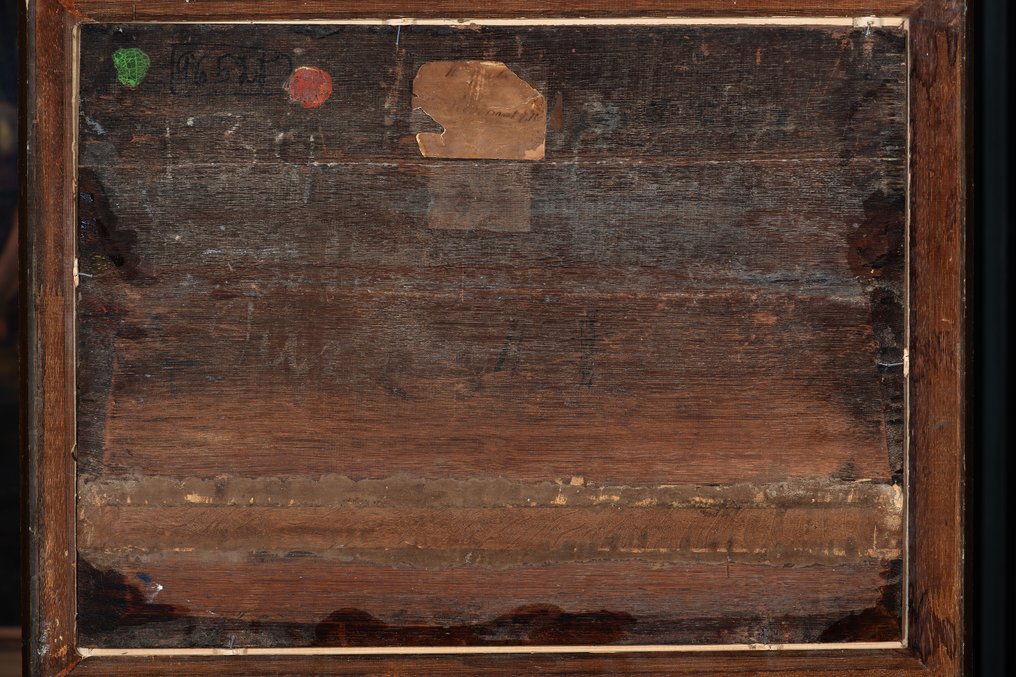
Reverse: unclear signature; old paper assignment (illegible/partially lost); panel makers'/collection seals (17th/18th century)
Condition: strongly darkened; retouchings visible under UV; localized paint loss; old crack repair (probably 18th/19th century); recently superficially cleaned and coated with ultrathin matte dammar varnish (satin gloss); frame with small updated damages.
Introduction
This work belongs to the attractive, narrative spectrum of the Dutch seventeenth century, where landscape, genre, and rider scenes come together in a single image. The painter does not opt for a loud climax but for a moment of restrained tension: a traveling party is confronted by a group of riders and foot soldiers on a remote route. The tension arises from distance, posture, and light, as well as from the way the landscape itself functions as a 'stage.' In the context of a premium auction with No Reserve, this panel offers a rare combination of narrative subject matter, powerful atmosphere, and convincing Golden Age imagery.
Subject and iconography
Depictions of highway robbers, assaults, and risky journeys fit within a seventeenth-century interest in everyday life, the dangers of travel, and the fragile order outside the city. Such scenes often operate on multiple levels: as exciting anecdotes, as recognizable travel images (carriages, riders, horses, sandy routes), and as moral references to vigilance, chance, and vulnerability.
It is important that the painter does not explicitly depict the 'crime'; rather, the moment of encounter – when not everything has been decided yet – keeps the viewer engaged. As a result, the work remains timeless: it is less about a specific incident, and more about the psychological weight of an insecure passage.
Description of the performance
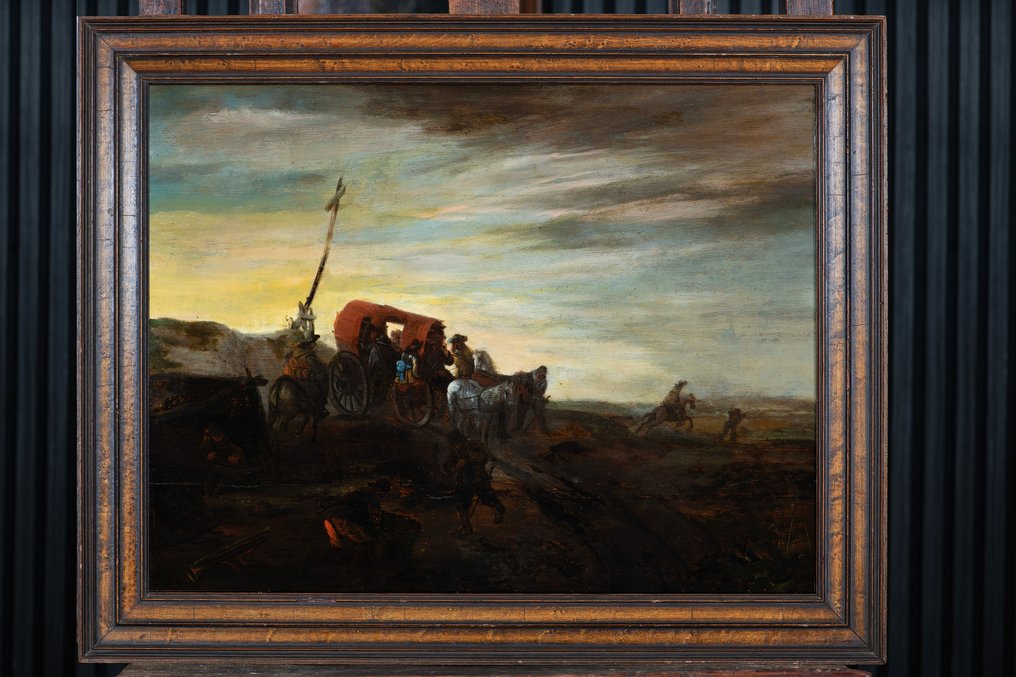
Links dominates a compact group: a red-covered carriage with passengers, accompanied by riders and horses. The carriage wheels, the massive forms of the horse bodies, and the clustering of figures create a heavy visual core. Immediately beside it stands a slender, diagonally ascending element (a stake or road marker) that acts as a vertical 'break' in the horizontal landscape.
The space opens up: a low horizon, a broad strip of flat land, and small figures moving in the distance. This openness gives the scene breath and depth, but also a sense of isolation. The travelers are not in a sheltered world of houses and city walls, but in a landscape where help is far away.
Composition and spatial structure
The composition is deliberately asymmetrical.
A dense, dark, and heavy cluster on the left (event, mass, proximity).
• an expanding, lighter right half (distance, horizon, escape space)
This contrast is a classic technique in Dutch landscape art: the painter first directs the eye to the narrative focal point and then allows it to 'look away' along the horizon. The diagonal of the road and the riders enhances the dynamism; it is as if the route not only cuts through the landscape but also through the story.
Light, atmosphere, and time of day.
The light enters low and from the side, with a bright band near the horizon on the left. This backlighting partially silhouettes both humans and animals, making the action more suggestive: details fade away, and the gestures become all the more significant. The sky is broadly rendered and sets the mood. Cloud streaks and color gradients suggest a day’s edge (early or late), exactly the kind of hour when paintings often emphasize the uncertainty of travel.
The current darkening enhances this effect: the scene has become more tonal, darker, and more mysterious. At the same time, the sky remains convincingly readable, allowing the work to retain its atmospheric 'tension.'
Color palette and accentuation
The palette consists of muted earth tones (brown, umber, dark greens) contrasted with cooler blue shades and gray-greens in the sky. Among this sobriety, one element immediately stands out: the red canopy of the cart. This is not an incidental detail but a compositional tool: the red patch fixes the gaze on the central scene and acts as a counterweight to the cool sky.
In the Dutch Golden Age, such a controlled color accent is typical for painters who want to highlight a story without losing the natural atmosphere.
Technique: oil paint on panel
The painting is executed on panel, which was widely used in the seventeenth century for works where control and sharpness were combined with subtle transitions. In the sky and the distance, the paint layers appear thinner and more fluid, with horizontal strokes structuring the cloud cover. In the foreground and around the group near the cart, the paint is more compact and matte, with stronger contrasts.
Panels age differently than fabric: they can function, tear, or show old repairs. In this case, it is a historic tear repair, which fits with a long-lasting lifespan of a panel painting.
Stylistic placement within art history
The work fits within the Dutch Golden Age and relates to the narrative landscape and the rider's piece. It is less topographically precise than some cityscapes, and less 'portrait-like' than pure figure pieces; the painter opts for a hybrid genre in which landscape is the emotional carrier and the figures serve as the narrative anchor.
Contemporaries: Philips Wouwerman, Karel Dujardin, Johannes Lingelbach, Jan Both, Pieter van Laer; Salvator Rosa, Jacques Courtois
Description, signature, and brands.
On the reverse side, there are an unclear signature and an old paper attribution (partly lost or illegible), alongside old marks/seals that may indicate panel maker or collection context (17th/18th century). These traces are interesting as witnesses of age and circulation but, based on the available legibility, do not allow for a definitive attribution of the name. Therefore, the work is carefully offered as Dutch School (17th century).
Condition and conservation reporting
The panel is in a condition that resembles a well-worn 17th-century object.
Strongly darkened: the image is heavier in tone; shadow areas are more compact.
Retouchings: visible under UV, matching older restorative procedures.
Paint loss: local, especially in dark zones where it is visually more noticeable.
• Old repair of the skull: historical (probably 18th/19th century), to be carefully considered as part of the material history.
Recent maintenance: superficial cleaning and a very thin matte dammar varnish that gives the surface a subtle sheen.
• List: small, locally updated damages; the presentation remains overall neat.
Presentation and collectible value
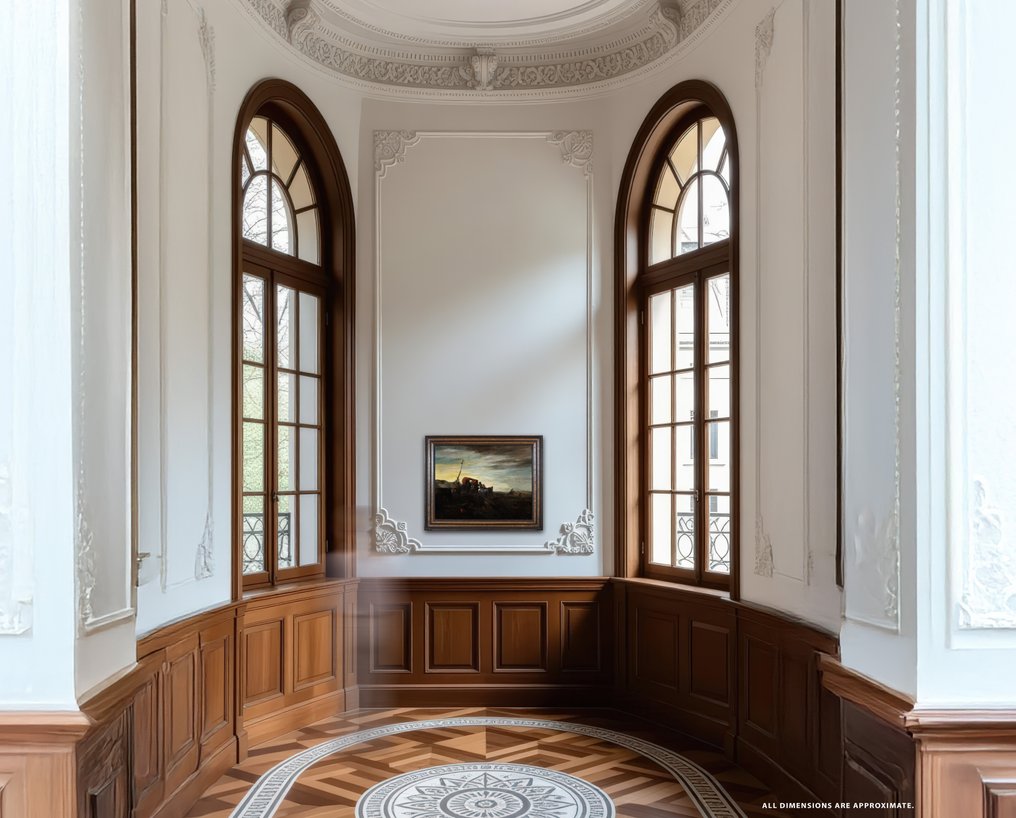
Despite – and partly because of – the tonal darkening, the work possesses a pronounced 'old master' presence: the eye is immediately drawn to the carriage, after which the viewer experiences the emptiness and risk of the route. In an interior, this panel works particularly well through the combination of dramatic sky, low horizon, and the red accent. Moreover, the subject is worth collecting: bandit and horseman scenes remain popular because they depict the Golden Age not only as a landscape tradition but also as a narrative culture of travel, trade, and uncertainty.
Conclusion
Struikrovers is a strongly atmospheric piece within the Dutch School of the seventeenth century, in which composition, atmosphere, and narrative are perfectly harmonized. The old restoration traces and the visible restoration history emphasize the authenticity and long lifespan of the object. Offered with No Reserve, this presents an excellent opportunity to acquire a characterful, narrative Golden Age panel with a subject that combines both tension and classical landscape quality.
The work 'Struikrovers' is made of a walnut wood frame (small damages: see photos).
Total dimensions: 60.5x75.5cm
Panel dimensions: 49.5x65cm
All shipments are sent in professional packaging via FedEx, DPD, or PostNL.
For all shipments, a surcharge for packaging material applies, which is already included in the stated shipping price.
Shipping artworks always carries certain risks. While shipping is possible, we recommend collecting the artwork in person when this option is available. If shipping is chosen, this is entirely at the buyer's risk. Collection ensures that the artwork will be received undamaged and in perfect condition. After purchase, you can easily schedule an appointment to collect the artwork from our workshop and studio, where it will be safely and carefully prepared for you.
Transport quotation request via our website (Service-transport) or via Catawiki support.
When purchasing this artwork, you have the option to have it delivered with or without a frame. The frame, richly decorated and matching the artwork, is offered free of charge so you can hang the painting immediately. Although we take utmost care in professional packaging and shipping, there is a small risk of damage to the frame or glass during transport. Any damage to the frame or glass that does not affect the artwork itself will not be accepted as a valid reason for a claim or cancellation. We recommend collecting the artwork in person or arranging your own transportation, as damage to the frame, especially the plaster ornaments, will not be covered.
We aim to deliver your artwork to you safely and in optimal condition, paying careful attention to packaging and the shipping process. If you have any questions or special requests, you can always contact Catawiki customer service.
The customer is responsible for any customs duties and additional costs that may apply upon delivery abroad.
From the moment your purchase is confirmed, we treat each shipment as an individual project. Each painting is carefully packed with high-quality, professional shipping materials, and we select the most suitable carrier based on destination, transit time, and handling requirements. We monitor each package closely until delivery is completed.
Since no two artworks are the same, we often create custom-made, handmade shipping containers or boxes tailored to the size, framing, and fragility of the painting, as well as the distance and transport conditions to your address. This guarantees the best possible protection throughout the entire journey.
To support a smooth international shipping process, we prepare the correct documents and shipping documentation, including customs codes and export-related information if necessary.
In some cases, we proactively contact you to confirm that your package has arrived safely, that the painting is in good condition, and to answer any questions you may have.
We usually call the phone number provided to Catawiki, and this conversation will be in English.
If desired, you can also reach us via email or through the Catawiki chat.
Seller's Story
Welcome to Vandenberg Fine Art BV on Catawiki.
Vandenberg Fine Art BV specializes in painting from the 15th through the 19th century, with a particular focus on Dutch, Flemish, and Italian masters. Our carefully curated collection comprises high-quality artworks distinguished by their artistic merit, authenticity, and historical significance.
Our offering includes works by leading artists of the Dutch and Flemish schools, as well as important representatives of the Italian Renaissance and Baroque. Each artwork is selected with expertise and care, with close attention paid to condition, provenance, and art-historical relevance.
At Vandenberg Fine Art, reliability and transparency are fundamental values. We provide detailed descriptions, high-quality images, and thoroughly conducted provenance research. Our aim is to support both experienced collectors and emerging art enthusiasts in making well-informed decisions.
Explore our exclusive collection and experience the rich history and enduring beauty of classical painting.
Translated by Google TranslateHollandse School (XVII)
Struikrovers
Oil paint on panel, 49.5 × 65 cm
With list 60.5 × 75.5 cm
Dutch Golden Age
Reverse: unclear signature; old paper assignment (illegible/partially lost); panel makers'/collection seals (17th/18th century)
Condition: strongly darkened; retouchings visible under UV; localized paint loss; old crack repair (probably 18th/19th century); recently superficially cleaned and coated with ultrathin matte dammar varnish (satin gloss); frame with small updated damages.
Introduction
This work belongs to the attractive, narrative spectrum of the Dutch seventeenth century, where landscape, genre, and rider scenes come together in a single image. The painter does not opt for a loud climax but for a moment of restrained tension: a traveling party is confronted by a group of riders and foot soldiers on a remote route. The tension arises from distance, posture, and light, as well as from the way the landscape itself functions as a 'stage.' In the context of a premium auction with No Reserve, this panel offers a rare combination of narrative subject matter, powerful atmosphere, and convincing Golden Age imagery.
Subject and iconography
Depictions of highway robbers, assaults, and risky journeys fit within a seventeenth-century interest in everyday life, the dangers of travel, and the fragile order outside the city. Such scenes often operate on multiple levels: as exciting anecdotes, as recognizable travel images (carriages, riders, horses, sandy routes), and as moral references to vigilance, chance, and vulnerability.
It is important that the painter does not explicitly depict the 'crime'; rather, the moment of encounter – when not everything has been decided yet – keeps the viewer engaged. As a result, the work remains timeless: it is less about a specific incident, and more about the psychological weight of an insecure passage.
Description of the performance
Links dominates a compact group: a red-covered carriage with passengers, accompanied by riders and horses. The carriage wheels, the massive forms of the horse bodies, and the clustering of figures create a heavy visual core. Immediately beside it stands a slender, diagonally ascending element (a stake or road marker) that acts as a vertical 'break' in the horizontal landscape.
The space opens up: a low horizon, a broad strip of flat land, and small figures moving in the distance. This openness gives the scene breath and depth, but also a sense of isolation. The travelers are not in a sheltered world of houses and city walls, but in a landscape where help is far away.
Composition and spatial structure
The composition is deliberately asymmetrical.
A dense, dark, and heavy cluster on the left (event, mass, proximity).
• an expanding, lighter right half (distance, horizon, escape space)
This contrast is a classic technique in Dutch landscape art: the painter first directs the eye to the narrative focal point and then allows it to 'look away' along the horizon. The diagonal of the road and the riders enhances the dynamism; it is as if the route not only cuts through the landscape but also through the story.
Light, atmosphere, and time of day.
The light enters low and from the side, with a bright band near the horizon on the left. This backlighting partially silhouettes both humans and animals, making the action more suggestive: details fade away, and the gestures become all the more significant. The sky is broadly rendered and sets the mood. Cloud streaks and color gradients suggest a day’s edge (early or late), exactly the kind of hour when paintings often emphasize the uncertainty of travel.
The current darkening enhances this effect: the scene has become more tonal, darker, and more mysterious. At the same time, the sky remains convincingly readable, allowing the work to retain its atmospheric 'tension.'
Color palette and accentuation
The palette consists of muted earth tones (brown, umber, dark greens) contrasted with cooler blue shades and gray-greens in the sky. Among this sobriety, one element immediately stands out: the red canopy of the cart. This is not an incidental detail but a compositional tool: the red patch fixes the gaze on the central scene and acts as a counterweight to the cool sky.
In the Dutch Golden Age, such a controlled color accent is typical for painters who want to highlight a story without losing the natural atmosphere.
Technique: oil paint on panel
The painting is executed on panel, which was widely used in the seventeenth century for works where control and sharpness were combined with subtle transitions. In the sky and the distance, the paint layers appear thinner and more fluid, with horizontal strokes structuring the cloud cover. In the foreground and around the group near the cart, the paint is more compact and matte, with stronger contrasts.
Panels age differently than fabric: they can function, tear, or show old repairs. In this case, it is a historic tear repair, which fits with a long-lasting lifespan of a panel painting.
Stylistic placement within art history
The work fits within the Dutch Golden Age and relates to the narrative landscape and the rider's piece. It is less topographically precise than some cityscapes, and less 'portrait-like' than pure figure pieces; the painter opts for a hybrid genre in which landscape is the emotional carrier and the figures serve as the narrative anchor.
Contemporaries: Philips Wouwerman, Karel Dujardin, Johannes Lingelbach, Jan Both, Pieter van Laer; Salvator Rosa, Jacques Courtois
Description, signature, and brands.
On the reverse side, there are an unclear signature and an old paper attribution (partly lost or illegible), alongside old marks/seals that may indicate panel maker or collection context (17th/18th century). These traces are interesting as witnesses of age and circulation but, based on the available legibility, do not allow for a definitive attribution of the name. Therefore, the work is carefully offered as Dutch School (17th century).
Condition and conservation reporting
The panel is in a condition that resembles a well-worn 17th-century object.
Strongly darkened: the image is heavier in tone; shadow areas are more compact.
Retouchings: visible under UV, matching older restorative procedures.
Paint loss: local, especially in dark zones where it is visually more noticeable.
• Old repair of the skull: historical (probably 18th/19th century), to be carefully considered as part of the material history.
Recent maintenance: superficial cleaning and a very thin matte dammar varnish that gives the surface a subtle sheen.
• List: small, locally updated damages; the presentation remains overall neat.
Presentation and collectible value
Despite – and partly because of – the tonal darkening, the work possesses a pronounced 'old master' presence: the eye is immediately drawn to the carriage, after which the viewer experiences the emptiness and risk of the route. In an interior, this panel works particularly well through the combination of dramatic sky, low horizon, and the red accent. Moreover, the subject is worth collecting: bandit and horseman scenes remain popular because they depict the Golden Age not only as a landscape tradition but also as a narrative culture of travel, trade, and uncertainty.
Conclusion
Struikrovers is a strongly atmospheric piece within the Dutch School of the seventeenth century, in which composition, atmosphere, and narrative are perfectly harmonized. The old restoration traces and the visible restoration history emphasize the authenticity and long lifespan of the object. Offered with No Reserve, this presents an excellent opportunity to acquire a characterful, narrative Golden Age panel with a subject that combines both tension and classical landscape quality.
The work 'Struikrovers' is made of a walnut wood frame (small damages: see photos).
Total dimensions: 60.5x75.5cm
Panel dimensions: 49.5x65cm
All shipments are sent in professional packaging via FedEx, DPD, or PostNL.
For all shipments, a surcharge for packaging material applies, which is already included in the stated shipping price.
Shipping artworks always carries certain risks. While shipping is possible, we recommend collecting the artwork in person when this option is available. If shipping is chosen, this is entirely at the buyer's risk. Collection ensures that the artwork will be received undamaged and in perfect condition. After purchase, you can easily schedule an appointment to collect the artwork from our workshop and studio, where it will be safely and carefully prepared for you.
Transport quotation request via our website (Service-transport) or via Catawiki support.
When purchasing this artwork, you have the option to have it delivered with or without a frame. The frame, richly decorated and matching the artwork, is offered free of charge so you can hang the painting immediately. Although we take utmost care in professional packaging and shipping, there is a small risk of damage to the frame or glass during transport. Any damage to the frame or glass that does not affect the artwork itself will not be accepted as a valid reason for a claim or cancellation. We recommend collecting the artwork in person or arranging your own transportation, as damage to the frame, especially the plaster ornaments, will not be covered.
We aim to deliver your artwork to you safely and in optimal condition, paying careful attention to packaging and the shipping process. If you have any questions or special requests, you can always contact Catawiki customer service.
The customer is responsible for any customs duties and additional costs that may apply upon delivery abroad.
From the moment your purchase is confirmed, we treat each shipment as an individual project. Each painting is carefully packed with high-quality, professional shipping materials, and we select the most suitable carrier based on destination, transit time, and handling requirements. We monitor each package closely until delivery is completed.
Since no two artworks are the same, we often create custom-made, handmade shipping containers or boxes tailored to the size, framing, and fragility of the painting, as well as the distance and transport conditions to your address. This guarantees the best possible protection throughout the entire journey.
To support a smooth international shipping process, we prepare the correct documents and shipping documentation, including customs codes and export-related information if necessary.
In some cases, we proactively contact you to confirm that your package has arrived safely, that the painting is in good condition, and to answer any questions you may have.
We usually call the phone number provided to Catawiki, and this conversation will be in English.
If desired, you can also reach us via email or through the Catawiki chat.
Seller's Story
Welcome to Vandenberg Fine Art BV on Catawiki.
Vandenberg Fine Art BV specializes in painting from the 15th through the 19th century, with a particular focus on Dutch, Flemish, and Italian masters. Our carefully curated collection comprises high-quality artworks distinguished by their artistic merit, authenticity, and historical significance.
Our offering includes works by leading artists of the Dutch and Flemish schools, as well as important representatives of the Italian Renaissance and Baroque. Each artwork is selected with expertise and care, with close attention paid to condition, provenance, and art-historical relevance.
At Vandenberg Fine Art, reliability and transparency are fundamental values. We provide detailed descriptions, high-quality images, and thoroughly conducted provenance research. Our aim is to support both experienced collectors and emerging art enthusiasts in making well-informed decisions.
Explore our exclusive collection and experience the rich history and enduring beauty of classical painting.
Translated by Google TranslateDetails
Artist
Hollandse School (XVII)
Sold with frame
Yes
Title of artwork
Struikrovers (NO RESERVE)
Technique
Oil painting
Signature
Hand signed
Country of Origin
Netherlands
Condition
Fair condition
Height
60.5 cm
Width
75.5 cm
Depiction/Theme
Historical scene
Style
Dutch Golden Age
Period
17th century
Sold by
