No reserve price - Necklace Silver Pearl - Pearl


00
days
20
hours
41
minutes
46
seconds

46 other people are watching this object
 Bidder 2397 Bidder 2397 | €11 | |
|---|---|---|
 Bidder 5268 Bidder 5268 | €9 | |
 Bidder 1325 Bidder 1325 | €8 | |
Catawiki Buyer Protection
Your payment’s safe with us until you receive your object.View details
Trustpilot 4.4 | 123641 reviews
Rated Excellent on Trustpilot.
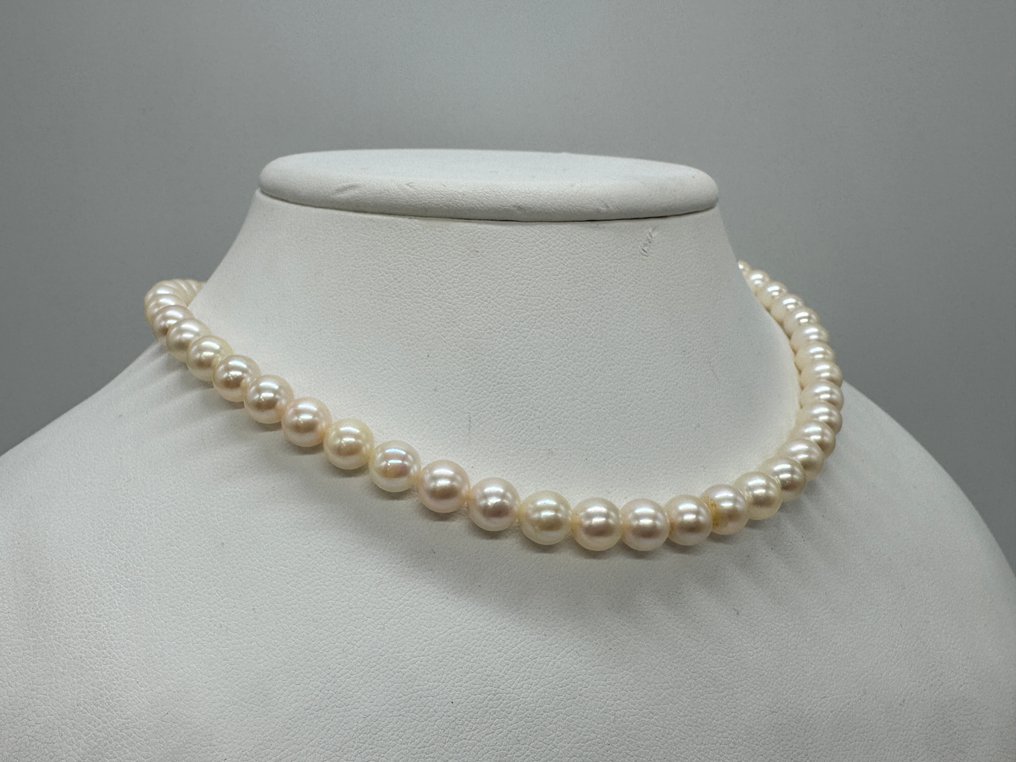
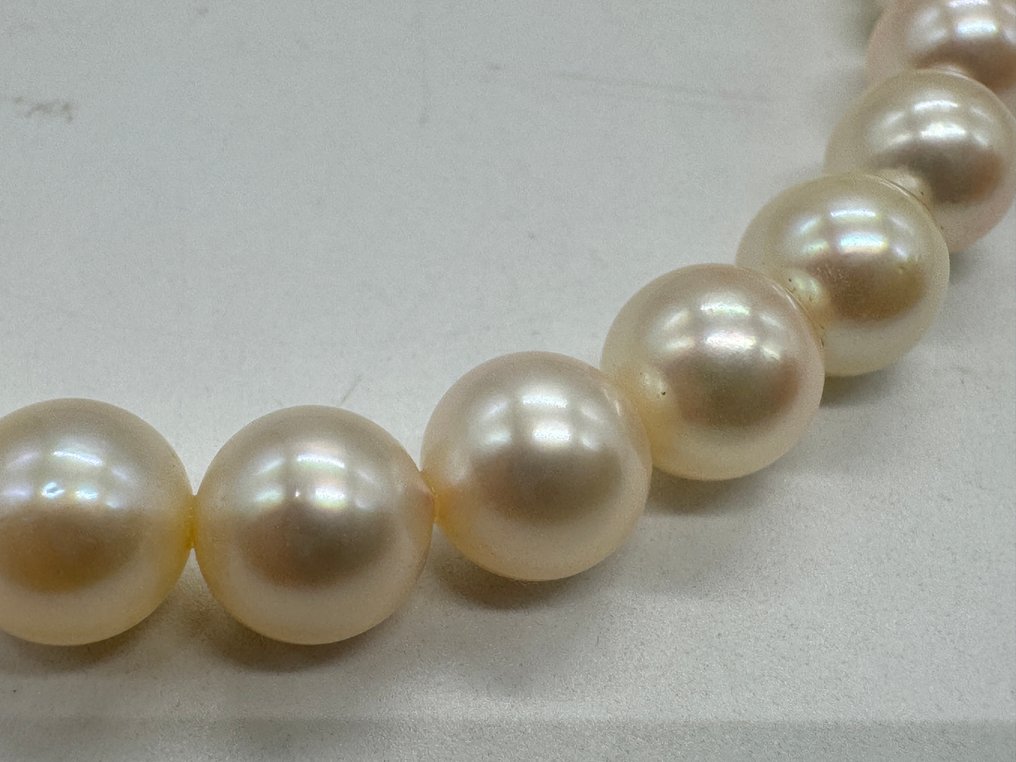
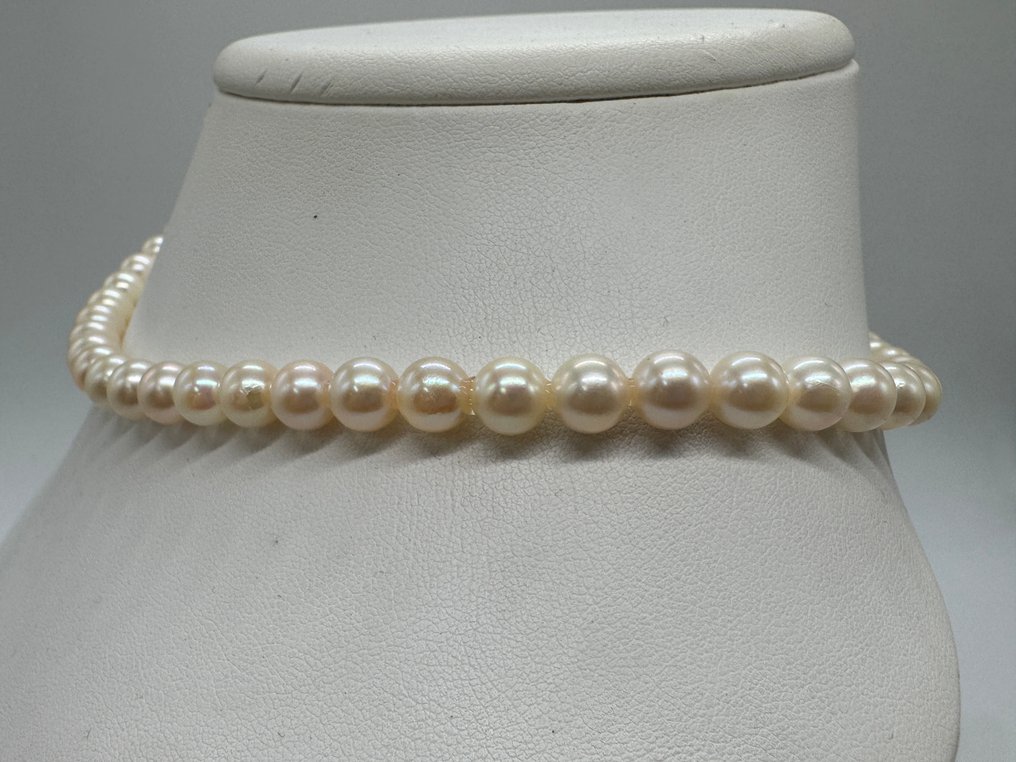
Silver necklace featuring 54 Akoya cultured pearls, round 7.0 mm white pearls with good lustre and moderately spotted surfaces, total weight 30 g, length 40 cm, made in Japan, no laboratory report and no brand, for women, in good used condition.
AI-assisted summary
Description from the seller
-History and Details-
Japanese Akoya Pearls: History and Value
The history of Japanese Akoya pearls began in 1893 when Kokichi Mikimoto established
the world's first cultured pearl technology.
Developing primarily around Ago Bay in Mie Prefecture, Japan became known worldwide
as a pioneer in the cultured pearl industry.
The value of Akoya pearls lies in their distinctive beautiful luster (teri).
The deep radiance created by thin, uniformly layered nacre and subtle
colors ranging from cream to pink and silver are characteristic features.
Sizes of 6-8mm are most common, with perfectly round, flawless top-grade specimens
being extremely rare.
Their rarity has increased due to extended cultivation periods (2-3 years),
rising water temperatures from climate change, disease outbreaks, and declining numbers of skilled technicians. Recent production decreases have also driven up their value.
The reasons for their global trend include growing interest in sustainability,
appreciation for Japanese craftsmanship, and a renaissance in classic jewelry.
Particularly in Western luxury jewelry markets, Japanese Akoya pearls are highly
valued for their quality and reliability, attracting attention as investment pieces.
Their natural beauty and rarity align perfectly with contemporary values.
-Condition-
This pearl necklace was manufactured and sold likely several decades ago.
It features the distinctive luster and nacre characteristic of pearls, with a refined, understated glow.
While the color has changed over the years, this can also be considered part of its unique character.
There are some signs of wear and minor scratches, but these are not noticeable at a conversational distance. The clasp uses a traditional SILVER metal fitting. As there are no cushions between the pearls,
it is prone to accumulating dirt.
We hope you will enjoy these beautiful Japanese pearls.
- Shipping method-
The lot will be carefully packaged and sent by DHL or FedEx depend on the situation.
It takes about 3 weeks to receive normally.
Import duties, taxes, and charges are not included in the item price or shipping cost.
These charges are the buyer's responsibility.
Sometimes Customes or delivery company in your country contact you for Customs clearance via phone or email. Please make sure that you could answer the phone. If you don't, the parcel will return to me and it cost more double shipping fee for reshipping.
I appreciate your cooperation.
-History and Details-
Japanese Akoya Pearls: History and Value
The history of Japanese Akoya pearls began in 1893 when Kokichi Mikimoto established
the world's first cultured pearl technology.
Developing primarily around Ago Bay in Mie Prefecture, Japan became known worldwide
as a pioneer in the cultured pearl industry.
The value of Akoya pearls lies in their distinctive beautiful luster (teri).
The deep radiance created by thin, uniformly layered nacre and subtle
colors ranging from cream to pink and silver are characteristic features.
Sizes of 6-8mm are most common, with perfectly round, flawless top-grade specimens
being extremely rare.
Their rarity has increased due to extended cultivation periods (2-3 years),
rising water temperatures from climate change, disease outbreaks, and declining numbers of skilled technicians. Recent production decreases have also driven up their value.
The reasons for their global trend include growing interest in sustainability,
appreciation for Japanese craftsmanship, and a renaissance in classic jewelry.
Particularly in Western luxury jewelry markets, Japanese Akoya pearls are highly
valued for their quality and reliability, attracting attention as investment pieces.
Their natural beauty and rarity align perfectly with contemporary values.
-Condition-
This pearl necklace was manufactured and sold likely several decades ago.
It features the distinctive luster and nacre characteristic of pearls, with a refined, understated glow.
While the color has changed over the years, this can also be considered part of its unique character.
There are some signs of wear and minor scratches, but these are not noticeable at a conversational distance. The clasp uses a traditional SILVER metal fitting. As there are no cushions between the pearls,
it is prone to accumulating dirt.
We hope you will enjoy these beautiful Japanese pearls.
- Shipping method-
The lot will be carefully packaged and sent by DHL or FedEx depend on the situation.
It takes about 3 weeks to receive normally.
Import duties, taxes, and charges are not included in the item price or shipping cost.
These charges are the buyer's responsibility.
Sometimes Customes or delivery company in your country contact you for Customs clearance via phone or email. Please make sure that you could answer the phone. If you don't, the parcel will return to me and it cost more double shipping fee for reshipping.
I appreciate your cooperation.
Details
Era
1900-2000
Pearl type
Akoya cultured pearl
Laboratory Report
No laboratory report
Number of pearls
54
Brand jewellery
No
Metal
Silver
Main Stone
Pearl
Diameter of pearls (in mm)
7 mm
Surrounding Stones
Pearl
Total weight
30 g
Pearl colour
White
Condition
Good condition - used with some signs of wear
Pearl shape
Round
Country of Origin
Japan
Pearl surface quality
Moderately spotted
Gender
Women
Pearl lustre
Good
Length
40 cm
Sold by
Disclaimer
Catawiki always aims to offer you the best possible buying experience. Our experts virtually review and select every object in line with our submission guidelines. While we strive to provide a detailed description and photographs of each jewellery object, discrepancies or inaccuracies may occur. It is your responsibility to review all of the information provided about an object, including the condition and description, before placing an order. Sellers are responsible for the information, pictures and description provided, including the quality, quantity and nature of the jewelry supplied. A small imperfection that cannot be seen in the photo but is included in the description is not a non-conformity. A Lab Report is not a guarantee, valuation or appraisal regarding the articles described therein. A Lab Report contains only the characteristics of an article described after it has been graded, tested, examined, and analyzed using the techniques and equipment used at the time of the examination from that specific Lab. The results of any other examination performed on the article may differ depending when, how, by whom and with which grading standard the article is examined. In addition, any changes and improvements in techniques and equipment that may have occurred which may enable the examiner to detect, among other things, the use of processes for altering the characteristics of an article which use was previously undetectable, does not automatically mean the object does not conform to its description.
Catawiki always aims to offer you the best possible buying experience. Our experts virtually review and select every object in line with our submission guidelines. While we strive to provide a detailed description and photographs of each jewellery object, discrepancies or inaccuracies may occur. It is your responsibility to review all of the information provided about an object, including the condition and description, before placing an order. Sellers are responsible for the information, pictures and description provided, including the quality, quantity and nature of the jewelry supplied. A small imperfection that cannot be seen in the photo but is included in the description is not a non-conformity. A Lab Report is not a guarantee, valuation or appraisal regarding the articles described therein. A Lab Report contains only the characteristics of an article described after it has been graded, tested, examined, and analyzed using the techniques and equipment used at the time of the examination from that specific Lab. The results of any other examination performed on the article may differ depending when, how, by whom and with which grading standard the article is examined. In addition, any changes and improvements in techniques and equipment that may have occurred which may enable the examiner to detect, among other things, the use of processes for altering the characteristics of an article which use was previously undetectable, does not automatically mean the object does not conform to its description.