Derk Jan Pruim (1806-1866) - Jagers Plaspauze (NO RESERVE)


10
days
07
hours
50
minutes
55
seconds
Current bid
€ 90
No reserve price

Expert
Selected by Leo Setz
Over 30 years’ experience as art dealer, appraiser and restorer.
Estimate € 1,100 - € 1,400
42 other people are watching this object
 Bidder 1792 Bidder 1792 | €90 | |
|---|---|---|
| Bidder 8368 | €85 | |
| Bidder 1792 | €80 | |
Catawiki Buyer Protection
Your payment’s safe with us until you receive your object.View details
Trustpilot 4.4 | 123718 reviews
Rated Excellent on Trustpilot.
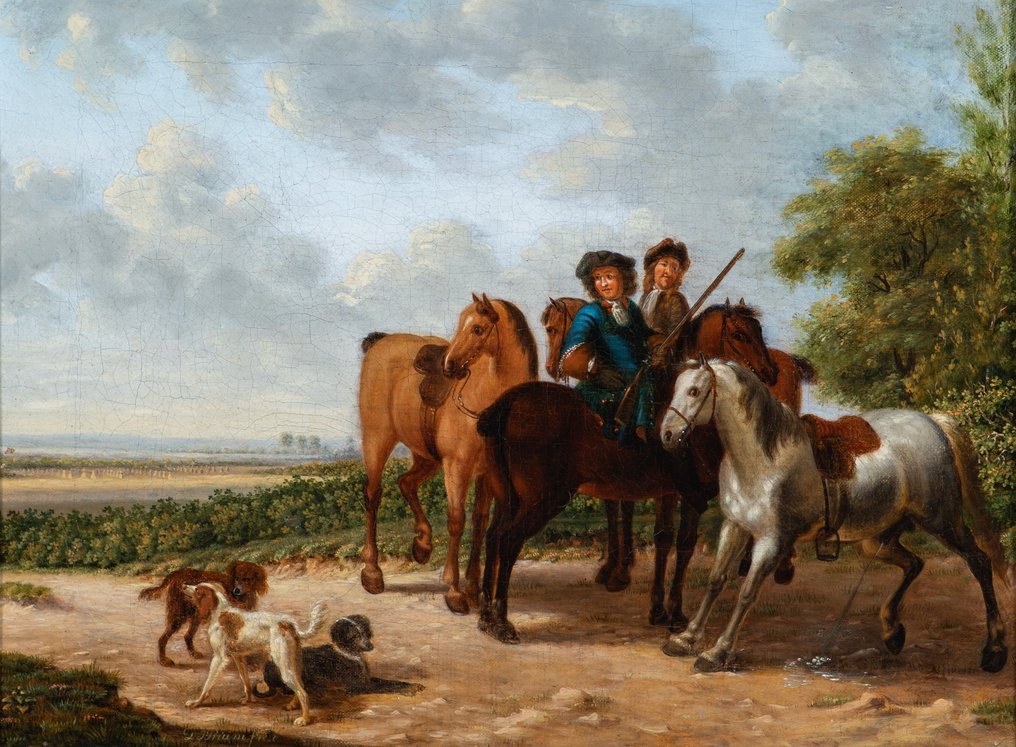
Jagers Plaspauze, a 19th‑century oil painting by Derk Jan Pruim (1831), Netherlands, sold with frame.
AI-assisted summary
Description from the seller
Derk Jan Pruim (1806–1866)
Hunters – fart break
Oil painting on canvas, 31 × 41.5 cm
With frame approx. 53 × 63 cm
Dutch Romanticism – hand-signed and dated 1831
Craquelé visible in retouchings (UV); baroque frame with updated damages; the work does not fit optimally in the frame (advice: (re)framing).
No Reserve
Introduction
This compact, precise painting captures a typical 19th-century romantic moment: riders and hunting dogs taking a short rest, with horses impatiently stamping at the edge of a country road. The artist combines genre, landscape, and animal study into an elegant scene that feels both anecdotal and monumental— a work that presents greatness in a small format, partly due to the lively stance of the white-gray horse in the foreground.
The artist: Derk Jan Pruim
Derk Jan Pruim is known to have come from Dalfsen and grew up in the environment of a painter-glassmaker; alongside working for his father, he drew and painted. His talent led him to a position as a draftsman in Zwolle, where he also lived. The same source mentions that he painted, in a romantic style, among other works, a depiction of Kasteel Rechteren—an indication that Pruim felt at home in the romantic imagination of the Dutch landscape and its surroundings.
That it is indeed plausible for a rider and hunting scene to be within his body of work is further supported by the auction circuit where similar subjects circulate under his name.
Presentation, composition, and narrative
The composition is clear and effectively structured around a compact group of riders and horses, subtly accentuated to the right by the tree cluster and the shiny white of the front horse. On the left, the landscape opens up to a low horizon with a broad sky—a classic romantic solution that provides space and breath, and as if to bring the figures forward.
The dogs in the foreground form the narrative anchor: they mark the pause, suggest the hunting context, and enhance everyday realism. The riders—with hunting rifles and traditional headgear—are not merely portrait figures but carriers of a snapshot of the era: a bourgeois-aristocratic leisure culture where hunting, riding, and landscape enjoyment come together.
Technique and painting style
Pruim works in oil paint with a delicate, refined brushwork that is especially visible in the horses: the modeling of muscles, the subtle transitions in the coat, and the gloss accents around the chest and flanks reveal an experienced eye for animal anatomy. The sky is painted in an uplifting manner with soft cloud formations and thin glazing-like transitions, creating a gentle atmosphere that is typical of romantic landscape concepts.
The signature and dating (1831) are integrated into the paint layer and confirm an early, fresh phase: the work still possesses that direct clarity often associated with relatively early romanticism, before the palette generally becomes heavier and browner in the second half of the century.
Color palette and light
The palette balances between warm earth tones (sand, horse brown, saddles) and cooler accents (sky blue, green in the tree foliage). The striking white-gray horse acts as a light carrier: it draws the eye and gives the whole an aristocratic flair. The color contrasts are not loud but refined—particularly the interplay of white, gray, and warm browns is carefully dosed.
Style and placement within art history
Within Dutch Romanticism, this work aligns with the reevaluation of the native landscape and the 'experienced' outdoor life: not the topographically exact state is central, but the suggestive, atmospheric moment. The combination of landscape and animal study places the painting within a tradition where the horse—symbol of status, freedom, and movement—takes a leading role.
Comparable national style peers (selection): Barend Cornelis Koekkoek, Andreas Schelfhout, Wijnand Nuijen, Charles Rochussen, Johannes Franciscus Hoppenbrouwers.
International: Théodore Géricault, Eugène Delacroix.
Condition, touch-ups, and list.
There is craquelure consistent with age and technique. Under UV light, retouchings are visible, especially in the higher, lighter areas (such as the sky), indicating previous maintenance and localized restoration. The Baroque frame shows some repaired damages. A practical point: the painting does not fit optimally in this frame; from a presentation perspective, re-framing or a better-fitting profile is recommended—especially for a work whose elegance benefits from a clean, correct fit.
Presentation and collectability
With its convincing animal depiction, time-appropriate romantic atmosphere, and attractive scale, this is an ideal work for a refined wall—ranging from library to study—where the story is immediately readable and at the same time offers enough painterly quality to remain captivating. It is a lot with No Reserve: an invitation to bid with a keen eye and own conviction on a characterful painting from 1831.
The work 'Jagers Plaspauze' is a gilded bronze gold wooden frame with plaster ornaments (some minor damages as shown in the photos).
Total dimensions: 53x63cm
Canvas dimensions: 31x41.5cm
All shipments are sent in professional packaging via FedEx, DPD, or PostNL.
For all shipments, a surcharge for packaging material applies, which is already included in the stated shipping price.
Shipping artworks always carries certain risks. While shipping is possible, we recommend collecting the artwork in person when this option is available. If shipping is chosen, this is entirely at the buyer's risk. Collection ensures that the artwork will be received undamaged and in perfect condition. After purchase, you can easily schedule an appointment to collect the artwork from our workshop and studio, where it will be safely and carefully prepared for you.
Transport quotation request via our website (Service-transport) or via Catawiki support.
When purchasing this artwork, you have the option to have it delivered with or without a frame. The frame, richly decorated and matching the artwork, is offered free of charge so you can hang the painting immediately. Although we take utmost care in professional packaging and shipping, there is a small risk of damage to the frame or glass during transport. Any damage to the frame or glass that does not affect the artwork itself will not be accepted as a valid reason for a claim or cancellation. We recommend collecting the artwork in person or arranging your own transportation, as damage to the frame, especially the plaster ornaments, will not be covered.
We aim to deliver your artwork to you safely and in optimal condition, paying careful attention to packaging and the shipping process. If you have any questions or special requests, you can always contact Catawiki customer service.
The customer is responsible for any customs duties and additional costs that may apply upon delivery abroad.
From the moment your purchase is confirmed, we treat each shipment as an individual project. Each painting is carefully packed with high-quality, professional shipping materials, and we select the most suitable carrier based on destination, transit time, and handling requirements. We monitor each package closely until delivery is completed.
Since no two artworks are the same, we often create custom-made, handmade shipping containers or boxes tailored to the size, framing, and fragility of the painting, as well as the distance and transport conditions to your address. This guarantees the best possible protection throughout the entire journey.
To support a smooth international shipping process, we prepare the correct documents and shipping documentation, including customs codes and export-related information if necessary.
In some cases, we proactively contact you to confirm that your package has arrived safely, that the painting is in good condition, and to answer any questions you may have.
We usually call the phone number provided to Catawiki, and this conversation will be in English.
If desired, you can also reach us via email or through the Catawiki chat.
Seller's Story
Welcome to Vandenberg Fine Art BV on Catawiki.
Vandenberg Fine Art BV specializes in painting from the 15th through the 19th century, with a particular focus on Dutch, Flemish, and Italian masters. Our carefully curated collection comprises high-quality artworks distinguished by their artistic merit, authenticity, and historical significance.
Our offering includes works by leading artists of the Dutch and Flemish schools, as well as important representatives of the Italian Renaissance and Baroque. Each artwork is selected with expertise and care, with close attention paid to condition, provenance, and art-historical relevance.
At Vandenberg Fine Art, reliability and transparency are fundamental values. We provide detailed descriptions, high-quality images, and thoroughly conducted provenance research. Our aim is to support both experienced collectors and emerging art enthusiasts in making well-informed decisions.
Explore our exclusive collection and experience the rich history and enduring beauty of classical painting.
Translated by Google TranslateDerk Jan Pruim (1806–1866)
Hunters – fart break
Oil painting on canvas, 31 × 41.5 cm
With frame approx. 53 × 63 cm
Dutch Romanticism – hand-signed and dated 1831
Craquelé visible in retouchings (UV); baroque frame with updated damages; the work does not fit optimally in the frame (advice: (re)framing).
No Reserve
Introduction
This compact, precise painting captures a typical 19th-century romantic moment: riders and hunting dogs taking a short rest, with horses impatiently stamping at the edge of a country road. The artist combines genre, landscape, and animal study into an elegant scene that feels both anecdotal and monumental— a work that presents greatness in a small format, partly due to the lively stance of the white-gray horse in the foreground.
The artist: Derk Jan Pruim
Derk Jan Pruim is known to have come from Dalfsen and grew up in the environment of a painter-glassmaker; alongside working for his father, he drew and painted. His talent led him to a position as a draftsman in Zwolle, where he also lived. The same source mentions that he painted, in a romantic style, among other works, a depiction of Kasteel Rechteren—an indication that Pruim felt at home in the romantic imagination of the Dutch landscape and its surroundings.
That it is indeed plausible for a rider and hunting scene to be within his body of work is further supported by the auction circuit where similar subjects circulate under his name.
Presentation, composition, and narrative
The composition is clear and effectively structured around a compact group of riders and horses, subtly accentuated to the right by the tree cluster and the shiny white of the front horse. On the left, the landscape opens up to a low horizon with a broad sky—a classic romantic solution that provides space and breath, and as if to bring the figures forward.
The dogs in the foreground form the narrative anchor: they mark the pause, suggest the hunting context, and enhance everyday realism. The riders—with hunting rifles and traditional headgear—are not merely portrait figures but carriers of a snapshot of the era: a bourgeois-aristocratic leisure culture where hunting, riding, and landscape enjoyment come together.
Technique and painting style
Pruim works in oil paint with a delicate, refined brushwork that is especially visible in the horses: the modeling of muscles, the subtle transitions in the coat, and the gloss accents around the chest and flanks reveal an experienced eye for animal anatomy. The sky is painted in an uplifting manner with soft cloud formations and thin glazing-like transitions, creating a gentle atmosphere that is typical of romantic landscape concepts.
The signature and dating (1831) are integrated into the paint layer and confirm an early, fresh phase: the work still possesses that direct clarity often associated with relatively early romanticism, before the palette generally becomes heavier and browner in the second half of the century.
Color palette and light
The palette balances between warm earth tones (sand, horse brown, saddles) and cooler accents (sky blue, green in the tree foliage). The striking white-gray horse acts as a light carrier: it draws the eye and gives the whole an aristocratic flair. The color contrasts are not loud but refined—particularly the interplay of white, gray, and warm browns is carefully dosed.
Style and placement within art history
Within Dutch Romanticism, this work aligns with the reevaluation of the native landscape and the 'experienced' outdoor life: not the topographically exact state is central, but the suggestive, atmospheric moment. The combination of landscape and animal study places the painting within a tradition where the horse—symbol of status, freedom, and movement—takes a leading role.
Comparable national style peers (selection): Barend Cornelis Koekkoek, Andreas Schelfhout, Wijnand Nuijen, Charles Rochussen, Johannes Franciscus Hoppenbrouwers.
International: Théodore Géricault, Eugène Delacroix.
Condition, touch-ups, and list.
There is craquelure consistent with age and technique. Under UV light, retouchings are visible, especially in the higher, lighter areas (such as the sky), indicating previous maintenance and localized restoration. The Baroque frame shows some repaired damages. A practical point: the painting does not fit optimally in this frame; from a presentation perspective, re-framing or a better-fitting profile is recommended—especially for a work whose elegance benefits from a clean, correct fit.
Presentation and collectability
With its convincing animal depiction, time-appropriate romantic atmosphere, and attractive scale, this is an ideal work for a refined wall—ranging from library to study—where the story is immediately readable and at the same time offers enough painterly quality to remain captivating. It is a lot with No Reserve: an invitation to bid with a keen eye and own conviction on a characterful painting from 1831.
The work 'Jagers Plaspauze' is a gilded bronze gold wooden frame with plaster ornaments (some minor damages as shown in the photos).
Total dimensions: 53x63cm
Canvas dimensions: 31x41.5cm
All shipments are sent in professional packaging via FedEx, DPD, or PostNL.
For all shipments, a surcharge for packaging material applies, which is already included in the stated shipping price.
Shipping artworks always carries certain risks. While shipping is possible, we recommend collecting the artwork in person when this option is available. If shipping is chosen, this is entirely at the buyer's risk. Collection ensures that the artwork will be received undamaged and in perfect condition. After purchase, you can easily schedule an appointment to collect the artwork from our workshop and studio, where it will be safely and carefully prepared for you.
Transport quotation request via our website (Service-transport) or via Catawiki support.
When purchasing this artwork, you have the option to have it delivered with or without a frame. The frame, richly decorated and matching the artwork, is offered free of charge so you can hang the painting immediately. Although we take utmost care in professional packaging and shipping, there is a small risk of damage to the frame or glass during transport. Any damage to the frame or glass that does not affect the artwork itself will not be accepted as a valid reason for a claim or cancellation. We recommend collecting the artwork in person or arranging your own transportation, as damage to the frame, especially the plaster ornaments, will not be covered.
We aim to deliver your artwork to you safely and in optimal condition, paying careful attention to packaging and the shipping process. If you have any questions or special requests, you can always contact Catawiki customer service.
The customer is responsible for any customs duties and additional costs that may apply upon delivery abroad.
From the moment your purchase is confirmed, we treat each shipment as an individual project. Each painting is carefully packed with high-quality, professional shipping materials, and we select the most suitable carrier based on destination, transit time, and handling requirements. We monitor each package closely until delivery is completed.
Since no two artworks are the same, we often create custom-made, handmade shipping containers or boxes tailored to the size, framing, and fragility of the painting, as well as the distance and transport conditions to your address. This guarantees the best possible protection throughout the entire journey.
To support a smooth international shipping process, we prepare the correct documents and shipping documentation, including customs codes and export-related information if necessary.
In some cases, we proactively contact you to confirm that your package has arrived safely, that the painting is in good condition, and to answer any questions you may have.
We usually call the phone number provided to Catawiki, and this conversation will be in English.
If desired, you can also reach us via email or through the Catawiki chat.
Seller's Story
Welcome to Vandenberg Fine Art BV on Catawiki.
Vandenberg Fine Art BV specializes in painting from the 15th through the 19th century, with a particular focus on Dutch, Flemish, and Italian masters. Our carefully curated collection comprises high-quality artworks distinguished by their artistic merit, authenticity, and historical significance.
Our offering includes works by leading artists of the Dutch and Flemish schools, as well as important representatives of the Italian Renaissance and Baroque. Each artwork is selected with expertise and care, with close attention paid to condition, provenance, and art-historical relevance.
At Vandenberg Fine Art, reliability and transparency are fundamental values. We provide detailed descriptions, high-quality images, and thoroughly conducted provenance research. Our aim is to support both experienced collectors and emerging art enthusiasts in making well-informed decisions.
Explore our exclusive collection and experience the rich history and enduring beauty of classical painting.
Translated by Google TranslateDetails
Artist
Derk Jan Pruim (1806-1866)
Sold with frame
Yes
Title of artwork
Jagers Plaspauze (NO RESERVE)
Technique
Oil painting
Signature
Hand signed
Country of Origin
Netherlands
Year
1831
Condition
Good condition
Height
53 cm
Width
63 cm
Style
Romanticism
Period
19th century
Sold by
