Castagna Maurizio 1961 - XL - L'ISOLA CHE VIVE NEL BENE


02
days
02
hours
07
minutes
18
seconds
Current bid
€ 500
Reserve price met

Expert
Selected by Itziar Ramos
Holds a bachelor’s degree in art history and led modern and contemporary post-war art at Bonhams.
Gallery Estimate € 3,000 - € 3,600
15 other people are watching this object
 Bidder 0408 Bidder 0408 | €500 | |
|---|---|---|
| Bidder 9026 | €290 | |
| Bidder 8437 | €270 | |
Catawiki Buyer Protection
Your payment’s safe with us until you receive your object.View details
Trustpilot 4.4 | 123718 reviews
Rated Excellent on Trustpilot.
Castagna Maurizio, L'ISOLA CHE VIVE NEL BENE, original 2025, mixed media on canvas, 80 x 100 cm, 2 kg, hand-signed, Italy, Abstract Expressionism.
AI-assisted summary
Description from the seller
Maurizio Castagna – Mixed media on canvas – 2025
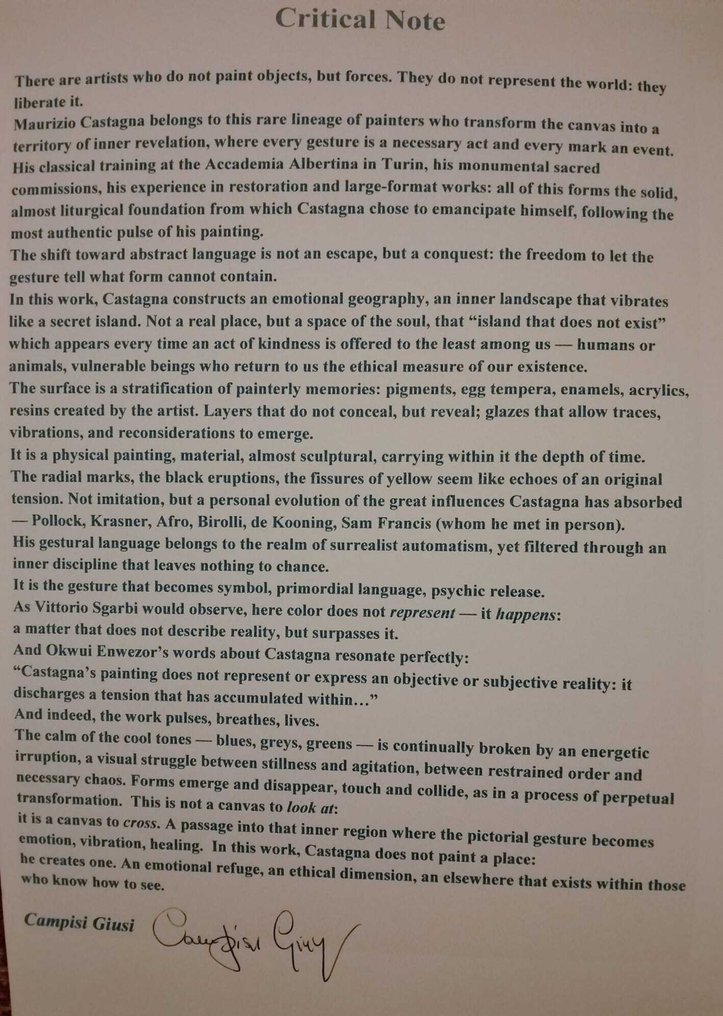
There are artists who do not paint reality, but the tension that runs through it. Maurizio Castagna — an Italian painter trained at the Accademia Albertina in Turin and possessing solid figurative experience before his abstract turn — is one of these rare interpreters of gesture as a primordial language.
In this work, presented by the seller as created by Castagna Maurizio, that material grammar emerges strongly, making him recognizable in every season of his production: a surface not simply painted, but sculpted in successive layers of pigments, enamels, acrylics, egg tempera, and resins he himself developed. The canvas thus becomes a battlefield and a revelation, where what was hidden beneath reemerges in filaments, shards, vibrations.
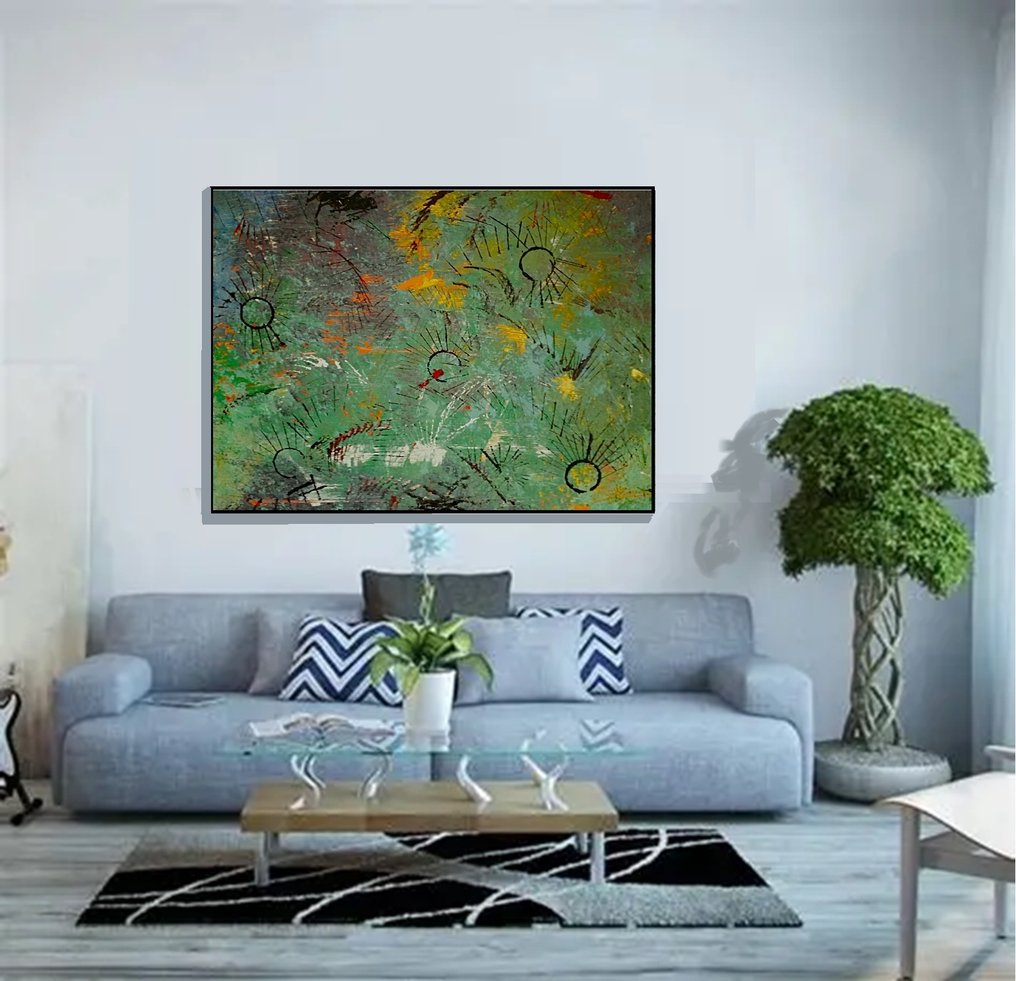
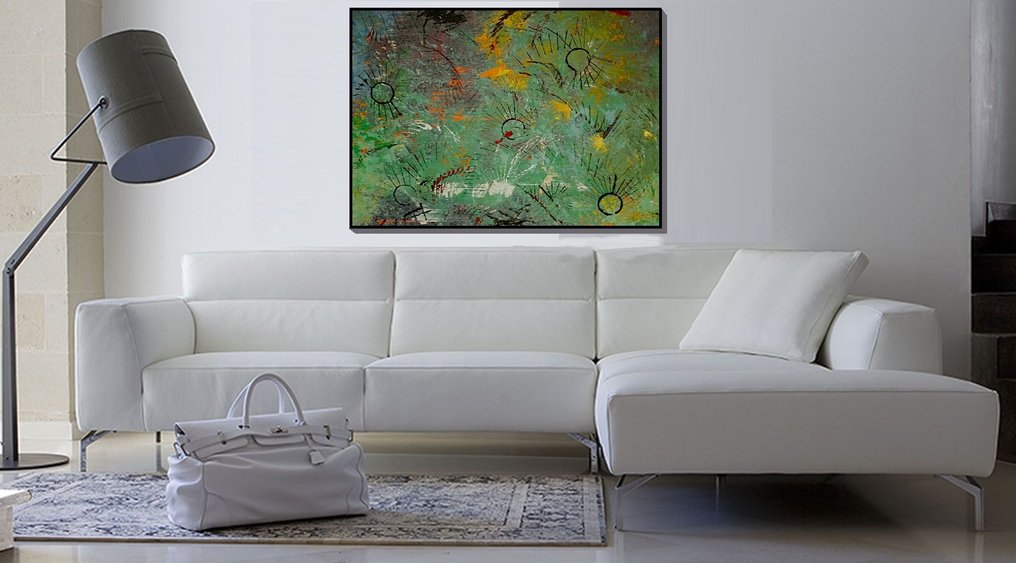
The composition, dense and lively, teems with nervous signs, concentric rays, and chromatic explosions that seem to materialize an uncontrollable inner energy. It is the lesson of the masters of Abstract Expressionism — Pollock, Krasner, De Kooning, Rothko, Sam Francis — filtered through Mediterranean sensibility and the artist's personal journey, who experienced the discipline of the sacred (episcopal portraits, commissions from the Curia of Asti, Catania, and Caltanissetta) before ultimately embracing the freedom of the unconscious.
As Sgarbi would say, here color is not a choice: it is an urgency.
Cool tones — gray, blue, layered greens — create an apparently calm base, soon shattered by the intrusion of blacks and yellows, which slice through space like sudden lightning bolts. It is a work of oppositions, contrasts, and internal dialectics: order and chaos, quiet and tension, light and shadow.
Behind this visual 'storm,' there is no blind improvisation. The gesturality is impulsive, yes, but not random. It is that 'automatic procedure' dear to the surrealists, where chance is only a conduit for a deeper intentionality. As Okwui Enwezor wrote about Castagna:
Castagna's painting does not represent, does not describe, does not interpret: it releases a tension that has accumulated inside...
And this canvas is the perfect demonstration of it.
Every sign is a release, every stain a thrill, every gesture a gateway opened to the emotion that arises as the artist performs it.
The work is not a scene, but a place: an inner island, an elsewhere that lives within each of us when we do good, when we turn our gaze to the least — men or animals — recognizing in them a vulnerable part of our own being. The painting, thus interpreted, does not depict a landscape but a moral geography.
The installation is energetic, vibrant, and complex. The texture is thick, almost sculptural, a distinctive mark of the artist's technique, and it gives the canvas a physicality that goes beyond sight, becoming a tactile experience, body, living matter.
Looking at it, she has the feeling that the painting is not still: it pulses, breathes, expands, almost wanting to cross the edges of the canvas to make space in the real world.
In this work coexist
the freedom of surrealist automatism
the primordial force of Action Painting
the lyrical depth of European color
and the technical wisdom of a painter who has traversed figurative art, sacred themes, and restoration before reaching abstraction.
It is a canvas that is not contemplated: it is crossed.
If you enter, you get lost; you emerge different.
Maurizio Castagna – Mixed media on canvas – 2025
There are artists who do not paint reality, but the tension that runs through it. Maurizio Castagna — an Italian painter trained at the Accademia Albertina in Turin and possessing solid figurative experience before his abstract turn — is one of these rare interpreters of gesture as a primordial language.
In this work, presented by the seller as created by Castagna Maurizio, that material grammar emerges strongly, making him recognizable in every season of his production: a surface not simply painted, but sculpted in successive layers of pigments, enamels, acrylics, egg tempera, and resins he himself developed. The canvas thus becomes a battlefield and a revelation, where what was hidden beneath reemerges in filaments, shards, vibrations.
The composition, dense and lively, teems with nervous signs, concentric rays, and chromatic explosions that seem to materialize an uncontrollable inner energy. It is the lesson of the masters of Abstract Expressionism — Pollock, Krasner, De Kooning, Rothko, Sam Francis — filtered through Mediterranean sensibility and the artist's personal journey, who experienced the discipline of the sacred (episcopal portraits, commissions from the Curia of Asti, Catania, and Caltanissetta) before ultimately embracing the freedom of the unconscious.
As Sgarbi would say, here color is not a choice: it is an urgency.
Cool tones — gray, blue, layered greens — create an apparently calm base, soon shattered by the intrusion of blacks and yellows, which slice through space like sudden lightning bolts. It is a work of oppositions, contrasts, and internal dialectics: order and chaos, quiet and tension, light and shadow.
Behind this visual 'storm,' there is no blind improvisation. The gesturality is impulsive, yes, but not random. It is that 'automatic procedure' dear to the surrealists, where chance is only a conduit for a deeper intentionality. As Okwui Enwezor wrote about Castagna:
Castagna's painting does not represent, does not describe, does not interpret: it releases a tension that has accumulated inside...
And this canvas is the perfect demonstration of it.
Every sign is a release, every stain a thrill, every gesture a gateway opened to the emotion that arises as the artist performs it.
The work is not a scene, but a place: an inner island, an elsewhere that lives within each of us when we do good, when we turn our gaze to the least — men or animals — recognizing in them a vulnerable part of our own being. The painting, thus interpreted, does not depict a landscape but a moral geography.
The installation is energetic, vibrant, and complex. The texture is thick, almost sculptural, a distinctive mark of the artist's technique, and it gives the canvas a physicality that goes beyond sight, becoming a tactile experience, body, living matter.
Looking at it, she has the feeling that the painting is not still: it pulses, breathes, expands, almost wanting to cross the edges of the canvas to make space in the real world.
In this work coexist
the freedom of surrealist automatism
the primordial force of Action Painting
the lyrical depth of European color
and the technical wisdom of a painter who has traversed figurative art, sacred themes, and restoration before reaching abstraction.
It is a canvas that is not contemplated: it is crossed.
If you enter, you get lost; you emerge different.
Details
Artist
Castagna Maurizio 1961 - XL
Sold with frame
No
Sold by
Owner or reseller
Edition
Original
Title of artwork
L'ISOLA CHE VIVE NEL BENE
Technique
Mixed media
Signature
Hand signed
Country of Origin
Italy
Year
2025
Condition
Excellent condition
Height
80 cm
Width
100 cm
Weight
2 kg
Style
Abstract Expressionism
Period
2020+
