David Oyens (1842-1902), - Lezende man aan tafel




08
days
15
hours
58
minutes
43
seconds
Current bid
€ 160
Reserve price not met

Expert
Selected by Leo Setz
Over 30 years’ experience as art dealer, appraiser and restorer.
Estimate € 1,100 - € 1,300
27 other people are watching this object
 Bidder 0662 Bidder 0662 | €160 | |
|---|---|---|
| Bidder 2128 | €150 | |
| Bidder 2128 | €100 | |
Catawiki Buyer Protection
Your payment’s safe with us until you receive your object.View details
Trustpilot 4.4 | 123759 reviews
Rated Excellent on Trustpilot.
David Oyens, Lezende man aan tafel, a 19th‑century oil painting on panel from the Netherlands depicting an interior scene; signed and sold with frame; 32 × 28 cm.
AI-assisted summary
Description from the seller
David Oyens
Amsterdam 1842 – 1902 Brussels
Reading man inside
oil paint on panel
David Oyens was the identical twin brother of Pieter Oyens, who was also a painter. The twins were born in Amsterdam and spent most of their working lives in Brussels. It is almost impossible to describe David's life and work without mentioning Pieter. They form a unique pair in art history because one brother often appeared in the work of the other. Additionally, their oeuvre is also stylistically difficult to distinguish from each other. This is despite the fact that, as far as known, they never worked together on the same painting and even lived apart for several years.
The brothers Oyens are renowned for their atelier scenes featuring figures, often with references to the artist's life. They also created portraits and a number of still lifes. The twins believed it was important to produce work that was current but also close to themselves. They did not necessarily seek their subjects outside their door. They did not use large social themes but were, in their own way, indeed engaged. In their work, one sees maids, models, buyers, and fellow artists pass by, usually combined with one twin happily laughing, yawning on a chair, tinkering on a piano, or courting a model. In David's works, Pieter served as the model and vice versa. Humor was never shunned, although it was never far from seriousness. The paintings and watercolors of the brothers Oyens speak of a well-considered intimacy and keen observation. Especially David was a master in depicting small gestures, imbuing them with much meaning. Pieter, who was highly skilled in portraits, even earned the nickname 'Le Frans Hals de la modernité' in 1880. Both David and Pieter Oyens possessed a lively, impressionistic painting style and a clear use of color. Light effects also played an important role in their work.
His father, a prominent Amsterdam stockbroker, initially hoped to train the twins to become successful entrepreneurs. After several attempts proved unsuccessful, he sent them to Brussels in 1860 on the advice of Jan Adam Kruseman. David and Pieter Oyens began their painting training during the day at Jean (Jan) Portaels' private studio, and in the evenings, they attended classes at the Brussels Academy. At that time, Brussels had rapidly grown into a world city, where the economy, industry, art, and culture flourished. Moreover, there was a rapidly expanding art market and plenty of opportunities for (young) artists to exhibit their work. Many other Dutch artists were also attracted to Brussels. For example, David and Pieter Oyens achieved great success at the exhibitions of Cercle Artistique et Litteraire. This artists' association had an important network, and famous Dutch painters like Willem Roelofs and Constant Gabriël sat on its board. Furthermore, as art historian Saskia de Bodt notes, the Oyens brothers arrived precisely at a time when a new wind was beginning to blow in Brussels. Around 1860-1865, the ideas of Baudelaire and Courbet regarding realism, modernity, and artistic freedom started to influence the city from France. Additionally, influential art criticism had already emerged there much earlier than in the Netherlands.
The Oyens brothers lived in Brussels like true bohemians. Portaels gave his students a lot of freedom and immediately introduced them to working from a live model. However, this was extraordinarily modern and completely different from the regime at the Academies, where students first had to diligently draw from plaster models and still life for three years before they could dare to depict a living figure. Ultimately, Portaels' studio grew to become one of the most renowned training places in Brussels.
The year 1866 marked a temporary separation of the brothers. David married Betsy Voûte, whom he had met at his parents' home in Amsterdam. The couple found a house in Sint Joost-ten-Noode (Brussels), while Pieter remained with his parents in Amsterdam. Pieter initially struggled somewhat with the new situation, but together they participated for the first time in the Triannual Exhibition of Ghent and the Brussels Salon. In 1869, Pieter decided to work in Paris for a while, where he came into contact with fellow painters Adolphe Artz, Jacob Maris, and Fritz Kaemmerer.
In 1870, Pieter received the sad news that David's one-year-old daughter had passed away. As a result, he decided to return to Brussels and resume the intensive collaboration with his brother. David and Pieter were both each other's best model and strictest judge. The twins participated in a vast number of exhibitions in the Netherlands, Belgium, and France. In the years that followed, the Oyensens received increasingly favorable reviews in the press. Their subjects were described as 'touching and original.' Sales also steadily increased.
In 1890, David and his wife decided to return to the Netherlands, where they spent about ten years in Arnhem. However, they missed the bustling Brussels and eventually returned to the Belgian capital. Pieter died at the age of 51 as a result of a stroke. David died just a few years later and was buried next to his brother.
Painting is carefully packaged and sent by registered mail.
David Oyens
Amsterdam 1842 – 1902 Brussels
Reading man inside
oil paint on panel
David Oyens was the identical twin brother of Pieter Oyens, who was also a painter. The twins were born in Amsterdam and spent most of their working lives in Brussels. It is almost impossible to describe David's life and work without mentioning Pieter. They form a unique pair in art history because one brother often appeared in the work of the other. Additionally, their oeuvre is also stylistically difficult to distinguish from each other. This is despite the fact that, as far as known, they never worked together on the same painting and even lived apart for several years.
The brothers Oyens are renowned for their atelier scenes featuring figures, often with references to the artist's life. They also created portraits and a number of still lifes. The twins believed it was important to produce work that was current but also close to themselves. They did not necessarily seek their subjects outside their door. They did not use large social themes but were, in their own way, indeed engaged. In their work, one sees maids, models, buyers, and fellow artists pass by, usually combined with one twin happily laughing, yawning on a chair, tinkering on a piano, or courting a model. In David's works, Pieter served as the model and vice versa. Humor was never shunned, although it was never far from seriousness. The paintings and watercolors of the brothers Oyens speak of a well-considered intimacy and keen observation. Especially David was a master in depicting small gestures, imbuing them with much meaning. Pieter, who was highly skilled in portraits, even earned the nickname 'Le Frans Hals de la modernité' in 1880. Both David and Pieter Oyens possessed a lively, impressionistic painting style and a clear use of color. Light effects also played an important role in their work.
His father, a prominent Amsterdam stockbroker, initially hoped to train the twins to become successful entrepreneurs. After several attempts proved unsuccessful, he sent them to Brussels in 1860 on the advice of Jan Adam Kruseman. David and Pieter Oyens began their painting training during the day at Jean (Jan) Portaels' private studio, and in the evenings, they attended classes at the Brussels Academy. At that time, Brussels had rapidly grown into a world city, where the economy, industry, art, and culture flourished. Moreover, there was a rapidly expanding art market and plenty of opportunities for (young) artists to exhibit their work. Many other Dutch artists were also attracted to Brussels. For example, David and Pieter Oyens achieved great success at the exhibitions of Cercle Artistique et Litteraire. This artists' association had an important network, and famous Dutch painters like Willem Roelofs and Constant Gabriël sat on its board. Furthermore, as art historian Saskia de Bodt notes, the Oyens brothers arrived precisely at a time when a new wind was beginning to blow in Brussels. Around 1860-1865, the ideas of Baudelaire and Courbet regarding realism, modernity, and artistic freedom started to influence the city from France. Additionally, influential art criticism had already emerged there much earlier than in the Netherlands.
The Oyens brothers lived in Brussels like true bohemians. Portaels gave his students a lot of freedom and immediately introduced them to working from a live model. However, this was extraordinarily modern and completely different from the regime at the Academies, where students first had to diligently draw from plaster models and still life for three years before they could dare to depict a living figure. Ultimately, Portaels' studio grew to become one of the most renowned training places in Brussels.
The year 1866 marked a temporary separation of the brothers. David married Betsy Voûte, whom he had met at his parents' home in Amsterdam. The couple found a house in Sint Joost-ten-Noode (Brussels), while Pieter remained with his parents in Amsterdam. Pieter initially struggled somewhat with the new situation, but together they participated for the first time in the Triannual Exhibition of Ghent and the Brussels Salon. In 1869, Pieter decided to work in Paris for a while, where he came into contact with fellow painters Adolphe Artz, Jacob Maris, and Fritz Kaemmerer.
In 1870, Pieter received the sad news that David's one-year-old daughter had passed away. As a result, he decided to return to Brussels and resume the intensive collaboration with his brother. David and Pieter were both each other's best model and strictest judge. The twins participated in a vast number of exhibitions in the Netherlands, Belgium, and France. In the years that followed, the Oyensens received increasingly favorable reviews in the press. Their subjects were described as 'touching and original.' Sales also steadily increased.
In 1890, David and his wife decided to return to the Netherlands, where they spent about ten years in Arnhem. However, they missed the bustling Brussels and eventually returned to the Belgian capital. Pieter died at the age of 51 as a result of a stroke. David died just a few years later and was buried next to his brother.
Painting is carefully packaged and sent by registered mail.
Details
Artist
David Oyens (1842-1902),
Sold with frame
Yes
Title of artwork
Lezende man aan tafel
Technique
Oil painting
Signature
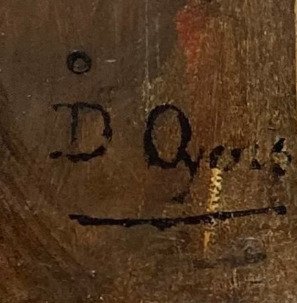
Hand signed
Country of Origin
Netherlands
Condition
Good condition
Height
32 cm
Width
28 cm
Weight
1 kg
Depiction/Theme
Interior scene
Style
Impressionism
Period
19th century
