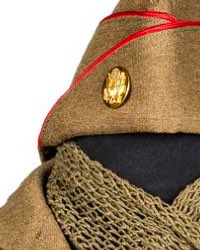
Japan - Army Jacket & 1000-stitch belt. - Military uniform - 1942



00
days
13
hours
56
minutes
28
seconds
Current bid
€ 68
No reserve price

Expert
Selected by Marcel van Hulst
Over 35 years trading and collecting militaria with deep industry knowledge.
Estimate € 180 - € 250
33 other people are watching this object
 Bidder 2362 Bidder 2362 | €68 | |
|---|---|---|
 Bidder 7660 Bidder 7660 | €63 | |
| Bidder 2362 | €54 | |
Catawiki Buyer Protection
Your payment’s safe with us until you receive your object.View details
Trustpilot 4.4 | 123609 reviews
Rated Excellent on Trustpilot.
Two-item lot from Japan comprising an Army Jacket and a 1000-stitch belt (Sen-ninbari) dating to 1942, with a cotton belt around 16×126 cm featuring red thread and coins, in good condition and without a certificate of authenticity.
AI-assisted summary
Description from the seller
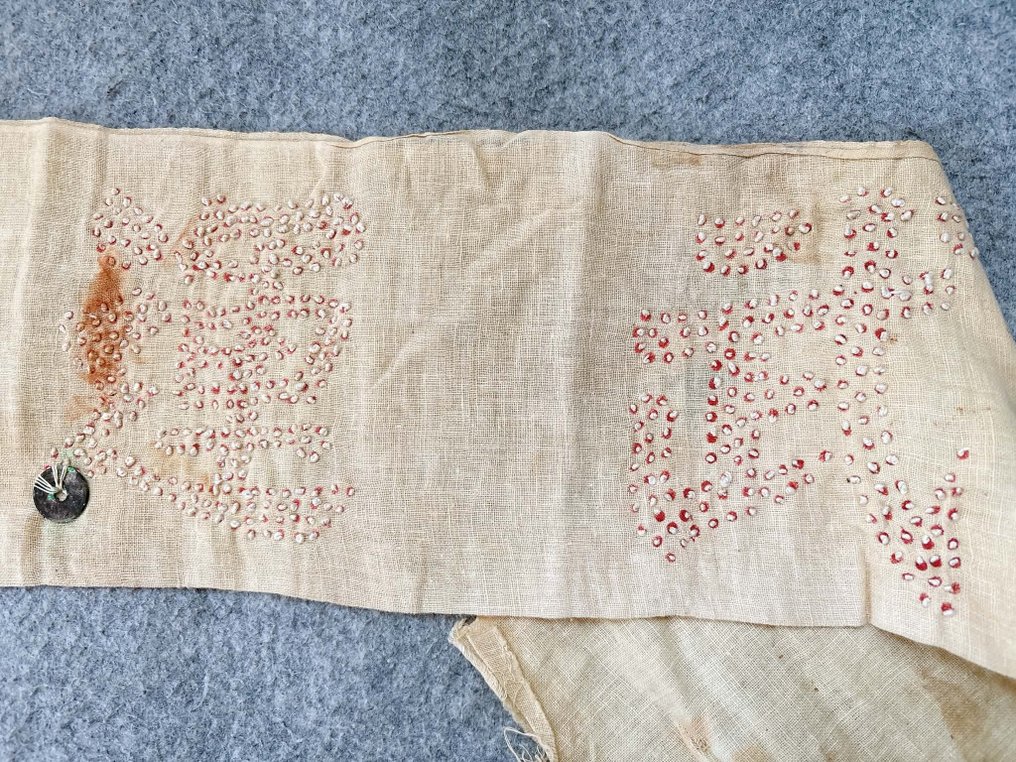
◆1000-stitch belt (Sen-ninbari 千人針)
Size: 16×126 cm
Material: cotton
1000-stitch belt (Sen-ninbari 千人針) was a prayer technique and resulting amulet that was popular in Japan until World War II, in which many women sewed threads into a piece of cloth and tied knots in it. It is a folk belief to pray for the longevity of military fortune, in other words, for soldiers' good luck on the battlefield.
A white cloth about one meter long is sewn with red thread to make a knot (tama-knot) at a glance. The goal of this activity is to have 1,000 women sew one stitch on each piece of cloth. In those days, many people called out to each other in the neighborhood and on the street.
The magical power of the cloth/thread/red color/ and the thoughts of a thousand women sewing one stitch at a time were combined in this thousand needle.
There are records that soldiers on the battlefield fought by wrapping it around their stomachs or heads as a talisman.
It is threatening, terrifying, and crazy to have a thousand people involved in a mere piece of cloth.
◆武運長久
The Japanese words "武運長久" can be seen.
These words are typical of prayers to soldiers during wartime.
That your good fortune on the battlefield will last for a long time. That the fate of a warrior will last for a long time.
The soldier who has gone to war will be safe and sound forever. The word "武運 BUUN" refers to the luck of victory in battle.
It is a single kanji character that expresses the wish for victory or good fortune in battle.
◆Sewn coin
And Japanese old coins, "5 sen (5銭)" and "10 sen (10銭)" are sewn with red thread.
These coins are sewn for good luck.
In other words, they are sewn with the Japanese people's wish for victory and safety in battle.
These coins are inscribed with the year of issue.
The year is "大正十年 Taisho 10."
"Taisho 11" means 1921, 100 years ago.
This 1000-stitch belt (Sen-ninbari 千人針) made of cotton, a light and strong material.
It is important that the amulet be light and strong, as soldiers fought on the battlefield with this amulet wrapped around their stomachs.
Various types of 1000-stitch belt were produced by Japanese women during the war.
This is so beautiful and carefully crafted in their overall workmanship and design.
And this is a very valuable item, nearly 100 years old but in excellent condition of preservation.
◆Army Jacket
This was worn by a soldier during World War II in Japan.
It is in relatively good condition and has survived to the present day.
Evidence can be found on the lining fabric of the jacket.
“昭和十七年 , Showa 17”
This corresponds to the year "1942."
The soldier's name is also written here. "Harada"
These two items are valuable pieces of Japanese history.
Nice collection.
Carefully packaged and shipped from Japan to overseas.
We have other rare items up for current auction,so please check back.
◆1000-stitch belt (Sen-ninbari 千人針)
Size: 16×126 cm
Material: cotton
1000-stitch belt (Sen-ninbari 千人針) was a prayer technique and resulting amulet that was popular in Japan until World War II, in which many women sewed threads into a piece of cloth and tied knots in it. It is a folk belief to pray for the longevity of military fortune, in other words, for soldiers' good luck on the battlefield.
A white cloth about one meter long is sewn with red thread to make a knot (tama-knot) at a glance. The goal of this activity is to have 1,000 women sew one stitch on each piece of cloth. In those days, many people called out to each other in the neighborhood and on the street.
The magical power of the cloth/thread/red color/ and the thoughts of a thousand women sewing one stitch at a time were combined in this thousand needle.
There are records that soldiers on the battlefield fought by wrapping it around their stomachs or heads as a talisman.
It is threatening, terrifying, and crazy to have a thousand people involved in a mere piece of cloth.
◆武運長久
The Japanese words "武運長久" can be seen.
These words are typical of prayers to soldiers during wartime.
That your good fortune on the battlefield will last for a long time. That the fate of a warrior will last for a long time.
The soldier who has gone to war will be safe and sound forever. The word "武運 BUUN" refers to the luck of victory in battle.
It is a single kanji character that expresses the wish for victory or good fortune in battle.
◆Sewn coin
And Japanese old coins, "5 sen (5銭)" and "10 sen (10銭)" are sewn with red thread.
These coins are sewn for good luck.
In other words, they are sewn with the Japanese people's wish for victory and safety in battle.
These coins are inscribed with the year of issue.
The year is "大正十年 Taisho 10."
"Taisho 11" means 1921, 100 years ago.
This 1000-stitch belt (Sen-ninbari 千人針) made of cotton, a light and strong material.
It is important that the amulet be light and strong, as soldiers fought on the battlefield with this amulet wrapped around their stomachs.
Various types of 1000-stitch belt were produced by Japanese women during the war.
This is so beautiful and carefully crafted in their overall workmanship and design.
And this is a very valuable item, nearly 100 years old but in excellent condition of preservation.
◆Army Jacket
This was worn by a soldier during World War II in Japan.
It is in relatively good condition and has survived to the present day.
Evidence can be found on the lining fabric of the jacket.
“昭和十七年 , Showa 17”
This corresponds to the year "1942."
The soldier's name is also written here. "Harada"
These two items are valuable pieces of Japanese history.
Nice collection.
Carefully packaged and shipped from Japan to overseas.
We have other rare items up for current auction,so please check back.
Details
Era
1900-2000
Number of items
2
Army Unit
Army Jacket & 1000-stitch belt.
Country of Origin
Japan
Year of Manufacture
1942
Material
Cotton, Metal
Condition
Good
Original/ Replica
Original
Comes with certificate of authenticity
No
Sold by