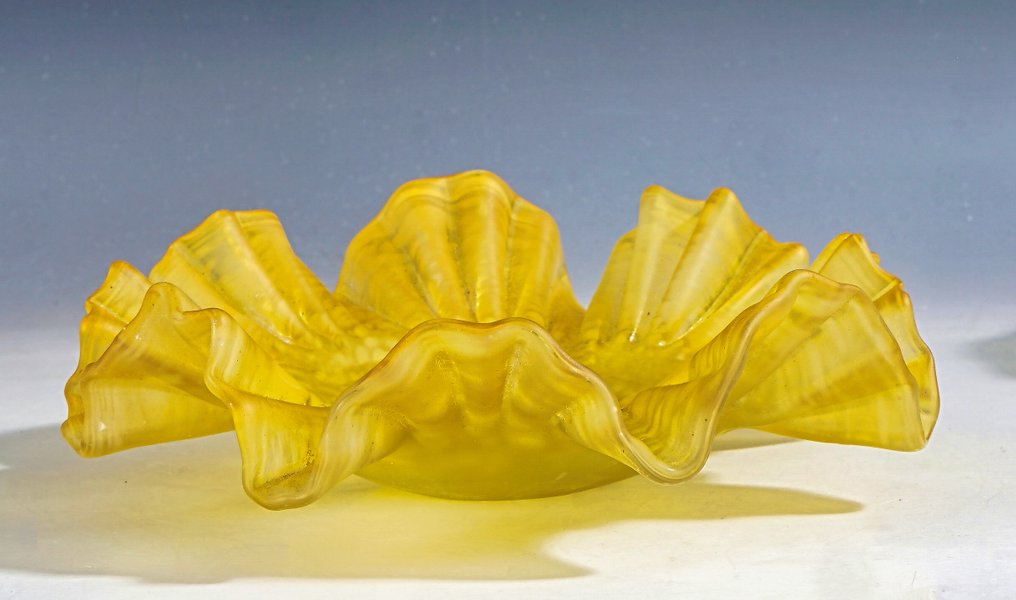
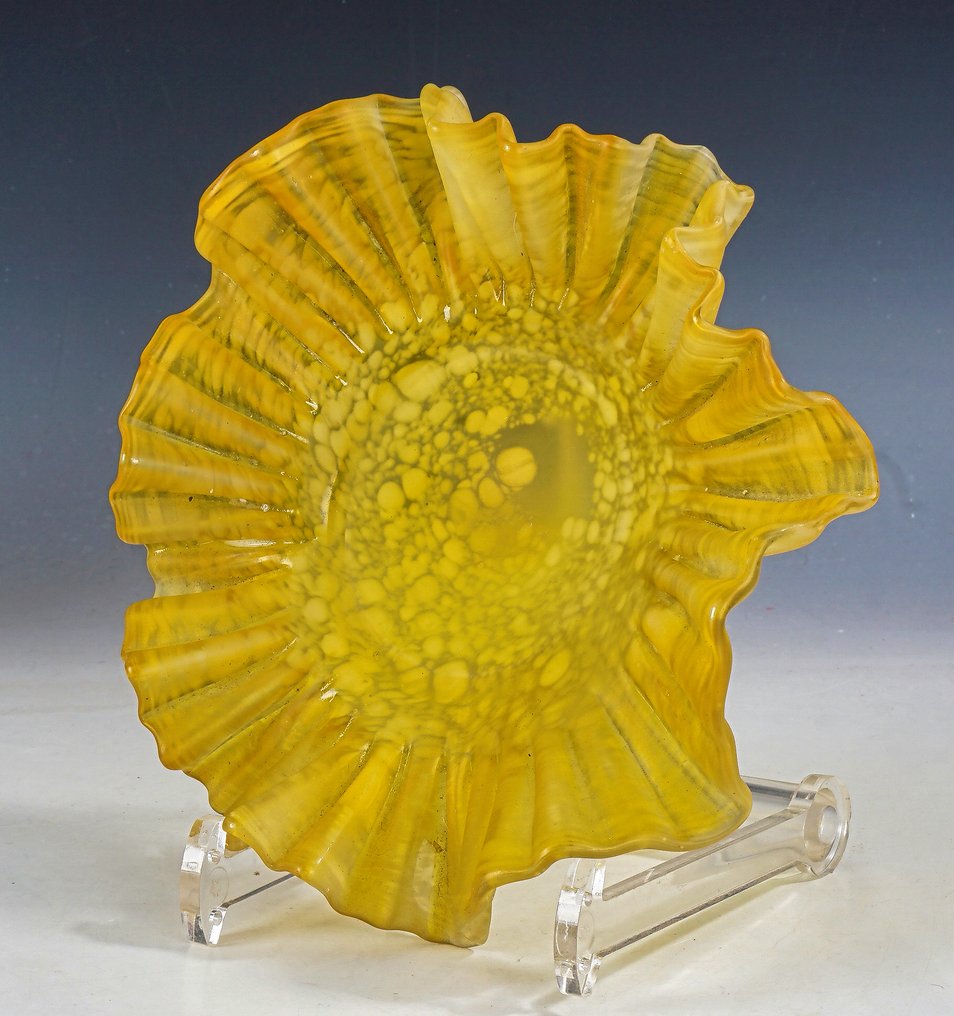
Platter - An American studio glass Macchia bowl with matte finish, circa 1981-1985. - Glass



02
days
21
hours
51
minutes
59
seconds

15 other people are watching this object
 Bidder 0320 Bidder 0320 | €6 | |
|---|---|---|
 Bidder 3194 Bidder 3194 | €5 | |
| Bidder 0320 | €4 | |
Catawiki Buyer Protection
Your payment’s safe with us until you receive your object.View details
Trustpilot 4.4 | 123779 reviews
Rated Excellent on Trustpilot.
American studio glass object in the Macchia technique with a matte finish, dating from circa 1981–1985, made of glass.
AI-assisted summary
Description from the seller
Title: An American studio glass Macchia object with matte finish, circa 1981-1985.
Specifications
Period: American Studio Glass Movement
Year: circa 1981-1985
Factory or Maker: Circle of the Pilchuck Glass School
Artist or Designer: In the style of Dale Chihuly (born 1941)
Type of Decor or Technique: Macchia technique with an acidified satin finish.
Model of Vormnummer: Unicum / Handgevormd
Dimensions: Height 6 cm, diameter 20 cm, weight 675 grams.
Description
A rare and artistically high-quality object made of hand-blown glass, executed in a free, organic form language that references the natural geometry of underwater organisms. The bowl is crafted using the complex macchia technique, where various layers of colored glass powder and fragments (frit) are fused between the glass walls. The interior displays a saturated ochre yellow color, while the exterior is characterized by a diffuse pattern of white spots. The entire body is finished with a satin or matte surface, achieved through an acid bath, giving the glass a soft, tactile quality and subtly breaking the light. The rim is masterfully folded into a flowing, undulating movement. The underside features a skillfully flat-ground pontil mark, typical of professional studio glass productions from the early 1980s.
Biographies & Context
This object is a representative example of the aesthetic revolution within American glass art, led by the Pilchuck Glass School in Washington. Dale Chihuly introduced the Macchia series in 1981, exploring the technical limits of color use in glass. The series was intended to showcase the full chromatic potential of the material. Objects with a matte finish from this specific period are less frequently found on the market and reflect a phase of experimental exploration into texture and natural realism within the movement.
History & Provenance
From a private collection.
Note: Although this object is unmarked, the technical perfection of its design and the quality of the grinding work testify to a creation by a highly experienced gaffer or glass artist within the American studio environment. The absence of a signature is more commonly observed in early experimental works or studio pieces from the 1980s. Given the specific color scheme and the characteristic anemone shape language, this piece can be confidently attributed to the direct influence of the Macchia series. The substantial weight of 675 grams with a diameter of 20 cm confirms the high-quality crystal composition and artisanal layering of the piece.
Seller's Story
Decaders Gallery – Eindhoven Region, Netherlands
Our passion lies in 20th century applied arts and design, with a particular focus on the Art Nouveau, Art Deco and Mid-Century Modern periods. But styles from the sixties, seventies and later also attract our attention. Each decade has made a unique contribution to the art world, which our name – *Decaders Gallery* – perfectly reflects.
Thanks to our love for art and design, we present new, special decorative objects every week. In addition, we have a broad interest in Asian art, antiques and collectibles. Our searches throughout Europe have led to a valuable network of like-minded enthusiasts, who help us track down unique finds.
This network has paid off: we are proud to have supplied artworks to renowned museums, including:
**The Netherlands:**
- CODA Museum, Apeldoorn
- Drents Museum, Assen
- National Textile Museum, Tilburg
- National Glass Museum, Leerdam
- Museum 'Amsterdam School' (*'t Schip*), Amsterdam
- PSV Football Museum, Eindhoven
- National War Museum, Overloon
**Belgium:**
- Musée de la Famenne, Marche-en-Famenne
- Museum of Natural Sciences, Belgium
**Spain:**
- Maritime Museum, Barcelona
We warmly invite you to visit our auctions with surprising artworks and follow us on Instagram. Discover your favorite decade at *Decaders Gallery*!
**Marc van der Heijden**
*Decaders Gallery, Netherlands*
Translated by Google TranslateTitle: An American studio glass Macchia object with matte finish, circa 1981-1985.
Specifications
Period: American Studio Glass Movement
Year: circa 1981-1985
Factory or Maker: Circle of the Pilchuck Glass School
Artist or Designer: In the style of Dale Chihuly (born 1941)
Type of Decor or Technique: Macchia technique with an acidified satin finish.
Model of Vormnummer: Unicum / Handgevormd
Dimensions: Height 6 cm, diameter 20 cm, weight 675 grams.
Description
A rare and artistically high-quality object made of hand-blown glass, executed in a free, organic form language that references the natural geometry of underwater organisms. The bowl is crafted using the complex macchia technique, where various layers of colored glass powder and fragments (frit) are fused between the glass walls. The interior displays a saturated ochre yellow color, while the exterior is characterized by a diffuse pattern of white spots. The entire body is finished with a satin or matte surface, achieved through an acid bath, giving the glass a soft, tactile quality and subtly breaking the light. The rim is masterfully folded into a flowing, undulating movement. The underside features a skillfully flat-ground pontil mark, typical of professional studio glass productions from the early 1980s.
Biographies & Context
This object is a representative example of the aesthetic revolution within American glass art, led by the Pilchuck Glass School in Washington. Dale Chihuly introduced the Macchia series in 1981, exploring the technical limits of color use in glass. The series was intended to showcase the full chromatic potential of the material. Objects with a matte finish from this specific period are less frequently found on the market and reflect a phase of experimental exploration into texture and natural realism within the movement.
History & Provenance
From a private collection.
Note: Although this object is unmarked, the technical perfection of its design and the quality of the grinding work testify to a creation by a highly experienced gaffer or glass artist within the American studio environment. The absence of a signature is more commonly observed in early experimental works or studio pieces from the 1980s. Given the specific color scheme and the characteristic anemone shape language, this piece can be confidently attributed to the direct influence of the Macchia series. The substantial weight of 675 grams with a diameter of 20 cm confirms the high-quality crystal composition and artisanal layering of the piece.
Seller's Story
Decaders Gallery – Eindhoven Region, Netherlands
Our passion lies in 20th century applied arts and design, with a particular focus on the Art Nouveau, Art Deco and Mid-Century Modern periods. But styles from the sixties, seventies and later also attract our attention. Each decade has made a unique contribution to the art world, which our name – *Decaders Gallery* – perfectly reflects.
Thanks to our love for art and design, we present new, special decorative objects every week. In addition, we have a broad interest in Asian art, antiques and collectibles. Our searches throughout Europe have led to a valuable network of like-minded enthusiasts, who help us track down unique finds.
This network has paid off: we are proud to have supplied artworks to renowned museums, including:
**The Netherlands:**
- CODA Museum, Apeldoorn
- Drents Museum, Assen
- National Textile Museum, Tilburg
- National Glass Museum, Leerdam
- Museum 'Amsterdam School' (*'t Schip*), Amsterdam
- PSV Football Museum, Eindhoven
- National War Museum, Overloon
**Belgium:**
- Musée de la Famenne, Marche-en-Famenne
- Museum of Natural Sciences, Belgium
**Spain:**
- Maritime Museum, Barcelona
We warmly invite you to visit our auctions with surprising artworks and follow us on Instagram. Discover your favorite decade at *Decaders Gallery*!
**Marc van der Heijden**
*Decaders Gallery, Netherlands*
Translated by Google TranslateDetails
Era
1900-2000
Weight
675 g
Material
Glass
Model
An American studio glass Macchia bowl with matte finish, circa 1981-1985.
Country of Origin
United States
Style
Contemporary
Colour
Yellow
Condition
Good condition - used with small signs of aging & blemishes
Height
6 cm
Width
20 cm
Depth
20 cm
Estimated Period
1980-1990
Sold by