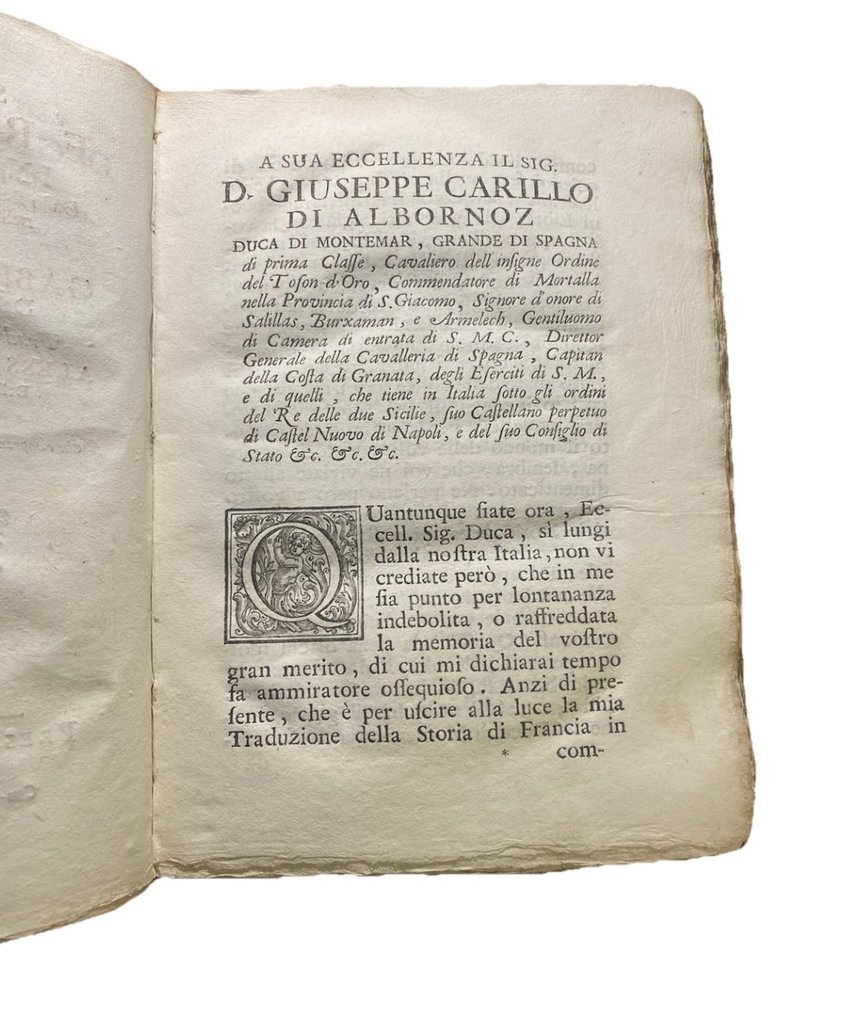
Gabriele Daniello - Storia di Francia - 1737



Opens Thursday
Starting bid
€ 1
Add to your favourites to get an alert when the auction starts.

Expert
Selected by Volker Riepenhausen
Specialist in travel literature and pre-1600 rare prints with 28 years experience.
Estimate € 170 - € 200
Catawiki Buyer Protection
Your payment’s safe with us until you receive your object.View details
Trustpilot 4.4 | 123418 reviews
Rated Excellent on Trustpilot.
Description from the seller
History of France in Summary
From the establishment of the French Monarchy in Gaul up to modern times.
Father Gabriele Daniello of the Society of Jesus.
Translation from French by the Father.
Alessandro Pompeo Berti of the Congregation of the Mother of God.
Publisher Pezzana, in Venice, 1737.
Three volumes pp. (12) xl, 740 (28); (4) 756 (48); (4) 506 (72).
Second volume that covers what has passed from the year 1421 to 1610.
Volume Three of the Continuation of the History of France by Father Alessandro Pompeo Berti... Volume Three covers everything that happened from the year 1610 up to 1715.
The 1737 edition of the History of France in summary, translated by Father Alessandro Pompeo Berti, presents itself as a clear and organized work, designed to offer the Italian public a concise yet authoritative overview of French history. The author adopts a style typical of 18th-century religious historiography, with attention to moral values and the Christian interpretation of events. The narrative begins with the arrival of the Franks in Gaul and with the central figure of Clovis, whose conversion is described as the true birth of the Christian monarchy of France. After examining the weakness of the Merovingian dynasty, the text presents the rise of the Carolingians and the exemplary role of Charlemagne in forming a unified and Christian empire. It then recounts the political fragmentation after his death and the slow process through which the Capetians managed to rebuild stable authority. The struggles with England, the Crusades, and later the Hundred Years' War are depicted as decisive tests for the nation. Religious wars also occupy an important place, culminating in the pacification carried out by Henry IV. The work devotes significant space to the Bourbons, described as architects of order and the strengthening of the state, culminating in the reign of Louis XIV. The volume concludes with a picture of early 18th-century France, seen as the mature result of a long historical evolution guided by the monarchy and faith.
The antiporta is missing.
History of France in Summary
From the establishment of the French Monarchy in Gaul up to modern times.
Father Gabriele Daniello of the Society of Jesus.
Translation from French by the Father.
Alessandro Pompeo Berti of the Congregation of the Mother of God.
Publisher Pezzana, in Venice, 1737.
Three volumes pp. (12) xl, 740 (28); (4) 756 (48); (4) 506 (72).
Second volume that covers what has passed from the year 1421 to 1610.
Volume Three of the Continuation of the History of France by Father Alessandro Pompeo Berti... Volume Three covers everything that happened from the year 1610 up to 1715.
The 1737 edition of the History of France in summary, translated by Father Alessandro Pompeo Berti, presents itself as a clear and organized work, designed to offer the Italian public a concise yet authoritative overview of French history. The author adopts a style typical of 18th-century religious historiography, with attention to moral values and the Christian interpretation of events. The narrative begins with the arrival of the Franks in Gaul and with the central figure of Clovis, whose conversion is described as the true birth of the Christian monarchy of France. After examining the weakness of the Merovingian dynasty, the text presents the rise of the Carolingians and the exemplary role of Charlemagne in forming a unified and Christian empire. It then recounts the political fragmentation after his death and the slow process through which the Capetians managed to rebuild stable authority. The struggles with England, the Crusades, and later the Hundred Years' War are depicted as decisive tests for the nation. Religious wars also occupy an important place, culminating in the pacification carried out by Henry IV. The work devotes significant space to the Bourbons, described as architects of order and the strengthening of the state, culminating in the reign of Louis XIV. The volume concludes with a picture of early 18th-century France, seen as the mature result of a long historical evolution guided by the monarchy and faith.
The antiporta is missing.
Details
Number of Books
3
Subject
History, Religion
Book Title
Storia di Francia
Author/ Illustrator
Gabriele Daniello
Condition
Very good
Publication year oldest item
1737
Height
24.5 cm
Edition
Translated edition
Width
17 cm
Language
Italian
Original language
No
Publisher
Niccolò Pezzana
Binding/ Material
Half leather
Number of pages
1500
Sold by
