Stefano Bargis (1916-1999) - Mattina d'inverno in Valle Bronda



01
day
09
hours
47
minutes
31
seconds

18 other people are watching this object
 Bidder 1816 Bidder 1816 | €70 | |
|---|---|---|
 Bidder 5510 Bidder 5510 | €50 | |
| Bidder 5510 | €45 | |
Catawiki Buyer Protection
Your payment’s safe with us until you receive your object.View details
Trustpilot 4.4 | 123878 reviews
Rated Excellent on Trustpilot.
Stefano Bargis, Mattina d'inverno in Valle Bronda, oil on panel, 40 × 50 cm, signed, original edition from the 1950s, Italy, Realism, sold with frame by Galleria.
AI-assisted summary
Description from the seller
Stefano Bargis (Busca, 1916 - 1999)
Winter morning in Valle Bronda
Technique: Oil on panel, 40 x 50 cm
Signed at the bottom right
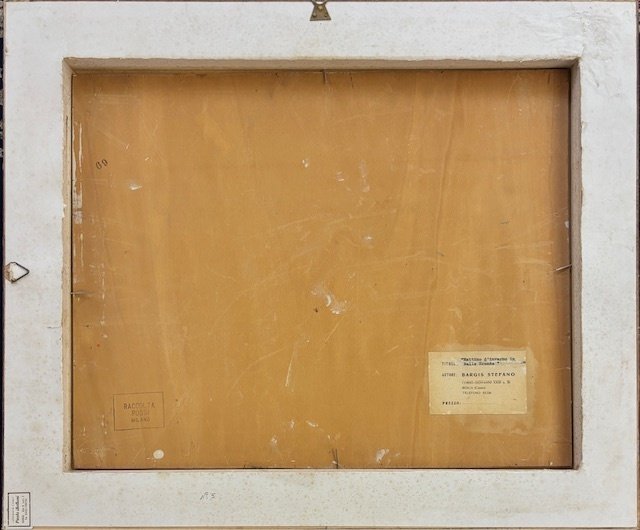
Provenance: Rossi Collection, Milan
Stefano Bargis was one of the most refined interpreters of Piedmontese landscape painting of the second half of the 20th century, deeply connected to his homeland. This work, 'Winter Morning in Valle Bronda,' is an emblematic example of his most celebrated and appreciated production.
The composition is dominated by a cool and luminous palette, where the whites of the snow dialogue with the grays and blues of the sky and shadows. The brushwork, sensitive and attentive, lyrically describes the tranquility of the winter landscape, capturing the crystalline light and the suspended atmosphere typical of the season. Bargis's ability to infuse a deep sense of peace and silence is at its peak here.
The work, signed at the bottom right and created on panel, is enhanced by a prestigious provenance from the 'Raccolta Rossi' of Milan. It is presented complete with frame.
Detailed Analysis of Technical Features
In-depth look at Technical Features
The work 'Winter Morning in Valle Bronda' by Stefano Bargis is an essay on how painting technique can become a tool for poetic expression.
The Support and Preparation: the Table
Bargis chooses a 40x50 cm panel, a rigid support that lends itself magnificently to his controlled and precise brushwork. Unlike a canvas, the panel does not 'absorb' the gesture but faithfully reflects it. This allows the artist to work with thin, well-defined layers of color, essential for capturing the delicacy and transparency of winter light. The smooth surface of the panel is ideal for depicting the smoothness of snow and the crystalline reflections of ice.
The Technique: Oil and Light
Bargis's mastery lies in the use of oil painting. His work is not a materialistic or aggressive style but rather a painting of 'tone' and 'light.' He constructs the scene through glazes and chromatic combinations of great refinement. His palette is deliberately limited: whites dominate, rendered in infinite shades (from pure white to blue-white, to gray-white) to depict snow illuminated by light or in shadow. The brushwork is light, almost a touch, used to define forms without heaviness: the bare branches of trees are traced with the finesse of a drawing, while the sky is a soft fill that diffuses light across the entire landscape.
The Firm and the Origin: Seals of Value
The signature, clear and positioned at the bottom right, is an element that balances the composition and certifies its authenticity. Even more significant is the biographical note on provenance: the 'Raccolta Rossi, Milano.' This is not merely a technical detail in the strict sense but a fundamental historical-critical element. It indicates that the work was selected and owned by an experienced collector, granting it a pedigree that enhances its prestige and validates its artistic quality in the market. Finally, the frame accompanying the painting should be considered an integral part of the work, chosen to dialogue with the cool tones and the silent atmosphere of the scene.
Seller's Story
XIX & XX century paintings
Translated by Google TranslateStefano Bargis (Busca, 1916 - 1999)
Winter morning in Valle Bronda
Technique: Oil on panel, 40 x 50 cm
Signed at the bottom right
Provenance: Rossi Collection, Milan
Stefano Bargis was one of the most refined interpreters of Piedmontese landscape painting of the second half of the 20th century, deeply connected to his homeland. This work, 'Winter Morning in Valle Bronda,' is an emblematic example of his most celebrated and appreciated production.
The composition is dominated by a cool and luminous palette, where the whites of the snow dialogue with the grays and blues of the sky and shadows. The brushwork, sensitive and attentive, lyrically describes the tranquility of the winter landscape, capturing the crystalline light and the suspended atmosphere typical of the season. Bargis's ability to infuse a deep sense of peace and silence is at its peak here.
The work, signed at the bottom right and created on panel, is enhanced by a prestigious provenance from the 'Raccolta Rossi' of Milan. It is presented complete with frame.
Detailed Analysis of Technical Features
In-depth look at Technical Features
The work 'Winter Morning in Valle Bronda' by Stefano Bargis is an essay on how painting technique can become a tool for poetic expression.
The Support and Preparation: the Table
Bargis chooses a 40x50 cm panel, a rigid support that lends itself magnificently to his controlled and precise brushwork. Unlike a canvas, the panel does not 'absorb' the gesture but faithfully reflects it. This allows the artist to work with thin, well-defined layers of color, essential for capturing the delicacy and transparency of winter light. The smooth surface of the panel is ideal for depicting the smoothness of snow and the crystalline reflections of ice.
The Technique: Oil and Light
Bargis's mastery lies in the use of oil painting. His work is not a materialistic or aggressive style but rather a painting of 'tone' and 'light.' He constructs the scene through glazes and chromatic combinations of great refinement. His palette is deliberately limited: whites dominate, rendered in infinite shades (from pure white to blue-white, to gray-white) to depict snow illuminated by light or in shadow. The brushwork is light, almost a touch, used to define forms without heaviness: the bare branches of trees are traced with the finesse of a drawing, while the sky is a soft fill that diffuses light across the entire landscape.
The Firm and the Origin: Seals of Value
The signature, clear and positioned at the bottom right, is an element that balances the composition and certifies its authenticity. Even more significant is the biographical note on provenance: the 'Raccolta Rossi, Milano.' This is not merely a technical detail in the strict sense but a fundamental historical-critical element. It indicates that the work was selected and owned by an experienced collector, granting it a pedigree that enhances its prestige and validates its artistic quality in the market. Finally, the frame accompanying the painting should be considered an integral part of the work, chosen to dialogue with the cool tones and the silent atmosphere of the scene.
Seller's Story
XIX & XX century paintings
Translated by Google TranslateDetails
Artist
Stefano Bargis (1916-1999)
Sold with frame
Yes
Sold by
Gallery
Edition
Original
Title of artwork
Mattina d'inverno in Valle Bronda
Technique
Oil painting
Signature
Hand signed
Country of Origin
Italy
Condition
Good condition
Height
40 cm
Width
50 cm
Style
Realism
Period
1950-1960
Sold by
