Libro d'ore - Ufficio della Madonna. Codice Vaticano Latino 3781 - 1480-1986



Opens tomorrow
Starting bid
€ 1
Add to your favourites to get an alert when the auction starts.

Expert
Selected by Sebastian Hau
Founded and directed two French book fairs; nearly 20 years of experience in contemporary books.
Estimate € 280 - € 350
Catawiki Buyer Protection
Your payment’s safe with us until you receive your object.View details
Trustpilot 4.4 | 123418 reviews
Rated Excellent on Trustpilot.
Description from the seller
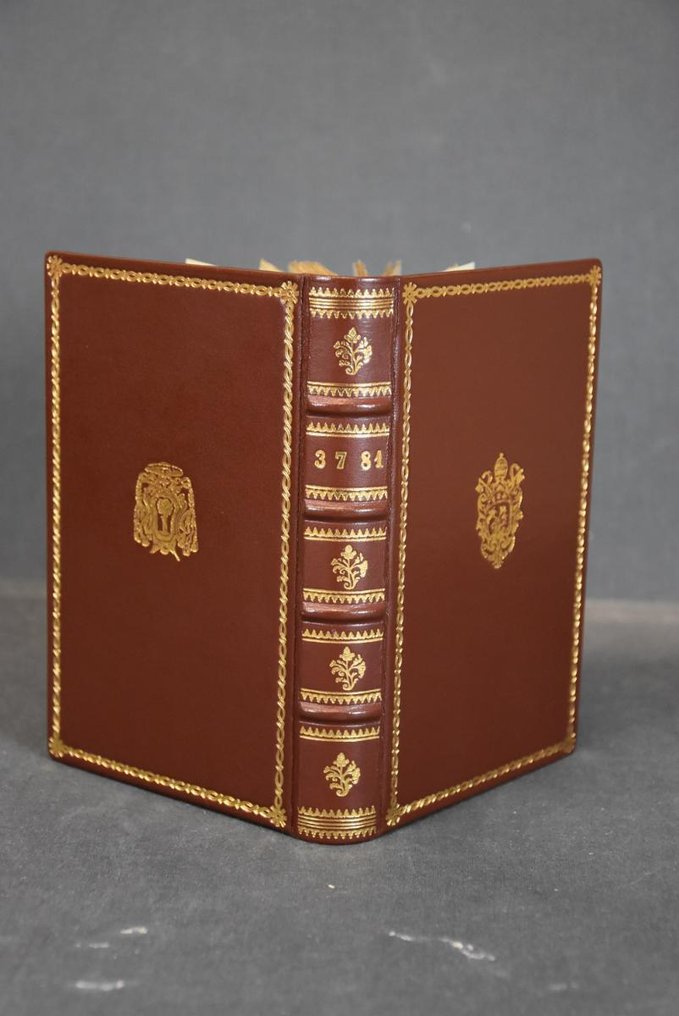
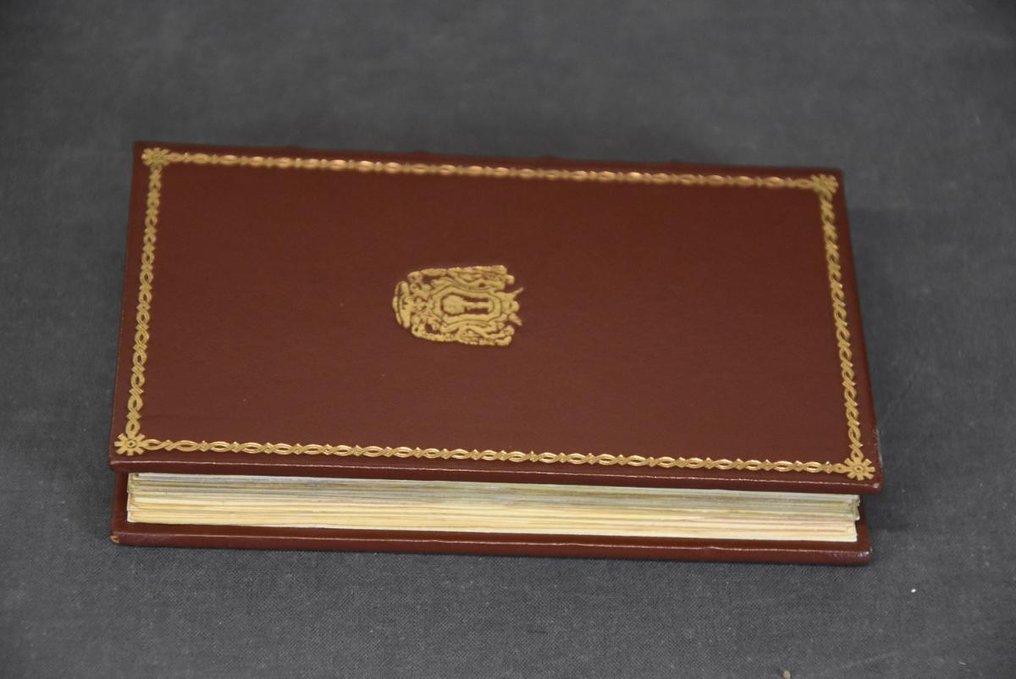
Office of the Madonna. Vat. Lat. 3781. 16.5 x 10 cm, leather binding, with gold titles and embellishments. 226 pages. In excellent condition inside a cloth case, complete with a commentary book.
The Vatican Latin Codex 3781, also known as Jean Bourdichon's Book of Hours, is a masterpiece of late 15th-century French miniature art preserved at the Vatican Library. It was created in France, probably in Tours, between 1480 and 1485. The decorations are attributed to Jean Bourdichon, a renowned court painter of the kings of France (including Louis XI and Charles VIII), and his circle. It is a devotional book for lay use that includes a liturgical calendar, Gospel passages, the Office of the Blessed Virgin Mary, and the Penitential Psalms. The codex is famous for its 17 three-quarter page miniatures enclosed in elaborate borders and over 1200 initials in gold, red, and blue. The style is distinguished by its realistic use of perspective and landscapes, typical of late Gothic French art. It is a parchment manuscript of 236 pages, measuring approximately 15.5 x 9.5 cm.
Jean Bourdichon (Tours, 1457 – 1521) was a French painter and miniaturist.
Virgin and Child, Saint John the Baptist, and John the Evangelist at the Certosa di San Martino, Naples.
He is the author of the illuminated manuscript Les Grandes Heures d'Anne de Bretagne (1508) for Anne of Brittany; his other famous works include the Heures d'Aragon and the Heures de Charles VIII.
The book of hours (Latin: horæ; French: livres d'heures; Spanish: horas; English: primers) is a popular Christian devotional book from the Middle Ages. It is the most common type of surviving medieval illuminated manuscript. Like any manuscript, each book of hours is unique but contains a collection of texts similar to others, such as prayers and psalms, often with appropriate decorations, for Christian devotion. Illumination or decoration is minimal in many examples, often limited to decorated capital letters at the beginning of psalms and other prayers, but books made for wealthy patrons can be extremely sumptuous, with full-page miniatures. These illustrations would combine picturesque scenes of rural life with sacred images. Books of hours were generally written in Latin, although many are entirely or partly in European vernacular languages, particularly Dutch. Tens of thousands of books of hours have survived to this day, in libraries and private collections around the world.
Description
Image of a Book of Hours
A French Book of Hours from the early 15th century (MS13, Society of Antiquaries of London) opened to an illustration of the Adoration of the Magi. It was bequeathed to the Society in 1769 by the Rev. Charles Lyttleton, Bishop of Carlisle and President of the Society (1765-1768).
The typical Book of Hours is a shortened form of the breviary, containing the canonical hours recited in monasteries. It was developed for the laity eager to incorporate elements of monastic daily life into their devotional practice. The recitation of the hours typically focused on reading a certain number of psalms and other prayers.
A typical Book of Hours contains the Calendar of the ecclesiastical feasts (known as the liturgical year), extracts from the Gospel, the readings for Mass for major feasts, the Little Office of the Blessed Virgin Mary, the fifteen Psalms of the Degrees, the seven Penitential Psalms, a Litany of saints, a Office for the dead, and the Hours of the Cross. Most Books of Hours from the 15th century have these basic contents. Marian prayers such as Obsecro te ('I beseech you') and O Intemerata ('O Immaculate') were frequently added, along with devotions to be used during Mass and meditations on the Passion of Jesus, among other optional texts.
Story
Example of an affordable book of hours: a 'simple' book of hours in Middle Dutch - second half of the 15th century - Duchy of Brabant[4]
This level of decoration is also richer than that of most books, although it is less elaborate than the sumptuous lighting found in luxury books, which are the ones most often reproduced.
The book of hours has its origins in the Psalter used by monks and nuns. By the 12th century, it had developed into the Breviary, with weekly cycles of psalms, prayers, hymns, antiphons, and readings that changed with the liturgical season. Eventually, a selection of texts was produced in much shorter volumes called 'books of hours.' During the late 13th century, the book of hours became popular as a personal prayer book for men and women leading secular lives. It consisted of a selection of prayers, psalms, hymns, and lessons based on the clergy's liturgy. Each book was unique in its content, although all included the Hours of the Virgin Mary, devotions to be performed during the eight canonical hours of the day, which is the origin of the name 'book of hours.'
Book of Hours by van Reynegom, c. 15th century - Royal Library of Belgium and King Baudouin Foundation.
Many books of hours were created for a female clientele. There is some evidence that they were sometimes given as wedding gifts from the husband to the bride. They were often passed down within families, as shown by wills. Until the 15th century, paper was rare, and most books of hours were made on parchment, paper, or vellum.
Although illuminated books of hours were enormously expensive, a small book with few or no miniatures was easily purchasable, to the extent that it became widely popular in the fifteenth century. The earliest surviving English example was written for a layperson living in Oxford or nearby around 1240: it is smaller than a modern pocket-sized book, well miniated in the initial letters but without full-page miniatures. In the fifteenth century, there are also examples of servants owning their own Libri d'Ore. In a legal case from 1500, a poor woman was accused of stealing a servant's book of hours.
Very rarely did books include prayers composed specifically for their owners, but more often the texts were adapted to their tastes or gender, including the owners' names in the prayers. Some include images depicting the owners and/or their coats of arms. These, along with the choice of saints commemorated in the calendar and the prayers, are the main clues to the identity of the patron. Eamon Duffy explains that 'the personal character of these books has often been indicated by the inclusion of prayers specially composed or adapted for their owners.' Furthermore, he states that 'up to half of the surviving handwritten books of hours contain annotations, marginalia, or additions of some kind. Such additions might not amount to the inclusion of a regional or personal patron saint in the standardized calendar but often include devotional material added by the owner. Owners could write in specific dates important to them, notes about the months in which events they wished to remember occurred, and even the images found within these books would be personalized for the owners, such as localized saints and local festivals.'
At least in the 15th century, Dutch and Parisian workshops produced books of hours for distribution, without waiting for individual commissions. These were sometimes made with spaces left for the addition of personalized elements such as local festivals or heraldry.
Black bulls, Morgan MS 493, Pentecost, folios 18v/19r, circa 1475–80. Morgan Library & Museum, New York
The style and arrangement of traditional Books of Hours became increasingly standardized around the mid-13th century. The new style can be seen in the books produced by the Oxford illuminator William de Brailes, a member of the minor orders who managed a commercial workshop. His books included various aspects of the Breviary and other liturgical elements for lay use. "He incorporated a perpetual calendar, Gospels, prayers to the Virgin Mary, the Way of the Cross, prayers to the Holy Spirit, penitential Psalms, litanies, prayers for the dead, and suffrages to the Saints. The book's goal was to help his devout patroness structure her daily spiritual life according to the eight canonical hours, from Matins to Compline, observed by all devout members of the Church. The text, enriched with rubrics, gilding, miniatures, and beautiful illuminations, aimed to inspire meditation on the mysteries of faith, the sacrifice made by Christ for mankind, and the horrors of hell, while particularly emphasizing devotion to the Virgin Mary, whose popularity peaked during the 13th century." This arrangement persisted over the years as many aristocrats commissioned their own Books of Hours.
By the end of the 15th century, the advent of printing made books more affordable, and much of the emerging middle class could afford to purchase a printed book of hours, with new manuscripts being commissioned only by the wealthiest. The first printed book of hours in Italy dates to 1472 in Venice, by J. Nelson, while production also began in Naples from 1476 (Moravo-Preller). In 1478, W. Caxton produced the first printed book of hours in England at Westminster, while the Netherlands (Brussels and Delft) began printing books of hours in 1480. These were books decorated with woodcuts, initially in limited numbers and increasingly more common.[9] In France, printers instead employed engravers to emulate the miniatures scattered throughout the page typical of handwritten books of hours, then printing on parchment rather than paper and not hesitating to have the drawings hand-colored: e.g., the printed book of hours in 1487 by Antoine Vérard.[10]
The Kitāb ṣalāt al‐sawā'ī (1514), widely considered the first book in Arabic printed with movable type, is a book of hours intended for Arabic-speaking Christians and presumably commissioned by Pope Julius II.
Decoration
A full-page miniature from May, from a calendar cycle by Simon Bening, early 16th century.
Since many Books of Hours are richly illuminated, they serve as important evidence of life in the 15th and 16th centuries, as well as iconography of medieval Christianity. Some of them were also decorated with jeweled covers, portraits, and heraldic emblems. A few were bound as belt books for easy transport, although few of these or other medieval bindings have survived. Luxury books, such as the Talbot Hours of John Talbot, the Earl of Shrewsbury, may include a portrait of the owner, and in this case, his wife, kneeling in adoration of the Virgin with Child as a form of donor portrait. In expensive books, miniature cycles depicted the Life of the Virgin or the Passion of Christ in eight scenes that decorate the eight Hours of the Virgin, as well as the Labors of the Months and the zodiac signs that adorn the calendar. Secular scenes in the calendar cycles include many of the most well-known images from Books of Hours and played an important role in the early history of landscape painting.
From the 14th century, decorated borders around the edges of at least important pages were common in heavily illuminated books, including books of hours. At the beginning of the 15th century, these were still usually based on foliage drawings and paintings on a simple background, but in the second half of the century, colored or fantasy backgrounds with images of all kinds of objects were used in luxury books.
Second-hand books of hours were often modified by their new owners, even among royalty. After defeating his rival Riccardo III, Henry VII of England gave his book of hours to his mother, who altered it to include her own name. Heraldry was usually erased or over-painted by new owners. Many contained handwritten annotations, personal additions, and marginal notes, but some new owners also commissioned artisans to add more illustrations or texts. Sir Thomas Lewkenor of Trotton hired an illustrator to add details to what is now known as the Lewkenor Hours. The pastedowns of some surviving books include notes of household accounts or birth and death records, similar to later family Bibles. Some owners also collected autographs of important visitors to their homes. Books of hours were often the only book in a household and were commonly used to teach children to read, sometimes featuring a page with the alphabet to assist them.
Towards the end of the 15th century, printers produced books of hours with woodcut illustrations, and the book of hours was one of the main decorated works using the related metal engraving technique.
The luxury book of hours
The illusionistic boundaries of this Flemish book of hours from the late 15th century are typical of luxury books from this period, which were often decorated on every page. The butterfly wing that cuts across the text area is an example of a play with visual conventions, typical of the era.
Among the plants are Veronica, Vinca, Viola tricolor, Bellis perennis, and Chelidonium majus. The butterfly at the bottom is Aglais urticae, and the butterfly at the top left is Pieris rapae. The Latin text is a devotion to Saint Christopher.
In the 14th century, the book of hours surpassed the psalter as the most common vehicle for luxury miniatures, demonstrating the now established dominance of lay patronage over religious patronage for miniatures. From the late 14th century, a number of crowned bibliophiles began collecting luxurious illuminated manuscripts for their decorations, a fashion that spread throughout Europe from the courts of the Valois in France and Burgundy, as well as in Prague under Charles IV of Luxembourg and later Wenceslaus of Luxembourg. A generation later, Duke Philip III of Burgundy was the most important collector of illuminated manuscripts, and many of his circle were as well. It was during this period that Flemish cities emerged as a driving force in miniature, a position they maintained until the decline of illuminated manuscripts in the early 16th century.
The most famous collector of all, the French prince Giovanni di Valois, Duke of Berry (1340–1416), owned several books of hours, some of which survive, including the most renowned of all, the Très riches heures du Duc de Berry. This work was begun around 1410 by the Limbourg brothers, although left incomplete, and its decoration continued for several decades by other artists and patrons. The same was true for the Hours of Turin, which were also owned, among others, by the Duke of Berry.
By the mid-15th century, a much broader group of nobility and wealthy businessmen was able to commission highly decorated books of hours, often small in size. With the advent of printing, the market sharply contracted, and by 1500, the finest quality books were produced again only for royal or very grand collectors. One of the last great illuminated books of hours was the so-called Farnese Hours of Cardinal Alessandro Farnese the Younger, created in 1546 by Giulio Clovio, the last great manuscript miniaturist.
Office of the Madonna. Vat. Lat. 3781. 16.5 x 10 cm, leather binding, with gold titles and embellishments. 226 pages. In excellent condition inside a cloth case, complete with a commentary book.
The Vatican Latin Codex 3781, also known as Jean Bourdichon's Book of Hours, is a masterpiece of late 15th-century French miniature art preserved at the Vatican Library. It was created in France, probably in Tours, between 1480 and 1485. The decorations are attributed to Jean Bourdichon, a renowned court painter of the kings of France (including Louis XI and Charles VIII), and his circle. It is a devotional book for lay use that includes a liturgical calendar, Gospel passages, the Office of the Blessed Virgin Mary, and the Penitential Psalms. The codex is famous for its 17 three-quarter page miniatures enclosed in elaborate borders and over 1200 initials in gold, red, and blue. The style is distinguished by its realistic use of perspective and landscapes, typical of late Gothic French art. It is a parchment manuscript of 236 pages, measuring approximately 15.5 x 9.5 cm.
Jean Bourdichon (Tours, 1457 – 1521) was a French painter and miniaturist.
Virgin and Child, Saint John the Baptist, and John the Evangelist at the Certosa di San Martino, Naples.
He is the author of the illuminated manuscript Les Grandes Heures d'Anne de Bretagne (1508) for Anne of Brittany; his other famous works include the Heures d'Aragon and the Heures de Charles VIII.
The book of hours (Latin: horæ; French: livres d'heures; Spanish: horas; English: primers) is a popular Christian devotional book from the Middle Ages. It is the most common type of surviving medieval illuminated manuscript. Like any manuscript, each book of hours is unique but contains a collection of texts similar to others, such as prayers and psalms, often with appropriate decorations, for Christian devotion. Illumination or decoration is minimal in many examples, often limited to decorated capital letters at the beginning of psalms and other prayers, but books made for wealthy patrons can be extremely sumptuous, with full-page miniatures. These illustrations would combine picturesque scenes of rural life with sacred images. Books of hours were generally written in Latin, although many are entirely or partly in European vernacular languages, particularly Dutch. Tens of thousands of books of hours have survived to this day, in libraries and private collections around the world.
Description
Image of a Book of Hours
A French Book of Hours from the early 15th century (MS13, Society of Antiquaries of London) opened to an illustration of the Adoration of the Magi. It was bequeathed to the Society in 1769 by the Rev. Charles Lyttleton, Bishop of Carlisle and President of the Society (1765-1768).
The typical Book of Hours is a shortened form of the breviary, containing the canonical hours recited in monasteries. It was developed for the laity eager to incorporate elements of monastic daily life into their devotional practice. The recitation of the hours typically focused on reading a certain number of psalms and other prayers.
A typical Book of Hours contains the Calendar of the ecclesiastical feasts (known as the liturgical year), extracts from the Gospel, the readings for Mass for major feasts, the Little Office of the Blessed Virgin Mary, the fifteen Psalms of the Degrees, the seven Penitential Psalms, a Litany of saints, a Office for the dead, and the Hours of the Cross. Most Books of Hours from the 15th century have these basic contents. Marian prayers such as Obsecro te ('I beseech you') and O Intemerata ('O Immaculate') were frequently added, along with devotions to be used during Mass and meditations on the Passion of Jesus, among other optional texts.
Story
Example of an affordable book of hours: a 'simple' book of hours in Middle Dutch - second half of the 15th century - Duchy of Brabant[4]
This level of decoration is also richer than that of most books, although it is less elaborate than the sumptuous lighting found in luxury books, which are the ones most often reproduced.
The book of hours has its origins in the Psalter used by monks and nuns. By the 12th century, it had developed into the Breviary, with weekly cycles of psalms, prayers, hymns, antiphons, and readings that changed with the liturgical season. Eventually, a selection of texts was produced in much shorter volumes called 'books of hours.' During the late 13th century, the book of hours became popular as a personal prayer book for men and women leading secular lives. It consisted of a selection of prayers, psalms, hymns, and lessons based on the clergy's liturgy. Each book was unique in its content, although all included the Hours of the Virgin Mary, devotions to be performed during the eight canonical hours of the day, which is the origin of the name 'book of hours.'
Book of Hours by van Reynegom, c. 15th century - Royal Library of Belgium and King Baudouin Foundation.
Many books of hours were created for a female clientele. There is some evidence that they were sometimes given as wedding gifts from the husband to the bride. They were often passed down within families, as shown by wills. Until the 15th century, paper was rare, and most books of hours were made on parchment, paper, or vellum.
Although illuminated books of hours were enormously expensive, a small book with few or no miniatures was easily purchasable, to the extent that it became widely popular in the fifteenth century. The earliest surviving English example was written for a layperson living in Oxford or nearby around 1240: it is smaller than a modern pocket-sized book, well miniated in the initial letters but without full-page miniatures. In the fifteenth century, there are also examples of servants owning their own Libri d'Ore. In a legal case from 1500, a poor woman was accused of stealing a servant's book of hours.
Very rarely did books include prayers composed specifically for their owners, but more often the texts were adapted to their tastes or gender, including the owners' names in the prayers. Some include images depicting the owners and/or their coats of arms. These, along with the choice of saints commemorated in the calendar and the prayers, are the main clues to the identity of the patron. Eamon Duffy explains that 'the personal character of these books has often been indicated by the inclusion of prayers specially composed or adapted for their owners.' Furthermore, he states that 'up to half of the surviving handwritten books of hours contain annotations, marginalia, or additions of some kind. Such additions might not amount to the inclusion of a regional or personal patron saint in the standardized calendar but often include devotional material added by the owner. Owners could write in specific dates important to them, notes about the months in which events they wished to remember occurred, and even the images found within these books would be personalized for the owners, such as localized saints and local festivals.'
At least in the 15th century, Dutch and Parisian workshops produced books of hours for distribution, without waiting for individual commissions. These were sometimes made with spaces left for the addition of personalized elements such as local festivals or heraldry.
Black bulls, Morgan MS 493, Pentecost, folios 18v/19r, circa 1475–80. Morgan Library & Museum, New York
The style and arrangement of traditional Books of Hours became increasingly standardized around the mid-13th century. The new style can be seen in the books produced by the Oxford illuminator William de Brailes, a member of the minor orders who managed a commercial workshop. His books included various aspects of the Breviary and other liturgical elements for lay use. "He incorporated a perpetual calendar, Gospels, prayers to the Virgin Mary, the Way of the Cross, prayers to the Holy Spirit, penitential Psalms, litanies, prayers for the dead, and suffrages to the Saints. The book's goal was to help his devout patroness structure her daily spiritual life according to the eight canonical hours, from Matins to Compline, observed by all devout members of the Church. The text, enriched with rubrics, gilding, miniatures, and beautiful illuminations, aimed to inspire meditation on the mysteries of faith, the sacrifice made by Christ for mankind, and the horrors of hell, while particularly emphasizing devotion to the Virgin Mary, whose popularity peaked during the 13th century." This arrangement persisted over the years as many aristocrats commissioned their own Books of Hours.
By the end of the 15th century, the advent of printing made books more affordable, and much of the emerging middle class could afford to purchase a printed book of hours, with new manuscripts being commissioned only by the wealthiest. The first printed book of hours in Italy dates to 1472 in Venice, by J. Nelson, while production also began in Naples from 1476 (Moravo-Preller). In 1478, W. Caxton produced the first printed book of hours in England at Westminster, while the Netherlands (Brussels and Delft) began printing books of hours in 1480. These were books decorated with woodcuts, initially in limited numbers and increasingly more common.[9] In France, printers instead employed engravers to emulate the miniatures scattered throughout the page typical of handwritten books of hours, then printing on parchment rather than paper and not hesitating to have the drawings hand-colored: e.g., the printed book of hours in 1487 by Antoine Vérard.[10]
The Kitāb ṣalāt al‐sawā'ī (1514), widely considered the first book in Arabic printed with movable type, is a book of hours intended for Arabic-speaking Christians and presumably commissioned by Pope Julius II.
Decoration
A full-page miniature from May, from a calendar cycle by Simon Bening, early 16th century.
Since many Books of Hours are richly illuminated, they serve as important evidence of life in the 15th and 16th centuries, as well as iconography of medieval Christianity. Some of them were also decorated with jeweled covers, portraits, and heraldic emblems. A few were bound as belt books for easy transport, although few of these or other medieval bindings have survived. Luxury books, such as the Talbot Hours of John Talbot, the Earl of Shrewsbury, may include a portrait of the owner, and in this case, his wife, kneeling in adoration of the Virgin with Child as a form of donor portrait. In expensive books, miniature cycles depicted the Life of the Virgin or the Passion of Christ in eight scenes that decorate the eight Hours of the Virgin, as well as the Labors of the Months and the zodiac signs that adorn the calendar. Secular scenes in the calendar cycles include many of the most well-known images from Books of Hours and played an important role in the early history of landscape painting.
From the 14th century, decorated borders around the edges of at least important pages were common in heavily illuminated books, including books of hours. At the beginning of the 15th century, these were still usually based on foliage drawings and paintings on a simple background, but in the second half of the century, colored or fantasy backgrounds with images of all kinds of objects were used in luxury books.
Second-hand books of hours were often modified by their new owners, even among royalty. After defeating his rival Riccardo III, Henry VII of England gave his book of hours to his mother, who altered it to include her own name. Heraldry was usually erased or over-painted by new owners. Many contained handwritten annotations, personal additions, and marginal notes, but some new owners also commissioned artisans to add more illustrations or texts. Sir Thomas Lewkenor of Trotton hired an illustrator to add details to what is now known as the Lewkenor Hours. The pastedowns of some surviving books include notes of household accounts or birth and death records, similar to later family Bibles. Some owners also collected autographs of important visitors to their homes. Books of hours were often the only book in a household and were commonly used to teach children to read, sometimes featuring a page with the alphabet to assist them.
Towards the end of the 15th century, printers produced books of hours with woodcut illustrations, and the book of hours was one of the main decorated works using the related metal engraving technique.
The luxury book of hours
The illusionistic boundaries of this Flemish book of hours from the late 15th century are typical of luxury books from this period, which were often decorated on every page. The butterfly wing that cuts across the text area is an example of a play with visual conventions, typical of the era.
Among the plants are Veronica, Vinca, Viola tricolor, Bellis perennis, and Chelidonium majus. The butterfly at the bottom is Aglais urticae, and the butterfly at the top left is Pieris rapae. The Latin text is a devotion to Saint Christopher.
In the 14th century, the book of hours surpassed the psalter as the most common vehicle for luxury miniatures, demonstrating the now established dominance of lay patronage over religious patronage for miniatures. From the late 14th century, a number of crowned bibliophiles began collecting luxurious illuminated manuscripts for their decorations, a fashion that spread throughout Europe from the courts of the Valois in France and Burgundy, as well as in Prague under Charles IV of Luxembourg and later Wenceslaus of Luxembourg. A generation later, Duke Philip III of Burgundy was the most important collector of illuminated manuscripts, and many of his circle were as well. It was during this period that Flemish cities emerged as a driving force in miniature, a position they maintained until the decline of illuminated manuscripts in the early 16th century.
The most famous collector of all, the French prince Giovanni di Valois, Duke of Berry (1340–1416), owned several books of hours, some of which survive, including the most renowned of all, the Très riches heures du Duc de Berry. This work was begun around 1410 by the Limbourg brothers, although left incomplete, and its decoration continued for several decades by other artists and patrons. The same was true for the Hours of Turin, which were also owned, among others, by the Duke of Berry.
By the mid-15th century, a much broader group of nobility and wealthy businessmen was able to commission highly decorated books of hours, often small in size. With the advent of printing, the market sharply contracted, and by 1500, the finest quality books were produced again only for royal or very grand collectors. One of the last great illuminated books of hours was the so-called Farnese Hours of Cardinal Alessandro Farnese the Younger, created in 1546 by Giulio Clovio, the last great manuscript miniaturist.
Details
Number of Books
1
Subject
History, Illustrated, Religion
Book Title
Ufficio della Madonna. Codice Vaticano Latino 3781
Author/ Illustrator
Libro d'ore
Condition
Fine
Publication year oldest item
1480
Publication year youngest item
1986
Height
16.5 cm
Edition
Illustrated Edition
Width
10 cm
Language
Italian
Original language
Yes
Publisher
Editoriale Jaca Book, Milano; Belser Verlag, Zurigo
Binding/ Material
Leather
Number of pages
226
Sold by
