Anton E. Lux - die Balkanhalbinsel - 1887


14
days
07
hours
17
minutes
19
seconds

No bids placed
Catawiki Buyer Protection
Your payment’s safe with us until you receive your object.View details
Trustpilot 4.4 | 123536 reviews
Rated Excellent on Trustpilot.
Anton E. Lux's Die Balkanhalbinsel is a German-language illustrated travel and geography book from 1887, hardcover, 265 pages, 24.5 × 15.5 cm, published by Herder'sche Verlagshandlung in Freiburg im Breisgau.
AI-assisted summary
Description from the seller
A.C. Lux - The Balkan Peninsula (excluding Greece). Physical and ethnographic descriptions and cityscapes - Freiburg im Breisgau, Herdersche Verlagshandlung, 1887 - 265 pages - 24.5 x 15.5 cm
- Physical Geography: Detailed descriptions of the terrain, climate, and natural features of Balkan regions such as Bulgaria, Serbia, Romania, and Albania.
Ethnographic insights: Observations on the diverse ethnic groups, customs, and social structures present in the Balkans during the late 19th century.
- Urban Portraits: Vivid portrayals of cities and towns, including architectural styles, marketplaces, and cultural life.
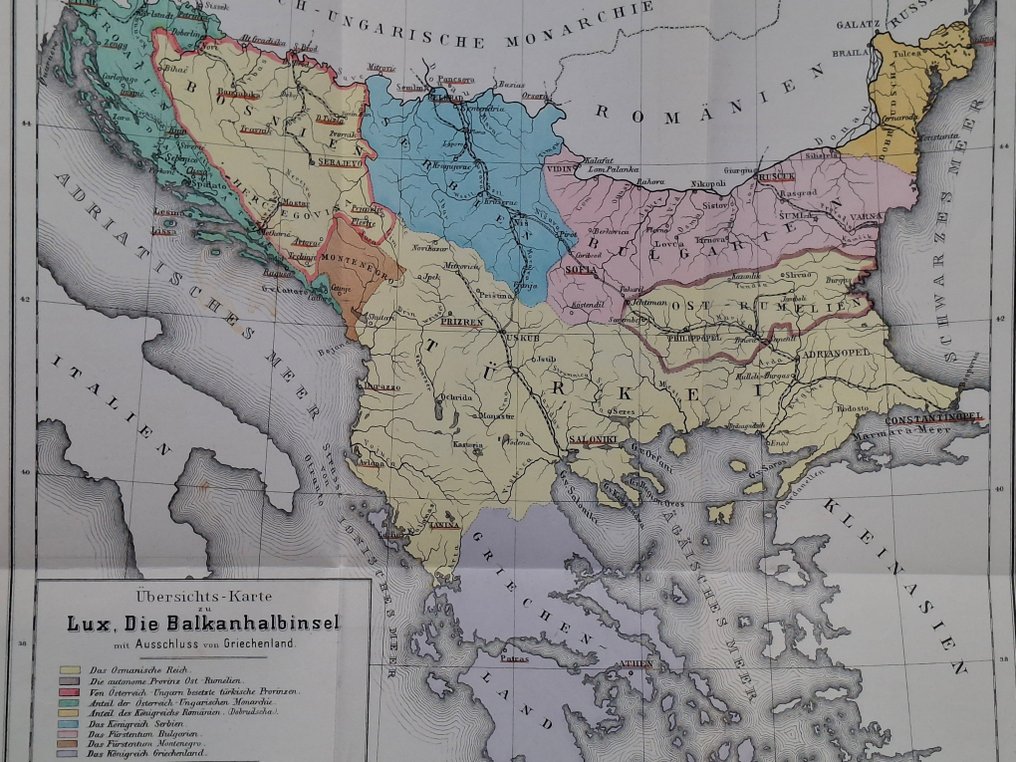
- Maps and illustrations: Some editions include visual elements to support the geographic and cultural analysis.
Historical Significance
Written during a period of rising nationalism and shifting borders in the Balkans, Lux’s work provides a snapshot of the region before major 20th-century upheavals.
It reflects a Central European scholarly perspective on Southeastern Europe, valuable for historians studying imperial views of the Balkans.
A.C. Lux - The Balkan Peninsula (excluding Greece). Physical and ethnographic descriptions and cityscapes - Freiburg im Breisgau, Herdersche Verlagshandlung, 1887 - 265 pages - 24.5 x 15.5 cm
- Physical Geography: Detailed descriptions of the terrain, climate, and natural features of Balkan regions such as Bulgaria, Serbia, Romania, and Albania.
Ethnographic insights: Observations on the diverse ethnic groups, customs, and social structures present in the Balkans during the late 19th century.
- Urban Portraits: Vivid portrayals of cities and towns, including architectural styles, marketplaces, and cultural life.
- Maps and illustrations: Some editions include visual elements to support the geographic and cultural analysis.
Historical Significance
Written during a period of rising nationalism and shifting borders in the Balkans, Lux’s work provides a snapshot of the region before major 20th-century upheavals.
It reflects a Central European scholarly perspective on Southeastern Europe, valuable for historians studying imperial views of the Balkans.
Details
Number of Books
1
Subject
Geography, History, Illustrated, Travels
Book Title
die Balkanhalbinsel
Author/ Illustrator
Anton E. Lux
Condition
Very good
Publication year oldest item
1887
Height
24.5 cm
Edition
Illustrated Edition
Width
15.5 cm
Language
German
Original language
Yes
Publisher
Herder'sche Verlagshandlung, Freiburg im Breisgau
Binding/ Material
Hardback
Number of pages
265
