Johan Caspar Lavater - Brieven aan Jongelingen - 1820


05
days
13
hours
44
minutes
22
seconds

No bids placed
Catawiki Buyer Protection
Your payment’s safe with us until you receive your object.View details
Trustpilot 4.4 | 123641 reviews
Rated Excellent on Trustpilot.
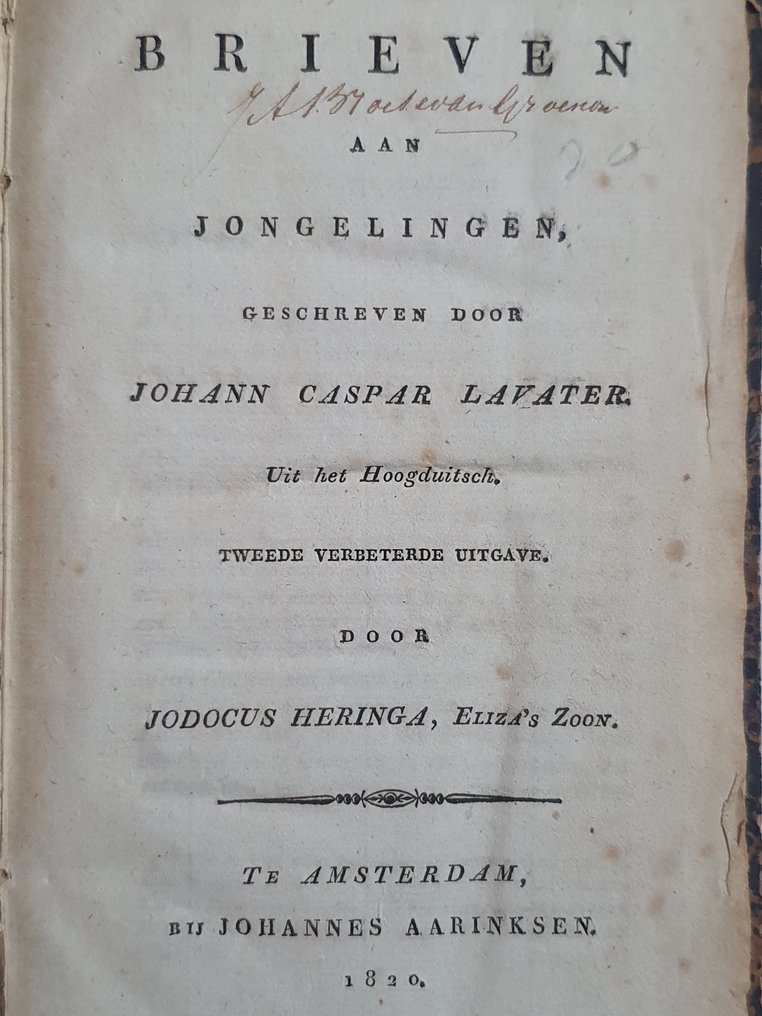
Johan Caspar Lavater, Brieven aan Jongelingen, Amsterdam, Johannes Aariksen, 1820, first edition, Dutch (original language), 144 pages, 21 × 13 cm, hardback, condition: reasonable.
AI-assisted summary
Description from the seller
Johan Caspar Lavater - Letters to Young Men - Amsterdam, Johannes Aariksen, 1820 - 144 pages - 21 x 13 cm
Condition: reasonable
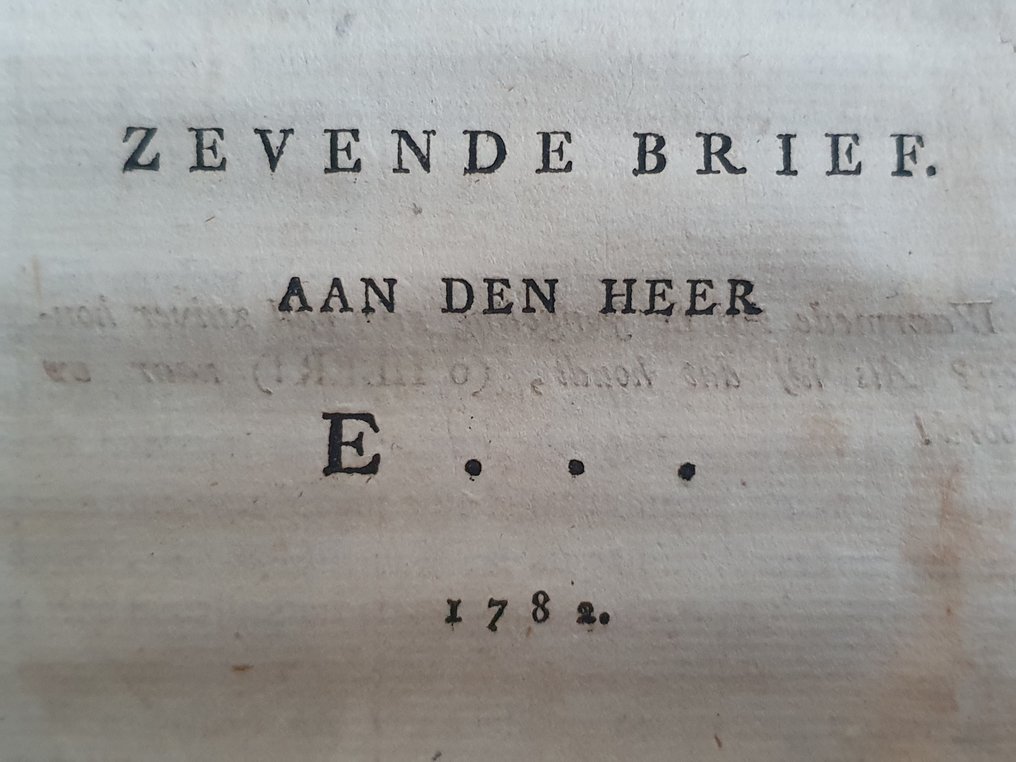
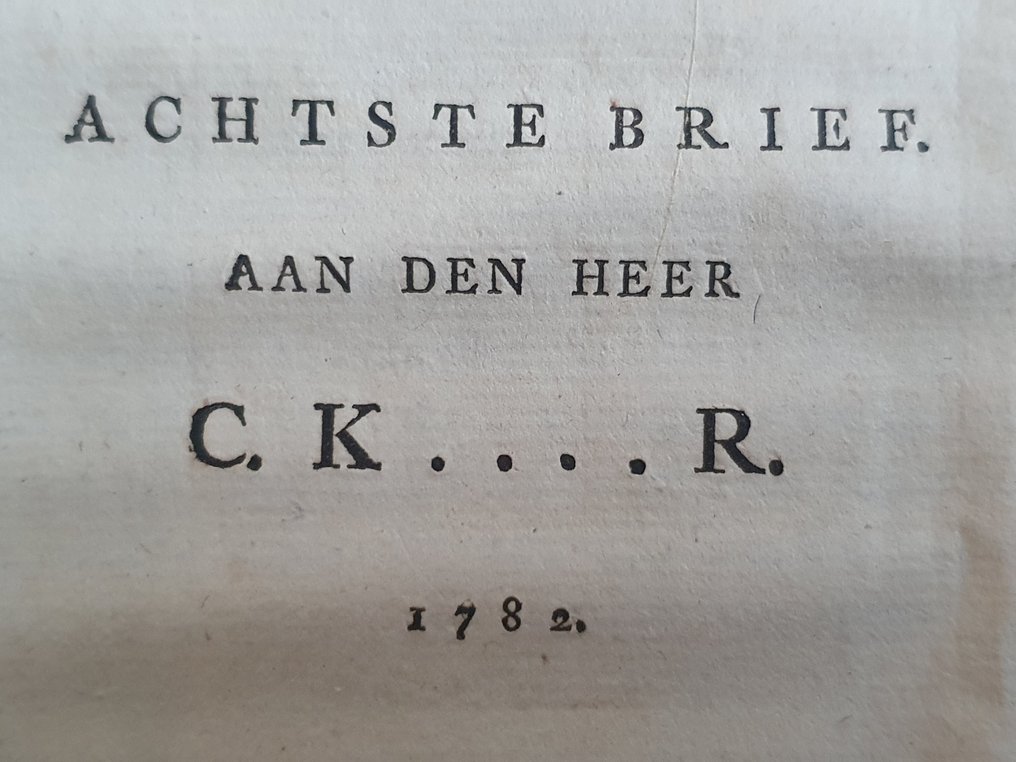
Bound in the original binding with marbled boards. Damage along the spine. Good book block and neat pages. Sometimes slight yellowing or foxing. The work is complete.
wikipedia:
Johann Kaspar Lavater (Zurich, 1741 - there, 1801) was a Swiss philosopher, preacher, and poet. He is perhaps a descendant of Ludovic Lavater.
Biography
Lavater studied theology at the Collegium Carolinum in Zurich. There, he met fellow student Johann Heinrich Füssli, with whom he formed a lifelong friendship. In 1762, the two, along with Felix Hess (1742-1768), wrote a pamphlet against the corruption of a local dignitary. The scandal caused by this pamphlet forced Lavater to leave Zurich. Together with Füssli and Hess, he traveled to Berlin. In 1764, Lavater was able to return to Switzerland. He became a pastor in various churches.
Physiognomy
Lavater became famous for his writings on physiognomy, the science of reading a person's character from their appearance, especially their face. His extensive, beautifully illustrated work, Physiognomische Fragmente zur Beförderung der Menschenkenntnis und Menschenliebe (1775-1778), made physiognomy a popular form of science. This work was translated into many languages, including Dutch in 1780, and was widely disseminated. Today, physiognomy is considered pseudoscientific.
Johan Caspar Lavater - Letters to Young Men - Amsterdam, Johannes Aariksen, 1820 - 144 pages - 21 x 13 cm
Condition: reasonable
Bound in the original binding with marbled boards. Damage along the spine. Good book block and neat pages. Sometimes slight yellowing or foxing. The work is complete.
wikipedia:
Johann Kaspar Lavater (Zurich, 1741 - there, 1801) was a Swiss philosopher, preacher, and poet. He is perhaps a descendant of Ludovic Lavater.
Biography
Lavater studied theology at the Collegium Carolinum in Zurich. There, he met fellow student Johann Heinrich Füssli, with whom he formed a lifelong friendship. In 1762, the two, along with Felix Hess (1742-1768), wrote a pamphlet against the corruption of a local dignitary. The scandal caused by this pamphlet forced Lavater to leave Zurich. Together with Füssli and Hess, he traveled to Berlin. In 1764, Lavater was able to return to Switzerland. He became a pastor in various churches.
Physiognomy
Lavater became famous for his writings on physiognomy, the science of reading a person's character from their appearance, especially their face. His extensive, beautifully illustrated work, Physiognomische Fragmente zur Beförderung der Menschenkenntnis und Menschenliebe (1775-1778), made physiognomy a popular form of science. This work was translated into many languages, including Dutch in 1780, and was widely disseminated. Today, physiognomy is considered pseudoscientific.
Details
Number of Books
1
Subject
History, Literature, Philosophy
Book Title
Brieven aan Jongelingen
Author/ Illustrator
Johan Caspar Lavater
Condition
Fair
Publication year oldest item
1820
Height
21 cm
Edition
1st Edition
Width
13 cm
Language
Dutch
Original language
Yes
Publisher
Amsterdam, Johannes Aariksen
Binding/ Material
Hardback
Number of pages
144
