Signed, Georges Bernanos - L'Imposture (1927) & La Joie (1928) - 1931



08
days
14
hours
23
minutes
17
seconds
Current bid
€ 1
Reserve price not met

Expert
Selected by Sebastian Hau
Founded and directed two French book fairs; nearly 20 years of experience in contemporary books.
Estimate € 380 - € 450
5 other people are watching this object
 Bidder 7881 Bidder 7881 | €1 |
|---|
Catawiki Buyer Protection
Your payment’s safe with us until you receive your object.View details
Trustpilot 4.4 | 123878 reviews
Rated Excellent on Trustpilot.
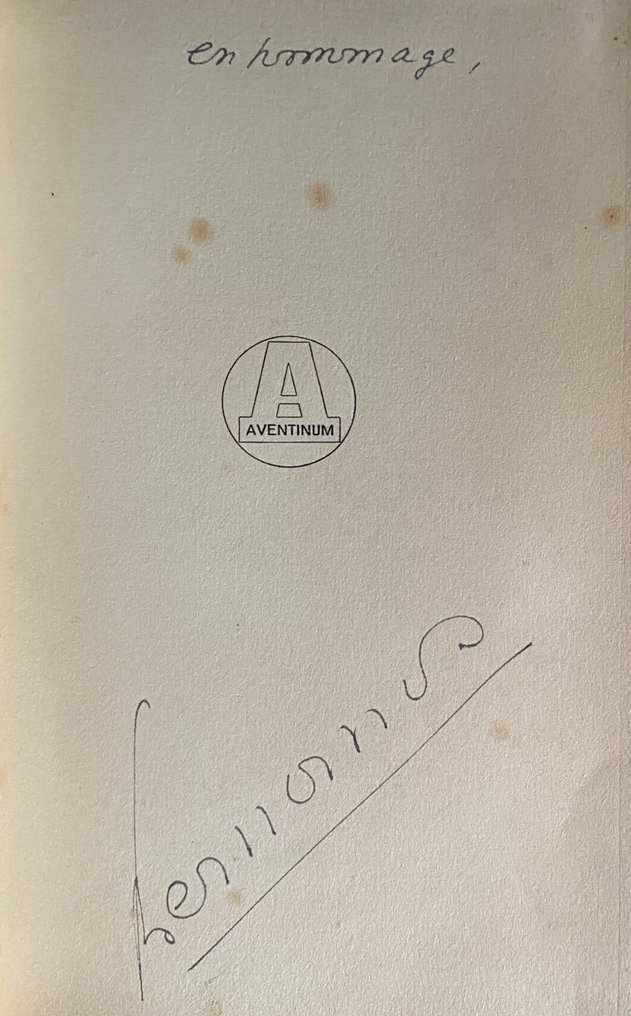
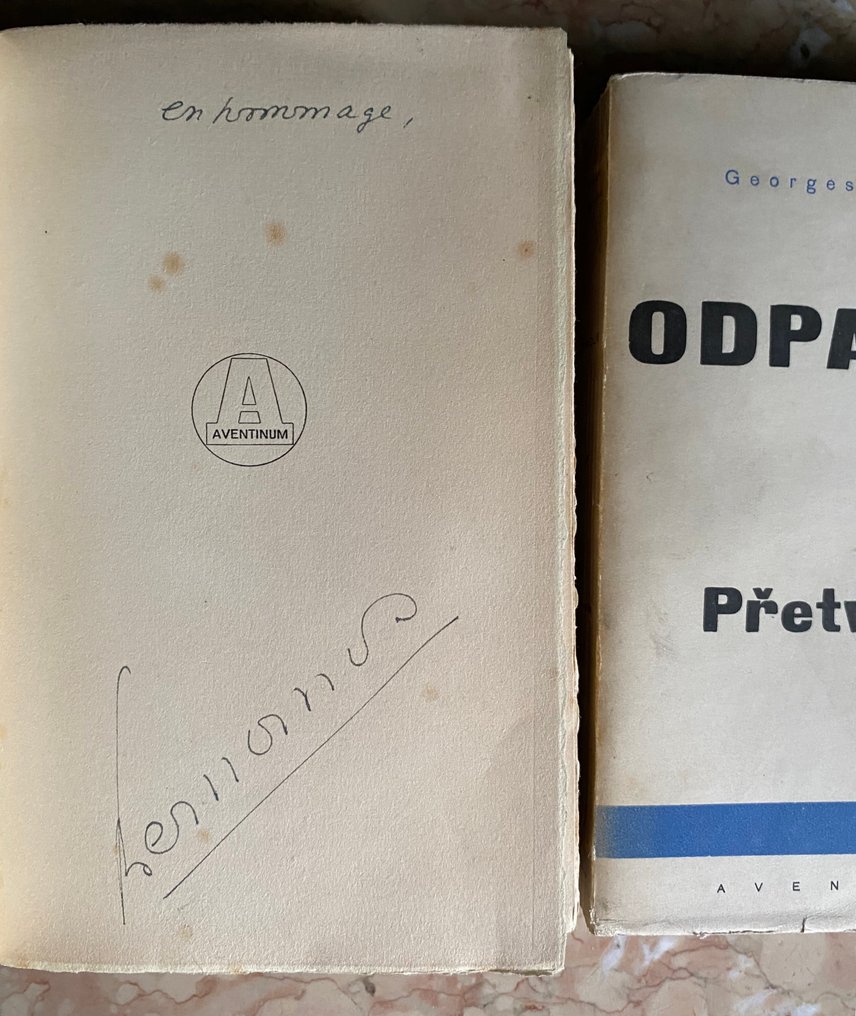
Two-volume Czech edition of Georges Bernanos's L'Imposture and La Joie, translated by Jan Čep and published in 1931 by Aventinum, signed by the author on the front endpaper of each volume, numbered 19 of 25, in softback and in very good condition.
AI-assisted summary
Description from the seller
Czech edition of G. Bernanos’s two-part novel with the author’s signature!
This copy contains two signatures of the author Georges Bernanos, one on the front endpaper of each volume. It is a numbered copy, specifically number 19 of 25, printed on handmade Dutch paper.
Condition: Both volumes are firm, with intact bindings. Minor spotting on the edges of the pages and on the front cover of the second volume. Otherwise, both books are in very good and attractive condition.
The two-volume Czech edition of The Renegade (Odpadlík) by Georges Bernanos, published in 1931 by the Aventinum publishing house, represents an exceptional event in the interwar literary culture of Czechoslovakia. The novel was translated by Jan Čep, a prominent Czech prose writer and translator, who managed to convey the deep spiritual and linguistic nuances of the French original "L'Imposture" (1927) and "La Joie" (1929) with great sensitivity. The book was published as part of the Kmen – Klub nakladatelů series within the larger collection titled Knihy dnešku (Books of Today), which aimed to introduce high-quality and intellectually stimulating foreign literature to the Czech readership.
The novel was divided into two volumes — the first titled Hypocrisy (Přetvářka), the second Joy (Radost). This division was not arbitrary, as it mirrors the internal structure of the novel, which explores the profound spiritual conflict between a false, formal Catholicism and authentic faith — faith often lived through suffering, humility, and inner struggle. The main character, Abbé Cénabre, is an intellectual and renowned scholar of mysticism whose spiritual life is reduced to theoretical constructs and public acclaim. In contrast, Bernanos introduces simple yet spiritually vibrant figures such as Abbé Chevance and the young girl Chantal, who embody a lived faith rooted in quiet heroism and everyday suffering. The second part of the novel, Joy, does not depict superficial happiness, but a profound joy that arises only after inner collapse and the rejection of hypocrisy.
The significance of this Czech edition lies not only in the literary merit of the novel itself, but also in the way it was introduced into the Czech context. At its height, Aventinum published works that were demanding, spiritually oriented, and culturally valuable — and The Renegade holds an honorable place among them. The Kmen series and the Books of Today collection played an irreplaceable role in the cultural life of interwar Czechoslovakia. They reflect not only an interest in spiritual themes, but also the openness of Czech literary circles to the broader European spiritual crisis, which is powerfully echoed in Bernanos's work.
The 1931 edition is today not only of literary value, but also highly sought after by collectors, especially when preserved in its complete two-volume form.
Seller's Story
I strive to find and offer you the most interesting items from Prague’s antiquarian bookstores and second-hand shops: autographs, rarities, photographs, bibliophilia, old prints, posters, maps, catalogs, high-quality or sold-out books, as well as fine art.
Prague has always been a meeting point of cultures and languages. Especially during the 20th century, Czechoslovakia was visited by numerous world-renowned artists, writers, scientists, and other notable figures who left their mark here and established connections with local culture or institutions. So the selection here will be rich in provenance — including German, French, English, Russian, or, for example, Italian.
However, I will also aim to highlight more or less well-known Czech artists and noteworthy items — of interest to collectors and art lovers, especially those passionate about autographs, fine art, and related fields.
Czech edition of G. Bernanos’s two-part novel with the author’s signature!
This copy contains two signatures of the author Georges Bernanos, one on the front endpaper of each volume. It is a numbered copy, specifically number 19 of 25, printed on handmade Dutch paper.
Condition: Both volumes are firm, with intact bindings. Minor spotting on the edges of the pages and on the front cover of the second volume. Otherwise, both books are in very good and attractive condition.
The two-volume Czech edition of The Renegade (Odpadlík) by Georges Bernanos, published in 1931 by the Aventinum publishing house, represents an exceptional event in the interwar literary culture of Czechoslovakia. The novel was translated by Jan Čep, a prominent Czech prose writer and translator, who managed to convey the deep spiritual and linguistic nuances of the French original "L'Imposture" (1927) and "La Joie" (1929) with great sensitivity. The book was published as part of the Kmen – Klub nakladatelů series within the larger collection titled Knihy dnešku (Books of Today), which aimed to introduce high-quality and intellectually stimulating foreign literature to the Czech readership.
The novel was divided into two volumes — the first titled Hypocrisy (Přetvářka), the second Joy (Radost). This division was not arbitrary, as it mirrors the internal structure of the novel, which explores the profound spiritual conflict between a false, formal Catholicism and authentic faith — faith often lived through suffering, humility, and inner struggle. The main character, Abbé Cénabre, is an intellectual and renowned scholar of mysticism whose spiritual life is reduced to theoretical constructs and public acclaim. In contrast, Bernanos introduces simple yet spiritually vibrant figures such as Abbé Chevance and the young girl Chantal, who embody a lived faith rooted in quiet heroism and everyday suffering. The second part of the novel, Joy, does not depict superficial happiness, but a profound joy that arises only after inner collapse and the rejection of hypocrisy.
The significance of this Czech edition lies not only in the literary merit of the novel itself, but also in the way it was introduced into the Czech context. At its height, Aventinum published works that were demanding, spiritually oriented, and culturally valuable — and The Renegade holds an honorable place among them. The Kmen series and the Books of Today collection played an irreplaceable role in the cultural life of interwar Czechoslovakia. They reflect not only an interest in spiritual themes, but also the openness of Czech literary circles to the broader European spiritual crisis, which is powerfully echoed in Bernanos's work.
The 1931 edition is today not only of literary value, but also highly sought after by collectors, especially when preserved in its complete two-volume form.
Seller's Story
I strive to find and offer you the most interesting items from Prague’s antiquarian bookstores and second-hand shops: autographs, rarities, photographs, bibliophilia, old prints, posters, maps, catalogs, high-quality or sold-out books, as well as fine art.
Prague has always been a meeting point of cultures and languages. Especially during the 20th century, Czechoslovakia was visited by numerous world-renowned artists, writers, scientists, and other notable figures who left their mark here and established connections with local culture or institutions. So the selection here will be rich in provenance — including German, French, English, Russian, or, for example, Italian.
However, I will also aim to highlight more or less well-known Czech artists and noteworthy items — of interest to collectors and art lovers, especially those passionate about autographs, fine art, and related fields.
Details
Number of Books
2
Subject
Literature
Book Title
L'Imposture (1927) & La Joie (1928)
Author/ Illustrator
Signed, Georges Bernanos
Condition
Very good
Publication year oldest item
1931
Height
19.3 cm
Edition
Translated edition
Width
12 cm
Language
Czech
Original language
No
Publisher
Aventinum
Binding/ Material
Softback
Extras
Signed, Signed by author
Number of pages
605
Sold by
