Achille Comte - Musée d'histoire naturelle - 1854



Opens tomorrow
Starting bid
€ 1
Add to your favourites to get an alert when the auction starts.

Catawiki Buyer Protection
Your payment’s safe with us until you receive your object.View details
Trustpilot 4.4 | 123641 reviews
Rated Excellent on Trustpilot.
Description from the seller
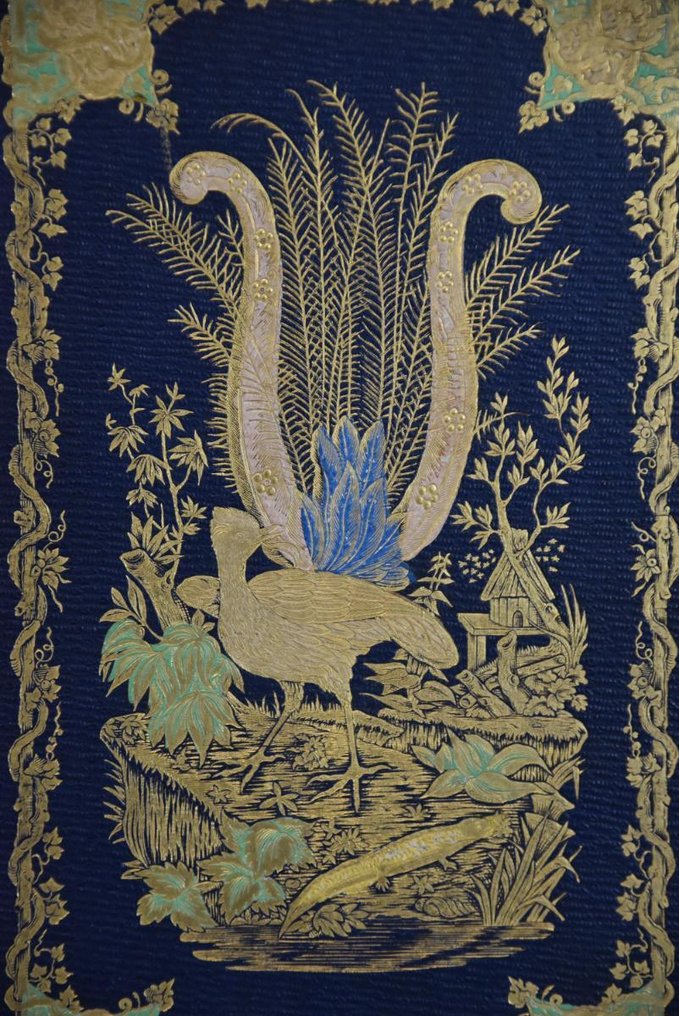
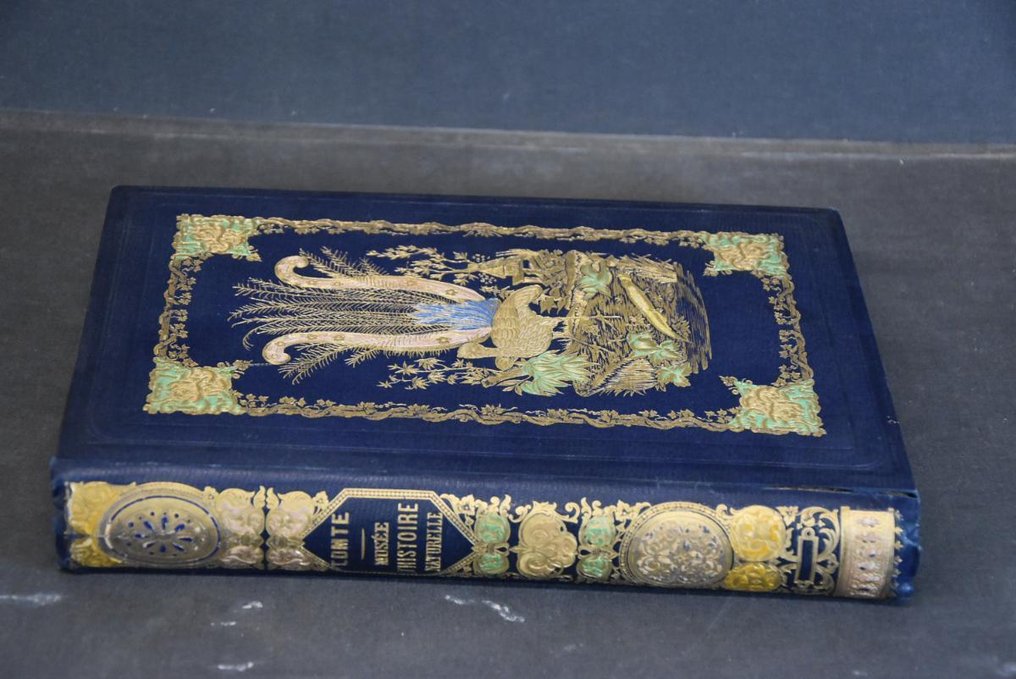
Natural History Museum. Cosmography - Geology - Zoology - Botany by Mr. Achille Compte. Paris, Gustave Havard, 1854. 30 x 21 cm, hardcover in cloth, with colored and gilded impressions, gilded edges, 272 pages. Text in French. Out-of-text watercolor illustrations. In excellent condition - normal signs of aging - a partially torn protective tissue (see photo). No reserve!
Achille Joseph Comte, born on September 29, 1802, in Grenoble (Isère), and died on January 17, 1866, in Nantes, was a French doctor, professor of natural history, zoologist, and physiologist.
Biographical overview
Count studied medicine at the Faculty of Medicine in Paris, became an intern, and worked in the most prestigious Parisian hospitals. Recruited by Jean Cruveilhier, he was one of the founding members of the Paris Anatomical Society. However, after discussing his thesis, he left medicine to take up the position of professor of natural sciences at the Collège Royal Charlemagne. For several years, he was president of the Society of Literature Men and a member of numerous scientific societies. Until the Revolution of 1848, he headed the 'Scientific and Medical Affairs Office' at the Ministry of Public Education. Forced to leave this position, but later recognized for his teaching talent, he was appointed director of the Preparatory School for Higher Education in Sciences and Letters in Nantes under the Second Empire.
Married Aglaé de Bouconville, widow of the playwright Jean-Louis Laya, who published several theatrical works [1] but also a Natural History told to young people, or An Explanation of the Instincts and Customs of Animals, preceded by a note on human races [2].
Decoration
Knight of the Legion of Honour (1846)
Works and publications
Achille Joseph Comte, Alfred Joseph Annedouche: Atlas of Human Anatomy, Imprimerie de Ch. Lahure, [Paris], [185?], plate 12.
He is the author of numerous publications, with many reprints, aimed at teaching natural history at universities and primary training institutes for teachers. In 1833, he supervised the publication, at the Crochard medical bookstore, of The Animal Kingdom by Georges Cuvier ('arranged in methodological tables by J. Achille Comte'), full text online [archive] [3].
Blood circulation in the fetus, described and illustrated, [Medical thesis, Paris], 1827.
Anatomical and physiological research on the predominance of the right arm over the left, [with plates], Paris, at the author's, 1828, VIII-48 pages - [2 pages of plates]; 22 cm.
Memory of natural history. Description of birds. Followed by an exposition on the art of their preparation and conservation, Paris, Bazouge-Pigoreau and London, Robert Tyas, [1838].
Animal kingdom arranged in methodological tables, [Carrying on the title page the mention 'work adopted by the Royal Council of Public Instruction for teaching in colleges and other university institutions'], Paris, Fortin Masson, 1840, 1 volume ([2] pages): 90 plates; Folio, Plates 81 x 57 cm.
Organization and physiology of humans, explained with the aid of cut-out and color-overlaid figures, (4th edition), Paris, Les principaux libraires scientifiques, 1842, 1 volume ([IV]-204 pages); in-8, available online [archive] on Gallica; fifth edition of 1845 available online [archive] on Gallica; sixth edition of 1851, full text [archive].
Complete treatise of natural history, Paris, F. Didot frères, in-12, 1844-1849.
Volume 1, "Zoology. Mammals," read online [archive] on Gallica.
Volume 2, 'Comparative organization and physiology of animals,' read online [archive] on Gallica.
Volume 3, 'Zoology. Mammals,' read online [archive] on Gallica.
The Jussieu family, [note on Antoine, Bernard, and Laurent de Jussieu], [Paris], [Langlois and Leclercq], [1846], 1 vol. (pp. 235-247): plate; Nel-8.
List of scientific societies in France and abroad, 1846.
Structure and physiology of humans: demonstrated with the aid of colored, cut-out, and overlapped figures, Paris, V. Masson et fils, 1861, 1 volume (252 pages): illustrations; octavo + 1 atlas (7 pages-8 pages of plates; octavo).
Natural history wall charts. Zoology, botany, geology. Legends, [2nd edition published by Henri Bocquillon], Paris, V. Masson et fils, 1869, 18mo, 75 pages, read online [archive] on Gallica.
Structure and physiology of animals demonstrated with the aid of colored and overlaid figures, Paris, G. Masson, 1875, 1 volume (252 pages): 8 plates in color; In-8 (12 X 18).
Structure and Physiology of Man, [multiple editions], Paris, Masson, 1885.
Natural history is the scientific research concerning beings and objects present in nature, such as plants, animals, and minerals.
This discipline is concerned with research aimed at studying and describing the vital elements and social structure of various species, covering specific areas of natural sciences such as biology, botany, zoology, paleontology, and geology.
Story
The origins of the history of nature date back to Aristotle, generally regarded as the first naturalist, and to other ancient philosophers who dedicated themselves to analyzing the diversity of the natural world.
Natural history, understood as the study and description of the components of nature, was essentially static until the Middle Ages, when the Aristotelian work was adopted into Christian philosophy, particularly by Thomas Aquinas, forming the basis for natural theology.
During the Renaissance, scholars, particularly humanists, returned to direct observation of plants and animals, and many began to accumulate large collections of exotic specimens and unusual displays. The rapid increase in the number of known organisms required many attempts at classifying and organizing the new species into taxonomic groups, culminating in Linnaeus's system.
In 1561, Ulisse Aldrovandi promoted at the University of Bologna a new chair dedicated to natural history.
In the 18th and 19th centuries, the term 'natural history' was often used to refer to all descriptive aspects, while the analytical study of nature was entrusted to natural philosophy.
With the emergence of various branches of biological sciences (physiology, botany, zoology, paleontology…) in Europe, the so-called 'natural history,' which previously was the main subject taught by the faculty, was increasingly relegated by specialized scientists to an 'amateur' realm, rather than being considered a core part of true science. Particularly in Great Britain and the United States, this discipline grew as a hobby, such as in the study of birds, butterflies, and flowers.
Amateur and specialist natural history collectors have played an important role in building major natural history collections, such as the National Museum of Natural History of the Smithsonian Institution.
Natural history museums
The term 'natural history' constitutes the descriptive part of the names of institutions, such as the Natural History Museum in London, the Humboldt Museum für Naturkunde in Berlin, the Smithsonian's National Museum of Natural History in Washington, and the American Museum of Natural History in New York, which also publishes a magazine called Natural History.
Natural history museums, which sometimes developed from cabinets of curiosities, played an important role in the emergence of professionals in biological disciplines and research programs. Particularly in the 19th century, scientists began to use their natural history collections as educational tools for lessons and as a basis for morphological studies.
Natural History Museum. Cosmography - Geology - Zoology - Botany by Mr. Achille Compte. Paris, Gustave Havard, 1854. 30 x 21 cm, hardcover in cloth, with colored and gilded impressions, gilded edges, 272 pages. Text in French. Out-of-text watercolor illustrations. In excellent condition - normal signs of aging - a partially torn protective tissue (see photo). No reserve!
Achille Joseph Comte, born on September 29, 1802, in Grenoble (Isère), and died on January 17, 1866, in Nantes, was a French doctor, professor of natural history, zoologist, and physiologist.
Biographical overview
Count studied medicine at the Faculty of Medicine in Paris, became an intern, and worked in the most prestigious Parisian hospitals. Recruited by Jean Cruveilhier, he was one of the founding members of the Paris Anatomical Society. However, after discussing his thesis, he left medicine to take up the position of professor of natural sciences at the Collège Royal Charlemagne. For several years, he was president of the Society of Literature Men and a member of numerous scientific societies. Until the Revolution of 1848, he headed the 'Scientific and Medical Affairs Office' at the Ministry of Public Education. Forced to leave this position, but later recognized for his teaching talent, he was appointed director of the Preparatory School for Higher Education in Sciences and Letters in Nantes under the Second Empire.
Married Aglaé de Bouconville, widow of the playwright Jean-Louis Laya, who published several theatrical works [1] but also a Natural History told to young people, or An Explanation of the Instincts and Customs of Animals, preceded by a note on human races [2].
Decoration
Knight of the Legion of Honour (1846)
Works and publications
Achille Joseph Comte, Alfred Joseph Annedouche: Atlas of Human Anatomy, Imprimerie de Ch. Lahure, [Paris], [185?], plate 12.
He is the author of numerous publications, with many reprints, aimed at teaching natural history at universities and primary training institutes for teachers. In 1833, he supervised the publication, at the Crochard medical bookstore, of The Animal Kingdom by Georges Cuvier ('arranged in methodological tables by J. Achille Comte'), full text online [archive] [3].
Blood circulation in the fetus, described and illustrated, [Medical thesis, Paris], 1827.
Anatomical and physiological research on the predominance of the right arm over the left, [with plates], Paris, at the author's, 1828, VIII-48 pages - [2 pages of plates]; 22 cm.
Memory of natural history. Description of birds. Followed by an exposition on the art of their preparation and conservation, Paris, Bazouge-Pigoreau and London, Robert Tyas, [1838].
Animal kingdom arranged in methodological tables, [Carrying on the title page the mention 'work adopted by the Royal Council of Public Instruction for teaching in colleges and other university institutions'], Paris, Fortin Masson, 1840, 1 volume ([2] pages): 90 plates; Folio, Plates 81 x 57 cm.
Organization and physiology of humans, explained with the aid of cut-out and color-overlaid figures, (4th edition), Paris, Les principaux libraires scientifiques, 1842, 1 volume ([IV]-204 pages); in-8, available online [archive] on Gallica; fifth edition of 1845 available online [archive] on Gallica; sixth edition of 1851, full text [archive].
Complete treatise of natural history, Paris, F. Didot frères, in-12, 1844-1849.
Volume 1, "Zoology. Mammals," read online [archive] on Gallica.
Volume 2, 'Comparative organization and physiology of animals,' read online [archive] on Gallica.
Volume 3, 'Zoology. Mammals,' read online [archive] on Gallica.
The Jussieu family, [note on Antoine, Bernard, and Laurent de Jussieu], [Paris], [Langlois and Leclercq], [1846], 1 vol. (pp. 235-247): plate; Nel-8.
List of scientific societies in France and abroad, 1846.
Structure and physiology of humans: demonstrated with the aid of colored, cut-out, and overlapped figures, Paris, V. Masson et fils, 1861, 1 volume (252 pages): illustrations; octavo + 1 atlas (7 pages-8 pages of plates; octavo).
Natural history wall charts. Zoology, botany, geology. Legends, [2nd edition published by Henri Bocquillon], Paris, V. Masson et fils, 1869, 18mo, 75 pages, read online [archive] on Gallica.
Structure and physiology of animals demonstrated with the aid of colored and overlaid figures, Paris, G. Masson, 1875, 1 volume (252 pages): 8 plates in color; In-8 (12 X 18).
Structure and Physiology of Man, [multiple editions], Paris, Masson, 1885.
Natural history is the scientific research concerning beings and objects present in nature, such as plants, animals, and minerals.
This discipline is concerned with research aimed at studying and describing the vital elements and social structure of various species, covering specific areas of natural sciences such as biology, botany, zoology, paleontology, and geology.
Story
The origins of the history of nature date back to Aristotle, generally regarded as the first naturalist, and to other ancient philosophers who dedicated themselves to analyzing the diversity of the natural world.
Natural history, understood as the study and description of the components of nature, was essentially static until the Middle Ages, when the Aristotelian work was adopted into Christian philosophy, particularly by Thomas Aquinas, forming the basis for natural theology.
During the Renaissance, scholars, particularly humanists, returned to direct observation of plants and animals, and many began to accumulate large collections of exotic specimens and unusual displays. The rapid increase in the number of known organisms required many attempts at classifying and organizing the new species into taxonomic groups, culminating in Linnaeus's system.
In 1561, Ulisse Aldrovandi promoted at the University of Bologna a new chair dedicated to natural history.
In the 18th and 19th centuries, the term 'natural history' was often used to refer to all descriptive aspects, while the analytical study of nature was entrusted to natural philosophy.
With the emergence of various branches of biological sciences (physiology, botany, zoology, paleontology…) in Europe, the so-called 'natural history,' which previously was the main subject taught by the faculty, was increasingly relegated by specialized scientists to an 'amateur' realm, rather than being considered a core part of true science. Particularly in Great Britain and the United States, this discipline grew as a hobby, such as in the study of birds, butterflies, and flowers.
Amateur and specialist natural history collectors have played an important role in building major natural history collections, such as the National Museum of Natural History of the Smithsonian Institution.
Natural history museums
The term 'natural history' constitutes the descriptive part of the names of institutions, such as the Natural History Museum in London, the Humboldt Museum für Naturkunde in Berlin, the Smithsonian's National Museum of Natural History in Washington, and the American Museum of Natural History in New York, which also publishes a magazine called Natural History.
Natural history museums, which sometimes developed from cabinets of curiosities, played an important role in the emergence of professionals in biological disciplines and research programs. Particularly in the 19th century, scientists began to use their natural history collections as educational tools for lessons and as a basis for morphological studies.
Details
Number of Books
1
Subject
Animals, Astronomy, Botany, Geology, Illustrated, Nature
Book Title
Musée d'histoire naturelle
Author/ Illustrator
Achille Comte
Condition
Fine
Publication year oldest item
1854
Height
30 cm
Edition
1st Edition
Width
21 cm
Language
French
Original language
Yes
Binding/ Material
Hardback
Number of pages
272
Sold by
