Ogawa Kinji - Tea bowl - Clay


Opens Friday
Starting bid
€ 1
Add to your favourites to get an alert when the auction starts.

Expert
Selected by Marion Oliviero
Holds a master's in Chinese archaeology with extensive expertise in Japanese art.
Estimate € 150 - € 200
Catawiki Buyer Protection
Your payment’s safe with us until you receive your object.View details
Trustpilot 4.4 | 123536 reviews
Rated Excellent on Trustpilot.
Description from the seller
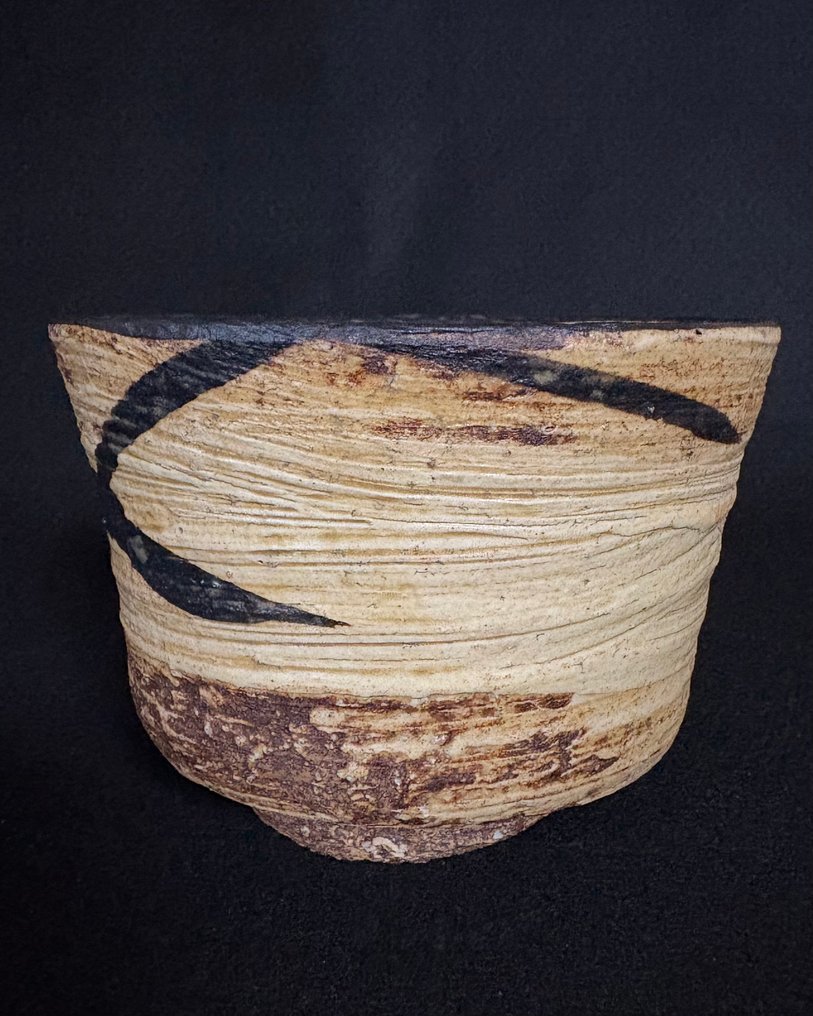
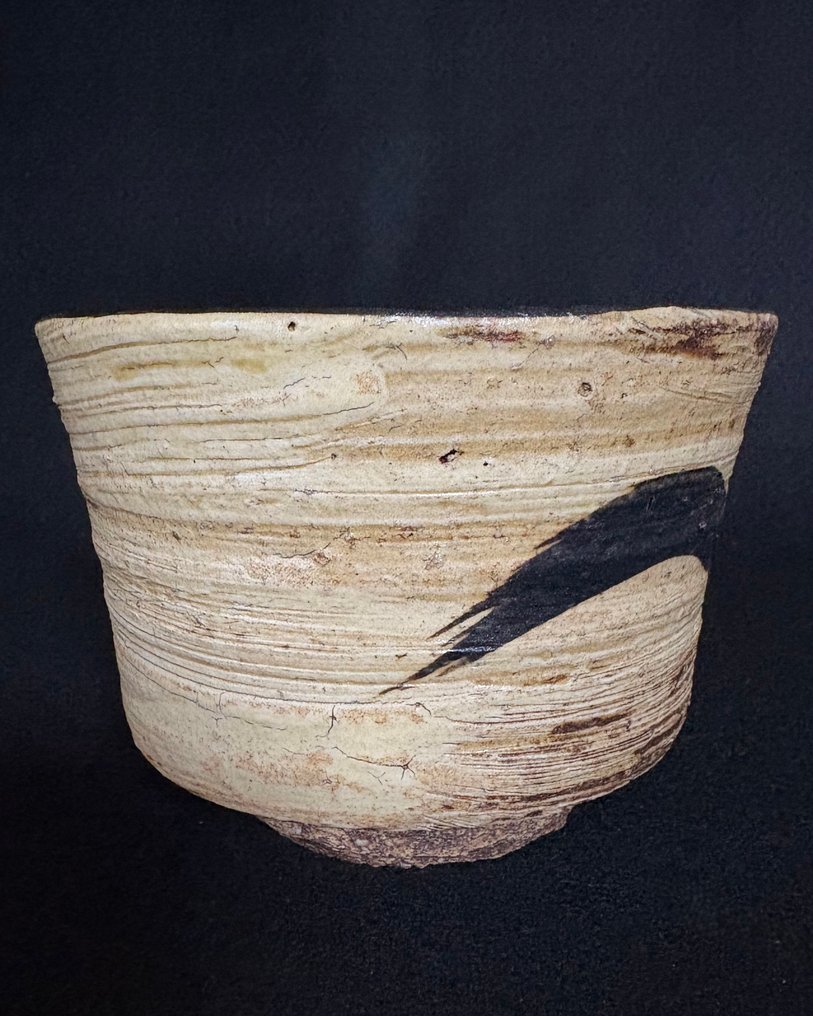
Irabo Tetsue Chawan 伊羅保鉄絵茶碗(いらぼてつえちゃわん)|Ogawa Kinji 小川欣二(おがわきんじ)
This tea bowl is a type of Goryeo tea bowl produced on the Korean Peninsula, known as an Irabo chawan.
Its defining characteristic lies in the coarse clay body, in which grains of sand create a distinctly rough and gritty texture, often described as an “iraira” tactile quality.
From the Momoyama period to the early Edo period, Japanese tea practitioners are believed to have commissioned such bowls as custom-made “ordered tea bowls,” and their rustic yet powerful appearance came to be highly valued within the context of wabi-cha.
This work is classified as Kugibori Irabo.
Fine, distinctive incised lines resembling nail-carved marks can be observed across the surface, forming a unique rhythm and landscape.
In addition, the vigorous iron-painted decoration serves as a strong accent, giving the bowl an expressive and individual presence.
The artist Ogawa Kinji, born in 1926, was affiliated with one of Japan’s largest art and craft organizations and worked primarily within the traditions of Kyo-yaki (Kyoto ware).
Alongside refined works, he also produced many rustic pieces such as Irabo and Kiseto, emphasizing the natural character of clay and surface.
This piece dates from the 1970s–1980s and represents a mature example of his ceramic expression.
---
Artist Profile
1926
Born in Japan.
Affiliated with one of Japan’s largest art and craft organizations.
Worked mainly using traditional techniques of Kyo-yaki (Kyoto ware).
Left numerous works in rustic styles such as Irabo and Kiseto.
---
Accessories
Original wooden storage box (tomobako).
---
Dimensions & Weight
Height 9 cm.
Diameter 12 cm.
Weight 348 g.
---
Technique & Condition
Material: Ceramic clay, iron glaze.
Technique: Pottery.
Estimated period: 1970–1980.
Condition: Excellent condition.
---
Shipping
Shipping via Japan Post EMS from Japan.
Items are shipped only to countries where EMS delivery from Japan is available.
Items are securely packed to ensure safe international delivery.
Import duties, VAT, and customs handling fees are the sole responsibility of the buyer.
For bidders in the United States:
Please note that Japan Post is currently not accepting EMS shipments of commercial goods to the United States.
If the winning bidder’s shipping address is in the United States, the item will be shipped via DHL Express instead.
Please be aware that shipping costs via DHL are significantly higher than EMS rates.
Seller's Story
In the 30th year as a Japanese art dealer, sharing the aesthetics and spirit of Japanese art.
Irabo Tetsue Chawan 伊羅保鉄絵茶碗(いらぼてつえちゃわん)|Ogawa Kinji 小川欣二(おがわきんじ)
This tea bowl is a type of Goryeo tea bowl produced on the Korean Peninsula, known as an Irabo chawan.
Its defining characteristic lies in the coarse clay body, in which grains of sand create a distinctly rough and gritty texture, often described as an “iraira” tactile quality.
From the Momoyama period to the early Edo period, Japanese tea practitioners are believed to have commissioned such bowls as custom-made “ordered tea bowls,” and their rustic yet powerful appearance came to be highly valued within the context of wabi-cha.
This work is classified as Kugibori Irabo.
Fine, distinctive incised lines resembling nail-carved marks can be observed across the surface, forming a unique rhythm and landscape.
In addition, the vigorous iron-painted decoration serves as a strong accent, giving the bowl an expressive and individual presence.
The artist Ogawa Kinji, born in 1926, was affiliated with one of Japan’s largest art and craft organizations and worked primarily within the traditions of Kyo-yaki (Kyoto ware).
Alongside refined works, he also produced many rustic pieces such as Irabo and Kiseto, emphasizing the natural character of clay and surface.
This piece dates from the 1970s–1980s and represents a mature example of his ceramic expression.
---
Artist Profile
1926
Born in Japan.
Affiliated with one of Japan’s largest art and craft organizations.
Worked mainly using traditional techniques of Kyo-yaki (Kyoto ware).
Left numerous works in rustic styles such as Irabo and Kiseto.
---
Accessories
Original wooden storage box (tomobako).
---
Dimensions & Weight
Height 9 cm.
Diameter 12 cm.
Weight 348 g.
---
Technique & Condition
Material: Ceramic clay, iron glaze.
Technique: Pottery.
Estimated period: 1970–1980.
Condition: Excellent condition.
---
Shipping
Shipping via Japan Post EMS from Japan.
Items are shipped only to countries where EMS delivery from Japan is available.
Items are securely packed to ensure safe international delivery.
Import duties, VAT, and customs handling fees are the sole responsibility of the buyer.
For bidders in the United States:
Please note that Japan Post is currently not accepting EMS shipments of commercial goods to the United States.
If the winning bidder’s shipping address is in the United States, the item will be shipped via DHL Express instead.
Please be aware that shipping costs via DHL are significantly higher than EMS rates.
Seller's Story
In the 30th year as a Japanese art dealer, sharing the aesthetics and spirit of Japanese art.
Details
Era
1900-2000
No. of items
1
Material
Clay
Country of Origin
Japan
Designer/Artist/Maker
Ogawa Kinji
Condition
Excellent condition: barely used with minimal signs of wear
Height
9 cm
Width
12 cm
Diameter
12 cm
Estimated Period
1970-1980
Sold by
