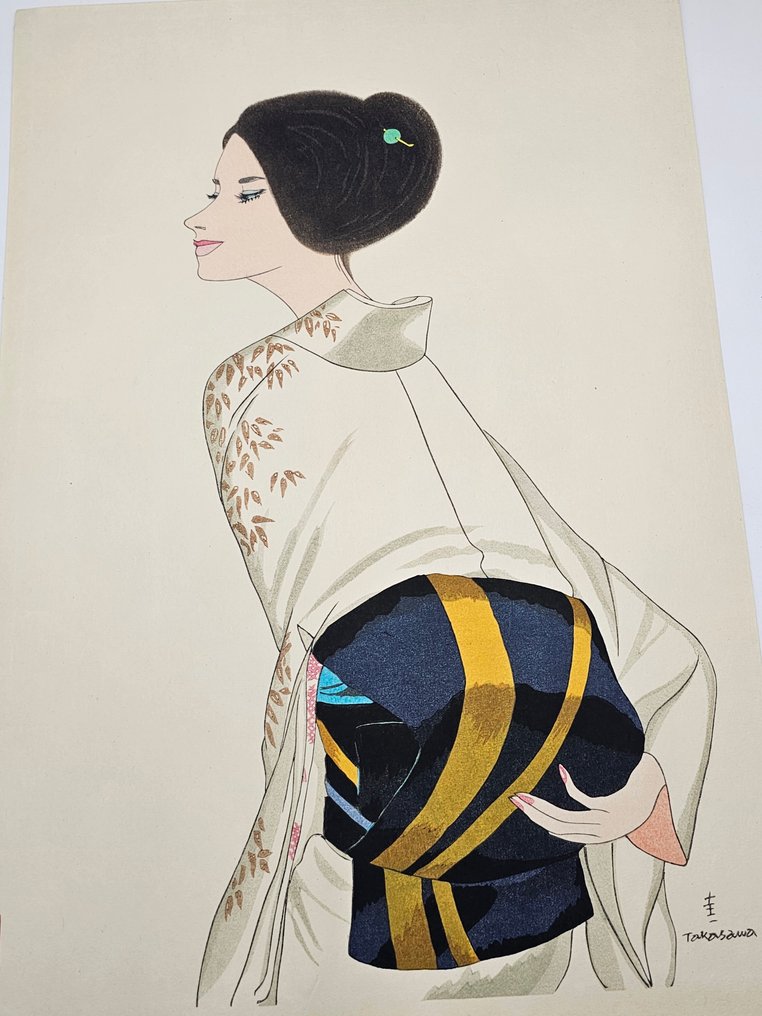
女絵四題より 女絵4 - Takasawa Keiichi 高沢圭一 (1914-1984) - Japan



05
days
20
hours
21
minutes
05
seconds

10 other people are watching this object
 Bidder 8753 Bidder 8753 | €52 | |
|---|---|---|
| Bidder 8753 | €1 |
Catawiki Buyer Protection
Your payment’s safe with us until you receive your object.View details
Trustpilot 4.4 | 123641 reviews
Rated Excellent on Trustpilot.
Limited edition colour woodblock print by Takasawa Keiichi (1914–1984): Four Female Portraits, signed, 1966, 41 × 28 cm image on paper, depicting a portrait in Japanese Showa-era modern beauty style.
AI-assisted summary
Description from the seller
One of Keiichi Takazawa's masterpieces, Four Themes of Women (Onnae Yondai), is a masterpiece where the renowned "Kato Printmaking Institute" masterfully reproduced Takazawa's delicate brushwork—representative of Showa-era beauty painting—as a woodblock print.
The "amazing skill" of the Kato Printmaking Institute in this work can be summarized in the following three points:
1. Superb Technique in Reproducing "Western Painting Nuances" Through Woodblock
Keichi Takazawa was a Western-style painter who studied under Tsuguharu Foujita. His beauty paintings differ from traditional Japanese art, characterized by a "modern sensuality" rooted in Western-style shading and drawing skills.
Skin texture and gradation: While woodblock printing is inherently suited to crisp color separation, Kato Printmaking Institute masterfully employed "blurring techniques" (suri no waza) to astonishingly naturally express Takazawa's signature soft skin texture and the faint blush on cheeks.
Line Strength: To reproduce Takazawa's supple yet sharp contour lines, the carvers meticulously controlled the wood grain to the utmost limit during the carving process.
2. Kato Printmaking Institute: A "Traditional and Trusted Brand"
Kato Printmaking Institute (Junji Kato) is a premier establishment that carried on the **"Shin-hanga"** tradition from the Taisho to Showa eras, handling print production for masters like Shinsui Ito and Hasui Kawase.
High Level of Engravers and Printers: Employing Japan's finest artisans, they preserve the original artwork's appeal without compromise—even for modern, complex color designs like those of Keiichi Takazawa—while imparting a "depth unique to prints."
Guarantee of Artistic Value: The mere presence of the "Kato Print Seal" serves as proof that the work was produced to a high technical standard, a factor that continues to command high prices at art auctions today.
3. Perfection as an Evolutionary Form of "Ukiyo-e"
The Four Women series draws from the tradition of Edo-period ukiyo-e while fusing it with the modern sensibilities of the Showa era.
Handcrafted by Living National Treasures: Washi paper made by Living National Treasures (such as Iwano Ichibei) at the time is used.
Rich, Deep Colors: Using high-quality Japanese paper and natural pigments, the multiple-color printing process involves layering colors repeatedly. This creates a depth of color and a sense of three-dimensionality that is absolutely impossible to achieve with printed materials (offset printing).
Why are there no handwritten signatures or edition numbers?
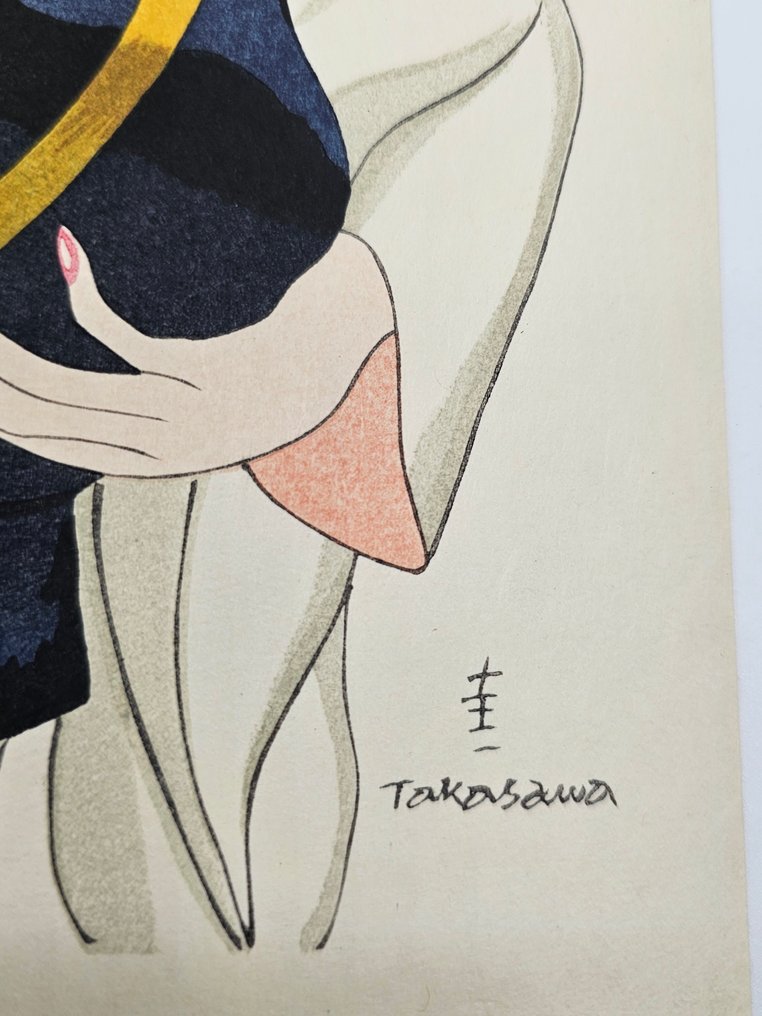
The absence of a handwritten signature does not mean it is a fake. The primary reason is that **"the style known as 'woodblock signatures,' created using traditional Japanese craftsmanship, was the standard for high-quality prints at the time."** For works from the Kato Print Research Institute, the "Institute Seal" or the "woodblock signature" found in the corner of the print are considered the hallmarks of the highest quality.
Kato Printmaking Institute is not currently printing prints. they only sell existing works. (No more prints will be produced.)
Keichi Takazawa (1914-1984) was a solitary realist painter who established a unique position within Japan's Western-style painting world. He is particularly acclaimed in the field of "beauty painting," and his works continue to captivate numerous art enthusiasts.
This work, "Portrait of a Woman," embodies a theme synonymous with his name and stands as a masterpiece distilling the artist's exceptional technique and aesthetic sensibility.
【About This Work】
Artist
Takasawa Keiichi 高沢圭一
Title
女絵四題より 女絵4(Four Female Portraits: Female Portrait 4)
Original publication date
c. 1966
This publication date
c. 1970
Publisher
Kato Printmaking Institute 加藤版画研究所
Medium
Colour woodblock print on paper 木版画
Image dimensions (h × w)
41 × 28 cm
Keichi Takazawa (1914–1984) was a Japanese painter and illustrator active during the Showa period. He is particularly renowned as the foremost artist of **"modern and stylish portraits of beautiful women"**.
His characteristics and career can be summarized as follows:
1. A Style Rooted in the "École de Paris" Tradition
Keichi Takazawa studied under the renowned **Tsuguharu Foujita (Léonard Foujita)**.
Consequently, his work diverged from traditional Japanese beauty paintings, characterized by sharp lines based on Western drawing techniques and a refined, urban sensibility.
His delicate brushwork, inherited from Fujita, and his meticulous attention to the texture of female skin lend his works a unique sensuality and elegance.
2. Beauty paintings symbolizing "Showa-era modernity"
The women he painted, even when dressed in kimono, possessed a distinctly modern (for their time) and independent, dignified beauty.
Expression of "Iki": He excelled at conveying Japanese sensibilities with a contemporary touch—not merely beauty, but also in details like downcast expressions and the movement of fingertips.
Works like the recently discussed 'Four Themes of Women' represent the pinnacle of this style.
3. Diverse Career (From Illustrations to Advertising)
Beyond pure painting, he was immensely popular in popular culture.
Newspaper and Magazine Illustrations: He illustrated numerous serialized novels, gaining popularity in living rooms across the nation.
Advertising and Design: He also handled many projects that colored the cutting-edge fashion and lifestyles of the time, such as the cover of Suntory's PR magazine "Western Liquor Heaven" and advertisements for Shiseido.
4. Relationship with the Kato Print Institute
The Kato Print Institute sought to reproduce Keiichi Takazawa's delicate original artwork using the traditional Japanese technique of "woodblock printing."
Expressing Western-style rendering (shading and gradation) through woodblock printing is extremely difficult. It was precisely due to Kato Print's advanced techniques that Takazawa's "modern beauty paintings" became widely circulated as prints and still hold high value as artworks today.
In a nutshell: He was a master who, as a disciple of Tsuguharu Foujita, perfectly captured the sophisticated, urban feminine beauty of the Showa era in a refined, fusion style blending Japanese and Western elements.
One of Keiichi Takazawa's masterpieces, Four Themes of Women (Onnae Yondai), is a masterpiece where the renowned "Kato Printmaking Institute" masterfully reproduced Takazawa's delicate brushwork—representative of Showa-era beauty painting—as a woodblock print.
The "amazing skill" of the Kato Printmaking Institute in this work can be summarized in the following three points:
1. Superb Technique in Reproducing "Western Painting Nuances" Through Woodblock
Keichi Takazawa was a Western-style painter who studied under Tsuguharu Foujita. His beauty paintings differ from traditional Japanese art, characterized by a "modern sensuality" rooted in Western-style shading and drawing skills.
Skin texture and gradation: While woodblock printing is inherently suited to crisp color separation, Kato Printmaking Institute masterfully employed "blurring techniques" (suri no waza) to astonishingly naturally express Takazawa's signature soft skin texture and the faint blush on cheeks.
Line Strength: To reproduce Takazawa's supple yet sharp contour lines, the carvers meticulously controlled the wood grain to the utmost limit during the carving process.
2. Kato Printmaking Institute: A "Traditional and Trusted Brand"
Kato Printmaking Institute (Junji Kato) is a premier establishment that carried on the **"Shin-hanga"** tradition from the Taisho to Showa eras, handling print production for masters like Shinsui Ito and Hasui Kawase.
High Level of Engravers and Printers: Employing Japan's finest artisans, they preserve the original artwork's appeal without compromise—even for modern, complex color designs like those of Keiichi Takazawa—while imparting a "depth unique to prints."
Guarantee of Artistic Value: The mere presence of the "Kato Print Seal" serves as proof that the work was produced to a high technical standard, a factor that continues to command high prices at art auctions today.
3. Perfection as an Evolutionary Form of "Ukiyo-e"
The Four Women series draws from the tradition of Edo-period ukiyo-e while fusing it with the modern sensibilities of the Showa era.
Handcrafted by Living National Treasures: Washi paper made by Living National Treasures (such as Iwano Ichibei) at the time is used.
Rich, Deep Colors: Using high-quality Japanese paper and natural pigments, the multiple-color printing process involves layering colors repeatedly. This creates a depth of color and a sense of three-dimensionality that is absolutely impossible to achieve with printed materials (offset printing).
Why are there no handwritten signatures or edition numbers?
The absence of a handwritten signature does not mean it is a fake. The primary reason is that **"the style known as 'woodblock signatures,' created using traditional Japanese craftsmanship, was the standard for high-quality prints at the time."** For works from the Kato Print Research Institute, the "Institute Seal" or the "woodblock signature" found in the corner of the print are considered the hallmarks of the highest quality.
Kato Printmaking Institute is not currently printing prints. they only sell existing works. (No more prints will be produced.)
Keichi Takazawa (1914-1984) was a solitary realist painter who established a unique position within Japan's Western-style painting world. He is particularly acclaimed in the field of "beauty painting," and his works continue to captivate numerous art enthusiasts.
This work, "Portrait of a Woman," embodies a theme synonymous with his name and stands as a masterpiece distilling the artist's exceptional technique and aesthetic sensibility.
【About This Work】
Artist
Takasawa Keiichi 高沢圭一
Title
女絵四題より 女絵4(Four Female Portraits: Female Portrait 4)
Original publication date
c. 1966
This publication date
c. 1970
Publisher
Kato Printmaking Institute 加藤版画研究所
Medium
Colour woodblock print on paper 木版画
Image dimensions (h × w)
41 × 28 cm
Keichi Takazawa (1914–1984) was a Japanese painter and illustrator active during the Showa period. He is particularly renowned as the foremost artist of **"modern and stylish portraits of beautiful women"**.
His characteristics and career can be summarized as follows:
1. A Style Rooted in the "École de Paris" Tradition
Keichi Takazawa studied under the renowned **Tsuguharu Foujita (Léonard Foujita)**.
Consequently, his work diverged from traditional Japanese beauty paintings, characterized by sharp lines based on Western drawing techniques and a refined, urban sensibility.
His delicate brushwork, inherited from Fujita, and his meticulous attention to the texture of female skin lend his works a unique sensuality and elegance.
2. Beauty paintings symbolizing "Showa-era modernity"
The women he painted, even when dressed in kimono, possessed a distinctly modern (for their time) and independent, dignified beauty.
Expression of "Iki": He excelled at conveying Japanese sensibilities with a contemporary touch—not merely beauty, but also in details like downcast expressions and the movement of fingertips.
Works like the recently discussed 'Four Themes of Women' represent the pinnacle of this style.
3. Diverse Career (From Illustrations to Advertising)
Beyond pure painting, he was immensely popular in popular culture.
Newspaper and Magazine Illustrations: He illustrated numerous serialized novels, gaining popularity in living rooms across the nation.
Advertising and Design: He also handled many projects that colored the cutting-edge fashion and lifestyles of the time, such as the cover of Suntory's PR magazine "Western Liquor Heaven" and advertisements for Shiseido.
4. Relationship with the Kato Print Institute
The Kato Print Institute sought to reproduce Keiichi Takazawa's delicate original artwork using the traditional Japanese technique of "woodblock printing."
Expressing Western-style rendering (shading and gradation) through woodblock printing is extremely difficult. It was precisely due to Kato Print's advanced techniques that Takazawa's "modern beauty paintings" became widely circulated as prints and still hold high value as artworks today.
In a nutshell: He was a master who, as a disciple of Tsuguharu Foujita, perfectly captured the sophisticated, urban feminine beauty of the Showa era in a refined, fusion style blending Japanese and Western elements.
Details
Artist
Takasawa Keiichi 高沢圭一 (1914-1984)
Sold by
Owner or reseller
Edition
Limited edition
Title of artwork
女絵四題より 女絵4
Technique
Woodcut print
Signature
Signed
Country of Origin
Japan
Year
1966
Condition
Good condition
Height
43 cm
Width
32 cm
Depiction/Theme
Portrait
Style
Contemporary
Period
1960-1970
Sold with frame
No
Sold by
