Arthur Conan Doyle - The crime of the Congo - 1909



12
days
09
hours
06
minutes
35
seconds

14 other people are watching this object
 Bidder 7779 Bidder 7779 | €15 | |
|---|---|---|
 Bidder 6932 Bidder 6932 | €10 | |
| Bidder 7779 | €7 | |
Catawiki Buyer Protection
Your payment’s safe with us until you receive your object.View details
Trustpilot 4.4 | 123641 reviews
Rated Excellent on Trustpilot.
The Crime of the Congo, 1st edition (1909) by Arthur Conan Doyle, published by Hutchinson & Co, in English, paperback, 128 pages.
AI-assisted summary
Description from the seller
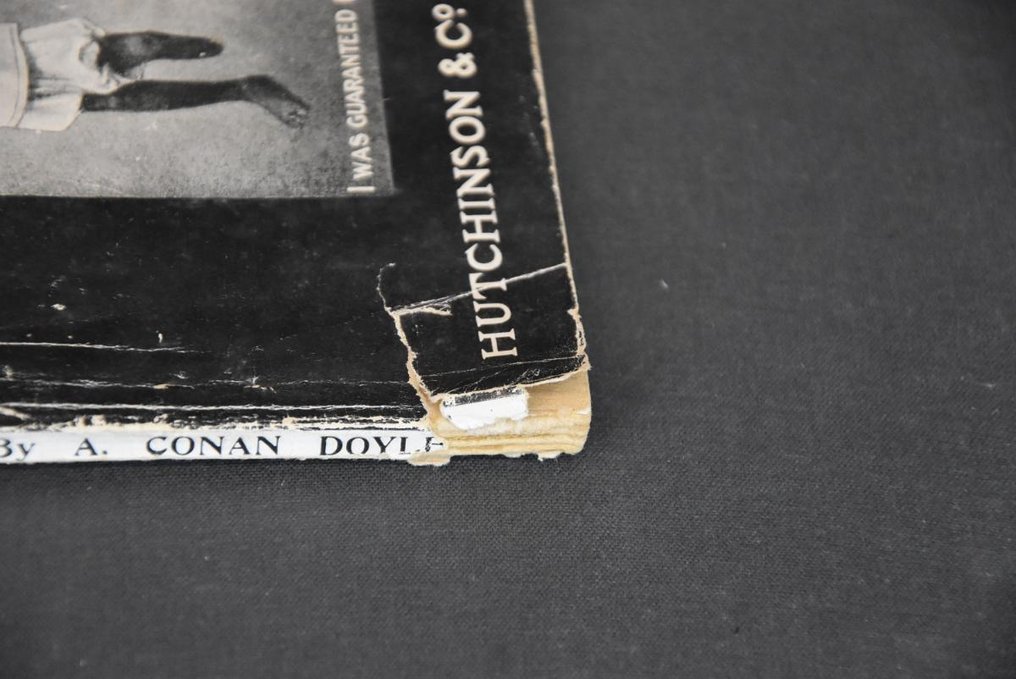
Arthur Conan Doyle, The Crime of the Congo. London, Hutchinson & Co, 1909. Cm 22 x 15, editorial paperback, 128 pages. First edition. Minor marginal flaws on the cover. No reserve!
The Crime of the Congo is a book written by Arthur Conan Doyle, first published by Hutchinson & Co. in October 1909. The American edition has a preface by Conan Doyle.
Editions
The Crime of the Congo (October 1909, Hutchinson & Co. [UK]) 1 Title page
Excerpts from The Seattle Star (October 18, 1909 [US]) as The nightmare of diabolical and barbaric cruelty in the Congo is attributed to King Leopold, states Conan Doyle (3 photos).
13th chapter of The New-York Times (October 21, 1909 [US])
9th chapter of The Seattle Star (October 22, 1909 [US]) as The bitterness of past death in the looted Congo, but will human hyenas satisfy justice? (1 photo)
The Crime of the Congo (November 1909, Doubleday, Page & Co. [US])
The Congo Crime (November 1909, D. Reimer [DE])
The Crime of the Congo (January 1910, Félix Juven [FR])
The Crime of the Congo (1910, Brazilian Edition [BR])
The crime of the Congo
Introduction
I am convinced that the reason public opinion has become less sensitive to the issue of the Free State of the Congo is that the terrible history has not been fully brought home to people. Mr. ED Morel has done the work of ten men, and the Congo Reform Association has fought hard with very limited means; but their time and energy have mostly been absorbed in addressing each new phase of the situation as it arose. Therefore, I believe there is room for a general account that covers the entire field and updates the issue. This account must necessarily be superficial if it is to be produced on a scale and at a cost that ensures it reaches the broad audience for whom it is intended. However, it contains the essential facts and will enable the reader to form their own opinion on the situation.
One could argue that part of all this is ancient history and that most of it refers to a period before the annexation of the Congo State by Belgium, which occurred on August 10, 1908. But responsibility cannot be so easily dismissed. The Congo State was founded by the Belgian King and exploited by Belgian capital, Belgian soldiers, and Belgian concessionaires. It was defended and supported by subsequent Belgian governments, which did everything possible to discourage reformers. Despite legal technicalities, it is an insult to common sense to assume that the responsibility for the Congo has not always fallen on Belgium. The Belgian apparatus has always been ready to help and defend the State, but never to keep it under control and prevent it from committing crimes.
Belgium had only one chance. If, immediately after taking control of the State, they had established a Judicial Commission for a rigorous investigation of the entire matter, with the power to punish all past crimes and examine all scandals of recent years, then they would have done something to clarify the past. If, in addition, they had freed the lands, completely abandoned the system of forced labor, and annulled the statutes of all concessionary companies, for the obvious reason that they had notoriously abused their powers, then Belgium could have continued its colonizing enterprise under the same conditions as other states, with its sins atoned for as much as atonement is now possible.
She has done none of that. For the past year, she has persisted in the wicked ways of her predecessor. Her colony is a scandal to the entire world. The era of murders and mutilations is, we hope, over, but the country has sunk into a state of intimidated and hopeless slavery. (*) This is not a new story, but simply another phase of the same. When Belgium took control of the State of Congo, it also took on its history and responsibilities. The weight of this is evident in these pages.
The recording of dates is the measure of our patience. Someone might say we are hasty if we now set aside empty words and assert with certainty that the matter must be resolved by a certain upcoming date, or that we will appeal to each and all of the Powers, with the evidence at their disposal, to assist us in resolving the situation. If the Powers refuse to do so, then it is our duty to honor the guarantees we have provided regarding the safety of these poor people and to dedicate ourselves to the task of resolving the situation. If the Powers join us or give us a mandate, all the better. But we have a mandate from something higher than the Powers that compels us to act.
Sir Edward Grey told us in his speech on July 22, 1909, that this event represents a danger to European peace. Let us face this danger. Where does it come from? From Germany, with its traditions of benevolent family life— is this the power that would raise its hand to help the butchers of Mongalla and the Domaine de la Couronne? Is it likely that those who rightly admire Wilhelm II's splendid private and public example would draw their swords for Leopold? In the name of commercial rights and humanity, Germany has an unsettled account with the Congo. Or are the United States blocking it, when their citizens have competed with ours in resisting and denouncing these injustices? Or, finally, is France the danger? Some believe that, because France has invested capital in these enterprises, because French Congo has degenerated under the influence and example of its neighbor, and because France holds a vague preemptive right, our problems are beyond the Channel. As for me, I cannot believe it. I know all too well the generous and chivalrous instincts of the French people. I also know that their colonial past over the centuries has not been at all inferior to ours. Such traditions are not easily set aside, and everything will soon be put right when a strong Minister of Colonies turns his attention to the concessionaires in French Congo. He will remember Brazzà's last words: 'Our Congo must not be turned into Mongalla.' It is impossible for France to ally with King Leopold, and certainly if it did, the cordial understanding would be strained to breaking. So, therefore, if these three Powers, the most directly involved, have such clear reasons to help each other rather than hinder, we can move forward without fear. But if not, if all of Europe disapproves of our enterprise, we would not be worthy to be called sons of our fathers if we did not proceed along the straight path of national duty.
Arthur Conan Doyle. Windlesham, Crowborough. September 1909.
Based on the above, the paragraph marked with an asterisk must be worsened. It has been unequivocally demonstrated by an excellent German witness, Dr. Dörpinghaus of Barmen, that in the Busiré area, which is right in the center of Cologne, the outrages continue exactly as in the old days. The story he recounts about the chicotte and the hostage house, the armed cannibal, and the burned village is exactly the same as the one often told elsewhere.
Arthur Conan Doyle, The Crime of the Congo. London, Hutchinson & Co, 1909. Cm 22 x 15, editorial paperback, 128 pages. First edition. Minor marginal flaws on the cover. No reserve!
The Crime of the Congo is a book written by Arthur Conan Doyle, first published by Hutchinson & Co. in October 1909. The American edition has a preface by Conan Doyle.
Editions
The Crime of the Congo (October 1909, Hutchinson & Co. [UK]) 1 Title page
Excerpts from The Seattle Star (October 18, 1909 [US]) as The nightmare of diabolical and barbaric cruelty in the Congo is attributed to King Leopold, states Conan Doyle (3 photos).
13th chapter of The New-York Times (October 21, 1909 [US])
9th chapter of The Seattle Star (October 22, 1909 [US]) as The bitterness of past death in the looted Congo, but will human hyenas satisfy justice? (1 photo)
The Crime of the Congo (November 1909, Doubleday, Page & Co. [US])
The Congo Crime (November 1909, D. Reimer [DE])
The Crime of the Congo (January 1910, Félix Juven [FR])
The Crime of the Congo (1910, Brazilian Edition [BR])
The crime of the Congo
Introduction
I am convinced that the reason public opinion has become less sensitive to the issue of the Free State of the Congo is that the terrible history has not been fully brought home to people. Mr. ED Morel has done the work of ten men, and the Congo Reform Association has fought hard with very limited means; but their time and energy have mostly been absorbed in addressing each new phase of the situation as it arose. Therefore, I believe there is room for a general account that covers the entire field and updates the issue. This account must necessarily be superficial if it is to be produced on a scale and at a cost that ensures it reaches the broad audience for whom it is intended. However, it contains the essential facts and will enable the reader to form their own opinion on the situation.
One could argue that part of all this is ancient history and that most of it refers to a period before the annexation of the Congo State by Belgium, which occurred on August 10, 1908. But responsibility cannot be so easily dismissed. The Congo State was founded by the Belgian King and exploited by Belgian capital, Belgian soldiers, and Belgian concessionaires. It was defended and supported by subsequent Belgian governments, which did everything possible to discourage reformers. Despite legal technicalities, it is an insult to common sense to assume that the responsibility for the Congo has not always fallen on Belgium. The Belgian apparatus has always been ready to help and defend the State, but never to keep it under control and prevent it from committing crimes.
Belgium had only one chance. If, immediately after taking control of the State, they had established a Judicial Commission for a rigorous investigation of the entire matter, with the power to punish all past crimes and examine all scandals of recent years, then they would have done something to clarify the past. If, in addition, they had freed the lands, completely abandoned the system of forced labor, and annulled the statutes of all concessionary companies, for the obvious reason that they had notoriously abused their powers, then Belgium could have continued its colonizing enterprise under the same conditions as other states, with its sins atoned for as much as atonement is now possible.
She has done none of that. For the past year, she has persisted in the wicked ways of her predecessor. Her colony is a scandal to the entire world. The era of murders and mutilations is, we hope, over, but the country has sunk into a state of intimidated and hopeless slavery. (*) This is not a new story, but simply another phase of the same. When Belgium took control of the State of Congo, it also took on its history and responsibilities. The weight of this is evident in these pages.
The recording of dates is the measure of our patience. Someone might say we are hasty if we now set aside empty words and assert with certainty that the matter must be resolved by a certain upcoming date, or that we will appeal to each and all of the Powers, with the evidence at their disposal, to assist us in resolving the situation. If the Powers refuse to do so, then it is our duty to honor the guarantees we have provided regarding the safety of these poor people and to dedicate ourselves to the task of resolving the situation. If the Powers join us or give us a mandate, all the better. But we have a mandate from something higher than the Powers that compels us to act.
Sir Edward Grey told us in his speech on July 22, 1909, that this event represents a danger to European peace. Let us face this danger. Where does it come from? From Germany, with its traditions of benevolent family life— is this the power that would raise its hand to help the butchers of Mongalla and the Domaine de la Couronne? Is it likely that those who rightly admire Wilhelm II's splendid private and public example would draw their swords for Leopold? In the name of commercial rights and humanity, Germany has an unsettled account with the Congo. Or are the United States blocking it, when their citizens have competed with ours in resisting and denouncing these injustices? Or, finally, is France the danger? Some believe that, because France has invested capital in these enterprises, because French Congo has degenerated under the influence and example of its neighbor, and because France holds a vague preemptive right, our problems are beyond the Channel. As for me, I cannot believe it. I know all too well the generous and chivalrous instincts of the French people. I also know that their colonial past over the centuries has not been at all inferior to ours. Such traditions are not easily set aside, and everything will soon be put right when a strong Minister of Colonies turns his attention to the concessionaires in French Congo. He will remember Brazzà's last words: 'Our Congo must not be turned into Mongalla.' It is impossible for France to ally with King Leopold, and certainly if it did, the cordial understanding would be strained to breaking. So, therefore, if these three Powers, the most directly involved, have such clear reasons to help each other rather than hinder, we can move forward without fear. But if not, if all of Europe disapproves of our enterprise, we would not be worthy to be called sons of our fathers if we did not proceed along the straight path of national duty.
Arthur Conan Doyle. Windlesham, Crowborough. September 1909.
Based on the above, the paragraph marked with an asterisk must be worsened. It has been unequivocally demonstrated by an excellent German witness, Dr. Dörpinghaus of Barmen, that in the Busiré area, which is right in the center of Cologne, the outrages continue exactly as in the old days. The story he recounts about the chicotte and the hostage house, the armed cannibal, and the burned village is exactly the same as the one often told elsewhere.
Details
Number of Books
1
Subject
Literature
Book Title
The crime of the Congo
Author/ Illustrator
Arthur Conan Doyle
Condition
Fair
Publication year oldest item
1909
Edition
1st Edition
Language
English
Original language
Yes
Publisher
Hutchinson & Co
Binding/ Material
Softback
Number of pages
128
Sold by
