Jules Demeulemeester (1920-2010) - Homo Sapiens


03
days
16
hours
16
minutes
10
seconds
Current bid
€ 3
No reserve price

Expert
Selected by Florent Fressier
Specialises in works on paper and (New) School of Paris artists. Former gallery owner.
Estimate € 150 - € 200
4 other people are watching this object
 Bidder 4231 Bidder 4231 | €3 |
|---|
Catawiki Buyer Protection
Your payment’s safe with us until you receive your object.View details
Trustpilot 4.4 | 123536 reviews
Rated Excellent on Trustpilot.
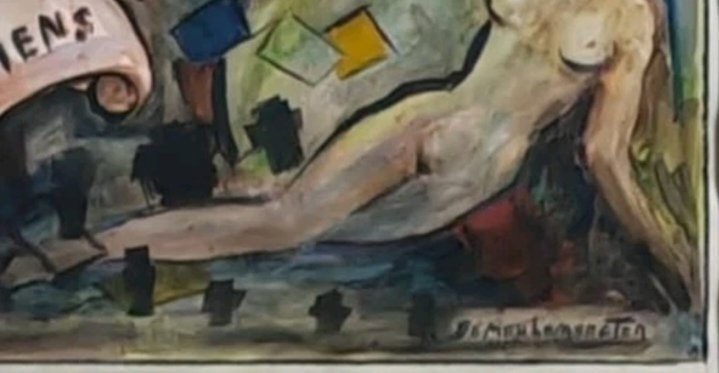
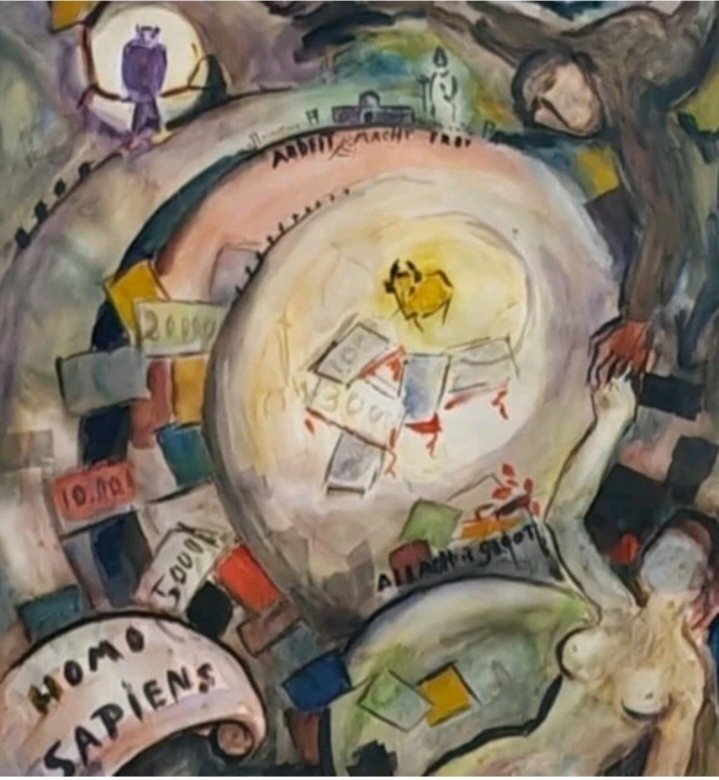
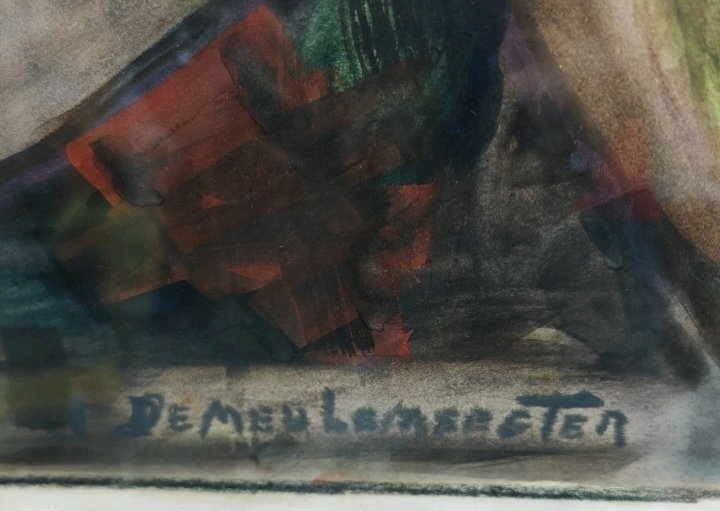
Jules De Meulemeester (1920–2010), Homo Sapiens, an original oil painting, hand-signed, from the 1970–1980 period, Belgian expressionism, 65 × 85 cm (with frame 85 × 105 cm), in good condition.
AI-assisted summary
Description from the seller
This work is a powerful and provocative piece by Jules De Meulemeester (often written Demeulemeester, 1920–2010), a Belgian artist known for his expressionist style capable of ranging from intimate portraits to harsh social critiques.
Although De Meulemeester is famous for his landscapes and his melancholic 'clown,' this painting represents an exception due to its explicit political and historical charge.
Analysis of the Main Themes
The Call to the Camps of Extermination: The phrase 'Arbeit Macht Frei' ('Work sets you free'), visible in the arch at the center, is the tragic motto placed at the entrance of Nazi concentration camps. The artist, having experienced the occupation of Belgium during the Second World War, uses this symbol to denounce the horror of recent history.
The Irony of 'Homo Sapiens': The title written on the label at the bottom left is deeply sarcastic. While the term suggests wisdom and evolution, the artwork shows a brutal and chaotic reality.
The Human Devolution: The dark, monkey-like figure above, which seems to stretch towards a nude and classical female figure, suggests a regression of humanity into bestiality and violence, contrasted with the ideal beauty of art.
The Vortex of Chaos: The composition is structured like a spiral or vortex that sucks in documents, numbers (perhaps brands or prisoner identification numbers), and fragments of colored paper. This symbolizes how the individual is crushed by the gears of bureaucracy, the economy, and ideology.
The Artist: Jules De Meulemeester
Originally from Bruges, De Meulemeester was a painter, watercolorist, and sculptor. His style is characterized by energetic brushwork and a color palette often 'livid' or twilight-like, typical of Flemish expressionism. He is an artist who seeks to capture the soul and human suffering behind appearances.
Dimensions
Cornice 85x105 cm
Opera 65x85 cm
This work is a powerful and provocative piece by Jules De Meulemeester (often written Demeulemeester, 1920–2010), a Belgian artist known for his expressionist style capable of ranging from intimate portraits to harsh social critiques.
Although De Meulemeester is famous for his landscapes and his melancholic 'clown,' this painting represents an exception due to its explicit political and historical charge.
Analysis of the Main Themes
The Call to the Camps of Extermination: The phrase 'Arbeit Macht Frei' ('Work sets you free'), visible in the arch at the center, is the tragic motto placed at the entrance of Nazi concentration camps. The artist, having experienced the occupation of Belgium during the Second World War, uses this symbol to denounce the horror of recent history.
The Irony of 'Homo Sapiens': The title written on the label at the bottom left is deeply sarcastic. While the term suggests wisdom and evolution, the artwork shows a brutal and chaotic reality.
The Human Devolution: The dark, monkey-like figure above, which seems to stretch towards a nude and classical female figure, suggests a regression of humanity into bestiality and violence, contrasted with the ideal beauty of art.
The Vortex of Chaos: The composition is structured like a spiral or vortex that sucks in documents, numbers (perhaps brands or prisoner identification numbers), and fragments of colored paper. This symbolizes how the individual is crushed by the gears of bureaucracy, the economy, and ideology.
The Artist: Jules De Meulemeester
Originally from Bruges, De Meulemeester was a painter, watercolorist, and sculptor. His style is characterized by energetic brushwork and a color palette often 'livid' or twilight-like, typical of Flemish expressionism. He is an artist who seeks to capture the soul and human suffering behind appearances.
Dimensions
Cornice 85x105 cm
Opera 65x85 cm
Details
Artist
Jules Demeulemeester (1920-2010)
Sold with frame
Yes
Sold by
Owner or reseller
Edition
Original
Title of artwork
Homo Sapiens
Technique
Oil painting
Signature
Hand signed
Country of Origin
Belgium
Condition
Good condition
Height
105 cm
Width
85 cm
Style
Expressionism
Period
1970-1980
Sold by
