Joža Uprka (1861-?), Nachfolger - Junge Bäuerinnen im Feld



05
days
22
hours
55
minutes
17
seconds

2 other people are watching this object
 Bidder 3013 Bidder 3013 | €5 |
|---|
Catawiki Buyer Protection
Your payment’s safe with us until you receive your object.View details
Trustpilot 4.4 | 123641 reviews
Rated Excellent on Trustpilot.
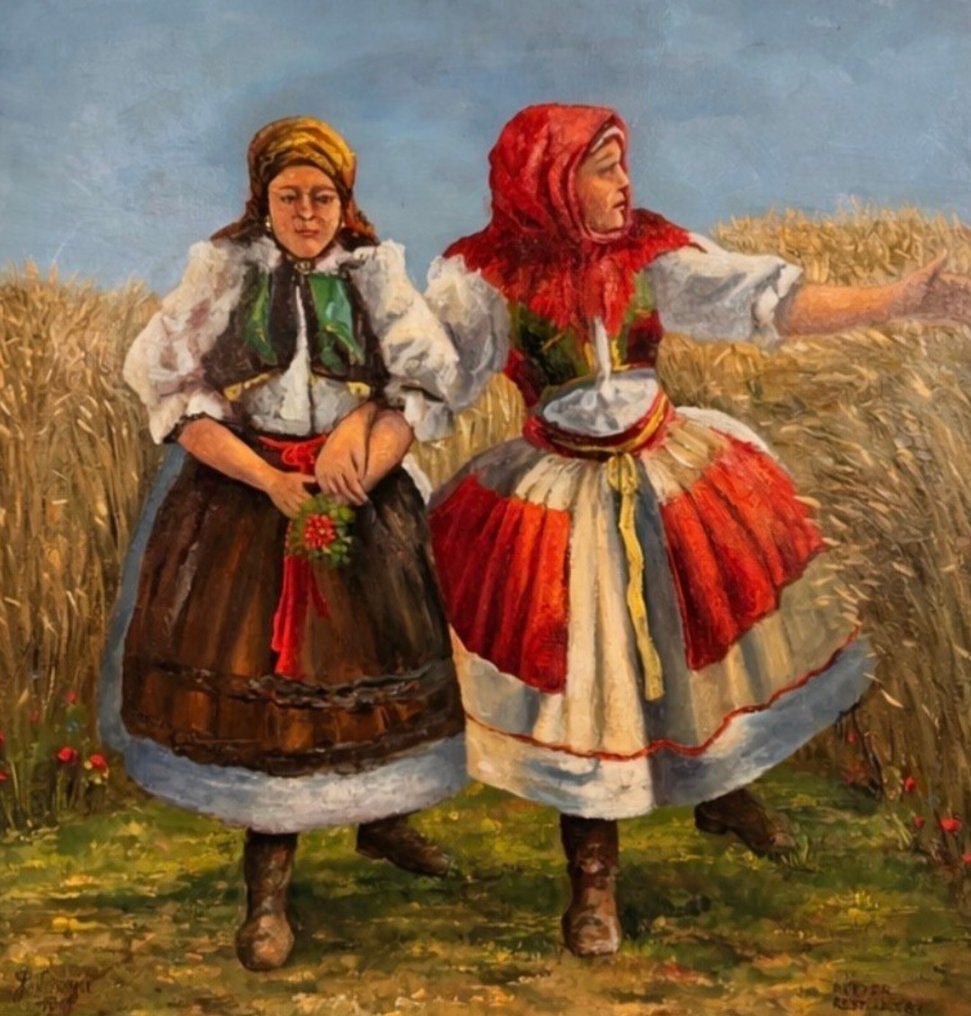
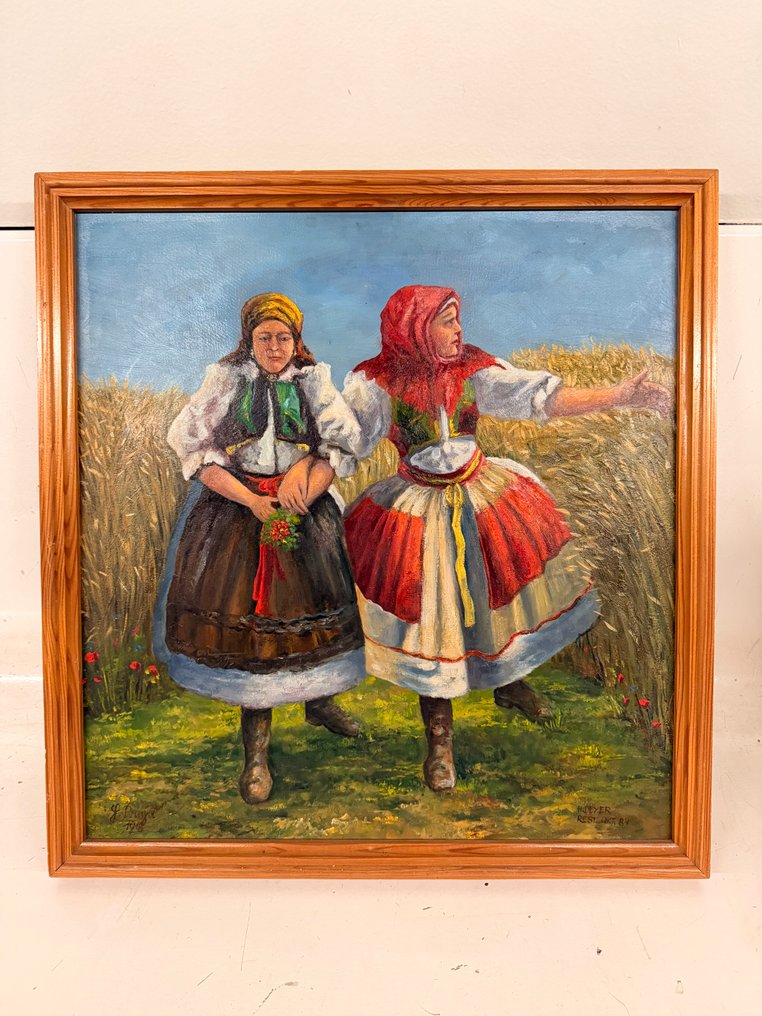
Junge Bäuerinnen im Feld, an oil painting from the 1910s in realist style, likely in the manner of Joža Uprka, country of origin unknown, framed and measuring about 51.5 × 54.2 cm overall (46.5 × 49.2 cm image).
AI-assisted summary
Description from the seller
The clothing items depicted are traditional costumes from the Moravia region (now Czechia), most likely from the area of the Moravian Slovakia (Slovácko).
The features of the painting strongly suggest this origin.
Characteristic details of the traditional costume
Head covering: The woman on the right wears a bright red headscarf, often intricately tied. The woman on the left wears a yellow cap or cloth, which is typical for married women or specific village traditions in Moravia.
Sleeves and bodices: The extremely wide, white puff sleeves with embroidery and the colorful vests (mieder) in green and black are classic elements of West Slavic folk costumes.
Skirts and aprons: The wide, often starched skirts with contrasting aprons (here dark with red ribbons on the left and white-red striped on the right) are particularly commonly seen in the regions around Uherské Hradiště or Kyjov.
Shoes: The dark, tall leather boots were the typical footwear for fieldwork and festive occasions in these rural areas.
Regarding the painting
The picture is signed in the lower left and dated 1918. The painting style strongly resembles artists like Joža Uprka, who became famous for his realistic and vividly colorful portrayals of Moravian folk life and traditional costumes. Although the signature here shows a different name, the work captures the style of that era precisely, when documenting rural traditions in Austria-Hungary was very popular.
The scene shows the women probably during harvest, as indicated by the golden ears of grain in the background.
Description of the painting
The painting depicts two women in traditional, colorful attire in front of a ripe grain field, presumably wheat. The scene appears lively and realistic, as if captured in a moment of conversation or movement.
Figures
The two female figures stand side by side. The woman on the right appears to be gesturing with her arm or pointing at something — creating an impression of movement and interaction. The figure on the left seems calmer, holding flowers or a small bouquet in front of her. Both women wear traditional folk costumes with embroidered details, colorful aprons, and headscarves.
Trachten
The clothing is richly decorated and colorfully contrasting: the woman on the left wears darker tones (complemented by green accents), while the woman on the right wears lighter tones and especially vivid red. The traditional costumes appear authentic and ethnographically significant – not just decorative, but embedded in a specific regional tradition.
Background & Composition
The background consists of a wide, open landscape, dominated by a field with ripe stems, above which is a mostly calm sky. The figures in the foreground are clearly defined, giving the composition a sense of frontal presence and immediacy.
style
The brushstrokes are visible and textured, the application of color is rich and reveals light moods—a blend of naturalistic accuracy and painterly liveliness.
Mounting & Condition
The painting is housed in a simple but precisely fitting wooden frame. It appears as a significant example of regionally oriented painting from around 1918.
Measurements
• Outer: approximately 51.5 × 54.2 cm
Interior (image area): approximately 46.5 × 49.2 cm
Classification within the circle around Joža Uprka
Although this picture is not directly signed by Joža Uprka himself, several aspects suggest that it could originate from his circle or his school.
Joža Uprka – Style & Thematic Focus
Joža Uprka (1861–1940) was an important Moravian painter, native to the Moravské Slovácko region (southern Moravia), where he documented traditional everyday life as well as festival and costume life. His work is characterized by the following:
Folkloristic themes: He almost exclusively painted scenes from rural life — festivals, everyday life, costumes, and ethnographically significant moments of rural culture.
Costumes & People: Women in colorful costumes are characteristic, often in groups or associated with a custom.
His painting technique evolved from realistic, naturalistic beginnings to a more lively, Impressionist-inspired use of color and light, while continuing to strongly emphasize tradition and ethnographic accuracy.
Ethnography & Realism: Its images are also considered ethnographic documents—they depict clothing, gestures, and rural rituals.
Artistic influence and environment
Joža Uprka was not only extremely important himself but also inspired numerous other artists who dealt with similar themes. His influence led to the formation of a regional artists' community where motifs of rural life, traditional costumes, and folk customs played a central role.
Examples of artists from his environment or with similar themes would be:
Antoš Frolka – a student or contemporary who also created scenes of Moravian rural life and costume painting.
Overall, there was a school of folklorist painting in this region from around the turn of the century to the early 1920s, strongly influenced by Uprka's ethnographic approach.
Why the present painting fits well in this context.
Trachten motif: Just like Uprka, here, precious folk costumes are at the center.
Figure focus: The human in their social and narrative context is the center.
Technique: The lively, colorful application of color and the depiction of light and fabrics are in the tradition of Uprka's work.
Date 1918: This corresponds to the late creative phase of the Uprka School and regional folklore realism in Moravia.
Summary
The painting depicts two women in traditional costumes against a rural landscape background, rendered in a lively, realistic, but also colorfully expressive painting style. It embodies typical regional folklore, which aligns with the tradition of Joža Uprka – not only thematically (costumes, everyday life, rural culture) but also stylistically (rich colors, ethnographic accuracy with a lively painting technique). Although it is not signed by Uprka himself, his influence is clearly evident in both the choice of motifs and the painting style.
In the last five photos, you see comparisons that are meant to serve as inspiration for research and do not need to be directly connected to the image or its painter.
Several images with elaborate backgrounds were generated by AI and sometimes show minimal variations; all other photos are natural.
The clothing items depicted are traditional costumes from the Moravia region (now Czechia), most likely from the area of the Moravian Slovakia (Slovácko).
The features of the painting strongly suggest this origin.
Characteristic details of the traditional costume
Head covering: The woman on the right wears a bright red headscarf, often intricately tied. The woman on the left wears a yellow cap or cloth, which is typical for married women or specific village traditions in Moravia.
Sleeves and bodices: The extremely wide, white puff sleeves with embroidery and the colorful vests (mieder) in green and black are classic elements of West Slavic folk costumes.
Skirts and aprons: The wide, often starched skirts with contrasting aprons (here dark with red ribbons on the left and white-red striped on the right) are particularly commonly seen in the regions around Uherské Hradiště or Kyjov.
Shoes: The dark, tall leather boots were the typical footwear for fieldwork and festive occasions in these rural areas.
Regarding the painting
The picture is signed in the lower left and dated 1918. The painting style strongly resembles artists like Joža Uprka, who became famous for his realistic and vividly colorful portrayals of Moravian folk life and traditional costumes. Although the signature here shows a different name, the work captures the style of that era precisely, when documenting rural traditions in Austria-Hungary was very popular.
The scene shows the women probably during harvest, as indicated by the golden ears of grain in the background.
Description of the painting
The painting depicts two women in traditional, colorful attire in front of a ripe grain field, presumably wheat. The scene appears lively and realistic, as if captured in a moment of conversation or movement.
Figures
The two female figures stand side by side. The woman on the right appears to be gesturing with her arm or pointing at something — creating an impression of movement and interaction. The figure on the left seems calmer, holding flowers or a small bouquet in front of her. Both women wear traditional folk costumes with embroidered details, colorful aprons, and headscarves.
Trachten
The clothing is richly decorated and colorfully contrasting: the woman on the left wears darker tones (complemented by green accents), while the woman on the right wears lighter tones and especially vivid red. The traditional costumes appear authentic and ethnographically significant – not just decorative, but embedded in a specific regional tradition.
Background & Composition
The background consists of a wide, open landscape, dominated by a field with ripe stems, above which is a mostly calm sky. The figures in the foreground are clearly defined, giving the composition a sense of frontal presence and immediacy.
style
The brushstrokes are visible and textured, the application of color is rich and reveals light moods—a blend of naturalistic accuracy and painterly liveliness.
Mounting & Condition
The painting is housed in a simple but precisely fitting wooden frame. It appears as a significant example of regionally oriented painting from around 1918.
Measurements
• Outer: approximately 51.5 × 54.2 cm
Interior (image area): approximately 46.5 × 49.2 cm
Classification within the circle around Joža Uprka
Although this picture is not directly signed by Joža Uprka himself, several aspects suggest that it could originate from his circle or his school.
Joža Uprka – Style & Thematic Focus
Joža Uprka (1861–1940) was an important Moravian painter, native to the Moravské Slovácko region (southern Moravia), where he documented traditional everyday life as well as festival and costume life. His work is characterized by the following:
Folkloristic themes: He almost exclusively painted scenes from rural life — festivals, everyday life, costumes, and ethnographically significant moments of rural culture.
Costumes & People: Women in colorful costumes are characteristic, often in groups or associated with a custom.
His painting technique evolved from realistic, naturalistic beginnings to a more lively, Impressionist-inspired use of color and light, while continuing to strongly emphasize tradition and ethnographic accuracy.
Ethnography & Realism: Its images are also considered ethnographic documents—they depict clothing, gestures, and rural rituals.
Artistic influence and environment
Joža Uprka was not only extremely important himself but also inspired numerous other artists who dealt with similar themes. His influence led to the formation of a regional artists' community where motifs of rural life, traditional costumes, and folk customs played a central role.
Examples of artists from his environment or with similar themes would be:
Antoš Frolka – a student or contemporary who also created scenes of Moravian rural life and costume painting.
Overall, there was a school of folklorist painting in this region from around the turn of the century to the early 1920s, strongly influenced by Uprka's ethnographic approach.
Why the present painting fits well in this context.
Trachten motif: Just like Uprka, here, precious folk costumes are at the center.
Figure focus: The human in their social and narrative context is the center.
Technique: The lively, colorful application of color and the depiction of light and fabrics are in the tradition of Uprka's work.
Date 1918: This corresponds to the late creative phase of the Uprka School and regional folklore realism in Moravia.
Summary
The painting depicts two women in traditional costumes against a rural landscape background, rendered in a lively, realistic, but also colorfully expressive painting style. It embodies typical regional folklore, which aligns with the tradition of Joža Uprka – not only thematically (costumes, everyday life, rural culture) but also stylistically (rich colors, ethnographic accuracy with a lively painting technique). Although it is not signed by Uprka himself, his influence is clearly evident in both the choice of motifs and the painting style.
In the last five photos, you see comparisons that are meant to serve as inspiration for research and do not need to be directly connected to the image or its painter.
Several images with elaborate backgrounds were generated by AI and sometimes show minimal variations; all other photos are natural.
Details
Artist
Joža Uprka (1861-?), Nachfolger
Sold with frame
Yes
Sold by
Owner or reseller
Edition
Original
Title of artwork
Junge Bäuerinnen im Feld
Technique
Oil painting
Signature
Signed
Country of Origin
Unknown
Year
1918
Condition
Fair condition
Height
54.2 cm
Width
51.5 cm
Depiction/Theme
Portrait
Style
Realism
Period
1910-1920
Sold by
