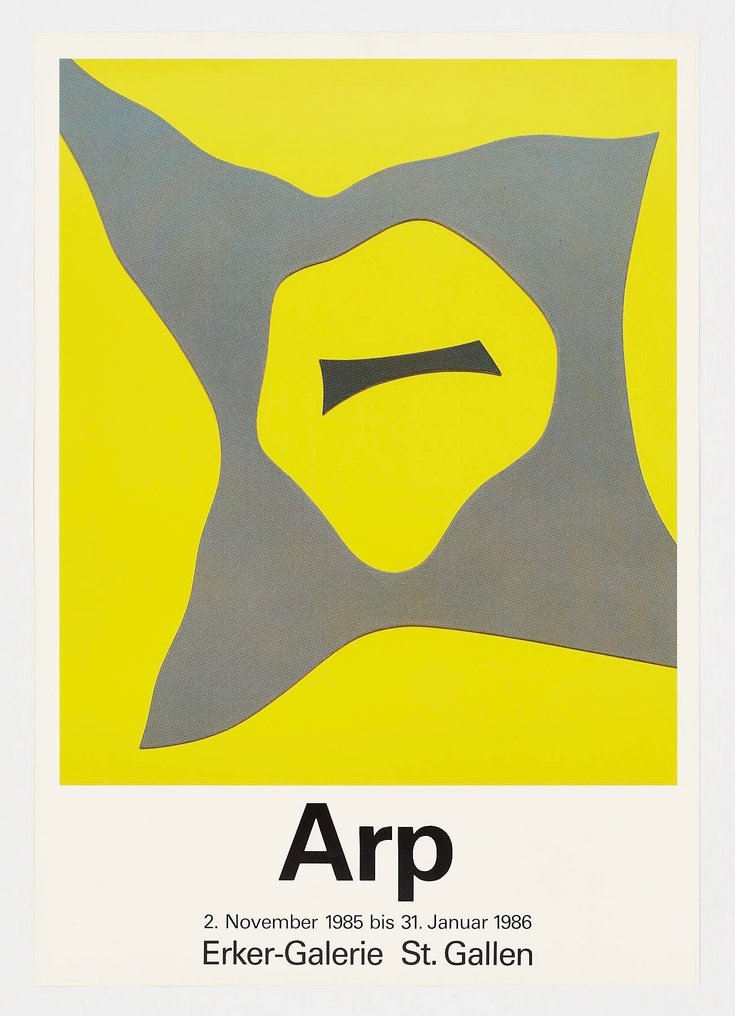
Hans Jean Arp (after) - Erker-Galerie St. Gallen - Original vintage poster - 1986



00
days
11
hours
49
minutes
45
seconds
Current bid
€ 35
Reserve price not met

Expert
Selected by Juan Antonio Rodríguez
Eight years experience valuing posters, previously valuer at Balclis, Barcelona.
Estimate € 150 - € 200
29 other people are watching this object
 Bidder 7156 Bidder 7156 | €35 | |
|---|---|---|
 Bidder 8483 Bidder 8483 | €30 |
Catawiki Buyer Protection
Your payment’s safe with us until you receive your object.View details
Trustpilot 4.4 | 123779 reviews
Rated Excellent on Trustpilot.
Description from the seller
Original poster by Hans Arp (*)
This work was edited on the occasion of the artist's solo exhibition at Erker-Galerie in 1985.
Edited by Erker-Presse.
Specifications
Dimensions: 63 x 44 cm
Year: 1985
Condition: Excellent (this artwork has never been framed or exhibited, and has always been kept in a professional art folder, so it is offered in perfect condition).
Provenance: Private Collection.
The item will be carefully handled and packaged in a reinforced cardboard box. The shipment will be certified with a tracking number.
The shipment will also include transport insurance for the final value of the artwork with full reimbursement in case of loss or damage, at no cost to the buyer.
He was born on September 16, 1886, in Strasbourg, Germany. A few years after the Franco-Prussian War (1870-1871), during which the area came under German control. This led Jean to master both French and German, signing as Jean when writing in French and as Hans Arp when writing in German. After World War I (1914-1918), Strasbourg returned to French control, and it was decided that his name would be Jean.
He was a poet in the two languages of his Franco-German cultural background, transforming them, according to his own image, into irony and romantic evasion, in a continuous 'invention', from Le siège de l'air and Der Vogel selbdritt to Loghbuch des traumkapitans and Soleil recerclé, published respectively in 1965 and 1996. Poetry constitutes the best commentary on the story of his life as a creator.
In 1904, after attending the School of Arts and Crafts in Strasbourg, he went to Paris, where he published his poetry for the first time. From 1905 to 1907, he studied at the Kunstschule (School of Art) in Weimar, Germany, and in 1908, he returned to Paris to attend the Académie Julian.
In 1915, he moved to Switzerland, taking advantage of Switzerland's neutrality in World War I.
He was a founding member of the Dada movement in Zurich in 1916. In 1920, together with Max Ernst and social activist Alfred Grünwald, he established the Dada group in Cologne. In 1925, his work appeared in the first exhibition of the Surrealist group, held at the Galerie Pierre in Paris.
In 1926, he moved to the suburb of Meudon in Paris. In 1931, he broke with the Surrealist movement and joined the group Abstraction-Creation, an association of abstract artists formed in Paris in 1931, working and editing in the magazine 'Transition' and, together with Seuphor and Torres García, he founded another group called Cercle et Carré, which represented the French contribution to abstract art. From the same year is his book 'The Isms in Art,' which he co-authored with El Lissitzky.
From the thirties until his death, he wrote and published essays and poetry. In 1942, he fled from his home in Meudon, escaping the German occupation, and lived in Zurich until the end of the war.
He traveled to America twice, first in 1949 to New York for her solo exhibition organized at the Curt Valentin Gallery, and a second time in 1950 to place a wooden relief at Harvard University in Cambridge.
In 1958, a retrospective exhibition of his works was presented at the Museum of Modern Art in New York (MoMA), followed by an exhibition at the Georges Pompidou National Center of Art and Culture in Paris, in 1962.
His aesthetic demand attributed to art the duty to free man from vanity and the oppression of reason, to save him by simplifying his life and identifying him with nature. From his wooden reliefs and collages, metallic reliefs, drawings, and cut-paper collages were born. His sculptures are liberated from humanistic inflections, directed back towards the spiritual values of essence and the absolute.
Currently, the Strasbourg Museum of Modern and Contemporary Art preserves many of its paintings and sculptures.
Jean Arp died in Basel, Switzerland, on June 7, 1966, at the age of 99, leaving a rich body of artistic work.
Seller's Story
EsKobARTE carefully selects artworks and posters from recognized and emerging artists worldwide to offer them here at affordable prices.*** AUTHENTIC WORKS *** We only sell genuine artworks and posters, as well as officially authorized prints.*** WE ARE PROFESSIONALS *** You can bid on your items with complete confidence. Over 1,000 positive reviews from our clients attest to our experience and professionalism on Catawiki.*** PROTECTED, CERTIFIED, AND INSURED SHIPPING *** All our items are carefully packaged in eco-friendly cardboard packaging. We work with the best shipping companies (UPS-DPD-DHL-FEDEX) to ensure the best service and tracking. Additionally, our shipments include insurance against damage or loss at no cost to the buyer.*** IF YOU PURCHASE MORE THAN ONE ITEM, WE COMBINE SHIPPING *** Even if they come from different auctions, you'll only have to pay the shipping cost for a single item.*** ANY QUESTIONS? CONTACT US *** You can use the chat to talk to us; we will be happy to assist you as soon as possible.*** THANK YOU AND GOOD LUCK WITH YOUR BIDS! ***
Translated by Google TranslateOriginal poster by Hans Arp (*)
This work was edited on the occasion of the artist's solo exhibition at Erker-Galerie in 1985.
Edited by Erker-Presse.
Specifications
Dimensions: 63 x 44 cm
Year: 1985
Condition: Excellent (this artwork has never been framed or exhibited, and has always been kept in a professional art folder, so it is offered in perfect condition).
Provenance: Private Collection.
The item will be carefully handled and packaged in a reinforced cardboard box. The shipment will be certified with a tracking number.
The shipment will also include transport insurance for the final value of the artwork with full reimbursement in case of loss or damage, at no cost to the buyer.
He was born on September 16, 1886, in Strasbourg, Germany. A few years after the Franco-Prussian War (1870-1871), during which the area came under German control. This led Jean to master both French and German, signing as Jean when writing in French and as Hans Arp when writing in German. After World War I (1914-1918), Strasbourg returned to French control, and it was decided that his name would be Jean.
He was a poet in the two languages of his Franco-German cultural background, transforming them, according to his own image, into irony and romantic evasion, in a continuous 'invention', from Le siège de l'air and Der Vogel selbdritt to Loghbuch des traumkapitans and Soleil recerclé, published respectively in 1965 and 1996. Poetry constitutes the best commentary on the story of his life as a creator.
In 1904, after attending the School of Arts and Crafts in Strasbourg, he went to Paris, where he published his poetry for the first time. From 1905 to 1907, he studied at the Kunstschule (School of Art) in Weimar, Germany, and in 1908, he returned to Paris to attend the Académie Julian.
In 1915, he moved to Switzerland, taking advantage of Switzerland's neutrality in World War I.
He was a founding member of the Dada movement in Zurich in 1916. In 1920, together with Max Ernst and social activist Alfred Grünwald, he established the Dada group in Cologne. In 1925, his work appeared in the first exhibition of the Surrealist group, held at the Galerie Pierre in Paris.
In 1926, he moved to the suburb of Meudon in Paris. In 1931, he broke with the Surrealist movement and joined the group Abstraction-Creation, an association of abstract artists formed in Paris in 1931, working and editing in the magazine 'Transition' and, together with Seuphor and Torres García, he founded another group called Cercle et Carré, which represented the French contribution to abstract art. From the same year is his book 'The Isms in Art,' which he co-authored with El Lissitzky.
From the thirties until his death, he wrote and published essays and poetry. In 1942, he fled from his home in Meudon, escaping the German occupation, and lived in Zurich until the end of the war.
He traveled to America twice, first in 1949 to New York for her solo exhibition organized at the Curt Valentin Gallery, and a second time in 1950 to place a wooden relief at Harvard University in Cambridge.
In 1958, a retrospective exhibition of his works was presented at the Museum of Modern Art in New York (MoMA), followed by an exhibition at the Georges Pompidou National Center of Art and Culture in Paris, in 1962.
His aesthetic demand attributed to art the duty to free man from vanity and the oppression of reason, to save him by simplifying his life and identifying him with nature. From his wooden reliefs and collages, metallic reliefs, drawings, and cut-paper collages were born. His sculptures are liberated from humanistic inflections, directed back towards the spiritual values of essence and the absolute.
Currently, the Strasbourg Museum of Modern and Contemporary Art preserves many of its paintings and sculptures.
Jean Arp died in Basel, Switzerland, on June 7, 1966, at the age of 99, leaving a rich body of artistic work.
Seller's Story
EsKobARTE carefully selects artworks and posters from recognized and emerging artists worldwide to offer them here at affordable prices.*** AUTHENTIC WORKS *** We only sell genuine artworks and posters, as well as officially authorized prints.*** WE ARE PROFESSIONALS *** You can bid on your items with complete confidence. Over 1,000 positive reviews from our clients attest to our experience and professionalism on Catawiki.*** PROTECTED, CERTIFIED, AND INSURED SHIPPING *** All our items are carefully packaged in eco-friendly cardboard packaging. We work with the best shipping companies (UPS-DPD-DHL-FEDEX) to ensure the best service and tracking. Additionally, our shipments include insurance against damage or loss at no cost to the buyer.*** IF YOU PURCHASE MORE THAN ONE ITEM, WE COMBINE SHIPPING *** Even if they come from different auctions, you'll only have to pay the shipping cost for a single item.*** ANY QUESTIONS? CONTACT US *** You can use the chat to talk to us; we will be happy to assist you as soon as possible.*** THANK YOU AND GOOD LUCK WITH YOUR BIDS! ***
Translated by Google TranslateDetails
Era
1900-2000
Designer/Artist
Hans Jean Arp (after)
Poster title
Erker-Galerie St. Gallen - Original vintage poster - 1986
Subject
Art, Original artwork
Country of Origin
Germany
Condition
A (excellent - mint condition)
Height
63 cm
Width
44 cm