Riccardo Guarnieri (1933) - Impronte



05
days
11
hours
26
minutes
34
seconds
Starting bid
€ 1
Reserve price not met

Expert
Selected by Silvia Possanza
Held senior specialist role at Finarte for 12 years, specialising in modern prints.
Estimate € 350 - € 400
No bids placed
Catawiki Buyer Protection
Your payment’s safe with us until you receive your object.View details
Trustpilot 4.4 | 123418 reviews
Rated Excellent on Trustpilot.
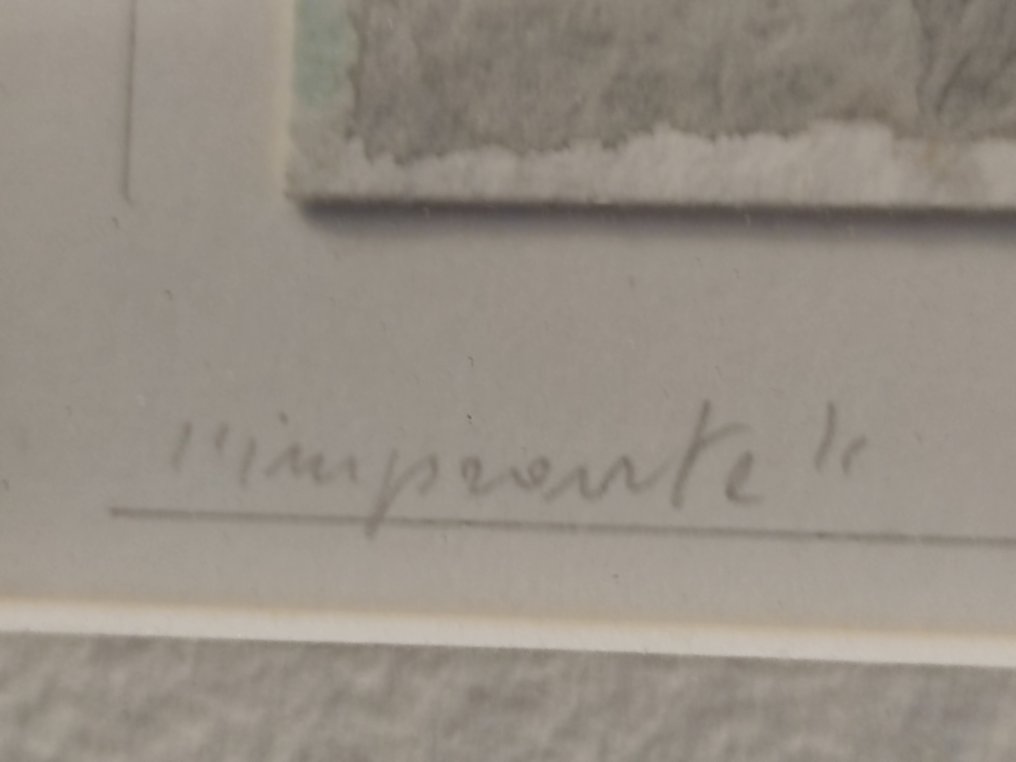
Riccardo Guarnieri, Impronte, mixed media on cardboard, 12 × 9 cm, 1970, original, hand-signed, sold with frame.
AI-assisted summary
Description from the seller
Opera by the Maestro
Riccardo Guarnieri
born in Florence in 1933
Mixed technique on cardboard
Art 'Analitica'
Imprints
Circa 1970
Dimensions: 12 x 9 cm (only artwork)
Biography
Born in Florence in 1933, after attending the Free School of Nude, the twenty-year-old began painting alongside a musical career that saw him perform with light music orchestras in Italy and abroad.
After the initial figurative works, he moved towards informality, as Guarneri himself recounts in an interview with Giovanna Uzzani published in the catalog of the 2004 Palazzo Pitti retrospective: "Then came 1958, and painting became more important, more serious. I was still groping. Between 1958 and 1959, I found myself in the Netherlands, in The Hague, playing music. I fell in love with Rembrandt's last self-portraits. Nothing more informal. On dark, heavy backgrounds like the night, I saw flickering signs, lightning bolts of light, golden glows. That’s how I started to draw inspiration from Rembrandt in my informal paintings, even if no one noticed. It was the light, those glows that interested me. Even then, I sensed how central the theme of light was, but I still couldn't give up material and thought of Wols and also Alechinskij. Then I realized that the Cobra artists felt too violent and instinctive, so I was rather attracted to Licini’s purity, Klee’s lyrical inventions. When I returned to Florence, I discovered that Fiamma Vigo had opened a new space on via degli Artisti, a meeting place for abstract painters and adventurous young artists. An opportunity arose for an exhibition in 1959, titled Baldi – Fallani – Guarneri – Masi – Verna. Five informals in Florence." Guarneri’s debut exhibition still linked him to the informal sphere but, as the artist recounts, it was "... fervent years, everything was like overwhelmed by experiences, by discoveries. In 1959, I went to Germany for the first time, to Düsseldorf. I was still painting informally. I started to visit the studios of those painters I felt closest to my research. Northern Europe then appeared to me as an extraordinary forge, laboratory, exciting network of experimentation, a lively, nervous, cosmopolitan reality. I met Otto Piene, Peter Brüning, Hansjorg Glattfelder. Then also Raimond Girke and Winfred Gaul. I went to their studios and we became friends, even though I was younger." His first solo exhibition was at Galerie de Posthoorn in The Hague in 1960, a year in which Guarneri also participated in Abstracte Italiensee Kunst in Ostenda and Modern Paintings of Italy at the Rose Marie Gallerie in Taipei, while in 1961 he had a solo show with Claudio Verna at Galleria L’Indiano in Florence, and in 1962 at Galleria San Matteo in Genoa.
In 1962, Guarneri began to focus on color as light, on drawing as painting, and on issues related to visual perception. From that moment on, line, light, and color became indistinguishable, forming a poetic world of acute sensitivity and, despite its different phases, serving as the guiding thread of a decidedly personal research. The first very clear paintings were created, in which space was marked by variations of light, and their surfaces were mainly treated with pencil. These works were first revealed in 1963 in a solo exhibition at La Strozzina in Palazzo Strozzi. It was Guarneri himself who recalled the overcoming of informality and the change in his research in the early sixties: 'My association with German friends confirmed this, suggested ways out of informality, and encouraged me in my pursuit of painting. My canvases already contained new proposals of light and the first effects of transparency. Then my abstract informal paintings began to lighten, and the search for light rekindled in me the love for the landscape of the North, in Germany, the Netherlands, Finland — that crystalline light, without humidity, weightless. It was thus that, by increasingly brightening tones, removing material, and decanting, I arrived at the silence of white. But it was not a sudden choice.'
In 1963, with Giancarlo Bargoni, Attilio Carreri, Arnaldo Esposto, and Gianni Stirone, Guarneri established the Gruppo Tempo 3, whose formal program, based on Rothko's lesson and gestalt theories, aimed at overcoming the opposition between concretism and informal, positioning itself as the third time of abstract painting.
Since 1964, work has taken on a more rigorous and geometric structure: "I was captivated by the geometric pattern of diamonds or squares repeated with imperceptible asymmetry, unfolding through carefully calculated sequences. An effect of eurythmy is achieved with the help of colors, or rather colored lights, which replace the old timbral color, creating poetic effects through the use of primary elements of light and rhythm of space. [...] I also had in mind a tribute to Josef Albers' square, with those effects of dynamic tension, compression, arising from arrangements of squares not organized around the same center; for Albers, the square also symbolized purity of form and a departure from emotional implications, seeking a basic module in relation to its multiples. But for me, Albers was too logical, too geometric; I preferred to be more ambiguous, I did not share his faith in pure form, I came from existentialism."
Guarneri's research, now mature and original, has been recognized with an invitation to the XXXIII Venice Biennale (where he shares the hall with Agostino Bonalumi and Paolo Scheggi) and to the Weiss auf Weiss exhibition at the Kunsthalle in Bern, while in 1967 he participated in the V Paris Biennale and in the Nuova Tendenza exhibitions. Numerous solo exhibitions saw the artist active in Italy and Europe during the 1960s: at Galleria Gritti in Venice in 1964, at Galleria II Bilico in Rome in 1965, at Galleria il Paladino in Palermo in 1966, at Galleria La Carabaga in Genoa and Galleria 3A in Lecce in 1967, at Studio d’informazione Estetica in Turin in 1968, and at Galleria Flori in Florence in 1969. It was from 1969 that the painting 'continued to refine itself. Nearly white paintings emerged, readable only through prolonged observation that provoked perceptual refinement. [...] The colors resulted from luminous and mutable transparencies and transformed into color-light. The signs had changed and, from being individual and meaningful, had become lighter, denser, and more regular, mere transcriptions of an imperceptible wrist movement. [...] But ultimately, the structure must constantly contend with a light that consumes and disintegrates it.'
In 1972, Guarneri held an anthological exhibition of over sixty works, closing a decade of activity at the Westfälischer Kunstverein in Münster, while the same year saw solo exhibitions at the Galleria Peccolo in Livorno, the Galleria La Polena in Genoa, the Galleria Morone 6 in Milan, and the Galerie Loehr in Frankfurt. Subsequent solo shows included the 1973 exhibition at the Galleria del Cavallino in Venice, and those in 1974 at the Galleria Godel in Rome and the Galerie December in Münster; in 1976 at the Galerie December in Dusseldorf, and in 1978 at the Galerie Artline in The Hague. His participation in various exhibitions includes the Rome Quadriennale of 1973, the Milan Biennale of 1974, and significant exhibitions on Italian art: 'The Active Image' at the Rotonda della Besana in Milan in 1971, and the same year, the 20th International Fiorino Exhibition at Palazzo Strozzi in Florence; 'Europe/America, Determined Abstraction 1960-76' at the National Gallery of Modern Art in Bologna in 1976; and 'Lines of Artistic Research in Italy 1960-1980' at the Palazzo delle Esposizioni in Rome in 1981.
The late '70s. A sense of dissatisfaction took hold of me regarding my previous work; my paintings were now too good, too perfect. I felt the need for rebellion, a desire to find an escape from such relentless rigor. [...] I kicked aside the geometric rigor, surrendered to the effects of chance and stain, and accepted letting the 'romantic' and 'sentimental' aspects of my inspiration prevail. [...] The first appreciable results of this new direction in my painting came around 1982. The countless watercolor stains overlapped each other, very clearly, filtered through a sheet of Japanese rice paper that I glued onto the canvas and used instead of my usual preparation.
The outcomes of these researches are featured in the exhibition titled Equilibrio, held in May 1984 at the Palazzo Pretorio in Certaldo (in collaboration with the GNAM in Rome), where Guarneri exhibits alongside Aricò, Uncini, Conte, Lorenzetti, and Napoleone.
In the late 1980s, I happened to grow tired of paper. The work was lengthy, and the handcrafted preparation was boring; it absorbed too much of my time. So I decided to return to canvas, but without giving up watercolor, which I liked for its lightness. [...] And so the 1990s arrived, during which I reaffirmed my ideas and my way of understanding painting, sometimes with a demand for geometric rigor in the structure, and other times with freer, more rhythmic and chromatic moments.
In 2000, the artist faced a completely new experience by creating the project for the 24-square-meter mosaic at the Lucio Sestio metro station in Rome.
Over the years, the artist has been invited to major exhibitions on the history of Italian art both in Italy and abroad: Abstract. Abstract Secessions in Italy from the post-war period to 1990 at the Galleria Civica di Verona in 1990; Art in Italy 1956-1968 at the Museo Civico di Conegliano Veneto in 1995; The Other Direction of Art. Abstract Art of Italy '60-'90 at the Kunsthalle in Cologne in 1997; Continuity. Art in Tuscany 1945-2000 at Palazzo Strozzi in Florence in 2002.
In 2004, at the Galleria d’Arte Moderna di Palazzo Pitti in Florence, the retrospective exhibition Contrappunto luce was held. On this occasion, a catalog was published featuring critical essays by Giovanna Uzzani and Maria Grazia Messina, statements by the artist, and an anthology of critical writings, which remains a reference text for Guarneri's work to this day.
Since the mid-2000s, within the renewed critical interest in analytical painting, exhibitions dedicated to its protagonists have flourished in Italy and abroad, with Riccardo Guarneri (one of the early representatives of this artistic movement) regularly invited. In 2007, he was in Milan, at the Palazzo della Permanente, for the exhibition 'Analytical Painting. Italian Paths 1970-1980,' and in numerous private galleries. In 2015, he was among the artists of 'An Idea of Painting. Analytical Abstraction in Italy, 1972-1976,' at the Galleria d’Arte Moderna in Udine, and in 2016, he participated in two other group exhibitions: 'Analytical Painting. The 1970s,' at Mazzoleni Art Gallery in London, and 'The Years of Analytical Painting. The Protagonists, the Works, the Research,' at the Palazzo della Gran Guardia in Verona. In 2017, he was invited to other exhibitions on analytical painting: 'Analytical Painting Yesterday and Today' at Galleria Mazzoleni in Turin, and 'Analytical Painting: Origins and Continuity,' held at Villa Contarini (Piazzola sul Brenta, PD) and Rocca di Umbertide.
We also recall his participation in historic exhibitions: Aniconic Painting at the Casa del Mantegna in Mantua in 2008; The Great Game. Forms of Art in Italy 1947-1989 at the Rotonda della Besana in Milan in 2010; Rediscovered Paths of Italian Art. VAF-Stiftung 1947-2010 at the Mart in Trento and Rovereto in 2011; and 100% Italy. A Century of Masterpieces, held at the Museo Ettore Fico in Turin in 2018.
These years see Guarneri as the protagonist of important solo exhibitions: in 2015 at Galerie 21 in Livorno and in three Milanese galleries (Il Milione, Antonio Battaglia, and Clivio), culminating with the exhibition in New York at the Rosai Ugolini Modern gallery. In 2016, it is instead the Michela Rizzo Gallery in Venice and Progetto Elm in Milan that showcase a wide selection of the artist's works. Progetto Elm repeats in 2017 by presenting Guarneri's works in a solo show at Artissima, the prestigious international fair in Turin.
Also in 2017, the artist received recognition with an invitation from Christine Macel to the 57th Venice Biennale of Art, Viva Arte Viva, fifty years after his first Biennale in 1966.
2018 begins instead with a trip to London, on the occasion of the solo exhibition organized by Ian Rosenfeld at the Gallery Rosenfeld in London, a gallery with which Guarneri continues to collaborate to this day, exhibiting in solo and group shows. The same Rosenfeld presents his works in 2019 at Art Brussels and at Frieze Art Fair (New York), and in 2025 at Art SG (Singapore). The year 2018 also features a solo exhibition held at Palazzo Sarcinelli in Conegliano Veneto.
In 2019, the Museo del Novecento in Milan included a work by Guarneri as part of the museum's reorganization, inaugurating a new exhibition route. The Museo del Novecento in Florence, on the other hand, dedicated a solo exhibition to him, as did the Galleria Giraldi in Livorno and the Dipartimento Arti Visive in Soresina.
In 2021, four of his works became part of the permanent collection of the Centre Pompidou in Paris.
In 2022 and 2023, he exhibited alongside Giorgio Griffa at the Galleria FerrarinArte in Legnago and at the Kromya Art Gallery in Lugano. Also in 2023, he was with Hemmes at the Museo Piaggio in Pontedera. In 2024, he will exhibit at the Galleria Lombardi in Rome, and in early 2025 at the Galleria Michela Rizzo in Venice. Alongside solo exhibitions, Guarneri is also invited to important group shows: at the Museo della Città in Livorno, the Museo di Villa Croce, the Museo di Palazzo Reale in Genoa, and the Abbey of Montecassino.
Riccardo Guarneri has taught painting at the Accademies of Fine Arts in Carrara, Bari, Venice, and Florence, and is also an Emeritus Academician of the Accademia delle Arti del Disegno in Florence, the city where he has always lived and worked.
Riccardo Guarneri, 2005 - 2025
Opera by the Maestro
Riccardo Guarnieri
born in Florence in 1933
Mixed technique on cardboard
Art 'Analitica'
Imprints
Circa 1970
Dimensions: 12 x 9 cm (only artwork)
Biography
Born in Florence in 1933, after attending the Free School of Nude, the twenty-year-old began painting alongside a musical career that saw him perform with light music orchestras in Italy and abroad.
After the initial figurative works, he moved towards informality, as Guarneri himself recounts in an interview with Giovanna Uzzani published in the catalog of the 2004 Palazzo Pitti retrospective: "Then came 1958, and painting became more important, more serious. I was still groping. Between 1958 and 1959, I found myself in the Netherlands, in The Hague, playing music. I fell in love with Rembrandt's last self-portraits. Nothing more informal. On dark, heavy backgrounds like the night, I saw flickering signs, lightning bolts of light, golden glows. That’s how I started to draw inspiration from Rembrandt in my informal paintings, even if no one noticed. It was the light, those glows that interested me. Even then, I sensed how central the theme of light was, but I still couldn't give up material and thought of Wols and also Alechinskij. Then I realized that the Cobra artists felt too violent and instinctive, so I was rather attracted to Licini’s purity, Klee’s lyrical inventions. When I returned to Florence, I discovered that Fiamma Vigo had opened a new space on via degli Artisti, a meeting place for abstract painters and adventurous young artists. An opportunity arose for an exhibition in 1959, titled Baldi – Fallani – Guarneri – Masi – Verna. Five informals in Florence." Guarneri’s debut exhibition still linked him to the informal sphere but, as the artist recounts, it was "... fervent years, everything was like overwhelmed by experiences, by discoveries. In 1959, I went to Germany for the first time, to Düsseldorf. I was still painting informally. I started to visit the studios of those painters I felt closest to my research. Northern Europe then appeared to me as an extraordinary forge, laboratory, exciting network of experimentation, a lively, nervous, cosmopolitan reality. I met Otto Piene, Peter Brüning, Hansjorg Glattfelder. Then also Raimond Girke and Winfred Gaul. I went to their studios and we became friends, even though I was younger." His first solo exhibition was at Galerie de Posthoorn in The Hague in 1960, a year in which Guarneri also participated in Abstracte Italiensee Kunst in Ostenda and Modern Paintings of Italy at the Rose Marie Gallerie in Taipei, while in 1961 he had a solo show with Claudio Verna at Galleria L’Indiano in Florence, and in 1962 at Galleria San Matteo in Genoa.
In 1962, Guarneri began to focus on color as light, on drawing as painting, and on issues related to visual perception. From that moment on, line, light, and color became indistinguishable, forming a poetic world of acute sensitivity and, despite its different phases, serving as the guiding thread of a decidedly personal research. The first very clear paintings were created, in which space was marked by variations of light, and their surfaces were mainly treated with pencil. These works were first revealed in 1963 in a solo exhibition at La Strozzina in Palazzo Strozzi. It was Guarneri himself who recalled the overcoming of informality and the change in his research in the early sixties: 'My association with German friends confirmed this, suggested ways out of informality, and encouraged me in my pursuit of painting. My canvases already contained new proposals of light and the first effects of transparency. Then my abstract informal paintings began to lighten, and the search for light rekindled in me the love for the landscape of the North, in Germany, the Netherlands, Finland — that crystalline light, without humidity, weightless. It was thus that, by increasingly brightening tones, removing material, and decanting, I arrived at the silence of white. But it was not a sudden choice.'
In 1963, with Giancarlo Bargoni, Attilio Carreri, Arnaldo Esposto, and Gianni Stirone, Guarneri established the Gruppo Tempo 3, whose formal program, based on Rothko's lesson and gestalt theories, aimed at overcoming the opposition between concretism and informal, positioning itself as the third time of abstract painting.
Since 1964, work has taken on a more rigorous and geometric structure: "I was captivated by the geometric pattern of diamonds or squares repeated with imperceptible asymmetry, unfolding through carefully calculated sequences. An effect of eurythmy is achieved with the help of colors, or rather colored lights, which replace the old timbral color, creating poetic effects through the use of primary elements of light and rhythm of space. [...] I also had in mind a tribute to Josef Albers' square, with those effects of dynamic tension, compression, arising from arrangements of squares not organized around the same center; for Albers, the square also symbolized purity of form and a departure from emotional implications, seeking a basic module in relation to its multiples. But for me, Albers was too logical, too geometric; I preferred to be more ambiguous, I did not share his faith in pure form, I came from existentialism."
Guarneri's research, now mature and original, has been recognized with an invitation to the XXXIII Venice Biennale (where he shares the hall with Agostino Bonalumi and Paolo Scheggi) and to the Weiss auf Weiss exhibition at the Kunsthalle in Bern, while in 1967 he participated in the V Paris Biennale and in the Nuova Tendenza exhibitions. Numerous solo exhibitions saw the artist active in Italy and Europe during the 1960s: at Galleria Gritti in Venice in 1964, at Galleria II Bilico in Rome in 1965, at Galleria il Paladino in Palermo in 1966, at Galleria La Carabaga in Genoa and Galleria 3A in Lecce in 1967, at Studio d’informazione Estetica in Turin in 1968, and at Galleria Flori in Florence in 1969. It was from 1969 that the painting 'continued to refine itself. Nearly white paintings emerged, readable only through prolonged observation that provoked perceptual refinement. [...] The colors resulted from luminous and mutable transparencies and transformed into color-light. The signs had changed and, from being individual and meaningful, had become lighter, denser, and more regular, mere transcriptions of an imperceptible wrist movement. [...] But ultimately, the structure must constantly contend with a light that consumes and disintegrates it.'
In 1972, Guarneri held an anthological exhibition of over sixty works, closing a decade of activity at the Westfälischer Kunstverein in Münster, while the same year saw solo exhibitions at the Galleria Peccolo in Livorno, the Galleria La Polena in Genoa, the Galleria Morone 6 in Milan, and the Galerie Loehr in Frankfurt. Subsequent solo shows included the 1973 exhibition at the Galleria del Cavallino in Venice, and those in 1974 at the Galleria Godel in Rome and the Galerie December in Münster; in 1976 at the Galerie December in Dusseldorf, and in 1978 at the Galerie Artline in The Hague. His participation in various exhibitions includes the Rome Quadriennale of 1973, the Milan Biennale of 1974, and significant exhibitions on Italian art: 'The Active Image' at the Rotonda della Besana in Milan in 1971, and the same year, the 20th International Fiorino Exhibition at Palazzo Strozzi in Florence; 'Europe/America, Determined Abstraction 1960-76' at the National Gallery of Modern Art in Bologna in 1976; and 'Lines of Artistic Research in Italy 1960-1980' at the Palazzo delle Esposizioni in Rome in 1981.
The late '70s. A sense of dissatisfaction took hold of me regarding my previous work; my paintings were now too good, too perfect. I felt the need for rebellion, a desire to find an escape from such relentless rigor. [...] I kicked aside the geometric rigor, surrendered to the effects of chance and stain, and accepted letting the 'romantic' and 'sentimental' aspects of my inspiration prevail. [...] The first appreciable results of this new direction in my painting came around 1982. The countless watercolor stains overlapped each other, very clearly, filtered through a sheet of Japanese rice paper that I glued onto the canvas and used instead of my usual preparation.
The outcomes of these researches are featured in the exhibition titled Equilibrio, held in May 1984 at the Palazzo Pretorio in Certaldo (in collaboration with the GNAM in Rome), where Guarneri exhibits alongside Aricò, Uncini, Conte, Lorenzetti, and Napoleone.
In the late 1980s, I happened to grow tired of paper. The work was lengthy, and the handcrafted preparation was boring; it absorbed too much of my time. So I decided to return to canvas, but without giving up watercolor, which I liked for its lightness. [...] And so the 1990s arrived, during which I reaffirmed my ideas and my way of understanding painting, sometimes with a demand for geometric rigor in the structure, and other times with freer, more rhythmic and chromatic moments.
In 2000, the artist faced a completely new experience by creating the project for the 24-square-meter mosaic at the Lucio Sestio metro station in Rome.
Over the years, the artist has been invited to major exhibitions on the history of Italian art both in Italy and abroad: Abstract. Abstract Secessions in Italy from the post-war period to 1990 at the Galleria Civica di Verona in 1990; Art in Italy 1956-1968 at the Museo Civico di Conegliano Veneto in 1995; The Other Direction of Art. Abstract Art of Italy '60-'90 at the Kunsthalle in Cologne in 1997; Continuity. Art in Tuscany 1945-2000 at Palazzo Strozzi in Florence in 2002.
In 2004, at the Galleria d’Arte Moderna di Palazzo Pitti in Florence, the retrospective exhibition Contrappunto luce was held. On this occasion, a catalog was published featuring critical essays by Giovanna Uzzani and Maria Grazia Messina, statements by the artist, and an anthology of critical writings, which remains a reference text for Guarneri's work to this day.
Since the mid-2000s, within the renewed critical interest in analytical painting, exhibitions dedicated to its protagonists have flourished in Italy and abroad, with Riccardo Guarneri (one of the early representatives of this artistic movement) regularly invited. In 2007, he was in Milan, at the Palazzo della Permanente, for the exhibition 'Analytical Painting. Italian Paths 1970-1980,' and in numerous private galleries. In 2015, he was among the artists of 'An Idea of Painting. Analytical Abstraction in Italy, 1972-1976,' at the Galleria d’Arte Moderna in Udine, and in 2016, he participated in two other group exhibitions: 'Analytical Painting. The 1970s,' at Mazzoleni Art Gallery in London, and 'The Years of Analytical Painting. The Protagonists, the Works, the Research,' at the Palazzo della Gran Guardia in Verona. In 2017, he was invited to other exhibitions on analytical painting: 'Analytical Painting Yesterday and Today' at Galleria Mazzoleni in Turin, and 'Analytical Painting: Origins and Continuity,' held at Villa Contarini (Piazzola sul Brenta, PD) and Rocca di Umbertide.
We also recall his participation in historic exhibitions: Aniconic Painting at the Casa del Mantegna in Mantua in 2008; The Great Game. Forms of Art in Italy 1947-1989 at the Rotonda della Besana in Milan in 2010; Rediscovered Paths of Italian Art. VAF-Stiftung 1947-2010 at the Mart in Trento and Rovereto in 2011; and 100% Italy. A Century of Masterpieces, held at the Museo Ettore Fico in Turin in 2018.
These years see Guarneri as the protagonist of important solo exhibitions: in 2015 at Galerie 21 in Livorno and in three Milanese galleries (Il Milione, Antonio Battaglia, and Clivio), culminating with the exhibition in New York at the Rosai Ugolini Modern gallery. In 2016, it is instead the Michela Rizzo Gallery in Venice and Progetto Elm in Milan that showcase a wide selection of the artist's works. Progetto Elm repeats in 2017 by presenting Guarneri's works in a solo show at Artissima, the prestigious international fair in Turin.
Also in 2017, the artist received recognition with an invitation from Christine Macel to the 57th Venice Biennale of Art, Viva Arte Viva, fifty years after his first Biennale in 1966.
2018 begins instead with a trip to London, on the occasion of the solo exhibition organized by Ian Rosenfeld at the Gallery Rosenfeld in London, a gallery with which Guarneri continues to collaborate to this day, exhibiting in solo and group shows. The same Rosenfeld presents his works in 2019 at Art Brussels and at Frieze Art Fair (New York), and in 2025 at Art SG (Singapore). The year 2018 also features a solo exhibition held at Palazzo Sarcinelli in Conegliano Veneto.
In 2019, the Museo del Novecento in Milan included a work by Guarneri as part of the museum's reorganization, inaugurating a new exhibition route. The Museo del Novecento in Florence, on the other hand, dedicated a solo exhibition to him, as did the Galleria Giraldi in Livorno and the Dipartimento Arti Visive in Soresina.
In 2021, four of his works became part of the permanent collection of the Centre Pompidou in Paris.
In 2022 and 2023, he exhibited alongside Giorgio Griffa at the Galleria FerrarinArte in Legnago and at the Kromya Art Gallery in Lugano. Also in 2023, he was with Hemmes at the Museo Piaggio in Pontedera. In 2024, he will exhibit at the Galleria Lombardi in Rome, and in early 2025 at the Galleria Michela Rizzo in Venice. Alongside solo exhibitions, Guarneri is also invited to important group shows: at the Museo della Città in Livorno, the Museo di Villa Croce, the Museo di Palazzo Reale in Genoa, and the Abbey of Montecassino.
Riccardo Guarneri has taught painting at the Accademies of Fine Arts in Carrara, Bari, Venice, and Florence, and is also an Emeritus Academician of the Accademia delle Arti del Disegno in Florence, the city where he has always lived and worked.
Riccardo Guarneri, 2005 - 2025
Details
Artist
Riccardo Guarnieri (1933)
Sold with frame
Yes
Sold by
Owner or reseller
Edition
Original
Title of artwork
Impronte
Technique
Mixed media
Signature
Hand signed
Country of Origin
Italy
Year
1970
Condition
Excellent condition
Height
12 cm
Width
9 cm
Weight
200 g
Style
Abstract
Period
1970-1980
Sold by
