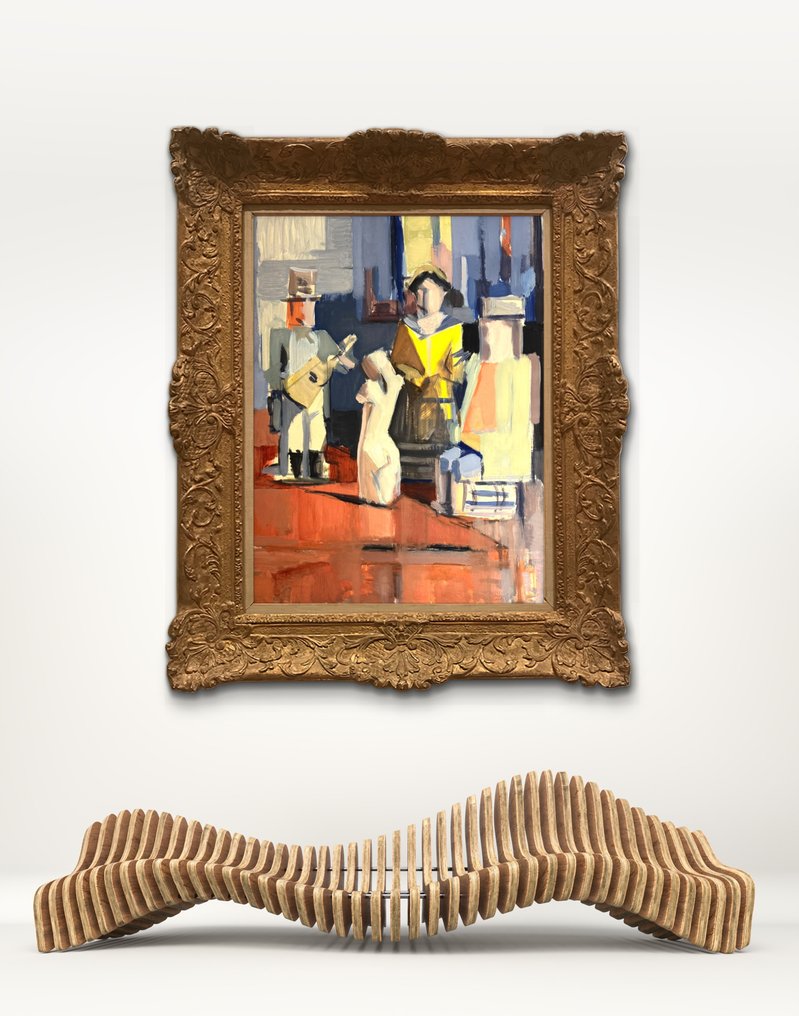
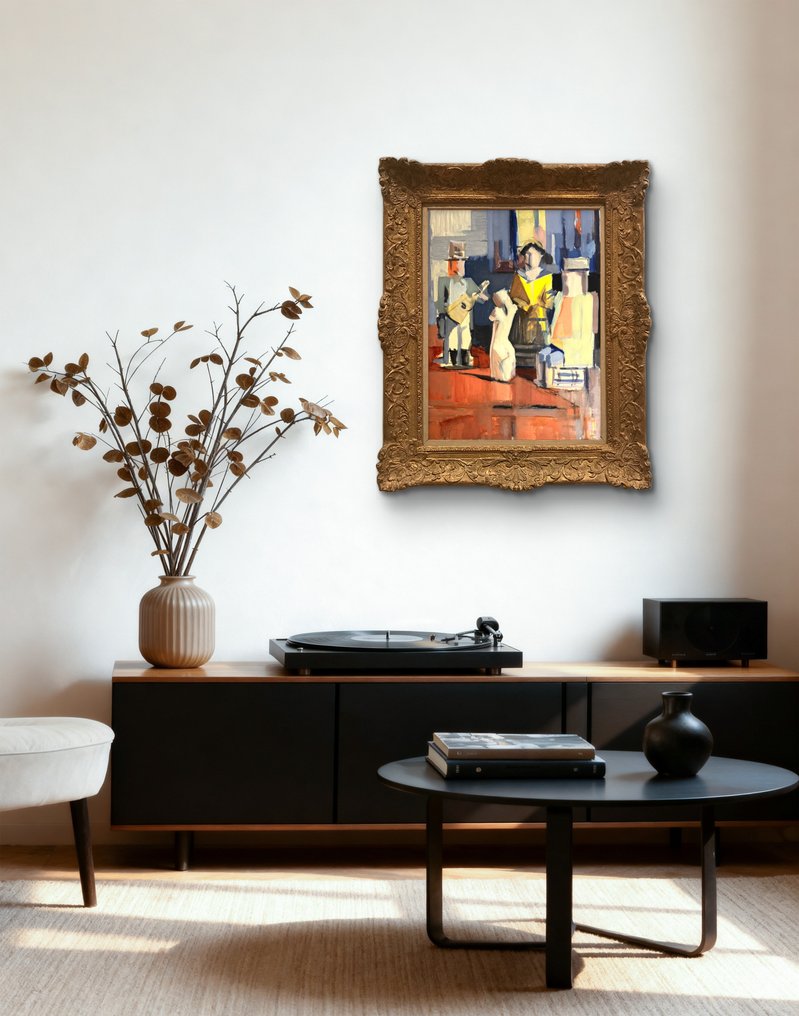
René Mels (1909-1977) - Atelier du sculpteur - 1950



03
days
18
hours
47
minutes
49
seconds
Current bid
€ 60
No reserve price

Expert
Selected by Silvia Possanza
Held senior specialist role at Finarte for 12 years, specialising in modern prints.
Estimate € 300 - € 400
15 other people are watching this object
 Bidder 6623 Bidder 6623 | €60 | |
|---|---|---|
 Bidder 3120 Bidder 3120 | €53 | |
| Bidder 6623 | €50 | |
Catawiki Buyer Protection
Your payment’s safe with us until you receive your object.View details
Trustpilot 4.4 | 123609 reviews
Rated Excellent on Trustpilot.
René Mels (1909–1977), Belgian artist, signed and dated 1950, created an original oil on paper titled Atelier du sculpteur – 1950, measuring 63 by 47.5 cm, depicting an interior scene, in good condition and unframed.
AI-assisted summary
Description from the seller
Artist René Mels (1909–1977) – Belgium
Sculptor's workshop
Technique: Oil on paper
Dimensions: 63 × 47.5 cm
Signature: Signed and dated 1950 at the bottom.
Date: 1950
Condition: Good condition
Framing: Sold without supervision
Inscriptions: Handwritten inscription on the back, in pencil, seemingly referring to a workshop (partially legible mention).
Description of the work
This oil on paper dated from 1950 depicts a structured interior scene, composed of stylized figures and volumes reminiscent of sculptural forms. The organization of space, the presence of objects with massive silhouettes, and the hieratic posture of certain figures suggest a possible interpretation of the scene as a sculptor's workshop, a theme frequently explored by modern artists through a synthetic and constructed approach.
The shapes are deliberately simplified and treated in flat areas, giving the whole an almost architectural dimension. The color palette, balanced and subtle, combines muted blues, ochres, browns, and bright yellows, creating a harmonious interplay between depth and surface. The brushwork is firm, controlled, yet retains a certain gestural freedom.
The work is distinguished by the clarity of its composition and by the tension between readable figuration and formal construction, characteristic of René Mels' plastic research in the early 1950s.
Artistic context
At the turn of the 1950s, René Mels was in a crucial transitional phase of his artistic journey. Not yet fully abandoning figuration, he was moving towards simplifying forms and rigorously structuring the pictorial space, foreshadowing his evolution towards abstraction.
Studio scenes, real or suggested, provide Mels with an ideal setting to explore the relationships between volumes, masses, and rhythms, independent of the narrative subject. This work fully illustrates this approach, where composition takes precedence over description, and where the figure becomes a fully-fledged plastic element.
Biography of René Mels (1909–1977)
Born in Herent-lez-Louvain, René Mels studied at the Leuven Academy, then in Brussels, before continuing his studies at La Cambre. An important figure in the Belgian post-war art scene, he was a member of the Jeune Peinture belge and the Art Abstrait group.
His work gradually evolves from expressionism and structured figuration to a refined abstraction, based on the balance between constructive rigor and chromatic sensitivity. He passed away in 1977 in Woluwe-Saint-Lambert, leaving a body of work recognized for its coherence and poetic depth.
This work from 1950 is a significant example of René Mels's intermediate period, combining stylized figuration, spatial reflection, and a search for formal balance. The possible evocation of a sculptor's studio enhances its iconographic and historical interest within the artist's body of work.
Artist René Mels (1909–1977) – Belgium
Sculptor's workshop
Technique: Oil on paper
Dimensions: 63 × 47.5 cm
Signature: Signed and dated 1950 at the bottom.
Date: 1950
Condition: Good condition
Framing: Sold without supervision
Inscriptions: Handwritten inscription on the back, in pencil, seemingly referring to a workshop (partially legible mention).
Description of the work
This oil on paper dated from 1950 depicts a structured interior scene, composed of stylized figures and volumes reminiscent of sculptural forms. The organization of space, the presence of objects with massive silhouettes, and the hieratic posture of certain figures suggest a possible interpretation of the scene as a sculptor's workshop, a theme frequently explored by modern artists through a synthetic and constructed approach.
The shapes are deliberately simplified and treated in flat areas, giving the whole an almost architectural dimension. The color palette, balanced and subtle, combines muted blues, ochres, browns, and bright yellows, creating a harmonious interplay between depth and surface. The brushwork is firm, controlled, yet retains a certain gestural freedom.
The work is distinguished by the clarity of its composition and by the tension between readable figuration and formal construction, characteristic of René Mels' plastic research in the early 1950s.
Artistic context
At the turn of the 1950s, René Mels was in a crucial transitional phase of his artistic journey. Not yet fully abandoning figuration, he was moving towards simplifying forms and rigorously structuring the pictorial space, foreshadowing his evolution towards abstraction.
Studio scenes, real or suggested, provide Mels with an ideal setting to explore the relationships between volumes, masses, and rhythms, independent of the narrative subject. This work fully illustrates this approach, where composition takes precedence over description, and where the figure becomes a fully-fledged plastic element.
Biography of René Mels (1909–1977)
Born in Herent-lez-Louvain, René Mels studied at the Leuven Academy, then in Brussels, before continuing his studies at La Cambre. An important figure in the Belgian post-war art scene, he was a member of the Jeune Peinture belge and the Art Abstrait group.
His work gradually evolves from expressionism and structured figuration to a refined abstraction, based on the balance between constructive rigor and chromatic sensitivity. He passed away in 1977 in Woluwe-Saint-Lambert, leaving a body of work recognized for its coherence and poetic depth.
This work from 1950 is a significant example of René Mels's intermediate period, combining stylized figuration, spatial reflection, and a search for formal balance. The possible evocation of a sculptor's studio enhances its iconographic and historical interest within the artist's body of work.
Details
Artist
René Mels (1909-1977)
Sold with frame
No
Sold by
Owner or reseller
Edition
Original
Title of artwork
Atelier du sculpteur - 1950
Technique
Oil painting
Signature
Signed
Country of Origin
Belgium
Year
1950
Condition
Good condition
Height
63 cm
Width
47.5 cm
Depiction/Theme
Interior scene
Style
Abstract Expressionism
Period
1950-1960
Sold by
