Honoré de Balzac. Eaux-fortes originales de Claude Leroy - La fille aux yeux d'or - 1946



06
days
16
hours
07
minutes
05
seconds

15 other people are watching this object
 Bidder 8935 Bidder 8935 | €3 | |
|---|---|---|
| Bidder 1701 | €2 | |
| Bidder 8935 | €1 |
Catawiki Buyer Protection
Your payment’s safe with us until you receive your object.View details
Trustpilot 4.4 | 123779 reviews
Rated Excellent on Trustpilot.
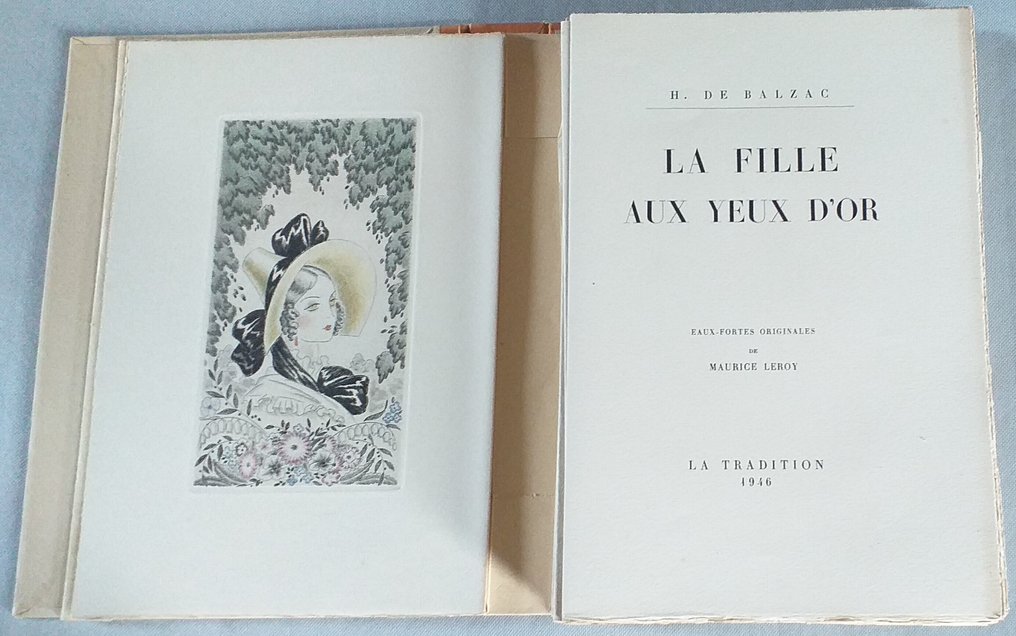
La fille aux yeux d'or by Honoré de Balzac, with original etchings by Claude Leroy, an illustrated limited edition (copy 506/700 on Arches velin) in a red cloth hardback with a case, 181 pages, 29 × 22 cm, in French, published by La Tradition in 1946, in very good condition.
AI-assisted summary
Description from the seller
In 4°, in sheets, in a cardboard case, in fair condition. Frontispiece and numerous etchings (18) in color, outside the text, with Maurice Leroy's serpents.
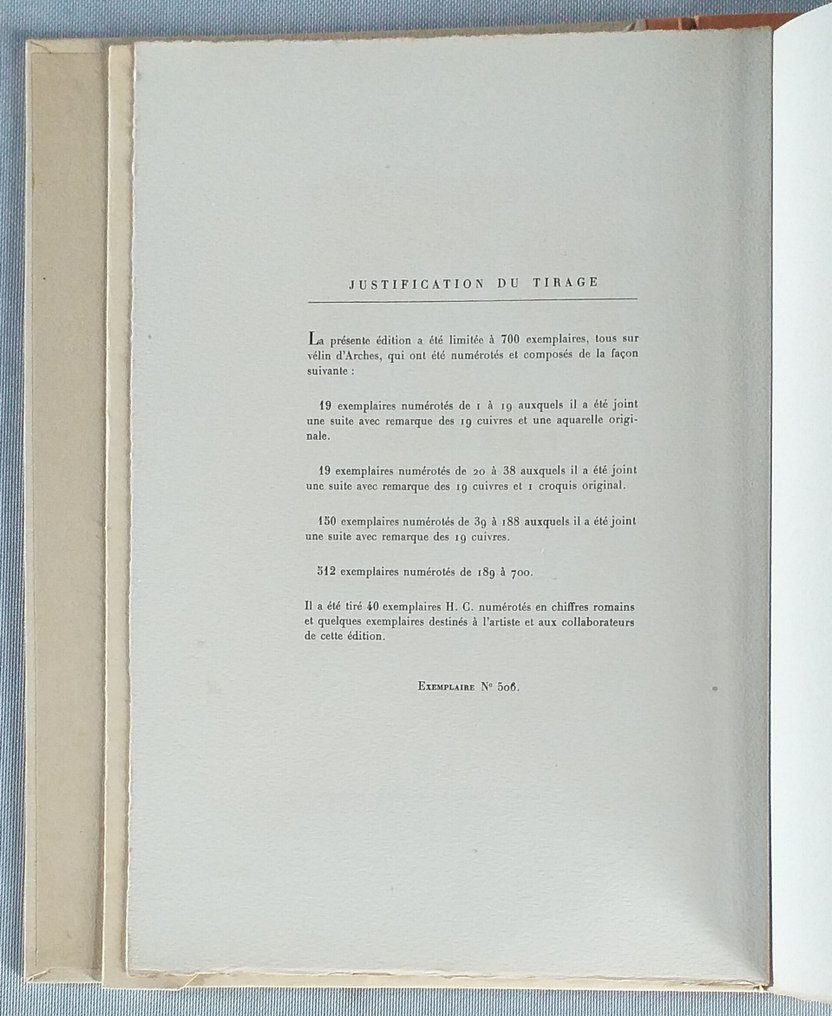
Copy 506/700 on uncut Arches vellum.
The Girl with the Golden Eyes was published in 1835, the third part of the Histoire des Treize, which includes Ferragus, La Duchesse de Langeais, and The Girl with the Golden Eyes. The collection is part of Scenes of Parisian Life, Studies of Manners, of La Comédie humaine.
Balzac shows boldness in depicting a passion between two women.
The novel also explores the theme of cross-dressing when Paquita dresses Henri de Marsay as a woman for her pleasure.
Honoré de Balzac (1799-1850) was a French writer. Novelist, art critic, playwright, literary critic, essayist, journalist, and printer, he left behind one of the most extensive body of novels in French literature, with more than ninety novels and short stories collected under the title of La Comédie humaine. This includes Les Cent Contes drolatiques, as well as youth novels published under pseudonyms and about twenty-five unfinished works.
He is a master of French novels, having explored several genres, from the philosophical novel to the fantastic novel with The Skin of Sorrow or the poetic novel with The Lily in the Valley. He excelled especially in the vein of realism, notably with Father Goriot and Eugénie Grandet.
The author describes the rise of capitalism, the growth of the bourgeoisie facing the nobility, in a complex relationship made of contempt and shared interests. Interested in beings who have a destiny, he creates characters larger than life.
His political opinions are ambiguous: while he displays legitimist convictions during the July Monarchy, he previously declared himself a liberal. He defends workers in 1840 and 1848. While professing conservative ideas, he produced a body of work admired by Marx and Engels, which in some aspects invites anarchism and revolt.
To reduce shipping costs, orders are shipped via Mondial Relay (delivery to a relay point) for: France, Belgium, Germany, Austria, Luxembourg, Italy, Spain, the Netherlands, Portugal, Poland (unless otherwise requested by you and with acceptance of the additional cost).
Other countries via Colissimo (unless requested by you and with acceptance of the additional cost).
In 4°, in sheets, in a cardboard case, in fair condition. Frontispiece and numerous etchings (18) in color, outside the text, with Maurice Leroy's serpents.
Copy 506/700 on uncut Arches vellum.
The Girl with the Golden Eyes was published in 1835, the third part of the Histoire des Treize, which includes Ferragus, La Duchesse de Langeais, and The Girl with the Golden Eyes. The collection is part of Scenes of Parisian Life, Studies of Manners, of La Comédie humaine.
Balzac shows boldness in depicting a passion between two women.
The novel also explores the theme of cross-dressing when Paquita dresses Henri de Marsay as a woman for her pleasure.
Honoré de Balzac (1799-1850) was a French writer. Novelist, art critic, playwright, literary critic, essayist, journalist, and printer, he left behind one of the most extensive body of novels in French literature, with more than ninety novels and short stories collected under the title of La Comédie humaine. This includes Les Cent Contes drolatiques, as well as youth novels published under pseudonyms and about twenty-five unfinished works.
He is a master of French novels, having explored several genres, from the philosophical novel to the fantastic novel with The Skin of Sorrow or the poetic novel with The Lily in the Valley. He excelled especially in the vein of realism, notably with Father Goriot and Eugénie Grandet.
The author describes the rise of capitalism, the growth of the bourgeoisie facing the nobility, in a complex relationship made of contempt and shared interests. Interested in beings who have a destiny, he creates characters larger than life.
His political opinions are ambiguous: while he displays legitimist convictions during the July Monarchy, he previously declared himself a liberal. He defends workers in 1840 and 1848. While professing conservative ideas, he produced a body of work admired by Marx and Engels, which in some aspects invites anarchism and revolt.
To reduce shipping costs, orders are shipped via Mondial Relay (delivery to a relay point) for: France, Belgium, Germany, Austria, Luxembourg, Italy, Spain, the Netherlands, Portugal, Poland (unless otherwise requested by you and with acceptance of the additional cost).
Other countries via Colissimo (unless requested by you and with acceptance of the additional cost).
Details
Number of Books
1
Subject
Illustrated, Literature
Book Title
La fille aux yeux d'or
Author/ Illustrator
Honoré de Balzac. Eaux-fortes originales de Claude Leroy
Condition
Very good
Publication year oldest item
1946
Height
29 cm
Edition
Illustrated Edition, Limited edition, Numbered edition
Width
22 cm
Language
French
Original language
Yes
Publisher
La tradition
Binding/ Material
Hardback
Extras
Slipcase
Number of pages
181
