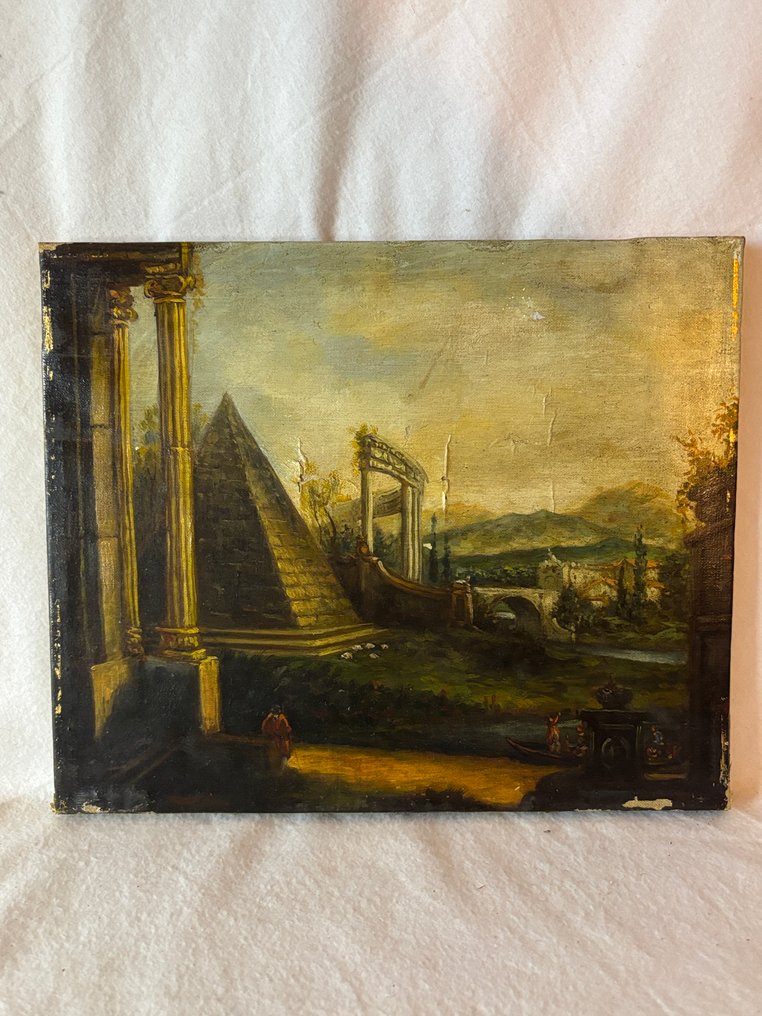
British school (XIX), Attributed to - Capriccio romano con Piramide Cestia e rovine classiche



07
days
11
hours
33
minutes
30
seconds
Starting bid
€ 1
Reserve price not met

Expert
Selected by Caterina Maffeis
Master in early Renaissance Italian painting with internship at Sotheby’s and 15 years' experience.
Estimate € 300 - € 400
No bids placed
Catawiki Buyer Protection
Your payment’s safe with us until you receive your object.View details
Trustpilot 4.4 | 123759 reviews
Rated Excellent on Trustpilot.
Capriccio romano con Piramide Cestia e rovine classiche, oil on canvas attributed to a 19th-century English school, produced in the United Kingdom, 25 by 30 cm, architectural subject.
AI-assisted summary
Description from the seller
This extraordinary canvas represents a refined testament to the Grand Tour, the formative journey undertaken by the British aristocracy and intellectuals across Europe. The work, an oil on canvas from the mid-19th century, is attributed to a master of the English school active in Italy, capable of blending the precision of architectural view with that exquisitely British taste for the picturesque and the sublime.
The painting is conceived as a learned tribute to classicism, interpreted through the nostalgic gaze of a traveler from across the Channel. In a masterful composition, the artist juxtaposes iconic elements of the Roman landscape: the imposing bulk of the Pyramid of Cestius, a symbol of eternity, dialogues with Corinthian columns and ruined arches, transforming reality into a 'Capriccio' of rare elegance.
The palette, characterized by warm brown tones, ochre, and a subdued twilight sky, immediately evokes the atmospheres of William Marlow or the Roman-inspired suggestions of Richard Wilson, the 'English Claude Lorrain'.
The painting technique reveals a peculiar sensitivity in the treatment of light, which envelops the ruins in an aura of romantic decay, typical of British painters who sought to capture the 'ancient' soul of Italy to bring it back to their country houses in the United Kingdom.
The perspective depth is rendered with exceptional mastery, guiding the eye from the dark foreground — where passing figures discreetly animate the scene — toward a hazy horizon of hills and ancient aqueducts, celebrating the myth of the 'Promised Land' of the artists.
Attribution: 19th-century English school (Grand Tour context).
Romantic vedutismo influenced by the tradition of British landscape painting of the 19th century.
The painting shows small dents and loss of color; see the photos carefully. Professional restoration and cleaning are recommended.
The frame is not for sale, used solely for illustrative purposes.
Accurate and tracked shipping
This extraordinary canvas represents a refined testament to the Grand Tour, the formative journey undertaken by the British aristocracy and intellectuals across Europe. The work, an oil on canvas from the mid-19th century, is attributed to a master of the English school active in Italy, capable of blending the precision of architectural view with that exquisitely British taste for the picturesque and the sublime.
The painting is conceived as a learned tribute to classicism, interpreted through the nostalgic gaze of a traveler from across the Channel. In a masterful composition, the artist juxtaposes iconic elements of the Roman landscape: the imposing bulk of the Pyramid of Cestius, a symbol of eternity, dialogues with Corinthian columns and ruined arches, transforming reality into a 'Capriccio' of rare elegance.
The palette, characterized by warm brown tones, ochre, and a subdued twilight sky, immediately evokes the atmospheres of William Marlow or the Roman-inspired suggestions of Richard Wilson, the 'English Claude Lorrain'.
The painting technique reveals a peculiar sensitivity in the treatment of light, which envelops the ruins in an aura of romantic decay, typical of British painters who sought to capture the 'ancient' soul of Italy to bring it back to their country houses in the United Kingdom.
The perspective depth is rendered with exceptional mastery, guiding the eye from the dark foreground — where passing figures discreetly animate the scene — toward a hazy horizon of hills and ancient aqueducts, celebrating the myth of the 'Promised Land' of the artists.
Attribution: 19th-century English school (Grand Tour context).
Romantic vedutismo influenced by the tradition of British landscape painting of the 19th century.
The painting shows small dents and loss of color; see the photos carefully. Professional restoration and cleaning are recommended.
The frame is not for sale, used solely for illustrative purposes.
Accurate and tracked shipping
Details
Artist
British school (XIX)
Sold with frame
No
Attribution
Attributed to
Title of artwork
Capriccio romano con Piramide Cestia e rovine classiche
Technique
Oil painting
Signature
Not signed
Country of Origin
United Kingdom
Year
1880
Condition
Good condition
Height
25 cm
Width
30 cm
Depiction/Theme
Architecture
Style
Romanticism
Period
19th century
Sold by
