Conrad Leemans - Romeinsche oudheden te Rossem. (Platen). - 1842


01
day
18
hours
46
minutes
52
seconds
Current bid
€ 47
No reserve price

Expert
Selected by Volker Riepenhausen
Specialist in travel literature and pre-1600 rare prints with 28 years experience.
Estimate € 150 - € 200
13 other people are watching this object
 Bidder 2959 Bidder 2959 | €47 | |
|---|---|---|
 Bidder 6224 Bidder 6224 | €40 | |
| Bidder 2959 | €35 | |
Catawiki Buyer Protection
Your payment’s safe with us until you receive your object.View details
Trustpilot 4.4 | 123878 reviews
Rated Excellent on Trustpilot.
Conrad Leemans is the author/illustrator of Romeinsche oudheden te Rossem. (Platen), a Dutch illustrated first‑edition from 1842 published by Leyden, H.W. Hazenberg & comp., bound in half leather, with 20 pages and fold‑out plates.
AI-assisted summary
Description from the seller
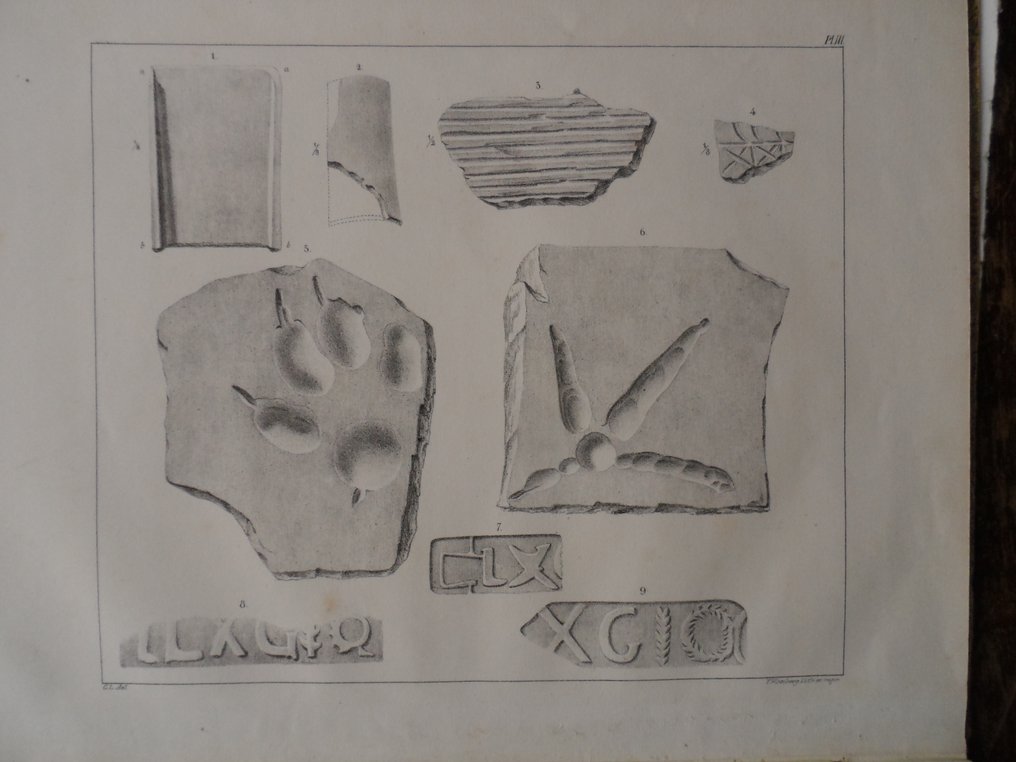
Conrad Leemans: Roman antiquities in Rossem. (Plates). ... Leyden, H.W. Hazenberg & co. 1842. Large 4to: (2) pages and XVIII numbered plates, of which the first is a large fold-out partly hand-colored. All plates have been photogravured. Plate 1 has some brown spots. Original half leather binding. Spine damaged at the bottom. A piece missing. Edges and corners somewhat worn. Binding in good condition.
Conradus (Conrad) Leemans (Zaltbommel, April 24, 1809 – Leiden, October 14, 1893) was a Dutch Egyptologist and director of the Rijksmuseum van Oudheden in Leiden.
Painted scene of the Evening Battle in Boutersem on August 11, 1831, with the wounded student Conrad Leemans in the foreground on the left.
Leemans studied theology at Leiden University. During his student years, in 1831, he participated as a volunteer in the Ten Days Campaign with the Volunteer Hunters of the Leiden University. He was injured on August 11 during the evening fight at Boutersem.
After a meeting with Caspar Reuvens, Leemans shifted his studies towards archaeology. From 1834, he worked at the National Museum of Antiquities, where he served as director from 1839 to 1891. Leemans organized the first public exhibition of the collections acquired by Reuvens, compiled a catalog of Egyptian objects (the Catalogue Raisonnée, 1840), and edited the serial publication of the Monumens Égyptiens, a lithographic catalog of the Egyptian collection. As museum director, Leemans studied Leiden papyri and completed the work begun by Reuvens.
Leemans was appointed as a member of the Royal Institute in 1840, the predecessor of the Royal Netherlands Academy of Arts and Sciences.
Leemans was a descendant of the Leemans family, which is listed in the Dutch Patriciaat, and a son of Dr. Wilhelmus Leemans (1774-1848), a physician, and Hillegonda Rachel Ganderheyden (1785-1858). In 1840, he married Cornelia Maria de Virieu (1818-1904), a daughter of landscape architect François Willem de Virieu (1789-1876), with whom he had a son and a daughter, including ir. Wilhelmus François Leemans (1841-1929).
Leemans was distinguished as a commander in the Order of the Dutch Lion. A bronze bust of Leemans is part of the tomb monument of Auguste Mariette in the front garden of the Egyptian Museum (Cairo).
Conrad Leemans: Roman antiquities in Rossem. (Plates). ... Leyden, H.W. Hazenberg & co. 1842. Large 4to: (2) pages and XVIII numbered plates, of which the first is a large fold-out partly hand-colored. All plates have been photogravured. Plate 1 has some brown spots. Original half leather binding. Spine damaged at the bottom. A piece missing. Edges and corners somewhat worn. Binding in good condition.
Conradus (Conrad) Leemans (Zaltbommel, April 24, 1809 – Leiden, October 14, 1893) was a Dutch Egyptologist and director of the Rijksmuseum van Oudheden in Leiden.
Painted scene of the Evening Battle in Boutersem on August 11, 1831, with the wounded student Conrad Leemans in the foreground on the left.
Leemans studied theology at Leiden University. During his student years, in 1831, he participated as a volunteer in the Ten Days Campaign with the Volunteer Hunters of the Leiden University. He was injured on August 11 during the evening fight at Boutersem.
After a meeting with Caspar Reuvens, Leemans shifted his studies towards archaeology. From 1834, he worked at the National Museum of Antiquities, where he served as director from 1839 to 1891. Leemans organized the first public exhibition of the collections acquired by Reuvens, compiled a catalog of Egyptian objects (the Catalogue Raisonnée, 1840), and edited the serial publication of the Monumens Égyptiens, a lithographic catalog of the Egyptian collection. As museum director, Leemans studied Leiden papyri and completed the work begun by Reuvens.
Leemans was appointed as a member of the Royal Institute in 1840, the predecessor of the Royal Netherlands Academy of Arts and Sciences.
Leemans was a descendant of the Leemans family, which is listed in the Dutch Patriciaat, and a son of Dr. Wilhelmus Leemans (1774-1848), a physician, and Hillegonda Rachel Ganderheyden (1785-1858). In 1840, he married Cornelia Maria de Virieu (1818-1904), a daughter of landscape architect François Willem de Virieu (1789-1876), with whom he had a son and a daughter, including ir. Wilhelmus François Leemans (1841-1929).
Leemans was distinguished as a commander in the Order of the Dutch Lion. A bronze bust of Leemans is part of the tomb monument of Auguste Mariette in the front garden of the Egyptian Museum (Cairo).
Details
Number of Books
1
Subject
Geography, History, Illustrated
Book Title
Romeinsche oudheden te Rossem. (Platen).
Author/ Illustrator
Conrad Leemans
Condition
Fair
Publication year oldest item
1842
Height
31.8 cm
Edition
1st Edition
Width
24.5 cm
Language
Dutch
Original language
Yes
Publisher
Leyden, H.W. Hazenberg & comp. 1842.
Binding/ Material
Half leather
Extras
Fold out maps or plates
Number of pages
20
Sold by
