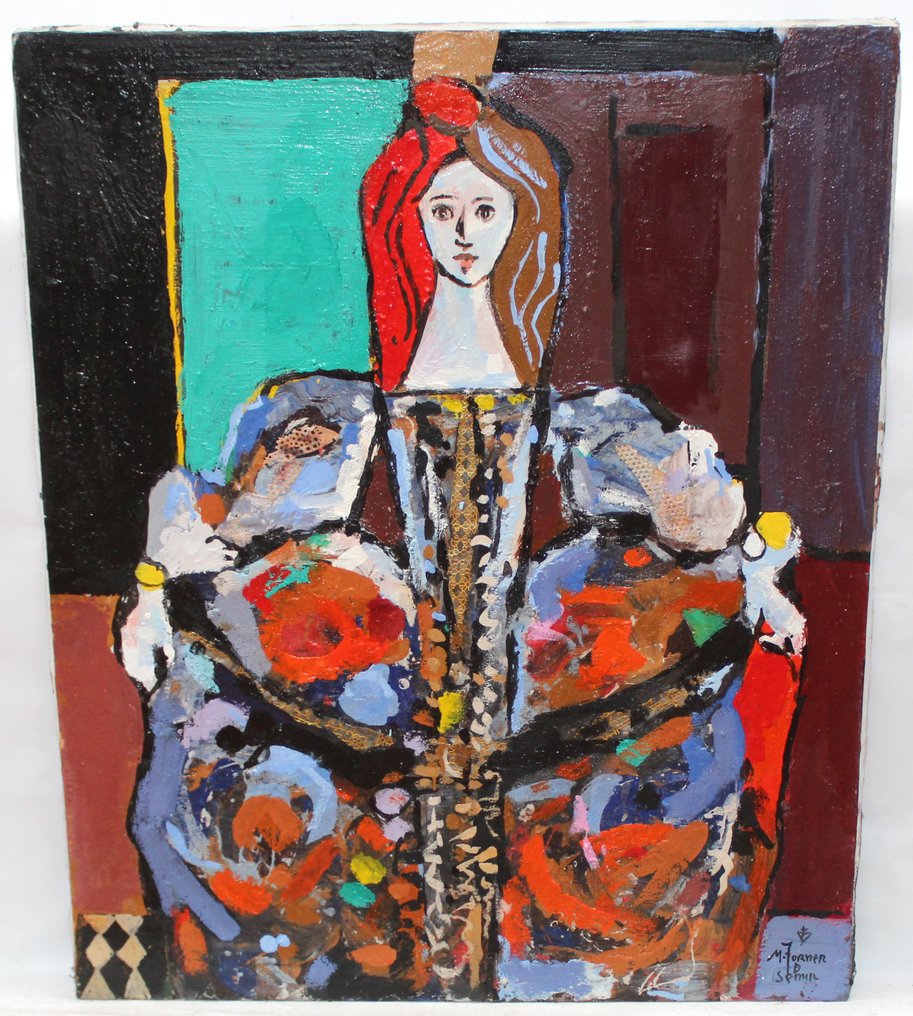
Miquel Torner de Semir (1938) - Interior con menina



05
days
09
hours
18
minutes
42
seconds
Starting bid
€ 1
Reserve price not met

Expert
Selected by Silvia Possanza
Held senior specialist role at Finarte for 12 years, specialising in modern prints.
Estimate € 1,000 - € 1,200
No bids placed
Catawiki Buyer Protection
Your payment’s safe with us until you receive your object.View details
Trustpilot 4.4 | 123536 reviews
Rated Excellent on Trustpilot.
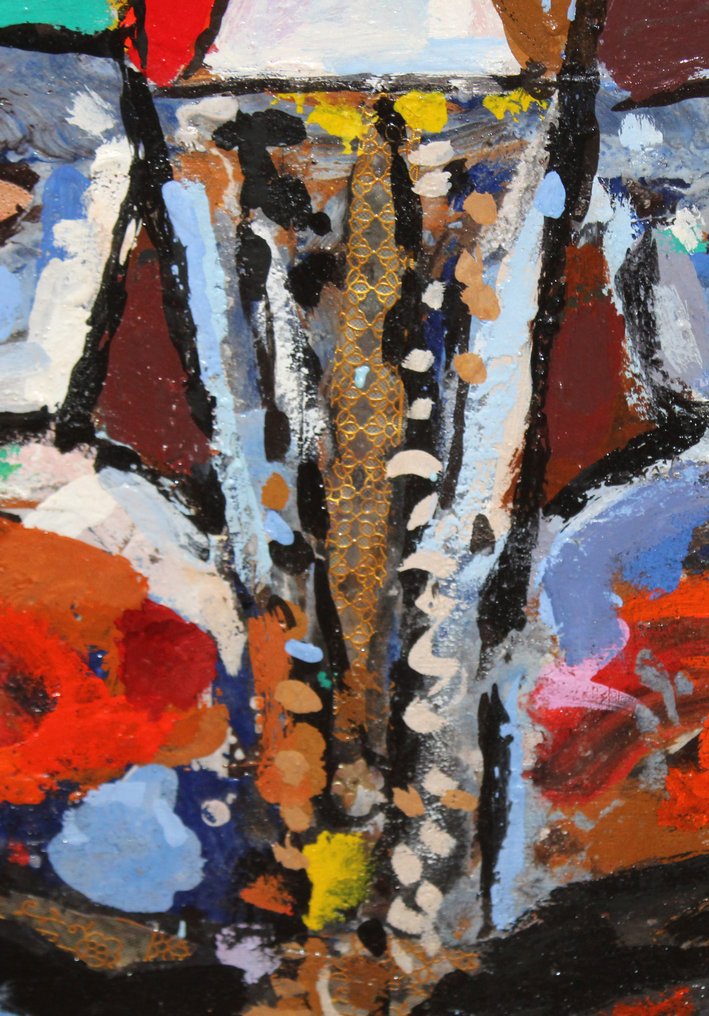
Original acrylic painting Interior con menina by Miquel Torner de Semir (1938), a 100 cm high by 81 cm wide work signed by hand, dating from 1990–2000, in good condition and unframed, produced in Spain and sold by Galería.
AI-assisted summary
Description from the seller
Signed by the artist at the bottom.
The work is presented without a frame.
Work dimensions: 100 cm. in height x 81 cm. in width
Good condition
:::::::::::::::::::::::::::::::::::::
Biography of Miquel Torner de Semir.
Miquel Torner de Semir was born in 1938, in the last century, at Santa Pau Castle in Garrotxa (Girona), being the last living person born in this emblematic building surrounded by volcanoes (he currently lives in San Feliu de Guíxols). This fact marks his facet as a painter. A man of old Catalonia, cultured, he has always been attracted to the Middle Ages, the Romanesque of the Pyrenees, and primitive Gothic art. The influence of Italian Renaissance art, especially painters of the Quattrocento such as Fra Angelico or Raphael, can be felt in many of Torner de Semir’s female portraits, including the one at hand. It is precisely this blend of the old and the new that lies at the heart of his originality. What seems to have shaped him most is his knowledge of Romanesque and Gothic art. His figures, often outlined with a thick dark line, evoke Gothic stained glass windows—luminescent, beautiful in themselves and for themselves. A disciple of mural painter and engraver Ricard Marlet, he learned what he considers most important: the discipline of drawing. Through master Marlet, he became familiar with Modernism and Catalan Noucentisme. He studied at the School of Fine Arts in Sant Jordi, Barcelona, and at the San Fernando School in Madrid, where he visited the Prado Museum and immersed himself in Velázquez’s paintings, choosing to reproduce Las Meninas in his own style, with vivid colors like pink and phosphorescent violet, leaving no doubt about the artist’s emphasis on prominence, modernity, and friendliness. Additionally, if one observes carefully, one can notice the artist’s use of collage techniques, incorporating pieces of fabric, cardboard, or even sheet music.
In Paris, he begins his work as he calls it, 'between the old and the new.' He started holding solo exhibitions in Terrassa in 1968, later doing so in other Catalan cities and in Paris (Espace and Boutique galleries). His work began with Mediterranean figurativism, then evolved into abstraction, before returning to a modern concept of figuration. He is ultimately considered one of the most important representatives of Mediterranean painting.
All these trends were not unfamiliar to him, as he had the opportunity to meet the Dau al Set group in Barcelona. At the Dau al Set school, he encountered renowned artists such as Tharrats, Muxart, and Tapies. His painting is characterized by the use of vivid and rich colors. His work can be defined in a single word: LIFE. Therefore, the magnificent work of this Catalan painter is characterized by its rich and textured coloring of great vivacity, which, combined with the various materials he uses as support, results in an expressionist painting of high chromatic quality and pronounced personality, establishing the artist as a master.
The classic and the new merge within the brushstrokes of Miquel Torner de Semir. Time dissolves, fades away. The dividing line between past and present is erased with his paintings, with his way of tracing on the canvas. Miquel achieves what very few before him have: speaking of the past with the voice of the present. His voice: his paintings. His method: passion. His achievement: his entire body of work.
The Gerundese painter is influenced by the ancients, Giotto, the Italian Renaissance, and the informal exploration of abstract painters. All of this is the starting point of his painting; he cares about the craft as much or more than the concept. He has tried to be a bridge painter between the past and the present, but also open to everything new, to constant search. An interesting contrast in Miquel's work is how he presents people, places, and situations from ancient times, depicted with modern painting techniques. This distinguished Catalan painter has been able to break with the rules of time. Miquel Torner de Semir is so direct in defining lines and shapes that it is sometimes incredible that the work is on a two-dimensional canvas, seeming at first glance that the painting is more like a sum of textures from a three-dimensional world.
Some of his works have a notable faubist accent, with an intense and expressive chromatic palette, contrasting with the serenity and vacant gaze of the faces that invite the viewer to delve into the environment of the artwork and the artist's thoughts. However, Torner de Semir has a personal style based on simplicity of execution within a very well-structured composition. The female figures have the calm forms of religious art and express the serenity of the spirit. The figure serves Semir to claim the order and rhythm of human actions.
According to Joan Lluís Montañé, a Barcelonan and member of the International Association of Art Critics, the renowned Catalan painter Torner de Semir, in his extensive pictorial work, 'is interested in composition and color,' generating especially elaborate creations where the imprint of determination and a contrasted color palette are evident. He exhibits figures, landscapes, and compositions that clearly demonstrate an exercise in pictorial academicism, in which he does not renounce a certain formal and technical innovation, all within an unmistakable personal artistic signature.
The art critic, Josep M. Cadena, says of Semir: 'The painter marks the silhouettes of the main elements of each composition with strong and precise lines and uses basic, pure colors to express feelings. When possible, he creates the painting within the painting, and even tries to include interpretations and abstract signs in his backgrounds. This achieves a positive relationship between the various forms of artistic expression that motivate him, and his visual language is much richer and more attractive. He has a unique style based on simplicity within a very well-structured composition. His female figures have calm forms reminiscent of religious art and express the serenity that should govern spiritual realizations. The figure serves to demand order and rhythm in human actions; his painting is ethical. He easily communicates positive sensations to those who know his work.'
For J.Llop S.: "The drawing, the fundamental stroke, strong, precise, incisive, establishes the form, delineates spaces in the thoughtful compositions that Torner de Semir presents to us. And then comes the seeing differently, the imaginative, the dreams that connect with the reality he describes and adorns with a chromaticism that combines basic colors and soft tones. It is a personal style that reveals the other reality of the landscape, of the figure. An interesting and captivating work that captures the viewer and guides them along the path of imagination."
Consistent with his vision of the primitives, he has not paid much attention to his social projection towards his teachers, who were sometimes unnamed, and although his works are in many countries, he has exhibited in Europe, America, and Japan. It is difficult to make an exhaustive compilation of his curriculum. Currently, he exhibits permanently at La Galería Arcadia in Madrid.
In 2003, he was chosen by the Museo de la Real Casa de la Moneda to have one of his works issued as a postage stamp and to participate in the exhibition celebrating the 25th anniversary of the Spanish Constitution. Meanwhile, the Museo de la Real Casa de la Moneda in Madrid has organized an exhibition of his works.
Torner's works have been exhibited in numerous European and Spanish cities such as: Paris, Brussels, Frankfurt, Heidelberg, Strasbourg, Saint Paul de Vence, Dijon, Clermont-Ferrand, Barcelona, Girona, Valencia, Seville, Pontevedra, Oviedo, etc. Let us now look at some of the most important exhibitions of the Catalan artist:
Most significant exhibitions
Friends of the Arts. Terrassa - Barcelona.
Pinacoteca. Sabadell - Barcelona.
Society of Independent Artists. Paris.
Grand Palais. Paris.
Dan Art, Béiziers, France
Galerie Espace. Paris - Beaubourg.
Lions Club. Chartres Doyen - France.
Honorary guest at the exhibition of the Cercle Espanyol. Dreux - France.
Auto Show in Clermont Ferrand - France.
Grand Prix of the Woman and the Imaginative Jeanne Gatineau. Paris.
Sala Gavina. Palamós - Girona.
Sala Clará, Olot-Barcelona.
Francolí-Barcelona Cultural Space
Gallery Boutique. Paris, France.
The Gallery of the Hotel Meridien. Paris.
L'Atelier. Platja d'Aro. Girona.
Exhibition rooms of the mineral spring Eptigen, Switzerland.
Arcadia Gallery - Madrid
Star Art Gallery. Collective. Madrid.
Gallery 4 Cantons. Olot. Girona.
Catalonia-Barcelona Gallery
Art Gallery 16. Olot, Girona.
Pedreguet Art, a contemporary space. Girona.
Da Vinci Art Gallery. Girona.
Ducs de Dijon Gallery, France.
Gallery Campo or Campo. Belgium.
Galería B.C.S. Strasbourg, France.
House Arnold. Frankfurt am Main. Germany.
Haus Berlinghoff, Heidelberg, Germany.
Naumilenium. Barcelona.
Last century art. Barcelona.
Real Club Naútico de Sanxenxo. Pontevedra.
Picassomio.com Madrid
Christian Dazy Art Galleries. Dijon-Megève-France.
Commemorative Exhibition of the 25th Anniversary of the Spanish Constitution. Madrid.
Sala Constanti Art, Reus. Christmas Collective, 2009 - Tarragona.
#parisapartment
Signed by the artist at the bottom.
The work is presented without a frame.
Work dimensions: 100 cm. in height x 81 cm. in width
Good condition
:::::::::::::::::::::::::::::::::::::
Biography of Miquel Torner de Semir.
Miquel Torner de Semir was born in 1938, in the last century, at Santa Pau Castle in Garrotxa (Girona), being the last living person born in this emblematic building surrounded by volcanoes (he currently lives in San Feliu de Guíxols). This fact marks his facet as a painter. A man of old Catalonia, cultured, he has always been attracted to the Middle Ages, the Romanesque of the Pyrenees, and primitive Gothic art. The influence of Italian Renaissance art, especially painters of the Quattrocento such as Fra Angelico or Raphael, can be felt in many of Torner de Semir’s female portraits, including the one at hand. It is precisely this blend of the old and the new that lies at the heart of his originality. What seems to have shaped him most is his knowledge of Romanesque and Gothic art. His figures, often outlined with a thick dark line, evoke Gothic stained glass windows—luminescent, beautiful in themselves and for themselves. A disciple of mural painter and engraver Ricard Marlet, he learned what he considers most important: the discipline of drawing. Through master Marlet, he became familiar with Modernism and Catalan Noucentisme. He studied at the School of Fine Arts in Sant Jordi, Barcelona, and at the San Fernando School in Madrid, where he visited the Prado Museum and immersed himself in Velázquez’s paintings, choosing to reproduce Las Meninas in his own style, with vivid colors like pink and phosphorescent violet, leaving no doubt about the artist’s emphasis on prominence, modernity, and friendliness. Additionally, if one observes carefully, one can notice the artist’s use of collage techniques, incorporating pieces of fabric, cardboard, or even sheet music.
In Paris, he begins his work as he calls it, 'between the old and the new.' He started holding solo exhibitions in Terrassa in 1968, later doing so in other Catalan cities and in Paris (Espace and Boutique galleries). His work began with Mediterranean figurativism, then evolved into abstraction, before returning to a modern concept of figuration. He is ultimately considered one of the most important representatives of Mediterranean painting.
All these trends were not unfamiliar to him, as he had the opportunity to meet the Dau al Set group in Barcelona. At the Dau al Set school, he encountered renowned artists such as Tharrats, Muxart, and Tapies. His painting is characterized by the use of vivid and rich colors. His work can be defined in a single word: LIFE. Therefore, the magnificent work of this Catalan painter is characterized by its rich and textured coloring of great vivacity, which, combined with the various materials he uses as support, results in an expressionist painting of high chromatic quality and pronounced personality, establishing the artist as a master.
The classic and the new merge within the brushstrokes of Miquel Torner de Semir. Time dissolves, fades away. The dividing line between past and present is erased with his paintings, with his way of tracing on the canvas. Miquel achieves what very few before him have: speaking of the past with the voice of the present. His voice: his paintings. His method: passion. His achievement: his entire body of work.
The Gerundese painter is influenced by the ancients, Giotto, the Italian Renaissance, and the informal exploration of abstract painters. All of this is the starting point of his painting; he cares about the craft as much or more than the concept. He has tried to be a bridge painter between the past and the present, but also open to everything new, to constant search. An interesting contrast in Miquel's work is how he presents people, places, and situations from ancient times, depicted with modern painting techniques. This distinguished Catalan painter has been able to break with the rules of time. Miquel Torner de Semir is so direct in defining lines and shapes that it is sometimes incredible that the work is on a two-dimensional canvas, seeming at first glance that the painting is more like a sum of textures from a three-dimensional world.
Some of his works have a notable faubist accent, with an intense and expressive chromatic palette, contrasting with the serenity and vacant gaze of the faces that invite the viewer to delve into the environment of the artwork and the artist's thoughts. However, Torner de Semir has a personal style based on simplicity of execution within a very well-structured composition. The female figures have the calm forms of religious art and express the serenity of the spirit. The figure serves Semir to claim the order and rhythm of human actions.
According to Joan Lluís Montañé, a Barcelonan and member of the International Association of Art Critics, the renowned Catalan painter Torner de Semir, in his extensive pictorial work, 'is interested in composition and color,' generating especially elaborate creations where the imprint of determination and a contrasted color palette are evident. He exhibits figures, landscapes, and compositions that clearly demonstrate an exercise in pictorial academicism, in which he does not renounce a certain formal and technical innovation, all within an unmistakable personal artistic signature.
The art critic, Josep M. Cadena, says of Semir: 'The painter marks the silhouettes of the main elements of each composition with strong and precise lines and uses basic, pure colors to express feelings. When possible, he creates the painting within the painting, and even tries to include interpretations and abstract signs in his backgrounds. This achieves a positive relationship between the various forms of artistic expression that motivate him, and his visual language is much richer and more attractive. He has a unique style based on simplicity within a very well-structured composition. His female figures have calm forms reminiscent of religious art and express the serenity that should govern spiritual realizations. The figure serves to demand order and rhythm in human actions; his painting is ethical. He easily communicates positive sensations to those who know his work.'
For J.Llop S.: "The drawing, the fundamental stroke, strong, precise, incisive, establishes the form, delineates spaces in the thoughtful compositions that Torner de Semir presents to us. And then comes the seeing differently, the imaginative, the dreams that connect with the reality he describes and adorns with a chromaticism that combines basic colors and soft tones. It is a personal style that reveals the other reality of the landscape, of the figure. An interesting and captivating work that captures the viewer and guides them along the path of imagination."
Consistent with his vision of the primitives, he has not paid much attention to his social projection towards his teachers, who were sometimes unnamed, and although his works are in many countries, he has exhibited in Europe, America, and Japan. It is difficult to make an exhaustive compilation of his curriculum. Currently, he exhibits permanently at La Galería Arcadia in Madrid.
In 2003, he was chosen by the Museo de la Real Casa de la Moneda to have one of his works issued as a postage stamp and to participate in the exhibition celebrating the 25th anniversary of the Spanish Constitution. Meanwhile, the Museo de la Real Casa de la Moneda in Madrid has organized an exhibition of his works.
Torner's works have been exhibited in numerous European and Spanish cities such as: Paris, Brussels, Frankfurt, Heidelberg, Strasbourg, Saint Paul de Vence, Dijon, Clermont-Ferrand, Barcelona, Girona, Valencia, Seville, Pontevedra, Oviedo, etc. Let us now look at some of the most important exhibitions of the Catalan artist:
Most significant exhibitions
Friends of the Arts. Terrassa - Barcelona.
Pinacoteca. Sabadell - Barcelona.
Society of Independent Artists. Paris.
Grand Palais. Paris.
Dan Art, Béiziers, France
Galerie Espace. Paris - Beaubourg.
Lions Club. Chartres Doyen - France.
Honorary guest at the exhibition of the Cercle Espanyol. Dreux - France.
Auto Show in Clermont Ferrand - France.
Grand Prix of the Woman and the Imaginative Jeanne Gatineau. Paris.
Sala Gavina. Palamós - Girona.
Sala Clará, Olot-Barcelona.
Francolí-Barcelona Cultural Space
Gallery Boutique. Paris, France.
The Gallery of the Hotel Meridien. Paris.
L'Atelier. Platja d'Aro. Girona.
Exhibition rooms of the mineral spring Eptigen, Switzerland.
Arcadia Gallery - Madrid
Star Art Gallery. Collective. Madrid.
Gallery 4 Cantons. Olot. Girona.
Catalonia-Barcelona Gallery
Art Gallery 16. Olot, Girona.
Pedreguet Art, a contemporary space. Girona.
Da Vinci Art Gallery. Girona.
Ducs de Dijon Gallery, France.
Gallery Campo or Campo. Belgium.
Galería B.C.S. Strasbourg, France.
House Arnold. Frankfurt am Main. Germany.
Haus Berlinghoff, Heidelberg, Germany.
Naumilenium. Barcelona.
Last century art. Barcelona.
Real Club Naútico de Sanxenxo. Pontevedra.
Picassomio.com Madrid
Christian Dazy Art Galleries. Dijon-Megève-France.
Commemorative Exhibition of the 25th Anniversary of the Spanish Constitution. Madrid.
Sala Constanti Art, Reus. Christmas Collective, 2009 - Tarragona.
#parisapartment
Details
Artist
Miquel Torner de Semir (1938)
Sold with frame
No
Sold by
Gallery
Edition
Original
Title of artwork
Interior con menina
Technique
Acrylic painting
Signature
Hand signed
Country of Origin
Spain
Condition
Good condition
Height
100 cm
Width
81 cm
Period
1990-2000
Sold by
