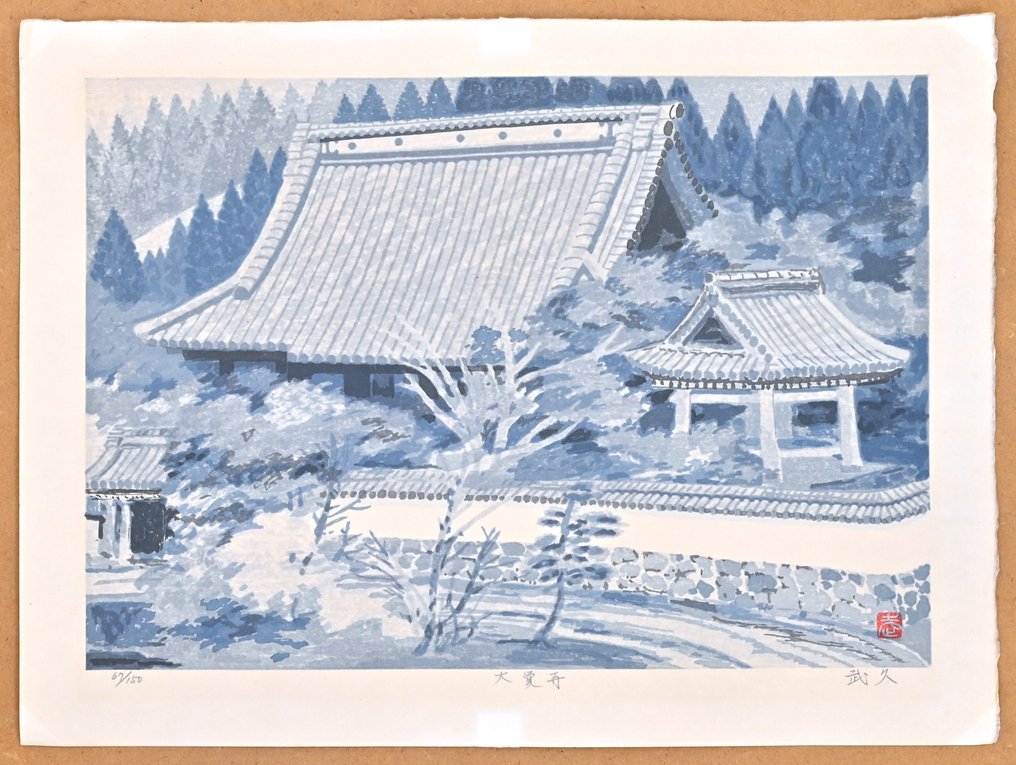
Daikaku-ji Temple 大覚寺 - Limited Edition 67/150 & Hand-Signed - Takehisa Imai 今井武久 (b. 1940) - Japan



01
day
04
hours
37
minutes
31
seconds

16 other people are watching this object
 Bidder 0446 Bidder 0446 | €29 | |
|---|---|---|
 Bidder 0695 Bidder 0695 | €20 | |
 Bidder 8198 Bidder 8198 | €15 | |
Catawiki Buyer Protection
Your payment’s safe with us until you receive your object.View details
Trustpilot 4.4 | 123951 reviews
Rated Excellent on Trustpilot.
Limited edition 67/150 hand-signed print by Takehisa Imai (b. 1940) titled Daikaku-ji Temple, 34 × 47 cm, produced 1980–1990, origin Japan, sold by owner or reseller, in good condition and framed.
AI-assisted summary
Description from the seller
We cannot ship to the USA due to suspension of the postal services from Malta. (Please read below).
Daikaku-ji (大覚寺, Daikaku-ji) is a Shingon Buddhist temple in Ukyō-ku, a western ward in the city of Kyoto, Japan. The site was originally a residence of Emperor Saga (785–842 CE), and later various emperors conducted their cloistered rule from here. The Saga Go-ryū school of ikebana has its headquarters in the temple. The artificial lake of the temple, Ōsawa Pond, is one of the oldest Japanese garden ponds to survive from the Heian period.
The origins of the temple dates back to the Heian period in the year 814 CE, when Emperor Saga had a palace, known as the Saga-in, constructed on the site. The palace later became his seat of retirement, known as Saga Rikyu imperial villa. According to tradition, when Japan suffered a serious epidemic, the Buddhist monk Kobo Daishi, the founder of Shingon Buddhism, suggested that the Emperor Saga personally copy an important Buddhist religious document called the Heart Sutra (Hannya Shingyō). The emperor made a handwritten copy, and the epidemic is said to have ended. The handwritten sutra is kept at the Shingyōden hall of the temple, and is displayed to the public once every sixty years, the next time being in 2078. Pilgrims still come to the temple to make copies of the sutra, which are kept in the temple with the original. (source: Wikipedia)
Although Takehisa Imai is a sought after hanga artist, and many serious collectors have his prints in their collection, very little is known about him. All I could find is that Mr. Imai was born in Nagoya city, Aichi prefecture, and is a member of Nihon Bijutsuin.
This specific print has been framed. It show very slight sunburn, and has tape on the back. The print itself is in excellent condition.
Due to the large size of the print, it will be shipped registered in a tube. This allows for drastically reduced shipping costs.
Due to the introduction of the import tariff system in 2025, Maltapost has suspended all postal services to the USA until further notice. If you live in the USA, you will need to give an alternative address outside of the USA for shipments. Otherwise, please refrain from bidding.
We cannot ship to the USA due to suspension of the postal services from Malta. (Please read below).
Daikaku-ji (大覚寺, Daikaku-ji) is a Shingon Buddhist temple in Ukyō-ku, a western ward in the city of Kyoto, Japan. The site was originally a residence of Emperor Saga (785–842 CE), and later various emperors conducted their cloistered rule from here. The Saga Go-ryū school of ikebana has its headquarters in the temple. The artificial lake of the temple, Ōsawa Pond, is one of the oldest Japanese garden ponds to survive from the Heian period.
The origins of the temple dates back to the Heian period in the year 814 CE, when Emperor Saga had a palace, known as the Saga-in, constructed on the site. The palace later became his seat of retirement, known as Saga Rikyu imperial villa. According to tradition, when Japan suffered a serious epidemic, the Buddhist monk Kobo Daishi, the founder of Shingon Buddhism, suggested that the Emperor Saga personally copy an important Buddhist religious document called the Heart Sutra (Hannya Shingyō). The emperor made a handwritten copy, and the epidemic is said to have ended. The handwritten sutra is kept at the Shingyōden hall of the temple, and is displayed to the public once every sixty years, the next time being in 2078. Pilgrims still come to the temple to make copies of the sutra, which are kept in the temple with the original. (source: Wikipedia)
Although Takehisa Imai is a sought after hanga artist, and many serious collectors have his prints in their collection, very little is known about him. All I could find is that Mr. Imai was born in Nagoya city, Aichi prefecture, and is a member of Nihon Bijutsuin.
This specific print has been framed. It show very slight sunburn, and has tape on the back. The print itself is in excellent condition.
Due to the large size of the print, it will be shipped registered in a tube. This allows for drastically reduced shipping costs.
Due to the introduction of the import tariff system in 2025, Maltapost has suspended all postal services to the USA until further notice. If you live in the USA, you will need to give an alternative address outside of the USA for shipments. Otherwise, please refrain from bidding.
Details
Artist
Takehisa Imai 今井武久 (b. 1940)
Sold by
Owner or reseller
Edition
Limited edition
Edition number
67/150
Title of artwork
Daikaku-ji Temple 大覚寺 - Limited Edition 67/150 & Hand-Signed
Signature
Hand signed
Country of Origin
Japan
Condition
Good condition
Height
34 cm
Width
47 cm
Period
1980-1990
