Ismaël Boulliau - Astronomia Philolaica - 1645


16
days
00
hours
35
minutes
57
seconds
Current bid
€ 777
Reserve price not met

Expert
Selected by Volker Riepenhausen
Specialist in travel literature and pre-1600 rare prints with 28 years experience.
Estimate € 9,400 - € 14,000
9 other people are watching this object
 Bidder 7436 Bidder 7436 | €777 |
|---|
Catawiki Buyer Protection
Your payment’s safe with us until you receive your object.View details
Trustpilot 4.4 | 123536 reviews
Rated Excellent on Trustpilot.
Astronomia philolaica by Ismaël Boulliau is the first edition (1645) in Latin, a large folio bound in half leather, 745 pages with fold-out plates, published by Sumptibus Simeonis Piget, and is a pivotal astronomical work bridging Kepler and Newton with explicit inverse-square discussions.
AI-assisted summary
Description from the seller
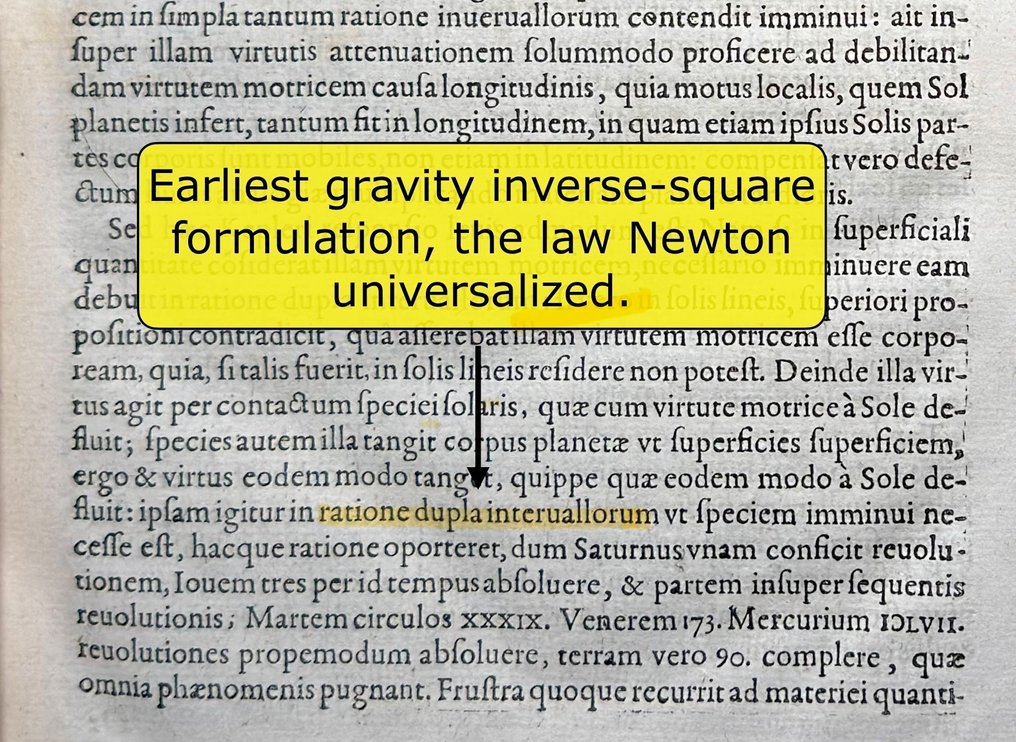
The most significant treatise between Kepler and Newton, Astronomia philolaica contains the earliest claim that planetary force varies with the inverse square of distance, the very law Newton would elevate to universal gravitation.
MOUSEION CURATOR NOTE:
“Not merely a treatise but the keystone: the earliest explicit inverse-square statement and the decisive bridge from Kepler to Newton—the book that made the heavens computable.
In this 1645 folio Boulliau first sets the Sun’s force to fall in the “duplicate ratio” (inverse square) and turns Kepler’s ellipses into working tables—the foundation on which Newton could build.
This first edition, with exceptional provenance and in excellent condition, embodies that pivotal moment.”
THE VOLUME:
Ismaël Boulliau (Bullialdus), Astronomia philolaica. (Paris: Sumptibus Simeonis Piget, 1645). First edition. 2 parts in 1 large folio.
Extent & size: prelims [22], 469, 232 pages COMPLETE. 36.2 × 23.5 cm.
Illustration & features: numerous woodcut diagrams; one folding typographical table; twelve divisional half-titles (Books I–XII); terminal blank Ggg4 present; the typographical tables include folded half-sheets at the classic openings.
Binding: contemporary sponge-decorated sheepskin (basane mouchetée) over boards, gilt-tooled spine.
DESCRIPTION:
First edition, a pivotal, exceptionally scarce masterwork of early modern astronomy. Astronomia philolaica is Boulliau’s masterwork and the canonical mid-century bridge between Kepler and Newton. Boulliau accepts elliptical orbits, rejects Kepler’s animating physics, and reconstructs planetary motion via a geometrical “conical hypothesis,” concluding with a full suite of Tabulae Philolaicae for practical computation. The edition’s architecture—twelve half-titles for navigability, woodcut diagrams, and a large folding typographical table—marks it as both treatise and instrument.
AUTHORITATIVE TESTIMONIA:
NEWTON, Principia III: “for the dimensions of the orbits, Kepler and Bullialdus, above all others, have determined them… with the greatest accuracy.”
NEWTON to Halley (1686): “Bullialdus wrote that all force… must be reciprocally in a duplicate ratio of the distance.”
MacTutor (Univ. St Andrews): Boulliau “proposed an inverse square law for gravitation before Newton.”
Boulliau’s famous phrasing—in duplicata ratione distantiarum—locates the Sun’s “motive virtue” in the inverse-square proportion, an antecedent that Newton later formalized as universal gravitation.
The presence of Tycho’s star catalogue and a synopsis of ‘Persian’ tables within the 1645 folio underscores Boulliau’s role as a broker of data and methods across classical, Islamicate, and early-modern European traditions.
BOOK’S PROVENANCE:
Groenendael Priory (Viridis Vallis), near Brussels — title with early institutional inscription “Bibliothecae Viridis Vallis”; ownership “F. Joannes Josephus Vanden Eede, Canonicus Regularis… et Pastor in Huldenbergh.” An Augustinian house with a documented learned library, placing Boulliau’s folio in a monastic scholarly milieu within decades of publication.
Professor Owen Gingerich (1930–2023) — Harvard astronomer and historian of astronomy (Copernicus/Kepler specialist), ex-libris on pastedown; his library is a touchstone in modern historiography of astronomical print.
Provenance significance: Monastic library to modern historian of science—a chain that materially narrates the use and afterlife of a computational keystone.
MOUSEION CURATOR NOTE:
“Numbers that taught the heavens to behave. Provenance that shows how knowledge travels. This is the bridge from Kepler’s ellipses to Newton’s law.”
CONDITION REPORT:
A handsome, honest first edition.
Binding: contemporary mottled sheep (sponge-decorated basane), gilt-tooled spine with raised bands; light overall rubbing, minor abrasions; front joint starting with a separation at the head; board remains secure.
Text block: complete in very good condition, paper with mild, even toning; occasional trivial marginal soil; folding typographical table intact;
A well-preserved and collationally correct volume. Ready for showcasing and research.
ADDITIONAL INFORMATION:
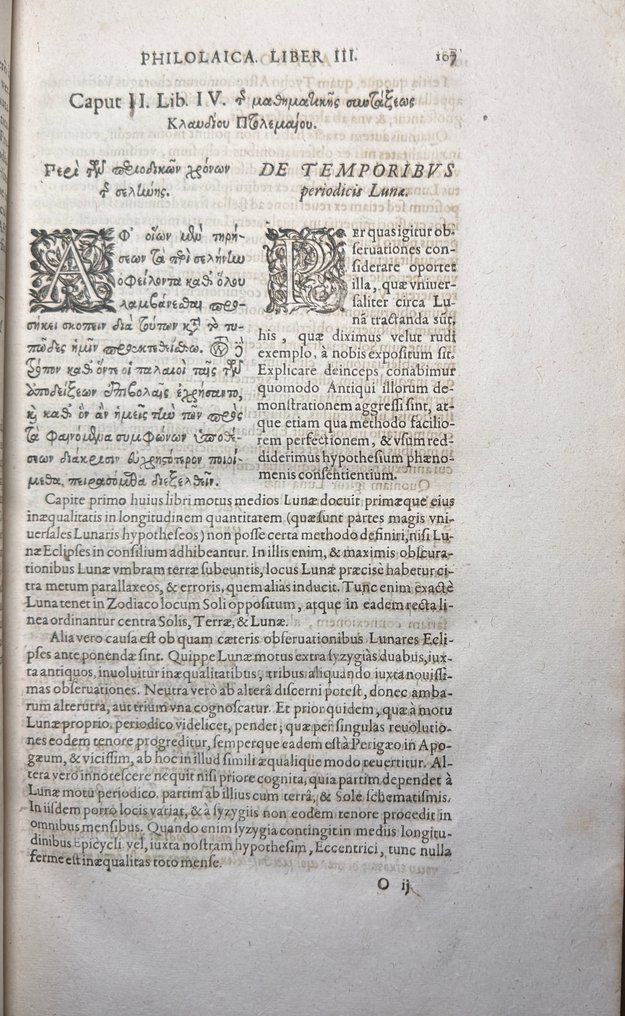
After a substantial Prolegomena surveying ancient, Arabic–Persian, and early-modern authorities, Boulliau lays out a fully operational astronomy: general kinematics, the tropical year and solar apparent motion; a reworked lunar theory; and a long chapter on the dimensions of the Sun, Earth, and Moon paired with an explicit method for eclipses (the “methodus nova”), which the tables then implement.
The core books are followed by planet-by-planet recalibrations—Saturn, Jupiter, Mars, Venus, Mercury—each treated with the elements ephemerists actually need: mean motions and epochs, longitudes of aphelia, eccentricities, equations (corrections) for the anomalies, and latitudinal parameters (inclinations and nodes) for out-of-ecliptic motion. Boulliau’s prose is spare and procedural, reading like instructions to a calculator.
Boulliau appends a catalogue of fixed stars (after Tycho) with longitudes and latitudes for a standard epoch, and a succinct synopsis of “Persian” astronomical tables drawn from a royal-library manuscript—evidence of his comparative method and the cross-cultural data stream feeding his astronomy.
The most significant treatise between Kepler and Newton, Astronomia philolaica contains the earliest claim that planetary force varies with the inverse square of distance, the very law Newton would elevate to universal gravitation.
MOUSEION CURATOR NOTE:
“Not merely a treatise but the keystone: the earliest explicit inverse-square statement and the decisive bridge from Kepler to Newton—the book that made the heavens computable.
In this 1645 folio Boulliau first sets the Sun’s force to fall in the “duplicate ratio” (inverse square) and turns Kepler’s ellipses into working tables—the foundation on which Newton could build.
This first edition, with exceptional provenance and in excellent condition, embodies that pivotal moment.”
THE VOLUME:
Ismaël Boulliau (Bullialdus), Astronomia philolaica. (Paris: Sumptibus Simeonis Piget, 1645). First edition. 2 parts in 1 large folio.
Extent & size: prelims [22], 469, 232 pages COMPLETE. 36.2 × 23.5 cm.
Illustration & features: numerous woodcut diagrams; one folding typographical table; twelve divisional half-titles (Books I–XII); terminal blank Ggg4 present; the typographical tables include folded half-sheets at the classic openings.
Binding: contemporary sponge-decorated sheepskin (basane mouchetée) over boards, gilt-tooled spine.
DESCRIPTION:
First edition, a pivotal, exceptionally scarce masterwork of early modern astronomy. Astronomia philolaica is Boulliau’s masterwork and the canonical mid-century bridge between Kepler and Newton. Boulliau accepts elliptical orbits, rejects Kepler’s animating physics, and reconstructs planetary motion via a geometrical “conical hypothesis,” concluding with a full suite of Tabulae Philolaicae for practical computation. The edition’s architecture—twelve half-titles for navigability, woodcut diagrams, and a large folding typographical table—marks it as both treatise and instrument.
AUTHORITATIVE TESTIMONIA:
NEWTON, Principia III: “for the dimensions of the orbits, Kepler and Bullialdus, above all others, have determined them… with the greatest accuracy.”
NEWTON to Halley (1686): “Bullialdus wrote that all force… must be reciprocally in a duplicate ratio of the distance.”
MacTutor (Univ. St Andrews): Boulliau “proposed an inverse square law for gravitation before Newton.”
Boulliau’s famous phrasing—in duplicata ratione distantiarum—locates the Sun’s “motive virtue” in the inverse-square proportion, an antecedent that Newton later formalized as universal gravitation.
The presence of Tycho’s star catalogue and a synopsis of ‘Persian’ tables within the 1645 folio underscores Boulliau’s role as a broker of data and methods across classical, Islamicate, and early-modern European traditions.
BOOK’S PROVENANCE:
Groenendael Priory (Viridis Vallis), near Brussels — title with early institutional inscription “Bibliothecae Viridis Vallis”; ownership “F. Joannes Josephus Vanden Eede, Canonicus Regularis… et Pastor in Huldenbergh.” An Augustinian house with a documented learned library, placing Boulliau’s folio in a monastic scholarly milieu within decades of publication.
Professor Owen Gingerich (1930–2023) — Harvard astronomer and historian of astronomy (Copernicus/Kepler specialist), ex-libris on pastedown; his library is a touchstone in modern historiography of astronomical print.
Provenance significance: Monastic library to modern historian of science—a chain that materially narrates the use and afterlife of a computational keystone.
MOUSEION CURATOR NOTE:
“Numbers that taught the heavens to behave. Provenance that shows how knowledge travels. This is the bridge from Kepler’s ellipses to Newton’s law.”
CONDITION REPORT:
A handsome, honest first edition.
Binding: contemporary mottled sheep (sponge-decorated basane), gilt-tooled spine with raised bands; light overall rubbing, minor abrasions; front joint starting with a separation at the head; board remains secure.
Text block: complete in very good condition, paper with mild, even toning; occasional trivial marginal soil; folding typographical table intact;
A well-preserved and collationally correct volume. Ready for showcasing and research.
ADDITIONAL INFORMATION:
After a substantial Prolegomena surveying ancient, Arabic–Persian, and early-modern authorities, Boulliau lays out a fully operational astronomy: general kinematics, the tropical year and solar apparent motion; a reworked lunar theory; and a long chapter on the dimensions of the Sun, Earth, and Moon paired with an explicit method for eclipses (the “methodus nova”), which the tables then implement.
The core books are followed by planet-by-planet recalibrations—Saturn, Jupiter, Mars, Venus, Mercury—each treated with the elements ephemerists actually need: mean motions and epochs, longitudes of aphelia, eccentricities, equations (corrections) for the anomalies, and latitudinal parameters (inclinations and nodes) for out-of-ecliptic motion. Boulliau’s prose is spare and procedural, reading like instructions to a calculator.
Boulliau appends a catalogue of fixed stars (after Tycho) with longitudes and latitudes for a standard epoch, and a succinct synopsis of “Persian” astronomical tables drawn from a royal-library manuscript—evidence of his comparative method and the cross-cultural data stream feeding his astronomy.
Details
Number of Books
1
Subject
Astronomy, Mathematics, Physics, Science
Book Title
Astronomia Philolaica
Author/ Illustrator
Ismaël Boulliau
Condition
Very good
Publication year oldest item
1645
Height
36 cm
Edition
1st Edition
Width
23 cm
Language
Latin
Original language
Yes
Publisher
Sumptibus Simeonis Piget
Binding/ Material
Half leather
Extras
Fold out maps or plates
Number of pages
745
Sold by
