David Origanus - ASTRONOMY PRESENTATION COPY Ephemerides novae annorum XXXVI - 1599



11
days
23
hours
30
minutes
13
seconds
Current bid
€ 600
Reserve price not met

Expert
Selected by Volker Riepenhausen
Specialist in travel literature and pre-1600 rare prints with 28 years experience.
Estimate € 5,500 - € 6,600
27 other people are watching this object
 Bidder 9105 Bidder 9105 | €600 | |
|---|---|---|
 Bidder 4859 Bidder 4859 | €550 | |
 Bidder 8512 Bidder 8512 | €500 | |
Catawiki Buyer Protection
Your payment’s safe with us until you receive your object.View details
Trustpilot 4.4 | 123759 reviews
Rated Excellent on Trustpilot.
First edition Latin presentation copy of Ephemerides novae annorum XXXVI by David Origanus, 1599, Frankfurt an der Oder, printed by Andreae Eichornii, half leather binding with fold-out maps, 1620 pages, very good condition.
AI-assisted summary
Description from the seller
Post-Copernican powerhouse: Origanus’s 1599 Landeck-inscribed Presentation Copy—first edition, two parts in one. Later owned by Owen Gingerich, Harvard astronomer and historian of science.
THE BOOK
David Origanus (David Tost) — Ephemerides novae annorum XXXVI, incipientes ab anno 1595 … & desinentes in annum 1630 (Frankfurt an der Oder: Typis Andreae Eichornii, 1599).
Two parts in one stout 4to; a large well preserved folding table. Dated 1599 author’s presentation copy, first edition, complete, very rare.
MOUSEION CURATOR NOTE
“Historians count Origanus among the core ephemeridists of the early seventeenth century; few copies make that history so tangible. This one is an author’s presentation, dated Landecae, 27 June 1599, carrying the book from the Viadrina press straight into his Silesian circle—from a correspondent of Kepler to a later home in Owen Gingerich’s library. With its folding proportional table and eclipse schemata, it is not only a computational tool but a document of practice whose provenance is genuinely unique.”
DESCRIPTION
First edition—extremely rare and completely scarce in commerce. Two parts in one volume; title-page with a three-line presentation inscription in the author’s hand (signed “Origanus,” Landecae, 27 June 1599).
A powerhouse of the post-Copernican era, enabling observation, underwriting astrology, structuring time-reckoning, and guiding calendar reform.
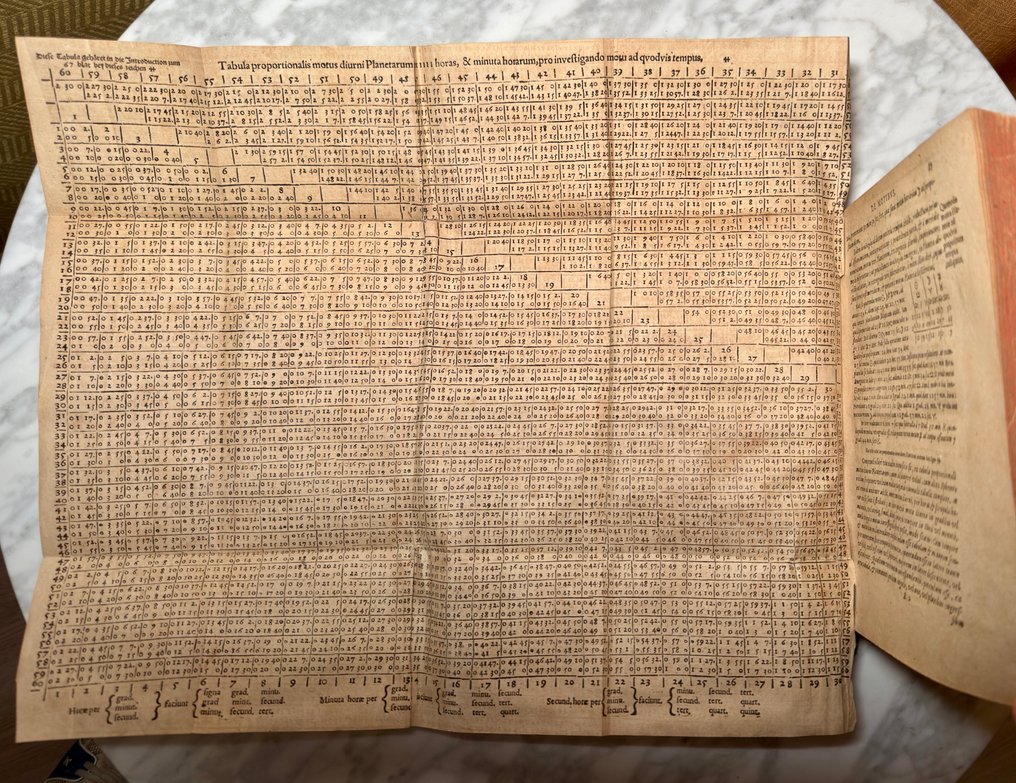
Origanus’s Ephemerides novae provides daily geocentric longitudes and latitudes of Sun, Moon, and planets for 1595–1630, computed ex hypothesibus Copernici with the Prutenic canon, and referred to the Frankfurt-an-der-Oder meridian. The Introductio sets constants and procedures (calendar handling, meridian time, sexagesimal units) and includes a large Tabula proportionalis motus diurni Planetarum for hourly interpolation (“pro investigando ad quodvis tempus”).
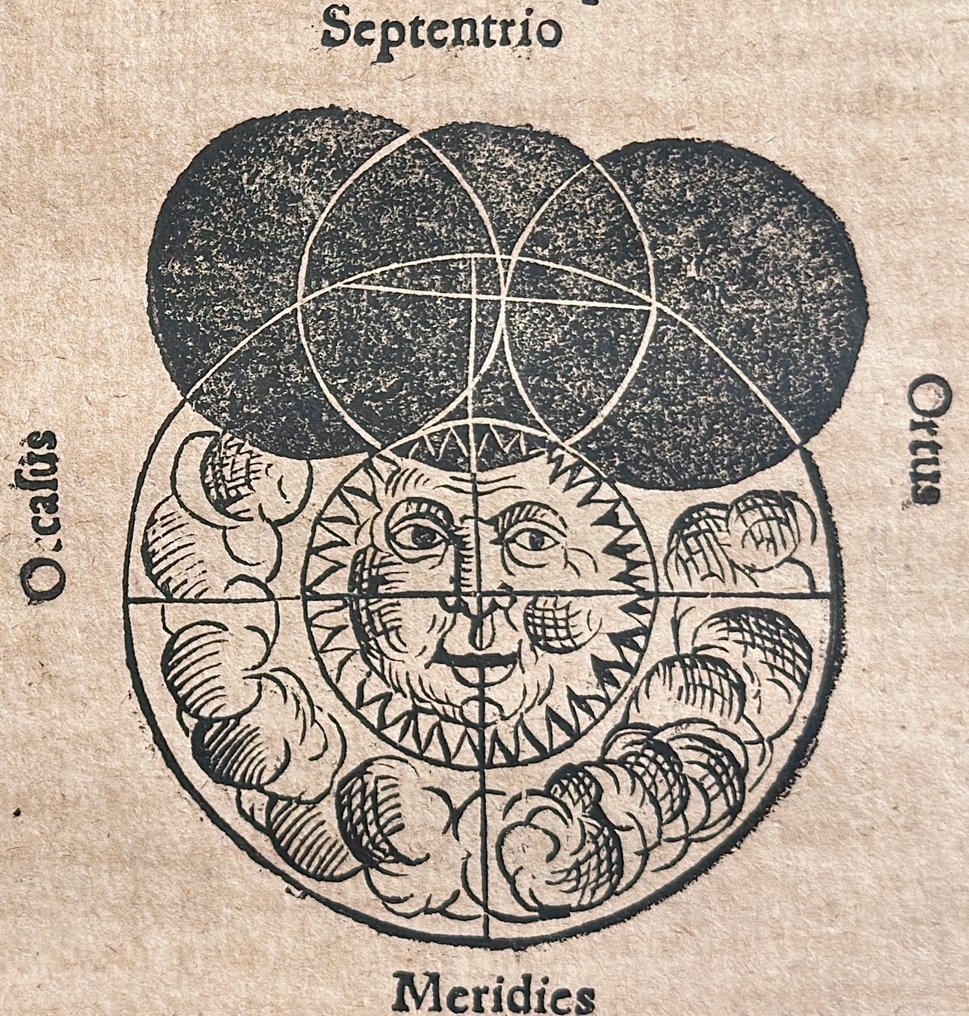
Part II adds the accidentia motus—stations, retrogradations, visibilities, and conjunctions—and a full eclipse program (“eclipsium omnium supra & infra terram accuratam descriptionem”) with schemata, contact times, and magnitudes. Together, these sections form a complete computational toolkit bridging method and tables: parameters, interpolation, phenomena, eclipses. Designed for operational use in observation, astrology, time-reckoning, and calendar work.
The eclipse schemata and vernal-ingress chart visualize a culture where astronomical computation and judicial astrology still spoke to each other.
Origanus stood in the same network of practitioners who fed the Keplerian revolution, and he corresponded directly with Kepler.
AUTHOR’S PRESENTATION COPY
Diplomatic translation:
“To the most distinguished gentleman Basil Habelius of Glatz, the most faithful Notary of Landeck, his friend—old and very dear—as a pledge of constant and sincere friendship the Author gave this book at Landeck, 27 June 1599.”
This localizes the book in Silesia within weeks of publication, mapping Origanus’s home network and giving a rare time-and-place stamp for a working ephemeris.
PROVENANCE
Author’s presentation, signed and dated as above (a1r).
Owen Gingerich (1930–2023), renowned astronomer & historian of science at Harvard;(Gingerich’s scholarship on ephemerides and the Rudolphine Tables gives this association special resonance.)
MOUSEION CURATOR NOTE
“An author’s gift become an historian’s tool: Origanus presents the book in 1599, and centuries later Gingerich preserves it. Between those points lie the folding table, eclipse diagrams, and a career in correspondence with Kepler—an ephemeris with a biography.”
CONDITION REPORT
very good: clean, complete, and crisp throughout, with even toning, wide margins, strong impressions of type and woodcuts, and the large folding Tabula proportionalis present and intact, tables and eclipse diagrams remain strong and legible.
Binding: Late-18th-century gilt calf, red edges; gilt bright; headcap losses, joints rubbed with beginning cracks; corners rounded; A credible working scholarly binding.
4°; a–b⁸ A–Z⁸ a–c⁸ d⁴; (:)⁶ A–Z⁸ Aa–Zz⁸ Aaa–Zzz⁸ 4A–4C⁸; [16], 424 pp.; Part II [582] ll.; full-page portraits (dedicatee in Part I; author in Part II), arms, large folding table, numerous diagrams.
ADDITIONAL INFORMATION
This title was listed on the Roman Index (1603), donec corrigatur—evidence that even numerical tables could carry confessional risk.
Astronomical program. The 1599 ephemerides operationalize the Copernican/Prutenic constants while remaining compatible with contemporary practice (mixed calendrical regimes; local meridian preference).
Kepler connection. Beyond the EMLO-listed 8 Aug. 1605 letter, the technical literature cites further exchange in 1609 (KGW 16); the conversation orbits accuracy limits of the Prutenics and the search for better parameters — precisely the pressure that culminated in Kepler’s Rudolphine Tables.
Post-Copernican powerhouse: Origanus’s 1599 Landeck-inscribed Presentation Copy—first edition, two parts in one. Later owned by Owen Gingerich, Harvard astronomer and historian of science.
THE BOOK
David Origanus (David Tost) — Ephemerides novae annorum XXXVI, incipientes ab anno 1595 … & desinentes in annum 1630 (Frankfurt an der Oder: Typis Andreae Eichornii, 1599).
Two parts in one stout 4to; a large well preserved folding table. Dated 1599 author’s presentation copy, first edition, complete, very rare.
MOUSEION CURATOR NOTE
“Historians count Origanus among the core ephemeridists of the early seventeenth century; few copies make that history so tangible. This one is an author’s presentation, dated Landecae, 27 June 1599, carrying the book from the Viadrina press straight into his Silesian circle—from a correspondent of Kepler to a later home in Owen Gingerich’s library. With its folding proportional table and eclipse schemata, it is not only a computational tool but a document of practice whose provenance is genuinely unique.”
DESCRIPTION
First edition—extremely rare and completely scarce in commerce. Two parts in one volume; title-page with a three-line presentation inscription in the author’s hand (signed “Origanus,” Landecae, 27 June 1599).
A powerhouse of the post-Copernican era, enabling observation, underwriting astrology, structuring time-reckoning, and guiding calendar reform.
Origanus’s Ephemerides novae provides daily geocentric longitudes and latitudes of Sun, Moon, and planets for 1595–1630, computed ex hypothesibus Copernici with the Prutenic canon, and referred to the Frankfurt-an-der-Oder meridian. The Introductio sets constants and procedures (calendar handling, meridian time, sexagesimal units) and includes a large Tabula proportionalis motus diurni Planetarum for hourly interpolation (“pro investigando ad quodvis tempus”).
Part II adds the accidentia motus—stations, retrogradations, visibilities, and conjunctions—and a full eclipse program (“eclipsium omnium supra & infra terram accuratam descriptionem”) with schemata, contact times, and magnitudes. Together, these sections form a complete computational toolkit bridging method and tables: parameters, interpolation, phenomena, eclipses. Designed for operational use in observation, astrology, time-reckoning, and calendar work.
The eclipse schemata and vernal-ingress chart visualize a culture where astronomical computation and judicial astrology still spoke to each other.
Origanus stood in the same network of practitioners who fed the Keplerian revolution, and he corresponded directly with Kepler.
AUTHOR’S PRESENTATION COPY
Diplomatic translation:
“To the most distinguished gentleman Basil Habelius of Glatz, the most faithful Notary of Landeck, his friend—old and very dear—as a pledge of constant and sincere friendship the Author gave this book at Landeck, 27 June 1599.”
This localizes the book in Silesia within weeks of publication, mapping Origanus’s home network and giving a rare time-and-place stamp for a working ephemeris.
PROVENANCE
Author’s presentation, signed and dated as above (a1r).
Owen Gingerich (1930–2023), renowned astronomer & historian of science at Harvard;(Gingerich’s scholarship on ephemerides and the Rudolphine Tables gives this association special resonance.)
MOUSEION CURATOR NOTE
“An author’s gift become an historian’s tool: Origanus presents the book in 1599, and centuries later Gingerich preserves it. Between those points lie the folding table, eclipse diagrams, and a career in correspondence with Kepler—an ephemeris with a biography.”
CONDITION REPORT
very good: clean, complete, and crisp throughout, with even toning, wide margins, strong impressions of type and woodcuts, and the large folding Tabula proportionalis present and intact, tables and eclipse diagrams remain strong and legible.
Binding: Late-18th-century gilt calf, red edges; gilt bright; headcap losses, joints rubbed with beginning cracks; corners rounded; A credible working scholarly binding.
4°; a–b⁸ A–Z⁸ a–c⁸ d⁴; (:)⁶ A–Z⁸ Aa–Zz⁸ Aaa–Zzz⁸ 4A–4C⁸; [16], 424 pp.; Part II [582] ll.; full-page portraits (dedicatee in Part I; author in Part II), arms, large folding table, numerous diagrams.
ADDITIONAL INFORMATION
This title was listed on the Roman Index (1603), donec corrigatur—evidence that even numerical tables could carry confessional risk.
Astronomical program. The 1599 ephemerides operationalize the Copernican/Prutenic constants while remaining compatible with contemporary practice (mixed calendrical regimes; local meridian preference).
Kepler connection. Beyond the EMLO-listed 8 Aug. 1605 letter, the technical literature cites further exchange in 1609 (KGW 16); the conversation orbits accuracy limits of the Prutenics and the search for better parameters — precisely the pressure that culminated in Kepler’s Rudolphine Tables.
Details
Number of Books
1
Subject
Astrology, Astronomy, Esotericism, Mathematics, Outer space, Physics
Book Title
ASTRONOMY PRESENTATION COPY Ephemerides novae annorum XXXVI
Author/ Illustrator
David Origanus
Condition
Very good
Publication year oldest item
1599
Height
21.6 m
Edition
1st Edition
Width
16.5 cm
Language
Latin
Original language
Yes
Publisher
Andreae Eichornii
Binding/ Material
Half leather
Extras
Fold out maps or plates
Number of pages
1620
Sold by
