Filippo PICINELLI - MONDO SIMBOLICO- Gorgeous emblems book - 1653



13
days
23
hours
30
minutes
24
seconds
Current bid
€ 30
Reserve price not met

Expert
Selected by Volker Riepenhausen
Specialist in travel literature and pre-1600 rare prints with 28 years experience.
Estimate € 1,800 - € 2,600
21 other people are watching this object
 Bidder 5943 Bidder 5943 | €30 | |
|---|---|---|
| Bidder 9367 | €25 | |
| Bidder 6420 | €2 | |
Catawiki Buyer Protection
Your payment’s safe with us until you receive your object.View details
Trustpilot 4.4 | 123641 reviews
Rated Excellent on Trustpilot.
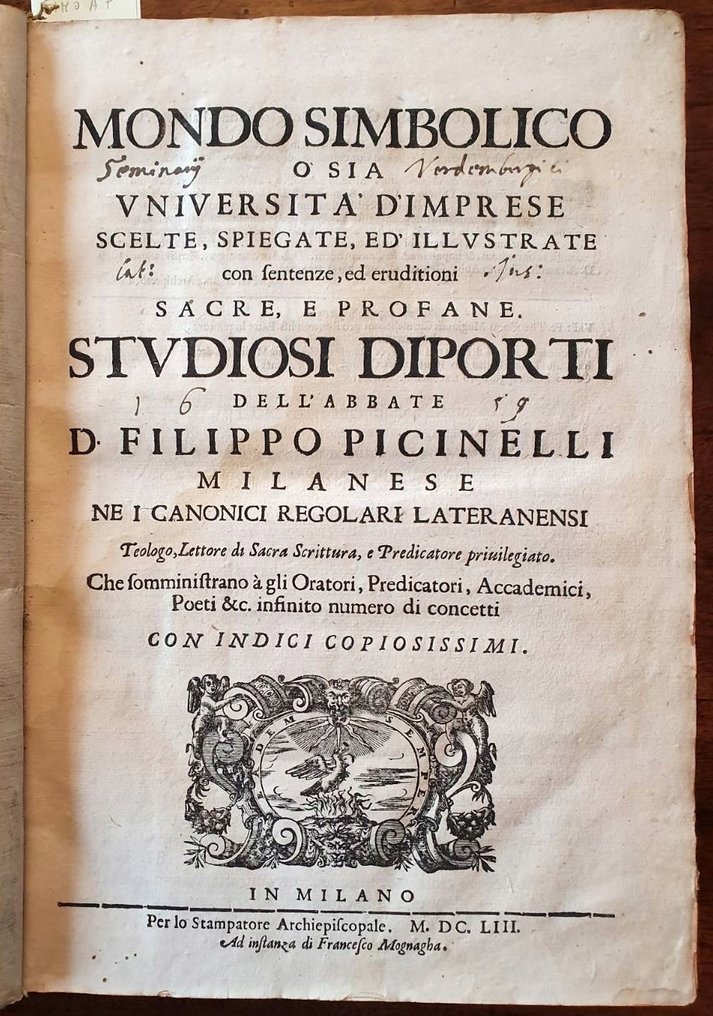
MONDO SIMBOLICO—Gorgeous emblems book by Filippo Picinelli, first Italian edition of 1653, in Italian, leather binding, 776 pages, fine condition.
AI-assisted summary
Description from the seller
(EMBLEMATA; ILLUSTRATED; FIRST EDITIONS; FINE BINDINGS) Filippo PICINELLI (1604-1686)
Mondo simbolico o sia università d’imprese scelte, spiegate, ed illustrate con sentenze, ed eruditioni sacre e profane. Studiosi diporti dell’abate D. Filippo Picinelli milanese ne i canonici regolari lateranensi ... Con indici copiosissimi In Milano Per lo Stampatore Archiepiscopale, 1653
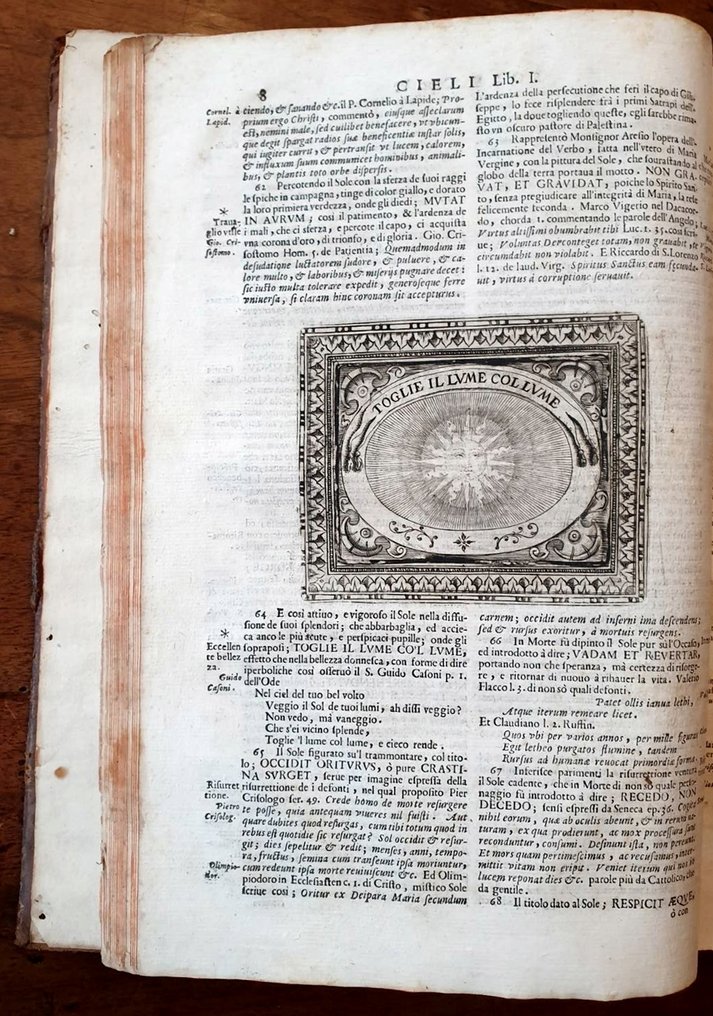
Folio ( 320 x 210),(28),572, (176) pp. magnificent contemporary blind-tooled brown calf binding , exquisite unusual blind-stamped central medaillon representing a dolphin surround by fleural motifs and inscribed into a double order of fillets forming a lozenge, four-ribs spine, handwritten title by ancient hand on labelled paper, red edges, an excellent copy on large and crisp paper, profusely illustrated with a gorgeous engraved frontispiece, a full- page author’s portrait and 40 exquisite engraved emblem vignettes, a fascinating copy in an intriguing contemporary fine binding.
First edition, later translated into Latin and enlarged by the Augustinian monk Augustinus Erath (1648-1729) and published in Cologne in 1681. The Latin version went through several editions and can be considered as the most comprehensive emblem encyclopedia of the seventeenth century (Daly). The work, divided in two parts (natural objects, or Corpora Naturalia and artifacts or Corpora Artificialia, respectively) is based on the conviction that all creation can be read as a symbolic book; originally intended for preachers, it is a collection of emblems representing the various vices and the mottos clarify the meaning. The Mondo simbolico well express “the educational will of the Counter-Reformation: thus the cat that purrs just before scratching represents the lascivious woman, who “when she jokes, she mocks”.” (Rodler).
The beautiful engraved frontispiece is worth some attention: in a highly symbolic manner it describes the all content and purpose of the work. For example, the sphere on the altar in the center of the engraving, represents the world, the Mondo simbolico (Symbolic world) of the title, while the two women gently touching it are respectively, the ideal world (at the left side, dressed in a dress adorned with stars) and the natural world, the physical Earth (at the right side, with a cornucopia of fruits and flowers). The parallels go on, with a column (a creation of man, even though inspired by the natural shape of a tree) on the left and a tree on the right side. The meaning, the entire philosophy behind the book, is thus well summarized in this engraving: “Therefore this frontispiece does not only show the most immediately intuitive difference that can exist between the celestial world and the earthly world, but also indicates to us a deeper difference that distances the two; it tells us, on the one hand, by showing that set of plants, trees, flowers and in short everything that spontaneously is born and lives, that the “naturalness” of the world that surrounds us is directly connected to creation, on the other that the “ideality” of the celestial world is instead first and foremost in its cultural and constructed character that makes it a creation, so to speak, entirely mental. The symbolic, therefore, has first and foremost the task of mediating between the two worlds, allowing them to contact” (Palumbo, p.624, translated). The frontispiece is signed by Giacomo Cotta (?-1689), an engraver and an accomplished painter of canvases and frescoes; he worked most of his life in Bergamo. The emblems, some of which are not signed, are from different artists.
Picinelli was an Italian Augustinian canon, scholar and emblematist; he wrote several books in Italian and Latin. the Mondo simbolico being his most famous work. It inspired several authors, such as Claude-François Ménestrier, Johannes Michael von der Ketten, Arthur Henkel: “But it was the comprehensiveness of Picinelli’s volume that made it so seductively attractive to those who came after. It was the model for Claude-François Menestrier’s monumental Philosophia imaginum ...” (Manning, p. 127).
Ref. Peter M. Daly Companion to emblem studies New York, AMS press, 2008, p. 213; Lucia Rodler L’Emblematica In: Umberto Eco (editor) Storia della civiltà europea 2014, e-book (https://www.treccani.it/enciclopedia/l-emblematica_(Storia-della-civilt%C3%A0-europea-a-cura-di-Umberto-Eco)/); John Manning The Emblem London, Reaktion Books, 2004, passim; G. Palumbo. Mondo reale e mondo ideale nel frontespizio del Mondo Simbolico di Filippo Picinelli In: Emblemática trascendente Pamplona, Sociedad Española de Emblemática/Universidad de Navarra, 2011, pp: 619-638.
(EMBLEMATA; ILLUSTRATED; FIRST EDITIONS; FINE BINDINGS) Filippo PICINELLI (1604-1686)
Mondo simbolico o sia università d’imprese scelte, spiegate, ed illustrate con sentenze, ed eruditioni sacre e profane. Studiosi diporti dell’abate D. Filippo Picinelli milanese ne i canonici regolari lateranensi ... Con indici copiosissimi In Milano Per lo Stampatore Archiepiscopale, 1653
Folio ( 320 x 210),(28),572, (176) pp. magnificent contemporary blind-tooled brown calf binding , exquisite unusual blind-stamped central medaillon representing a dolphin surround by fleural motifs and inscribed into a double order of fillets forming a lozenge, four-ribs spine, handwritten title by ancient hand on labelled paper, red edges, an excellent copy on large and crisp paper, profusely illustrated with a gorgeous engraved frontispiece, a full- page author’s portrait and 40 exquisite engraved emblem vignettes, a fascinating copy in an intriguing contemporary fine binding.
First edition, later translated into Latin and enlarged by the Augustinian monk Augustinus Erath (1648-1729) and published in Cologne in 1681. The Latin version went through several editions and can be considered as the most comprehensive emblem encyclopedia of the seventeenth century (Daly). The work, divided in two parts (natural objects, or Corpora Naturalia and artifacts or Corpora Artificialia, respectively) is based on the conviction that all creation can be read as a symbolic book; originally intended for preachers, it is a collection of emblems representing the various vices and the mottos clarify the meaning. The Mondo simbolico well express “the educational will of the Counter-Reformation: thus the cat that purrs just before scratching represents the lascivious woman, who “when she jokes, she mocks”.” (Rodler).
The beautiful engraved frontispiece is worth some attention: in a highly symbolic manner it describes the all content and purpose of the work. For example, the sphere on the altar in the center of the engraving, represents the world, the Mondo simbolico (Symbolic world) of the title, while the two women gently touching it are respectively, the ideal world (at the left side, dressed in a dress adorned with stars) and the natural world, the physical Earth (at the right side, with a cornucopia of fruits and flowers). The parallels go on, with a column (a creation of man, even though inspired by the natural shape of a tree) on the left and a tree on the right side. The meaning, the entire philosophy behind the book, is thus well summarized in this engraving: “Therefore this frontispiece does not only show the most immediately intuitive difference that can exist between the celestial world and the earthly world, but also indicates to us a deeper difference that distances the two; it tells us, on the one hand, by showing that set of plants, trees, flowers and in short everything that spontaneously is born and lives, that the “naturalness” of the world that surrounds us is directly connected to creation, on the other that the “ideality” of the celestial world is instead first and foremost in its cultural and constructed character that makes it a creation, so to speak, entirely mental. The symbolic, therefore, has first and foremost the task of mediating between the two worlds, allowing them to contact” (Palumbo, p.624, translated). The frontispiece is signed by Giacomo Cotta (?-1689), an engraver and an accomplished painter of canvases and frescoes; he worked most of his life in Bergamo. The emblems, some of which are not signed, are from different artists.
Picinelli was an Italian Augustinian canon, scholar and emblematist; he wrote several books in Italian and Latin. the Mondo simbolico being his most famous work. It inspired several authors, such as Claude-François Ménestrier, Johannes Michael von der Ketten, Arthur Henkel: “But it was the comprehensiveness of Picinelli’s volume that made it so seductively attractive to those who came after. It was the model for Claude-François Menestrier’s monumental Philosophia imaginum ...” (Manning, p. 127).
Ref. Peter M. Daly Companion to emblem studies New York, AMS press, 2008, p. 213; Lucia Rodler L’Emblematica In: Umberto Eco (editor) Storia della civiltà europea 2014, e-book (https://www.treccani.it/enciclopedia/l-emblematica_(Storia-della-civilt%C3%A0-europea-a-cura-di-Umberto-Eco)/); John Manning The Emblem London, Reaktion Books, 2004, passim; G. Palumbo. Mondo reale e mondo ideale nel frontespizio del Mondo Simbolico di Filippo Picinelli In: Emblemática trascendente Pamplona, Sociedad Española de Emblemática/Universidad de Navarra, 2011, pp: 619-638.
Details
Number of Books
1
Subject
Esotericism, Fine Bindings, Illustrated, Science
Book Title
MONDO SIMBOLICO- Gorgeous emblems book
Author/ Illustrator
Filippo PICINELLI
Condition
Fine
Publication year oldest item
1653
Height
320 mm
Edition
1st Edition
Width
210 mm
Language
Italian
Original language
Yes
Publisher
Stampatore archiepiscopale
Binding/ Material
Leather
Number of pages
776
Sold by
